










QD Double Girder Bridge Crane
Products Description
Key Features and Characteristics
Double Girder Design: The most defining feature. The bridge consists of two main girders that run parallel to each other, connected by end trucks at both ends. This provides superior strength and rigidity compared to single girder cranes.
Top-Running: The crane's end trucks run on rails mounted on the top of the runway beams. This is the most robust design, allowing for the highest lifting capacities and longest spans.
Hook-Based: It is primarily designed to lift loads using a hook. While attachments like magnets or grabs can be added, the core design is for a hook.
Cab or Pendant Control: QD cranes are traditionally operated from an operator's cab mounted to the bridge or from a pendant control station (push-button pendant) suspended from the crane. Modern versions often use radio remote controls.
Comparison with Other Crane Types
| Feature | QD Double Girder | Single Girder (e.g., LX) | Grab Crane (QZ) |
|---|---|---|---|
| Main Purpose | General heavy lifting with a hook | Light to medium duty hook lifting | Handling bulk materials |
| Capacity Range | High (5 - 550+ Tons) | Low to Medium (1 - 20 Tons) | Medium to High (5 - 50+ Tons) |
| Span | Long spans | Short to medium spans | Medium to long spans |
| Hook Height | High | Lower | Varies |
| Cost | Higher | Lower | Higher (specialized system) |
| Complexity | Standard | Simple | Complex (2 winches) |
Core Components:Bearing, Gearbox, Motor, Pump
Place of Origin:Henan, China
Warranty:1 Year
Weight (KG):2000 kg
Video outgoing-inspection:Provided
Machinery Test Report:Provided
Design:Double beam
Effectiveness:high efficiency
Operating speed:High speed operation
Stability:Anti-swing function
Color:Optional
Power Source:110V/220V/230V/380V/440V,customized
Span:7.5-31.5m

Pictures & Components
1. Bridge Girder System
This is the primary load-bearing structure that spans the width of the bay.
Main Girders (2): These are the principal horizontal beams, typically fabricated as welded box girders for their superior strength and rigidity. They support the entire weight of the trolley, hoist, and the load. Their robust design allows for high capacities and long spans.
End Tie Beams/Connectors: Strong horizontal members that connect the two main girders at each end, ensuring they remain parallel and stable, distributing loads to the end trucks.

2. End Truck & Travel System
Located at each end of the bridge, this system enables the entire crane to move along the length of the runway.
End Trucks (2): The fabricated assemblies that house the travel components.
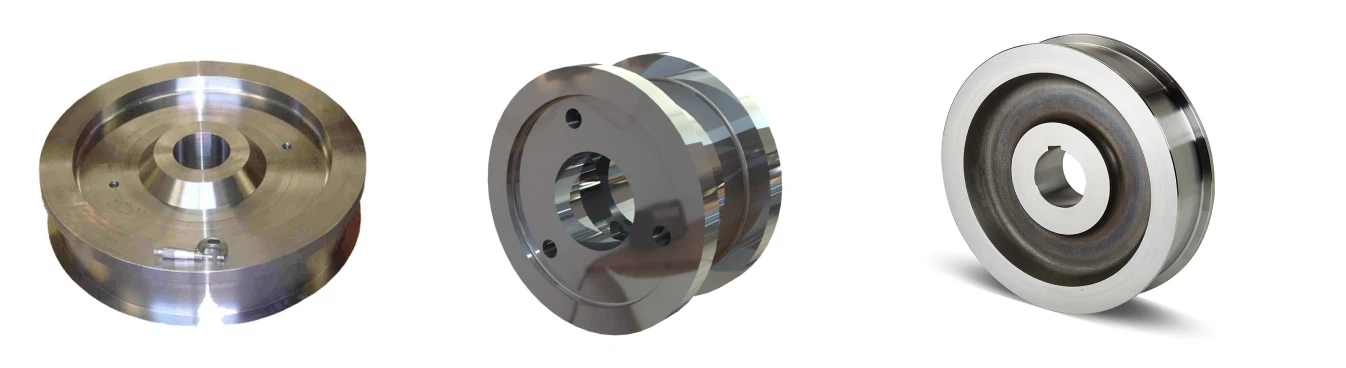
Travel Wheels: Large, heavy-duty wheels mounted on the end trucks that run on the runway rails. A typical QD crane has multiple wheels per end truck to distribute the load.
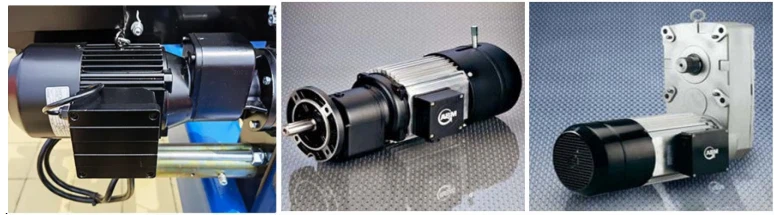
Travel Drive Motor(s): Electric motors that provide the power to move the bridge. For synchronization, there is typically one drive motor per end truck.
 |
 |
Travel Reducer (Gearbox): Reduces the high-speed rotation of the motor to the lower speed and higher torque required to turn the travel wheels.
Brakes: Fail-safe, spring-set brakes that automatically engage when power is cut off to hold the crane in position.
Buffers/Bumpers: Energy-absorbing devices (often polyurethane or spring-loaded) mounted on the end trucks to absorb energy in the event of a collision with the end stops.
 |
 |
3. Hoist Trolley System
This is the unit that carries the hoist and moves across the bridge girders.
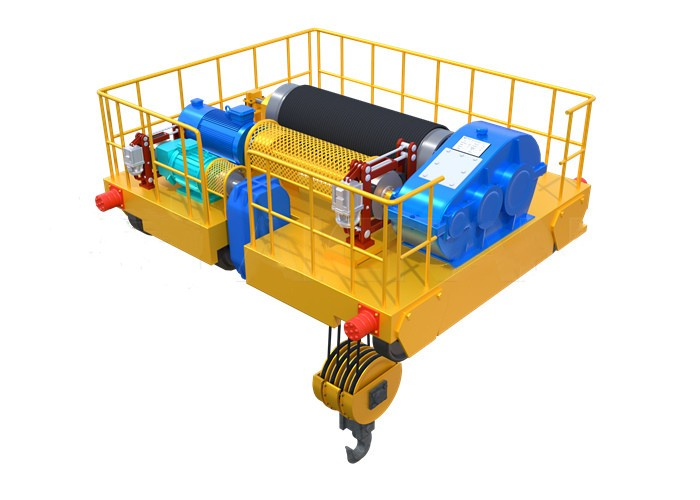
Trolley Frame: The rigid steel structure that supports all trolley components and runs on rails mounted on the top of the main girders.
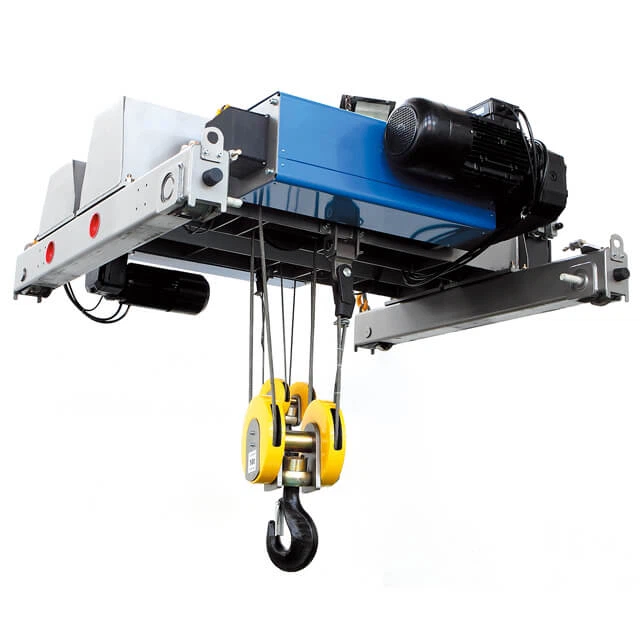
Hoist Unit: The primary lifting mechanism. Its key sub-components are:
Hoist Motor: Powers the lifting and lowering function.
Hoist Reducer (Gearbox): Converts the motor's speed into powerful torque for lifting.
Drum: A steel cylinder around which the wire rope is spooled.
Wire Rope: The high-strength, flexible cable that does the actual lifting.
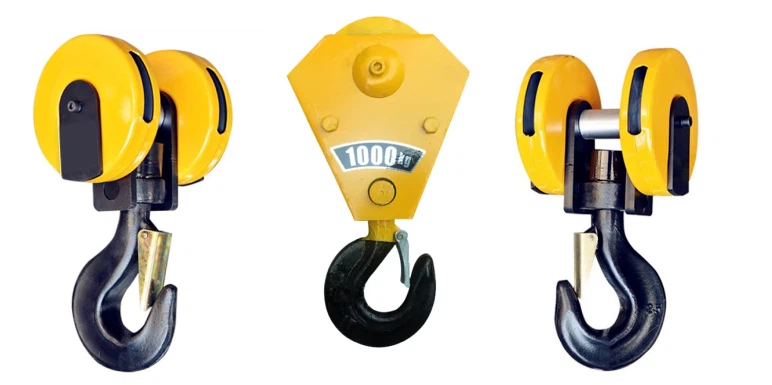
Hook Block: The assembly at the end of the wire rope, consisting of sheaves (pulleys) and the hook itself. A block-and-tackle configuration provides a mechanical advantage.
Brakes: The primary hoist brake is crucial for safely holding the load. It is typically a disc or caliper brake.
Trolley Travel Drive: The system that moves the trolley back and forth along the bridge girders.
Trolley Drive Motor
Trolley Reducer (Gearbox)
Trolley Wheels
Trolley Brakes
Auxiliary Hoist (Optional): A smaller, secondary hoist mounted on the same trolley for lighter loads or to assist in positioning.
4. Electrical & Control System
This system provides power and command to all moving parts.
Main Power Supply (Festoon or Conductor Bar):
Festoon System: A series of cables carried on a rolling trolley or in a cable tray.
Conductor Bar (Enclosed Track): A system of insulated power bars mounted along the runway, collected by spring-loaded collectors on the crane. Often preferred for heavy-duty applications due to reliability and higher duty cycles.

Control Panel/Cabinet: The "brain" of the crane. It houses:
Contactors/Starters: To switch motors on and off.
Variable Frequency Drives (VFDs): For smooth control of speed, acceleration, and deceleration of all motions (in modern cranes).
Overload Limiter: A critical safety device that prevents the crane from lifting a load beyond its rated capacity.
Programmable Logic Controller (PLC): (In advanced cranes) to manage logic and safety interlocks.
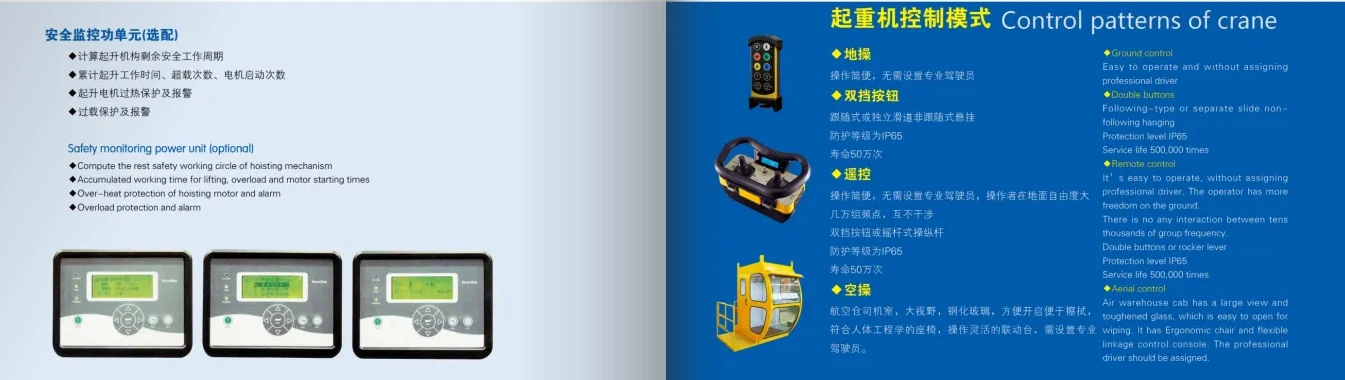
Operator Interface:
Pendant Control Station: A push-button pendant suspended from the crane that allows for control from the floor.
Operator's Cab: An enclosed cabin mounted on the bridge for the operator to sit in. More common for very large cranes or applications requiring constant use.
Radio Remote Control: Increasingly standard, allowing the operator to move freely on the floor for the best visibility and safety.
Limit Switches: Safety devices that automatically cut power to prevent the hoist block or trolley from traveling beyond its intended limits.
Emergency Stop Buttons: Located at multiple points (pendant, cab, remote) to immediately cut power in an emergency.

5. Runway System (Not part of the crane, but essential)
The crane operates on a fixed runway structure.
Runway Rails: Heavy-duty steel rails (e.g., ASCE, DIN, or CR standards) mounted on the runway beams.
Runway Beams: The structural steel (often welded I-beams or fabricated boxes) that support the rails and the entire crane system.
Rail Clips/Clamps: Secure the rail to the runway beam.
End Stops: Physical barriers at the extreme ends of the runway to prevent the crane from running off the rails.
Sketch

Main technical

Advantages
Advantages of QD Double Girder Bridge Crane
The double girder design offers significant benefits over single girder and other lighter-duty cranes:
1. Higher Lifting Capacity and Durability
Core Advantage: The dual main girders provide immense structural integrity and rigidity. This allows QD cranes to handle very heavy loads, typically from 5 tons up to 550 tons or more, making them suitable for the most demanding industrial applications.
Robust Construction: They are built with heavy-duty components (box girders, powerful drives, large wheels) designed for continuous, severe-duty cycles found in environments like steel mills and foundries.
2. Greater Hook Height
Design Feature: The hoist trolley runs on rails on top of the bridge girders. This means the hoist and hook are positioned between the girders, not hanging below them.
Benefit: This design provides a significantly higher lift height compared to a single girder crane of the same runway height. This vertical space is crucial for maximizing usable workspace in a building.
3. Longer Span Capability
Structural Rigidity: The double girder design is inherently more rigid and resistant to bending and twisting (torsion).
Benefit: This allows the crane to safely and effectively span much wider bays (e.g., 35 meters / 115 feet and more) without intermediate supports, offering clear, unobstructed floor space.
4. Superior Trolley Performance
Stable Platform: The top-running trolley on a wide, stable girder platform can carry much heavier loads at higher speeds with less sway.
Flexibility: The spacious top of the bridge allows for the easy integration of auxiliary hoists (a second, smaller hoist on the same trolley) and specialized attachments like magnets, grabs, or vacuum lifters.
5. Ease of Maintenance and Accessibility
Access: All major components-the trolley drive, hoist, and electrical panels-are mounted on top of the bridge and are easily accessible for inspection and maintenance without the need for specialized lifting equipment to reach them.
6. Improved Safety and Control
Stability: The robust construction minimizes deflection and sway, ensuring stable and precise load control.
Advanced Controls: Modern QD cranes are almost always equipped with Variable Frequency Drives (VFDs). VFDs provide smooth, controlled acceleration and deceleration, preventing load swing, reducing mechanical stress, and enabling pinpoint precision for positioning heavy loads.
7. Customization and Versatility
QD cranes can be highly customized with various cab, pendant, or radio remote controls, environmental protections (e.g., for high heat or corrosion), and a wide range of safety devices to meet specific operational needs.
Application:
Applications of QD Double Girder Bridge Crane
QD cranes are the default choice for heavy-duty material handling across a vast range of industries. Their primary application is anywhere heavy, bulky, or high-value items need to be moved reliably and efficiently.
1. Steel Mills and Metal Fabrication
Use Case: Handling raw materials (coils, sheets, plates), moving molds in foundries, transporting molten metal in ladles (with special safety features), and loading/unloading finished products. This is a classic severe-duty application.
2. Power Generation
Use Case: Installation and maintenance of massive components like turbines, generators, rotors, and transformers. The high capacity and precision are essential.
3. Heavy Machinery Manufacturing
Use Case: Moving large machine parts, assemblies, and entire machines during the production process. Common in automotive, aerospace, and heavy equipment plants.
4. Paper and Pulp Mills
Use Case: Handling massive, heavy rolls of paper with precision to avoid damaging the product.
5. Shipping and Port Logistics (Indoor)
Use Case: Moving heavy containers, machinery, and other cargo within large port-side warehouses and maintenance facilities.
6. Large-Scale Warehousing and Logistics
Use Case: For moving extremely heavy palletized goods, industrial products, or large fabricated items that exceed the capacity of forklifts or single girder cranes.
7. Aerospace Industry
Use Case: Precise handling and positioning of large, high-value aircraft components like wings, fuselage sections, and engines during assembly.
8. Railway Maintenance Facilities
Use Case: Lifting locomotives and railcars for repair and maintenance.
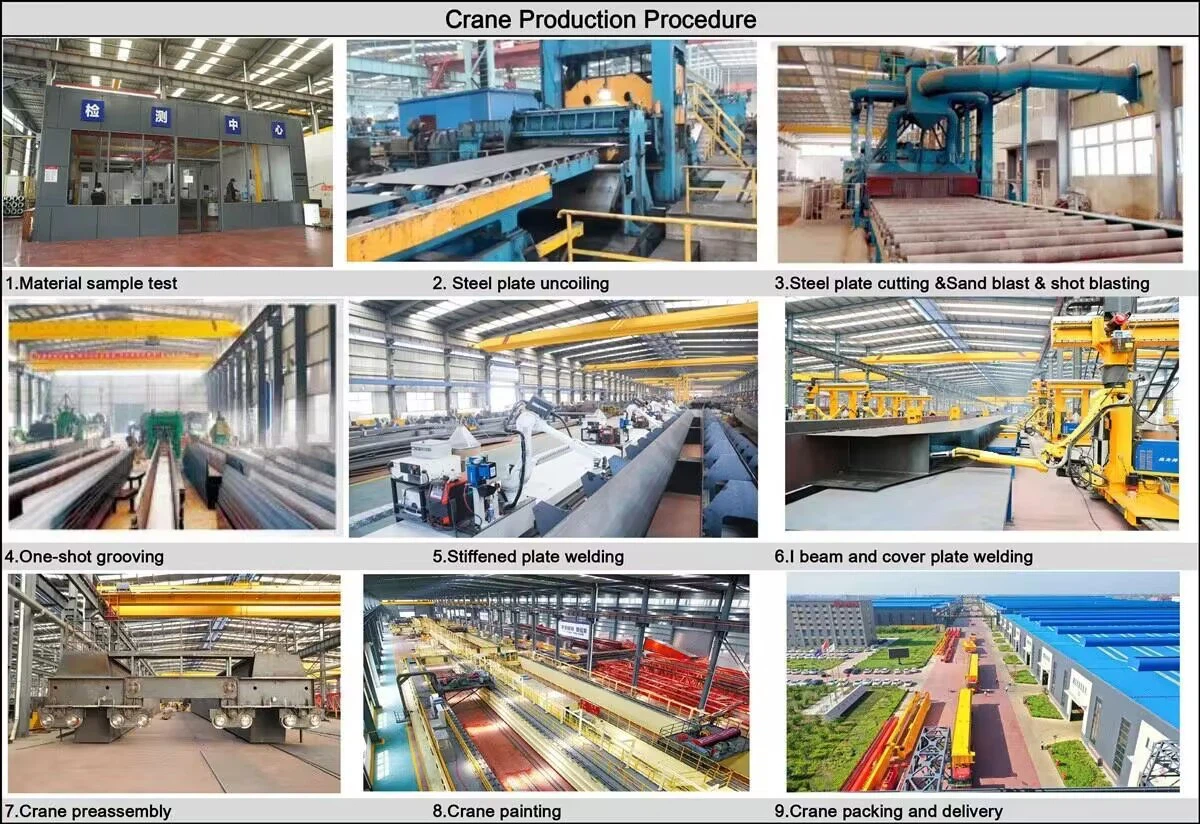
Crane production procedure
The manufacturing process of a QDY metallurgical casting bridge crane involves strict quality control and specialized engineering to ensure durability, heat resistance, and safety. Below is a step-by-step breakdown of the production procedure:
1. Design & Engineering
Load & Environment Analysis – Calculations for lifting capacity (5–500+ tons), span, and heat resistance.
CAD/3D Modeling – Structural design, stress simulations (FEA), and compliance with ISO, FEM, or GB standards.
Customization – Optional features (explosion-proofing, insulated hoists, automation) are integrated.
2. Material Selection & Preparation
Main Girders & End Carriages – High-strength steel (Q345B, Q460C) or heat-resistant alloy steel.
Wire Ropes & Hooks – Special heat-treated alloy steel (for molten metal handling).
Electrical Components – High-temperature-resistant cables, motors, and insulation materials.
3. Fabrication of Key Components
A. Bridge Girder Construction
Cutting & Welding – CNC plasma/laser cutting for precision; submerged arc welding (SAW) for high-strength joints.
Heat Treatment – Stress-relieving annealing to prevent deformation.
Machining – Drilling, milling, and surface grinding for assembly accuracy.
B. Hoist & Trolley Assembly
Hoist Drum & Gearbox – Machined for smooth operation; tested under 1.25x rated load.
Heat-Resistant Brakes – Dual-disc or electromagnetic brakes for fail-safe holding.
Ladle Hook & Safety Latch – Forged and ultrasonically tested for cracks.
C. End Trucks & Runway System
Wheel & Rail Machining – Hardened steel wheels for long wear life.
Drive Motors & Reducers – Equipped with anti-skid mechanisms for heavy loads.
4. Electrical & Control System Integration
Festoon/Conductor Bar System – For power supply along the runway.
Variable Frequency Drives (VFDs) – For smooth speed control and energy efficiency.
Safety Circuits – Overload sensors, limit switches, and emergency stop.
Operator Controls – Pendant, cabin, or remote/automated systems.
5. Surface Treatment & Corrosion Protection
Sandblasting (SA 2.5 Grade) – Removes rust and improves paint adhesion.
High-Temp Paint/Coating – Zinc-rich primer + heat-resistant topcoat (up to 800°C).
Critical Component Insulation – Ceramic fiber or refractory coatings on hooks and ropes.
6. Assembly & Testing
A. Pre-Assembly Checks
Dimensional inspection of girders, trolley, and end carriages.
Alignment of runway rails and crane tracks.
B. Load Testing (Per ISO 4310 / GB Standards)
No-Load Test – Checks motor, brake, and travel functions.
Static Load Test – 1.25x rated capacity for 10+ minutes.
Dynamic Load Test – 1.1x rated capacity with repeated movements.
Emergency Brake Test – Verifies fail-safe mechanisms.
C. Heat Resistance Validation (For Foundry Cranes)
Simulated high-temperature exposure (if required).
7. Packaging & Delivery
Disassembly (if needed) – For large cranes, components are shipped separately.
Anti-Corrosion Packaging – VCI film or desiccant for overseas transport.
Documentation – Manuals, test reports, and certifications (CE, ISO, GOST, etc.).
8. Installation & Commissioning (On-Site)
Runway alignment and crane reassembly.
Final load testing and operator training.
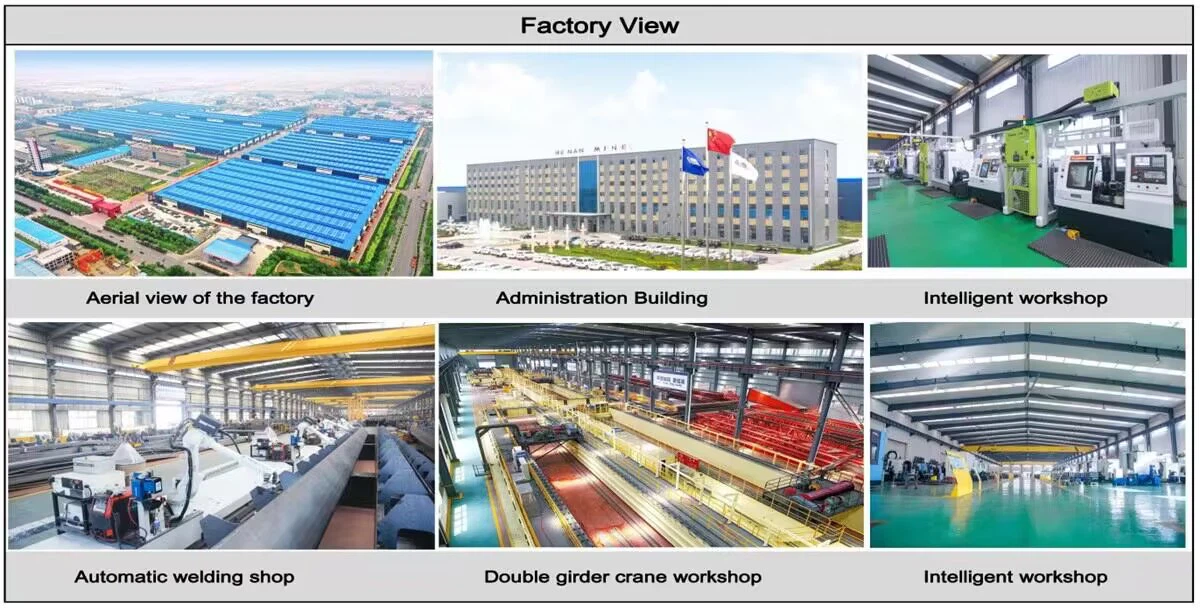
Workshop view:
The company has installed an intelligent equipment management platform, and has installed 310 sets (sets) of handling and welding robots. After the completion of the plan, there will be more than 500 sets (sets), and the equipment networking rate will reach 95%. 32 welding lines have been put into use, 50 are planned to be installed, and the automation rate of the entire product line has reached 85%.


Hot Tags: qd double girder bridge crane, China qd double girder bridge crane manufacturers, suppliers, factory, Double Girder Overhead Crane, Double Girder Overhead Travelling Crane
You Might Also Like


Send Inquiry