










Automatic Grab Overhead Crane
Products Description
Key Features of Automatic Grab Overhead Cranes:
Automated Operation
Uses PLC (Programmable Logic Controller) and sensors for precise control.
Can be integrated with remote control or fully autonomous systems (AI-based).
Supports pre-programmed lifting paths for repetitive tasks.
Grab Bucket Types
Clamshell Grab – For loose materials like sand and grain.
Orange Peel Grab – For scrap metal and rocks.
Motorized Grab – Electrically operated for better control.
High Efficiency & Safety
Faster loading/unloading compared to manual cranes.
Anti-sway technology for smooth operation.
Overload protection and emergency stop functions.
Applications
Ports & Terminals – Loading/unloading ships.
Power Plants – Coal handling.
Steel Mills – Scrap metal handling.
Waste Management – Moving bulk waste materials.
Comparison with Manual Grab Cranes
| Feature | Automatic Grab Crane | Manual Grab Crane |
|---|---|---|
| Speed | Faster, consistent cycles | Slower, variable |
| Labor Requirement | Minimal (remote/auto) | Requires skilled operator |
| Precision | High (laser-guided) | Depends on operator skill |
| Safety | Advanced sensors & AI | Higher accident risk |
| Cost Over Time | Lower operational cost | Higher labor costs |
Lifting Capacity 5 – 50 tons (up to 100+ tons for heavy-duty)
Span 10 – 35 meters (adjustable)
Lifting Height 10 – 30 meters
Work Duty Class A6 (Heavy Duty) or A7 (Severe Duty)
Operating Speed - Hoisting: 5 – 20 m/min
-Trolley Travel: 20 – 45 m/min
- Crane Travel: 30 – 60 m/min
Voltage 380V/50Hz or 480V/60Hz (3-phase)
Protection Grade IP55 (dust/water-resistant)
Safety Devices Overload limiter, emergency stop, limit switches, collision avoidance.

Pictures & Components
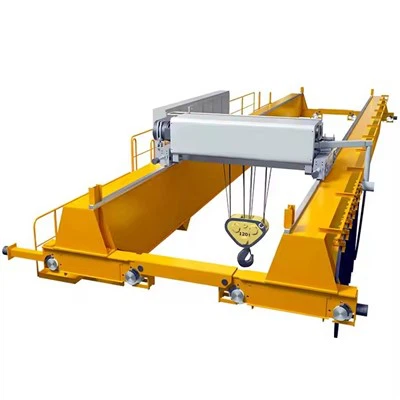
An automatic grab overhead crane consists of several key mechanical, electrical, and control components that work together to enable efficient and automated material handling. Below is a detailed breakdown of its major components:
1. Structural Components
A. Bridge Girder (Main & End Beams)
The primary load-bearing structure that moves along the runway rails.
Made of welded steel (box-type or truss design) for strength and durability.
Supports the hoist, trolley, and grab mechanism.

B. End Trucks (Wheel Assemblies)
Located at both ends of the bridge girder.
Equipped with wheels, motors, and brakes for crane movement along the runway.
May include buffers to absorb impact at travel limits.
C. Runway Rails
Installed on the building structure or support columns.
Provides a smooth path for crane movement.
 |
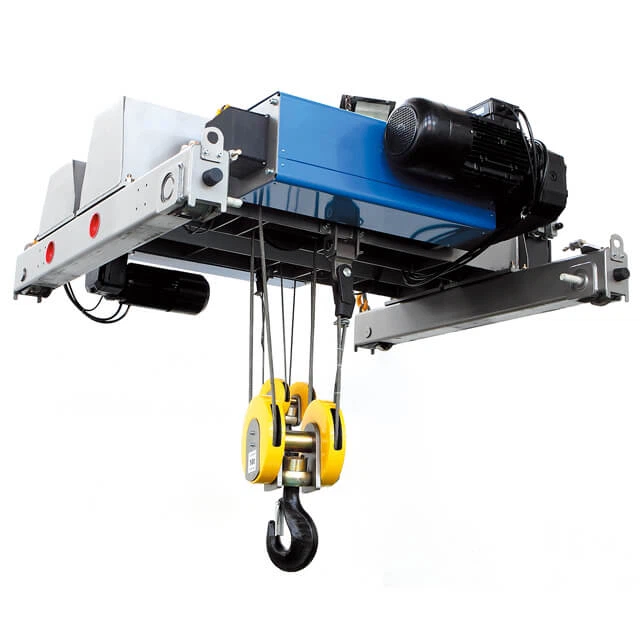 |
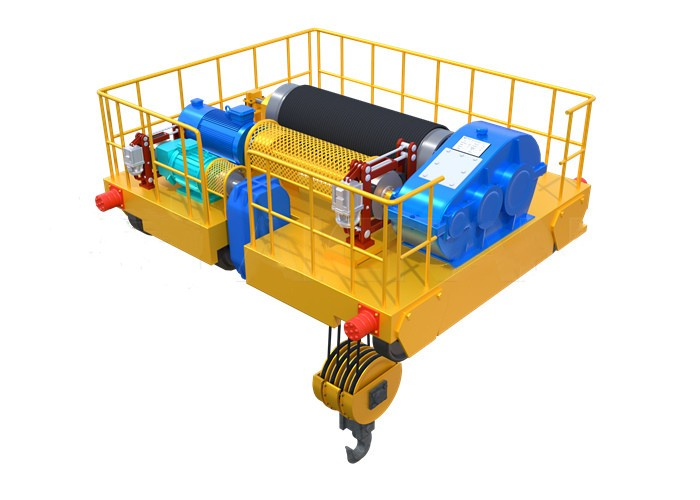
2. Lifting & Grabbing Components
A. Hoisting Mechanism
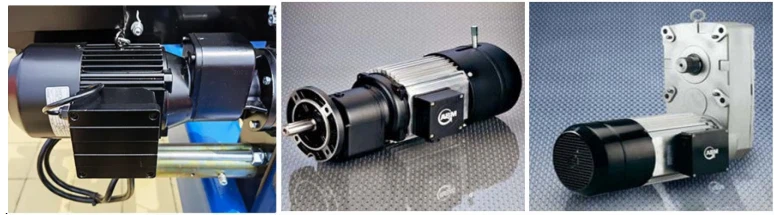
Hoist Motor (AC/DC or variable frequency drive-controlled).
Wire Rope or Chain (for lifting/lowering the grab).
Drum or Sheave System (guides the rope/chain).
Brakes (electromagnetic or hydraulic for safety).
 |
 |
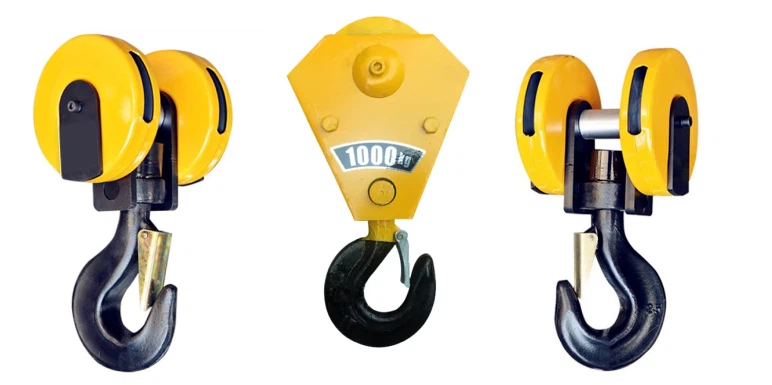
B. Grab Bucket
Clamshell Grab (for bulk materials like coal, grain).
Orange Peel Grab (for scrap metal, rocks).
Motorized Grab (self-opening/closing via electric motor).
Rope-Operated Grab (controlled by separate hoist drums).
C. Trolley Assembly
Moves horizontally along the bridge girder.
Carries the hoist and grab for precise positioning.
Includes trolley motor, wheels, and brakes.
3. Drive & Motion Systems
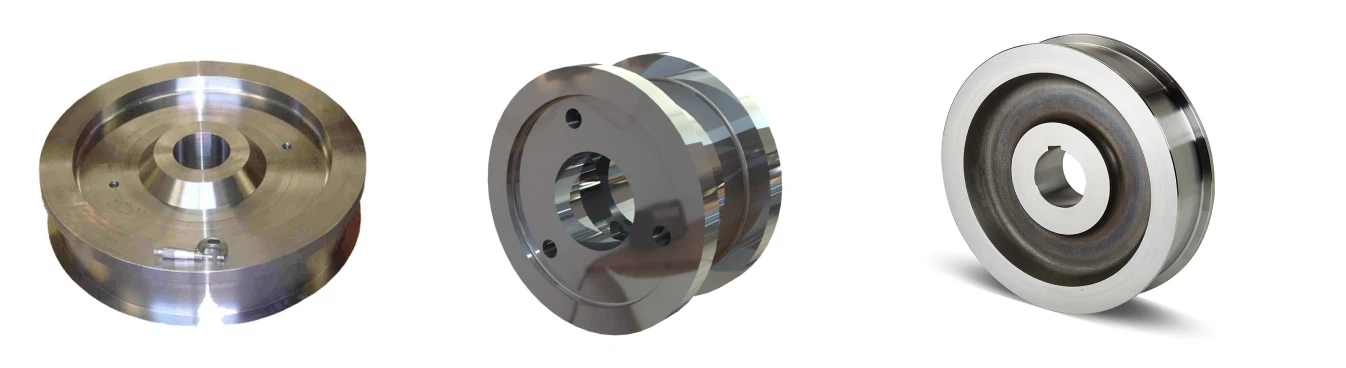
A. Travel Drives (Bridge & Trolley)
Travel Motors (for crane and trolley movement).
Reducer Gearboxes (for speed control).
Wheel & Rail System (for smooth motion).
B. Control Cabin or Pendant Station
Operator cabin (for manual/semi-auto control).
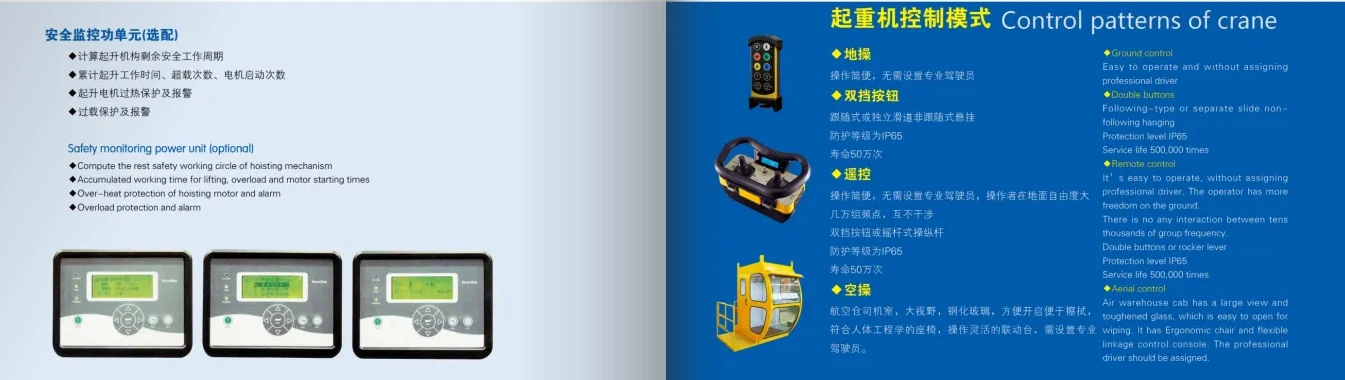
Radio remote control (wireless operation).
Touchscreen HMI (in advanced systems).
4. Automation & Control Components
A. Programmable Logic Controller (PLC)
Central control unit for automated sequences.
Brands: Siemens, Allen-Bradley, Mitsubishi.
B. Sensors & Feedback Systems
Load Cell (weighs material in real time).
Encoder (tracks position/speed).
Laser/Ultrasonic Sensors (for positioning).
Anti-Sway System (reduces load swing).

C. Human-Machine Interface (HMI)
Touchscreen panel for monitoring and control.
Displays weight, position, alarms, etc.
D. Frequency Inverters (VFDs)
Controls motor speed for smooth operation.
Brands: ABB, Schneider, Danfoss.
.
5. Power & Safety Systems
A. Power Supply
Festoon System or Cable Reel (for power/data transmission).
Main Circuit Breaker & Contactors (electrical protection).
B. Safety Devices
Overload Limiter (prevents exceeding capacity).
Limit Switches (stops crane at travel limits).
Emergency Stop Buttons (instant shutdown).
Anti-Collision System (for multiple cranes).
Anemometer (wind speed monitor for outdoor cranes).

6. Auxiliary Components
Lubrication System (auto-greasing for gears).
Lighting & Alarm Systems (for safety alerts).
Dust & Weather Protection (IP-rated enclosures).
Sketch

Main technical

Advantages
Automatic grab overhead cranes offer significant benefits over traditional manual or semi-automatic cranes, making them ideal for heavy-duty industrial applications.
1. High Efficiency & Productivity
Faster Material Handling: Automated grabs reduce cycle times, increasing throughput.
Continuous Operation: Can work 24/7 with minimal human intervention.
Precision Control: Automated systems ensure accurate positioning and grab movement.
2. Reduced Labor Costs & Human Error
Minimal Operator Dependency: Can be controlled remotely or autonomously.
Eliminates Manual Mistakes: Automated weight measurement and path planning reduce errors.
3. Improved Safety
Collision Avoidance: Sensors prevent accidents with obstacles or other cranes.
Overload Protection: Automatic shutdown if weight exceeds capacity.
No Manual Handling: Reduces worker exposure to hazardous environments (e.g., dust, heat).
4. Energy Savings & Lower Maintenance
Variable Frequency Drives (VFDs): Optimize motor speed, reducing power consumption.
Smart Diagnostics: Predictive maintenance alerts reduce downtime.
5. Versatility in Material Handling
Adaptable to different grab types (clamshell, orange peel, motorized).
Can handle various bulk materials (coal, grain, scrap, cement).
Application:
These cranes are widely used in industries requiring high-speed, large-volume bulk material handling.
1. Ports & Terminals
Ship Loading/Unloading: Efficiently transfers coal, grain, and minerals between ships and storage.
Barge & Container Handling: Moves bulk cargo in ports.
2. Power Plants
Coal Handling: Transports coal from storage yards to boilers.
Ash Removal: Moves fly ash and slag for disposal.
3. Steel & Scrap Yards
Scrap Metal Handling: Orange peel grabs sort and load scrap into furnaces.
Raw Material Feeding: Transports iron ore, coke, and limestone.
4. Cement & Construction Industry
Clinker & Raw Material Handling: Moves limestone, gypsum, and additives.
Bulk Cement Loading: Transfers cement to silos or trucks.
5. Grain & Food Processing
Silo Loading/Unloading: Handles wheat, rice, soybeans, and other grains.
Food-Grade Material Handling: Hygienic grabs for sugar, salt, or flour.
6. Waste Management & Recycling
Municipal Waste Handling: Moves bulk waste in recycling plants.
Biomass Processing: Transfers wood chips, agricultural waste.
7. Mining & Quarrying
Ore & Aggregate Handling: Loads/unloads rocks, sand, and minerals.
Stockpile Management: Automated stacking and reclaiming.
Crane production procedure
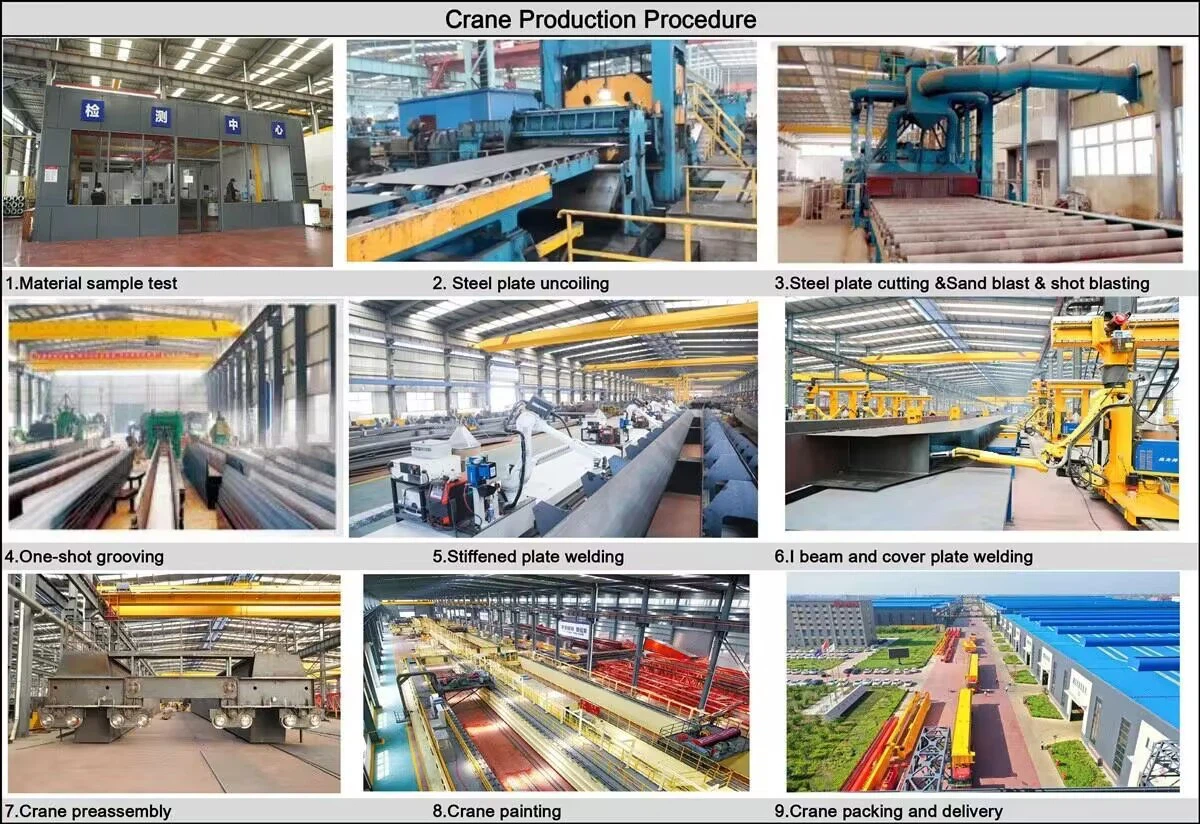
The production procedure for a 45-ton Double Girder Overhead Crane involves several key stages, from design to final testing. Below is a detailed step-by-step overview:
1. Design & Engineering
Load & Span Calculation: Determine crane capacity (45 tons), span (distance between rails), lifting height, and duty cycle (FEM/ISO classification).
Structural Design:
Main girders (box-type or truss design)
End carriages (for movement along rails)
Hoist and trolley mechanism
Electrical & Mechanical Design:
Motor power, gearbox, brakes, and control system
Wiring, pendant/radio remote control, or cabin operation
Software & Simulation: Finite Element Analysis (FEA) for stress testing.
2. Material Procurement
Steel Plates & Profiles: High-quality Q235B/Q345B steel for girders.
Electrical Components: Motors (hoist/travel), brakes, limit switches, and control panels.
Mechanical Parts: Wheels, gears, wire ropes, hooks, and bearings.
3. Fabrication of Main Components
A. Double Girder Fabrication
Cutting & Welding: CNC plasma cutting for precision; automatic submerged arc welding (SAW) for girders.
Assembly: Align and weld girders with end carriages.
Shot Blasting & Painting: Anti-rust treatment (primer + topcoat).
B. Hoist & Trolley Assembly
Hoist Mechanism:
45-ton electric wire rope hoist (or chain hoist).
Drum, motor, gearbox, and brake assembly.
Trolley Frame: Fabrication and mounting of wheels, motors, and rails.
C. End Carriages
Frame Construction: Welded steel with wheel assemblies.
Buffers & Bumpers: Installation for collision protection.
4. Electrical System Installation
Wiring & Controls:
Power supply (3-phase AC)
Variable Frequency Drives (VFDs) for smooth operation
Pendant/remote control system
Safety Devices:
Overload limiter
Limit switches (upper/lower travel)
Emergency stop
5. Assembly & Integration
Erection of Girders: Mount double girders onto end carriages.
Trolley & Hoist Installation: Position trolley between girders; secure hoist.
Rail Alignment: Ensure runway rails are level and parallel.
6. Testing & Quality Control
A. Factory Testing (Before Shipment)
No-Load Test: Run crane without load to check movement, brakes, and controls.
Load Test:
Static Test: 1.25 × rated load (56.25 tons) for 10 mins.
Dynamic Test: 1.1 × rated load (49.5 tons) with movements.
Safety Checks: Verify limit switches, emergency stop, and overload protection.
B. On-Site Testing (After Installation)
Re-run load tests under customer supervision.
7. Painting & Corrosion Protection
Final Coating: Weather-resistant paint (e.g., epoxy zinc-rich primer).
Markings: Labels for load capacity, warnings, and manufacturer info.
8. Packaging & Delivery
Disassembly (if needed): For easy transport.
Packaging: Waterproof wrapping for sea/land shipping.
9. Installation & Commissioning (On-Site)
Runway Beam Inspection: Ensure proper alignment and strength.
Crane Assembly: Reassemble girders, hoist, and electrical systems.
Final Testing: Conduct load tests and operator training.
Workshop view:
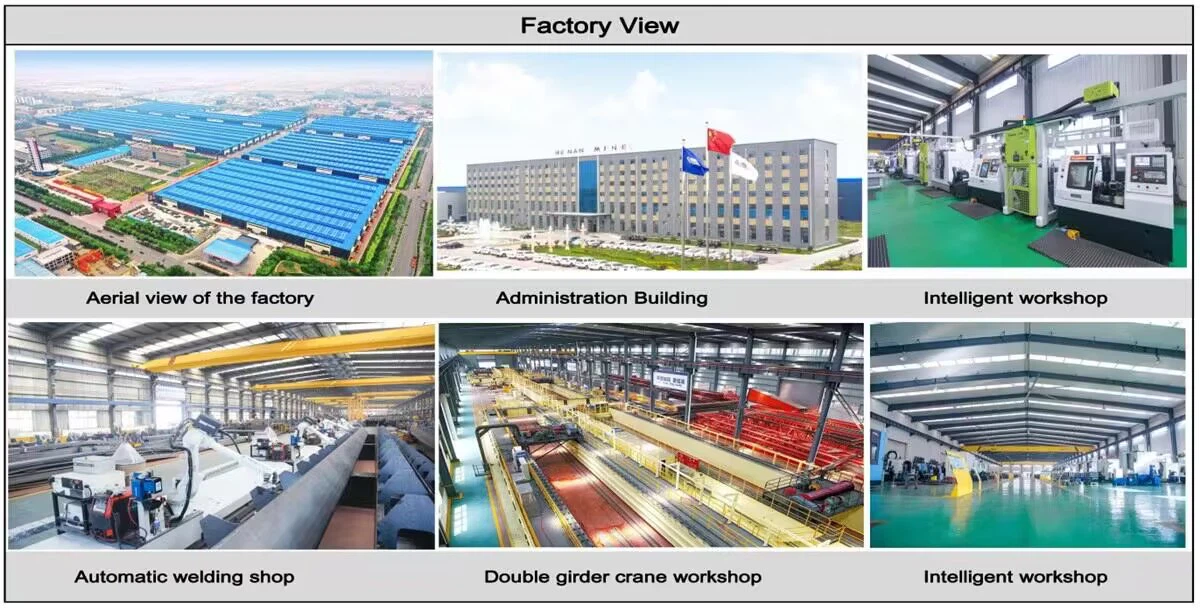
The company has installed an intelligent equipment management platform, and has installed 310 sets (sets) of handling and welding robots. After the completion of the plan, there will be more than 500 sets (sets), and the equipment networking rate will reach 95%. 32 welding lines have been put into use, 50 are planned to be installed, and the automation rate of the entire product line has reached 85%.


Hot Tags: automatic grab overhead crane, China automatic grab overhead crane manufacturers, suppliers, factory, Double Girder Overhead Crane, Double Girder Overhead Travelling Crane
You Might Also Like




Send Inquiry