










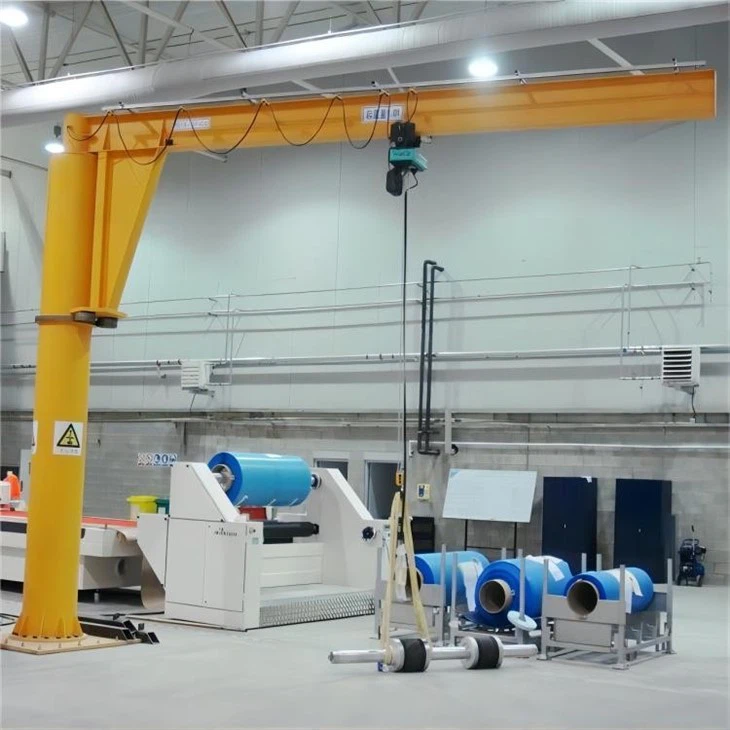

Floor Mounted Jib Crane
A floor-mounted jib crane is a versatile lifting solution designed to handle materials and loads in industrial settings. It provides a cost-effective and efficient way to move heavy objects within a specific area, making it an essential tool for various industries such as manufacturing, construction, and warehouses.

Key Features
- Sturdy Construction:
■ The crane is built with robust materials, ensuring durability and longevity.
■ Heavy-duty steel components provide strength and stability.
- Floor Mounting:
■ The crane is securely anchored to the floor, offering a stable and fixed lifting solution.
■ Ideal for applications where overhead space is limited or when the crane needs to cover a specific work area.
- 360-Degree Rotation:
■ The jib arm can rotate a full 360 degrees, providing a wide range of motion.
■ Allows for precise positioning and easy maneuverability of loads.
- Variable Capacities:
■ Available in a range of load capacities to meet the specific lifting requirements of different industries.
■ Capacities typically range from a few hundred kilograms to several tons.
- Customizable Boom Length:
■ The boom length can be customized to suit the specific needs of the application.
■ Different boom configurations provide flexibility in lifting height and reach.
- Easy to Operate:
■ Equipped with user-friendly controls, making it easy for operators to handle lifting tasks efficiently.
■ Smooth and precise movements enhance productivity and reduce the risk of load damage.
- Safety Features:
■ Designed with safety in mind, incorporating features such as overload protection and emergency stop mechanisms.
■ Reduces the risk of accidents and ensures a secure lifting environment.
- Low Maintenance:
■ Minimal maintenance requirements contribute to cost-effectiveness and overall reliability.
■ Durable components and well-engineered design reduce downtime.
- Versatile Applications:
■ Suitable for a variety of applications, including material handling in workshops, loading and unloading in warehouses, and assembly line processes.
- Compliance with Standards:
■ Manufactured in compliance with industry standards and regulations to ensure safety and performance.

Parts & Components
A floor-mounted jib crane is composed of several key parts and components that work together to facilitate efficient lifting and material handling. The specific design and components may vary among manufacturers, but the following list outlines the common parts you can find in a typical floor-mounted jib crane:
- Base/Foundation: The foundation or base is the lowermost part of the crane, securely anchored to the floor to provide stability and support for the entire structure.
- Column/Pillar: The vertical column or pillar extends from the base and supports the rotating jib arm. It is an integral part of the crane's structure, providing stability.
- Jib Arm: The horizontal jib arm is the projecting part of the crane that extends from the column. It can rotate 360 degrees, allowing for flexible movement and positioning of loads.
- Hoist Trolley: The hoist trolley is mounted on the boom and moves along its length. It houses the hoisting mechanism and facilitates the vertical movement of the load.
- Hoist Mechanism: The hoist mechanism is responsible for lifting and lowering the load. It typically includes an electric or manual hoist, a motor, and a set of pulleys and cables.
- Control System: The control system consists of buttons, levers, or a remote control device that allows the operator to control the movement of the crane, including hoisting, lowering, and the rotation of the jib arm.
- Rotation Mechanism: A rotating mechanism allows the jib arm to rotate 360 degrees, providing the crane with the ability to cover a wide area. This can be manual or powered, depending on the crane design.
- Electrical Components: Electrical components, including wiring, connectors, and safety features, are integrated into the crane to ensure proper functioning and compliance with safety standards.
- Limit Switches: Limit switches are safety devices that prevent over-travel of the crane components. They help avoid collisions and ensure safe operation.
- Counterweights (optional): In some cases, floor-mounted jib cranes may include counterweights to balance the load and reduce stress on the crane structure.
- Safety Features: Various safety features, such as overload protection, emergency stop buttons, and warning signals, are incorporated to enhance operator and workplace safety.

Parameters

Sketch

Advantages
Floor-mounted jib cranes offer several advantages in industrial and material handling applications. Here are some of the key benefits:
- Space Efficiency: Floor-mounted jib cranes are ideal for facilities with limited overhead space. Since they are anchored to the floor, they don't require extensive overhead clearance, making them suitable for areas with low ceilings.
- 360-Degree Rotation: The ability to rotate a full 360 degrees allows the crane to cover a wide working area without the need for repositioning. This enhances flexibility and efficiency in material handling processes.
- Cost-Effective Solution: Floor-mounted jib cranes are generally more cost-effective than larger overhead crane systems. They provide a practical lifting solution for specific workstations or localized material handling needs.
- Ease of Installation: Installation of floor-mounted jib cranes is typically straightforward, especially compared to more complex overhead crane installations. This can result in shorter downtime during implementation.
- Versatility in Lifting Heights: Floor-mounted jib cranes can be designed with customizable boom lengths, allowing for a range of lifting heights. This adaptability makes them suitable for various applications with different vertical lifting requirements.
- Increased Productivity: The 360-degree rotation and ease of control contribute to efficient material handling. Operators can quickly position loads with precision, reducing the time and effort required for lifting and moving objects.
- Reduced Manual Labor: By automating lifting tasks, floor-mounted jib cranes help reduce the need for manual labor in material handling. This can lead to increased productivity and a safer working environment.
- Sturdy and Durable Construction: These cranes are designed with heavy-duty materials, ensuring durability and stability. This robust construction allows them to handle heavy loads consistently over time.
- Enhanced Safety Features: Floor-mounted jib cranes are equipped with safety features such as limit switches, overload protection, and emergency stop mechanisms. These features contribute to a safer working environment and protect both operators and equipment.
- Adaptability to Specific Workstations: Floor-mounted jib cranes can be tailored to suit the specific needs of individual workstations. This adaptability makes them suitable for a variety of industries and applications.
- Low Maintenance Requirements: Compared to more complex crane systems, floor-mounted jib cranes often have lower maintenance requirements. This results in reduced downtime and overall operational costs.
- Compliance with Industry Standards: Reputable manufacturers design floor-mounted jib cranes in compliance with industry standards and regulations, ensuring that they meet safety and performance criteria.

Application
Floor-mounted jib cranes find applications in various industries where efficient and precise material handling is essential. Here are common applications of floor-mounted jib cranes:
- Manufacturing Facilities: Floor-mounted jib cranes are often used in manufacturing plants for tasks such as moving raw materials, positioning components during assembly, and transferring finished products.
- Workshops: These cranes are employed in workshops for tasks like lifting and moving heavy machinery, positioning workpieces for welding or machining, and facilitating efficient material handling within the workshop.
- Warehouses and Distribution Centers: Floor-mounted jib cranes are utilized in warehouses and distribution centers for loading and unloading goods, stacking pallets, and rearranging inventory. Their ability to cover a broad area makes them suitable for diverse storage configurations.
- Assembly Lines: In assembly line environments, floor-mounted jib cranes assist in the movement of components and subassemblies, aiding in the assembly process. They contribute to streamlined production and reduce the strain on manual labor.
- Maintenance and Repair Shops: These cranes are commonly found in maintenance facilities where they help lift and position heavy equipment for maintenance or repair work. They provide a reliable and efficient solution for handling machinery and components.
- Construction Sites: Floor-mounted jib cranes are used on construction sites for lifting and placing construction materials, tools, and equipment. Their flexibility and mobility contribute to increased productivity in construction projects.
- Loading Docks: In loading dock areas, floor-mounted jib cranes assist in loading and unloading trucks and containers. They help move heavy cargo efficiently, reducing the reliance on manual labor and enhancing the speed of material transfer.
- Foundries and Forges: Industries involved in metal casting and forging use floor-mounted jib cranes to handle heavy molds, pour molten metal, and transport finished products within the production area.
- Automotive Industry: Floor-mounted jib cranes are applied in automotive manufacturing for tasks such as moving vehicle components, positioning engines or chassis, and assisting in the assembly of automobiles.
- Aerospace Industry: In aerospace facilities, these cranes are used to handle large and heavy components of aircraft, spacecraft, and related equipment. They contribute to the precision and safety required in aerospace manufacturing.

Production Procedure
The production procedure of a floor-mounted jib crane involves several steps, from design and manufacturing to assembly and testing. Here is a general overview of the production procedure for a floor-mounted jib crane:
1.Design Phase:
- Project Requirements: Understand the specific requirements of the customer, including lifting capacity, working radius, height, and any special features needed.
- Engineering Design: Create detailed engineering drawings and specifications for the floor-mounted jib crane, considering factors such as material strength, safety standards, and operational requirements.
2.Material Selection:
- Choose high-quality materials for the various components of the crane, including the base, column, jib arm, boom, hoist trolley, and other structural elements. The materials should be selected based on factors like strength, durability, and resistance to environmental conditions.
3.Fabrication:
- Cut and shape the raw materials according to the design specifications.
- Weld the components together to form the main structure of the floor-mounted jib crane.
- Ensure precision and accuracy in the fabrication process to maintain structural integrity.
4.Surface Treatment:
- Apply surface treatments such as painting or coating to protect the crane from corrosion and environmental wear.
- Surface treatments may include priming, painting, or galvanizing, depending on the materials used and the intended application.
5.Assembly:
- Assemble the various components, including the base, column, jib arm, boom, hoist trolley, and any additional features according to the engineering design.
- Ensure that all connections are secure and that the crane is structurally sound.
6.Installation of Mechanical Components:
- Install the hoist mechanism, rotation mechanism, and other mechanical components.
- Connect the electrical components, including wiring, control panels, and safety features.
7.Quality Control and Testing:
- Conduct thorough quality control inspections at different stages of the manufacturing process to ensure compliance with design specifications and industry standards.
- Perform load testing to verify the crane's lifting capacity and overall functionality.
8.Documentation and Certification:
- Prepare documentation, including user manuals, maintenance instructions, and certification documents.
- Ensure that the floor-mounted jib crane complies with relevant safety and quality standards.
9.Packaging and Shipping:
- Package the floor-mounted jib crane securely to prevent damage during transportation.
- Arrange for shipping to the customer's location.
10.Installation and Commissioning:
- Provide on-site installation services or detailed installation instructions for the customer.
- Commission the crane, ensuring that all components function correctly and safely.
11.Training:
- Offer training to operators on the proper use, maintenance, and safety procedures associated with the floor-mounted jib crane.
12.After-Sales Support:
- Provide ongoing support, including maintenance services, spare parts availability, and troubleshooting assistance.

Workshop View
Henan Mine Crane Co., Ltd has implemented a smart equipment management platform and deployed 310 sets of handling and welding robots. Upon the fulfillment of the initiative, the total number of sets will exceed 500, achieving a 95% equipment networking rate. Currently, 32 welding lines are operational, with plans to install an additional 50. The overall automation rate for the entire product line has already reached 85%.


Hot Tags: floor mounted jib crane, China floor mounted jib crane manufacturers, suppliers, factory
Previous
No InformationYou Might Also Like


Send Inquiry