







General Purpose Double Girder Bridge Crane
Products Description
Structure
Double Girders: Two parallel main girders run across the span, enhancing strength and stability.
End Carriages: Located at both ends to support the girders and allow crane travel along the runway.
Trolley (Crab Unit): Moves along the girders and carries the hoisting mechanism (wire rope hoist or winch).
Core Components:Bearing, Gearbox, Motor, Pump
Place of Origin:Henan, China
Warranty:1 Year
Weight (KG):2000 kg
Video outgoing-inspection:Provided
Machinery Test Report:Provided
Design:Double beam
Effectiveness:high efficiency
Operating speed:High speed operation
Stability:Anti-swing function
Color:Optional
Power Source:110V/220V/230V/380V/440V,customized
Span:7.5-31.5m
Pictures & Components
1.Main beam
1) Structure & Design
Composed of two parallel girders made from welded box-section or rolled steel I-beams, depending on capacity.
Provides the primary structural support for the trolley and lifting mechanism.
Usually includes walkways and maintenance platforms for inspection and repair access.
Designed to handle bending forces, dynamic loads, and lateral stress during lifting and crane travel.
2)Key Features
Material: High-strength structural steel (e.g., Q235B/Q345B).
Camber design: Slight upward arch to counter deflection under heavy loads.
Rail Track: Trolley travels on rails mounted on top of the girders.
Connection: Welded or bolted to the end carriages for smooth integration.
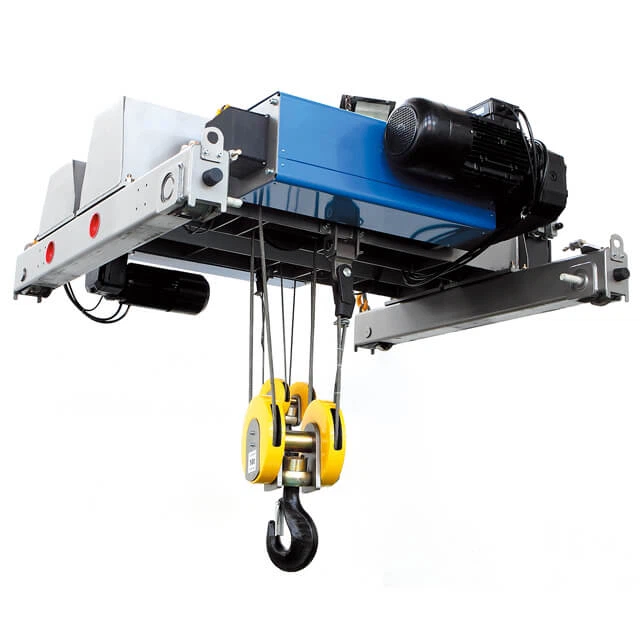
2.Lifting System
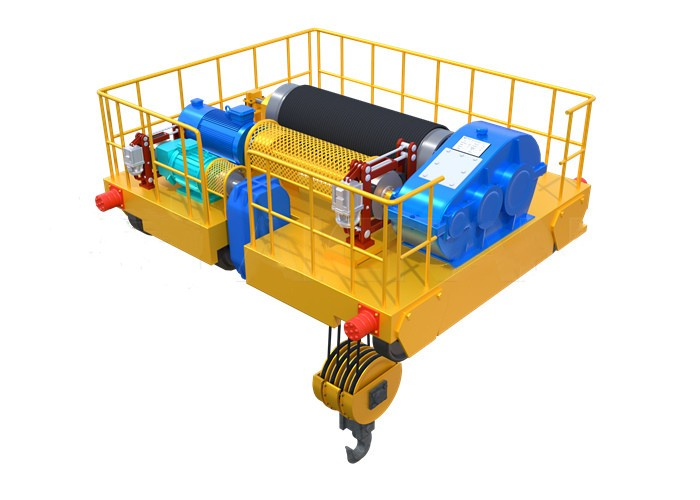
1)Hoisting Mechanism:
Typically a wire rope hoist or a winch system.
Mounted on a trolley (also called a crab unit) that runs along the double girders.
2)Motor:
Heavy-duty motor with Variable Frequency Drive (VFD) for smooth speed control.
Provides power for vertical lifting.
3)Gearbox:
Connects motor to drum, offering speed reduction and torque amplification.
4)Drum & Wire Rope:
The steel wire rope winds around the grooved drum during lifting.
Drum is precisely machined to prevent rope slippage and extend rope life.
5)Hook Block:
Carries the lifting hook, pulley system, and safety latch.
Rated for the full load capacity of the crane.
6)Brake System:
Electromagnetic or hydraulic brakes automatically engage during power failure or overload.
7)Limit Switches:
Prevent over-lifting or over-lowering by cutting off the hoisting motor at preset limits.
 |
 |
3.End carriage
The end carriage (also called end truck) is the structure at both ends of the bridge.
It carries the bridge girders and travels along the runway rails.
It transfers the load (including the weight of the crane itself, the trolley, and the lifted load) to the building structure through wheels running on rails.
 |
 |
4.Crane travelling mechanism
Operation Flow
Operator initiates crane travel via control panel or remote.
Drive motors activate, turning the wheels on the end carriages.
The bridge structure moves along the runway rails.
Brakes engage for safe and controlled stopping.
Limit switches cut off motion at track ends.
5.Trolley travelling mechanism
Safety and Performance Features
Limit switches to stop trolley before reaching physical end of rail.
Soft start/stop via VFD to reduce sway.
Overload protection if integrated with hoisting unit.
Rigid and vibration-resistant structure for stable travel.
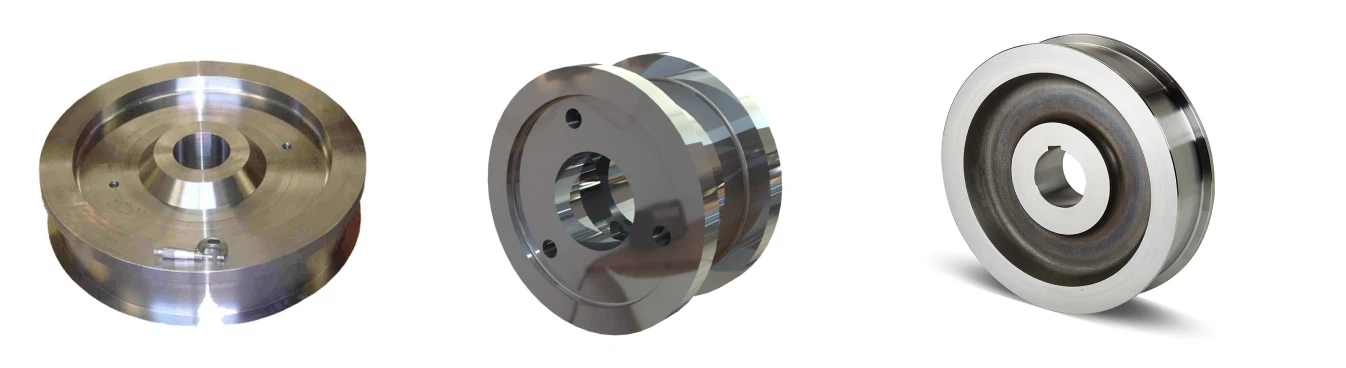
6.Crane wheel
Function:
To support the crane's weight and enable smooth longitudinal movement along the runway rails.
Transmit the driving force from the motor to the rail.
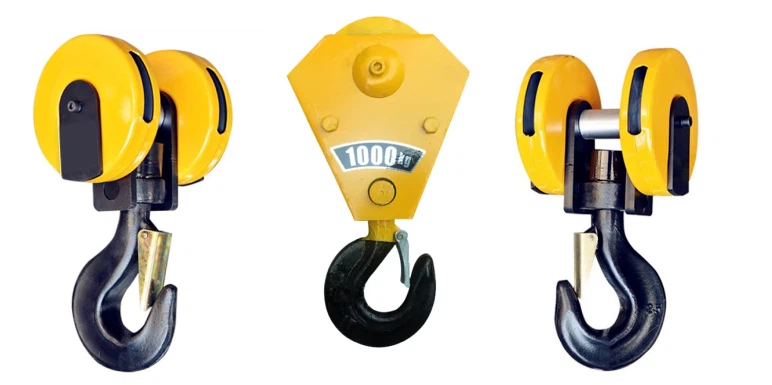
7.Crane Hook
The hook of a General Purpose Double Girder Bridge Crane is the primary component that directly engages with the load during lifting operations. It's mounted on the hook block and connected to the hoisting mechanism via a steel wire rope system, allowing safe and efficient lifting, lowering, and load holding.
Function:
Acts as the load-bearing interface between the crane and the item being lifted.
Designed to safely grip and release loads using slings, chains, or other lifting gear.
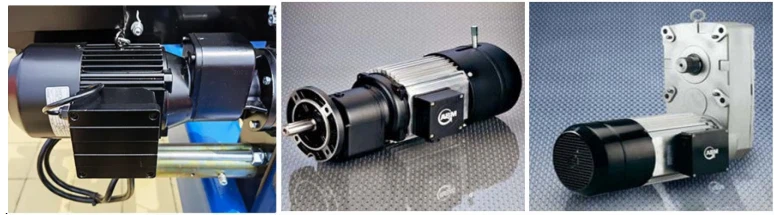
8.Motor
The motor of a General Purpose Double Girder Bridge Crane is the driving force behind all key movements, including lifting (hoisting), crane travel, and trolley travel. Each motion system uses dedicated motors optimized for torque, duty cycle, and speed control.
Function:
Powers the hoisting mechanism to lift/lower loads.
Drives the trolley and bridge travel systems for horizontal movement.
Enables precise load control and safe operation under various working conditions.

.
9.Sound and light alarm system & limit switch
The Sound and Light Alarm System and Limit Switches on a General Purpose Double Girder Bridge Crane are critical safety and signaling components that help prevent accidents, alert personnel, and limit crane movement within safe operational boundaries.
1)Sound and Light Alarm System
Purpose:
Warns personnel of crane movement or emergency situations through audible and visual signals.
Enhances safety awareness in busy industrial environments.
2)Limit Switches
Purpose:
Stop or restrict movement when the crane, trolley, or hook reaches its maximum allowable travel.
Prevents over-travel, over-hoisting, and potential collisions.

10.Safety Devices
1. Overload Limiter
Prevents lifting beyond rated capacity.
Stops hoisting or triggers alarm when load exceeds safe limit.
Often integrated with load cells or current sensors.
2. Limit Switches
Hoisting Limit Switch: Prevents hook from over-hoisting or over-lowering.
Trolley Travel Limit Switch: Stops trolley at end of travel path.
Crane Travel Limit Switch: Stops bridge movement at runway ends.
3. Emergency Stop Button
Instantly cuts power to all operations when pressed.
Located on the control pendant, remote control, and/or control cabin.
4. Buffer Devices (End Stops)
Rubber or hydraulic buffers at the end of rails.
Absorb kinetic energy if crane or trolley over-travels.
5. Anti-Collision Device (Optional)
Ultrasonic, infrared, or laser sensors detect nearby cranes or obstacles.
Automatically slows or stops the crane to avoid collisions.
6. Rail Clamp / Wheel Brake (Windproof Device)
Secures the crane in place when not in use, especially for outdoor cranes.
Prevents wind-induced movement.
7. Sound and Light Alarm
Audible sirens and flashing lights warn nearby personnel during crane movement.
8. Motor Overload Protection
Built-in thermal protection in motors prevents overheating and burnout.
Includes sensors like thermistors or thermal relays.
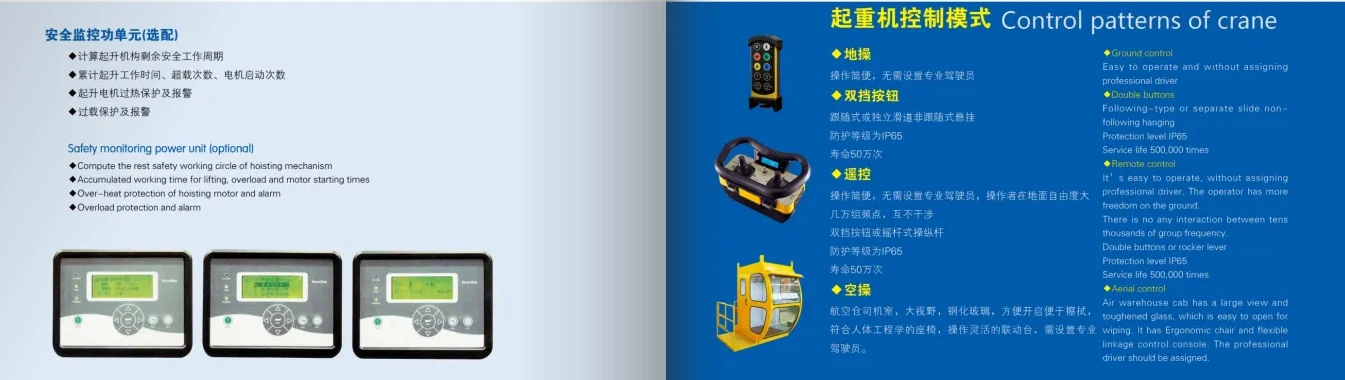
11.Control Mode
Control Modes: Common Functions/Applications
Cab Control: Heavy cranes (large capacity) Full control with operator visibility
Suspended Control: Medium to large cranes, ground operation, wired connection
Wireless Remote Control: Small to medium cranes, flexible control, high maneuverability
Automatic Control: Professional or repetitive lifting tasks, precise, consistent, safe
Joystick Control: Small cranes or applications requiring simple control, easy to operate for light tasks
12.Sketch

Main technical

Advantages
1. High Load Capacity
Double girder design provides superior strength and stability, allowing for heavier loads to be lifted safely.
Typically ranges from 10T to 500T or more, depending on the application.
Ideal for handling heavy equipment, machinery, steel, or large loads that other cranes may struggle with.
2. Increased Lifting Height and Span
The double girder design allows for a higher lifting height compared to single girder cranes.
Can accommodate wider spans, making it suitable for large workshops, warehouses, and open areas.
The greater lifting height is particularly useful for large containers, heavy machinery, or equipment maintenance.
3. Enhanced Stability
The double girder structure distributes the load more evenly across the entire crane system, providing more stability during lifting.
This reduces the risk of tipping or shifting under high loads and improves safety.
4. Efficient and Precise Load Control
With advanced electrical controls and variable speed drives, the crane offers precise control over the movement of the load.
Hoisting, travel, and trolley movements can be fine-tuned to meet the needs of sensitive applications, reducing risks and improving operational efficiency.
5. Versatility in Operation
Multiple control modes (pendant, cabin, wireless remote, automated) allow for flexible operation depending on the environment and requirements.
Can be used for general lifting, material handling, or construction tasks in a variety of industries such as manufacturing, steel mills, shipyards, warehouses, and heavy machinery assembly.
6. Durability and Longevity
Heavy-duty construction and use of high-quality materials (e.g., forged steel, alloyed components) ensure long-lasting performance.
Designed for continuous duty cycles, making it perfect for operations requiring frequent and extended crane use.
Application:
1.Manufacturing Plants
Material Handling: Moving raw materials, components, and finished products throughout the production line.
Assembly Operations: Lifting heavy machinery, large parts, and components for assembly in manufacturing plants.
Machine Maintenance: Lifting and relocating heavy equipment or motors for repairs and maintenance.
Advantages: Ability to handle high weights and wide spans, reducing the need for multiple cranes.
2. Steel Mills & Foundries
Heavy Lifting: Handling large steel billets, coils, and ingots.
Casting and Pouring: Used to lift molten metal ladles or mold components in foundries.
Material Transport: Moving heavy steel components and materials between various stages of production.
Advantages: Strong enough to handle extreme temperatures and heavy loads in harsh industrial environments.
3. Construction & Heavy Engineering
Building Construction: Lifting large pre-fabricated components, beams, and structural elements.
Heavy Machinery Handling: Moving large construction equipment, such as bulldozers, generators, or cranes.
Bridge and Tunnel Construction: Used in projects where large structures are assembled in situ.
Advantages: Capability to work with heavy, large components and materials, along with high safety standards.
4. Shipyards & Maritime Applications
Shipbuilding: Lifting large ship components like hull sections, engines, and cranes.
Dockside Loading/Unloading: Moving heavy cargo or containers from ships to trucks or storage.
Repair and Maintenance: Lifting and maneuvering large parts of ships or offshore platforms for repairs.
Advantages: Offers high lifting capacities and spans needed to handle large vessels and components.
5. Warehouses and Distribution Centers
Storage and Retrieval: Lifting, storing, and retrieving goods in warehouses, particularly in high-density storage systems.
Bulk Material Handling: Moving large quantities of goods or raw materials such as timber, concrete, or metal.
Shipping/Loading: Loading goods onto trucks for distribution and unloading from containers.
Advantages: Helps to improve operational efficiency by automating load handling and reducing human labor.
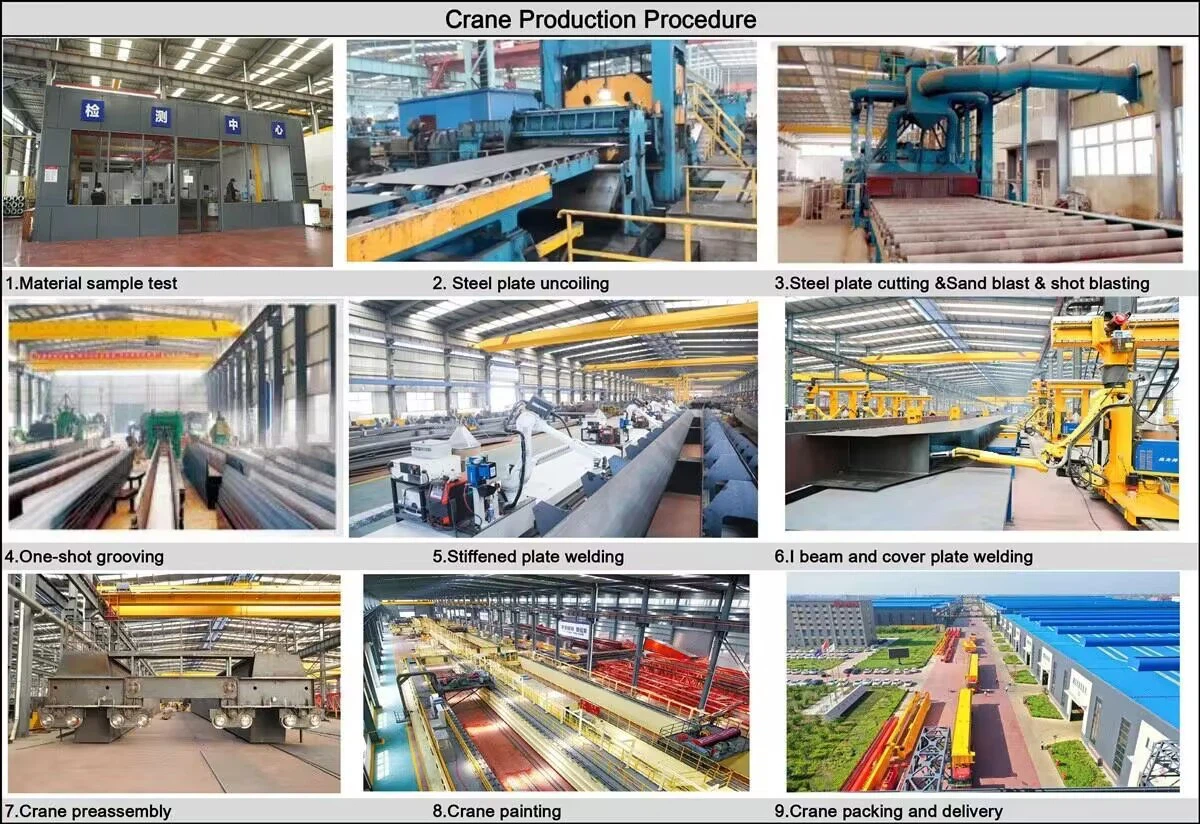
Crane production procedure
1.Design and Engineering
Requirements Gathering:
Load capacity (e.g., 10T, 50T, 100T, etc.), span, lifting height, and operational environment are defined.
Customization needs are assessed, such as control modes (pendant, wireless, cabin) and special features (e.g., anti-collision, overload protection).
Preliminary Design:
Structural engineers and crane designers create the crane's initial design, including the main beam, end carriage, lifting system, trolley system, travel mechanism, and other components.
Calculation and Simulation:
Load calculations are performed to ensure the crane can handle the specified capacity.
Finite element analysis (FEA) may be used to simulate stresses and deflections in the structure to ensure safety and stability.
Detailed Design:
After approval, detailed drawings for each part are made, including the main girder, end carriage, hoist system, motors, control systems, and safety features.
2. Material Procurement
Raw Material Selection:
High-quality materials like steel, alloyed steel, forged steel, and electrical components are sourced according to specifications.
Materials are inspected for quality certification and compliance with industry standards (e.g., ISO, CE).
Component Sourcing:
Standard components such as motors, hoists, control panels, limit switches, and safety devices are sourced from reliable suppliers.
3. Fabrication of Components
Main Girder:
Cutting and welding of steel plates to form the bridge girder.
The girder is assembled by welding or bolting sections, ensuring it meets the required strength and precision.
End Carriage Assembly:
The end carriage is fabricated and assembled to hold the crane on the runway rails.
Wheel assemblies are installed to ensure smooth travel along the rails.
Hoist and Trolley System:
The hoist unit (electric or manual) is assembled, including the drum, wire rope, hook, and motor.
The trolley system is built to transport the hoist across the bridge, including trolley wheels and drive mechanisms.
Crane Traveling Mechanism:
The crane wheels are mounted on the end carriages, ensuring smooth horizontal movement.
The drive system is installed to control travel speed.
4. Assembly of Crane
Main Beam Installation:
The assembled main girder is lifted and positioned onto the end carriages.
The girder is aligned to ensure structural integrity.
Trolley and Hoist Installation:
The trolley system is mounted onto the main girder, and the hoist is mounted to the trolley.
The load chain or wire rope is installed and tested for smooth operation.
Travel Mechanism Setup:
The crane wheels are fitted, and the drive mechanism is connected to the control system for horizontal movement.
5. Electrical and Control System Installation
Wiring and Control Panel:
The control panel is installed and wired to manage all crane movements (hoisting, trolley, crane travel).
Limit switches, emergency stop buttons, and safety alarms are integrated into the control system.
Motor and Gear Installation:
Motors for hoisting, traveling, and the trolley are installed and connected to their respective gear systems.
Testing of Control Systems:
Control systems are checked to ensure proper integration of pendant control, wireless remote, or cabin control options.
6. Testing and Quality Control
Load Testing:
The crane undergoes static load testing (to check stability) and dynamic load testing (to check operational performance under actual working conditions).
Overload protection and limit switches are tested to ensure they function correctly.
Safety System Testing:
The sound and light alarms, limit switches, emergency stop buttons, and safety devices are all tested for functionality.
Movement Testing:
All movements-hoisting, trolley movement, bridge travel, and sway control-are tested for smooth operation and precision.
Electrical Testing:
All electrical components are tested for proper wiring, grounding, and communication between systems.
Documentation and Certification:
The crane is inspected according to international safety standards and undergoes certification by relevant authorities (e.g., CE, ISO).
Test certificates for motors, cranes, and load testing are prepared.
7. Final Inspection and Painting
Visual Inspection:
A thorough inspection is carried out to ensure that the crane meets design specifications and safety requirements.
Painting:
The crane is painted with high-quality anti-corrosion coatings to protect it from environmental conditions.
Marking and Labeling:
Safety labels, warnings, and capacity markings are applied to the crane for proper identification.
8. Delivery and Installation
Shipping:
The crane is carefully disassembled into transportable parts (if needed) and shipped to the customer's location.
Installation:
The crane is installed on-site, and all connections (power, mechanical, control) are made.
Final Commissioning:
The crane is commissioned by running it through a series of operational tests to ensure it works properly.
Operator training is conducted, if necessary, for safe and efficient use.
9. Post-Installation Support
Customer Training:
Operator training on how to use the crane safely and effectively.
Maintenance Schedule:
Providing a maintenance plan for the crane's continued operation, including regular inspections, lubrication, and testing.
After-Sales Support:
Offering spare parts, troubleshooting, and repair services.
Workshop view:
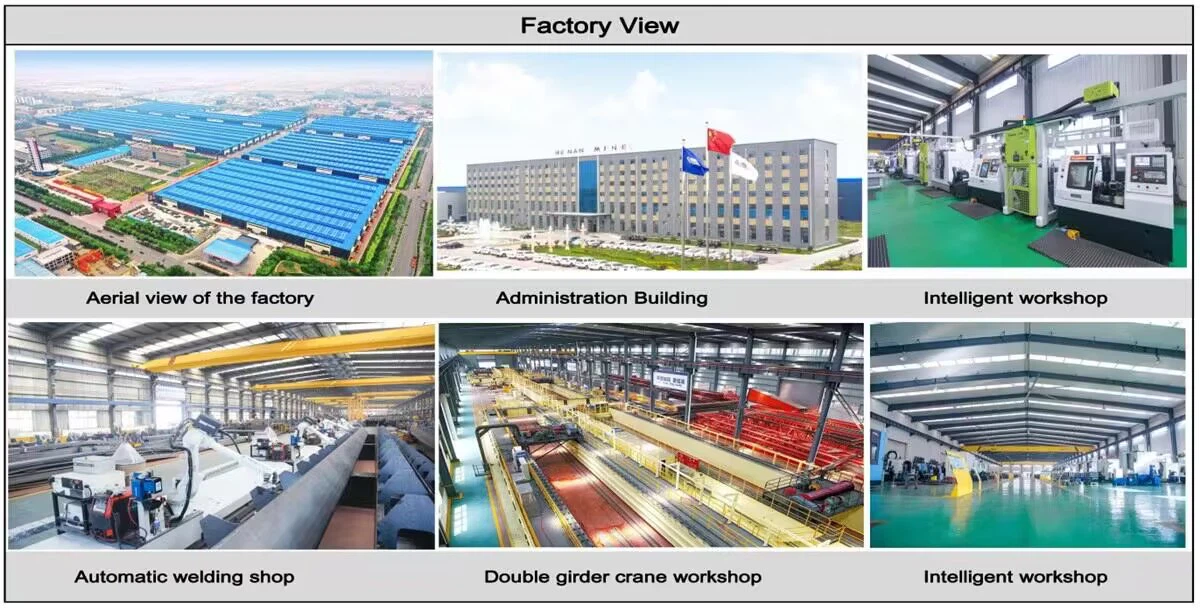
The company has installed an intelligent equipment management platform, and has installed 310 sets (sets) of handling and welding robots. After the completion of the plan, there will be more than 500 sets (sets), and the equipment networking rate will reach 95%. 32 welding lines have been put into use, 50 are planned to be installed, and the automation rate of the entire product line has reached 85%.


Hot Tags: general purpose double girder bridge crane, China general purpose double girder bridge crane manufacturers, suppliers, factory, Double Girder Overhead Travelling Crane, Double Girder Overhead Crane
Previous
Steel Coil Overhead CraneYou Might Also Like


Send Inquiry