





Steel Buildings
What is Steel Buildings?
A steel building is a metal structure fabricated with steel for the internal support and for exterior cladding, as opposed to steel framed buildings which generally use other materials for floors, walls, and external envelope. Steel buildings are used for a variety of purposes including storage, work spaces and living accommodation. They are classified into specific types depending on how they are used.Steel is one of the most commonly used building materials in modern construction. A strong foundation of a building can not be created without the use of steel, which gives the building the strength to withstand natural calamities such as earthquakes.
Advantages of Steel Buildings
Modern design and creative freedom:Architects can let their artistic imaginations run wild, while also maintaining the capability to design and build a strong and durable building. The ability of steel to stretch greater distances with steel ceiling joists is one of the most obvious benefits of using a steel frame in the building.
Strength and durability:The components of structural steel are stronger and lighter than those made of weight-bearing concrete or wood. The fabrication of weight-bearing steel is 30 – 50 percent lighter than its wooden counterpart. This makes the construction of steel buildings stronger than conventional wooden or concrete buildings.
Easy and quick to install:Inside the production plant/manufacturing factory, steel parts in steel buildings are pre-manufactured to a specific requirement and are shipped out in ready-to-be erected condition. It thus greatly boosts up construction time. So in a shorter time than average, it is possible to complete large-scale projects.
Versatile:Steel is highly flexible as it can be moulded into almost any form, making it an attractive alternative for residential and commercial buildings as well. For wide spans and heavy structures that accommodate all forms of industrial structures, a steel framework is highly recommended.


Why Choose Us?
High quality
Our products are manufactured or executed to very high standards, using the finest materials and manufacturing processes.
Rich experience
Dedicated to strict quality control and attentive customer service, our experienced staff is always available to discuss your requirements and ensure complete customer satisfaction.
Quality control
We have professional personnel to monitor the production process, inspect the products and ensure that the final product meets the required quality level standards, guidelines and specifications.
24h online service
We try and respond to all concerns within 24 hours and our teams are always at your disposal in case of any emergencies.
Types of Steel Buildings
The portal steel frame comprises hot-rolled or welded section steel, cold-formed c/z steel, and steel pipe as the main force-bearing components and adopts a light roof and wall structure. The portal frame is the most common form of the light steel structure.The rigid portal frame is a structure with rigidly connected beams and columns. It has the characteristics of a simple structure, lightweight, reasonable stress, and simple construction. Therefore, it is widely used in industrial, commercial, agricultural, and institutional buildings.
The steel frame structure comprises beams and columns that can withstand vertical and horizontal loads. Columns, beams, bracing, and other members are rigidly or hingedly connected to form a flexible layout and create a larger space. It is widely used in multi-story, high-rise, super-highrise buildings, commercial office buildings, conference centers, etc.
The steel truss structure comprises several rods hinged at both ends of each rod. It can be divided into a plane truss and a space truss. According to the parts section, it can be separated into tube truss and angle steel truss. The truss generally comprises the upper chord, lower chord, vertical rod, diagonal web, and inter-truss support. The steel used in trusses is less than that of solid web beams, the structural weight is lighter, and the rigidity is greater.The advantage of the steel truss is that it is used to form more significant members with smaller cross-sections. It is often used in roofs, bridges, tv towers, mast towers, marine oil platforms, and tower corridors of industrial and civil buildings.
According to a specific rule, the grid structure comprises many rods with minor space stress, are lightweight, have high rigidity, and offer excellent seismic resistance. It is used as a gymnasium, exhibition hall, and aircraft hangar.
Cold-formed thin-walled steel structures refer to finished steel products with various cross-section shapes bent from steel plates or strips with a thickness of 1.5 to 6 mm in a cold state. Cold-formed steel is an economical cross-section of lightweight, thin-walled steel, known as steel cold-formed or cold-formed profiles.In industrial, civil, and agricultural buildings, thin-walled steel building structures can make various structures and components, such as roof trusses, rigid frames, grids, purlins, wall beams, and columns.
The Composition of the Steel Frame Structure
For the steel frame structure, with the increase of layers and height and bearing a sizeable vertical load, the lateral resistance requirements become the primary bearing characteristics of the frame.The steel frame structure system is generally divided into frame structure, frame bracing structure, frame shear wall structure, and frame tube structure.
Frame structure
The frame comprises columns and beams bearing vertical and lateral forces. Steel columns generally use h-shaped steel, box-shaped steel columns, or steel tube concrete columns.
Frame shear wall structure
Similar to the frame bracing structure, except that the bracing is replaced with a shear wall to resist lateral forces.The shear wall is generally a concrete slab, steel plate, or a steel-concrete composite structure with better lateral stiffness than bracing. It is more flexible in layout and suitable for higher building structures.

Frame bracing structure
The frame comprises columns and beams, and bracings are provided between the columns to resist lateral forces.
Frame tube structure
The structure generally comprises a reinforced concrete core tube and an outer ring steel frame.The system form uses pure steel frames in the horizontal direction and arranges an appropriate number of vertical inter-column bracing in the longitudinal direction to strengthen the longitudinal rigidity, reduce the amount of steel used in the frame, and form a larger space.
Steel Building Structures VS Reinforced Concrete
Economy
The steel building structures use advanced design, processing technology, and large-scale production methods to reduce costs significantly. Simultaneously, the simple and rapid installation saves many construction costs and enables enterprises or developers to put it into production more quickly.Traditional reinforced concrete buildings have a high civil construction cost and long construction periods. The cost is susceptible to unpredictable factors, such as natural disasters, construction in winter and rainy seasons, and rising material prices.
Construction schedule
The steel structure building can be delivered and installed quickly. The installation is expected to be completed within four or five months after the contract is signed, and it is not affected by winter construction.The construction speed of traditional reinforced concrete structures is slow, and the construction period can reach 8-10 months or longer.
Carrying capacity
The weight of the steel structure building is usually only equivalent to 1/6 of its design bearing capacity. The importance of components is much lighter than that of reinforced concrete components.In traditional reinforced concrete buildings, the structure’s weight is often equal to its designed load-bearing capacity, and the prefabricated components are heavy, requiring high-lifting equipment.
Basic cost
Due to the light weight of the steel structure building, the reaction force at the bottom of the column is small, saving many foundation treatment costs.Traditional reinforced concrete buildings have complicated foundation treatment due to their complex self-weight. Over half of the total structure cost will be used for the foundation in poor soil quality.
Shock resistance
Steel structure buildings have large deformations before destruction, which is easy to detect and avoid. Simultaneously, the steel structure has excellent seismic performance due to the lightweight and the joints’ mechanical properties.Traditional reinforced concrete buildings are based on the material properties of concrete. Compared with light steel structures, reinforced concrete buildings are more prone to brittle failure, and their seismic performance is significantly lower than steel structure buildings.
Ample space and floor plan
The interior space of the steel structure building is spacious, with a span of up to 60m. It can be expanded and rebuilt relatively quickly, and various industrial pipelines can be flexibly laid out.The span of traditional reinforced concrete buildings is limited, and prestressing technology must be used to achieve a span of more than 15m. The internal space layout is limited, with many columns and large space waste. After its completion, it is more difficult to persuade its structure. The structural design is more complicated to cooperate with other professions.
Mobility
Bolts can connect the steel structure building, and they can be easily disassembled, transferred, and assembled without much expense, and has muscular mobility. There is no possibility of movement in traditional reinforced concrete buildings.
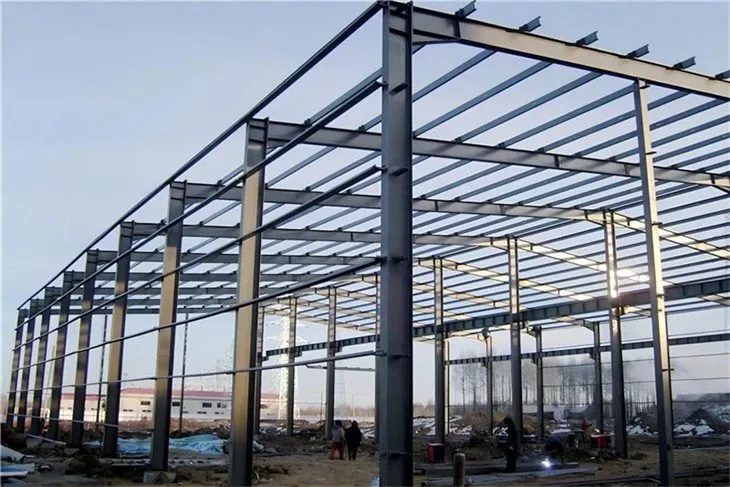
What are the Characteristics of Steel Structure
Steel structures use steel, and steel has relatively high strength. Compared with concrete building structures or wood building structures, its density ratio is relatively low. Under the same stress conditions, the weight is lighter, and it is relatively more convenient to install and transport. Suitable places are structures with relatively large heights and large spans, and have good load-bearing capacity.
Teel has certain impact resistance and the material is relatively uniform. Houses built with such materials have a relatively high safety factor. Moreover, the steel structure can be manufactured in the factory and then brought to the site for assembly, so the production efficiency and assembly speed are relatively fast.
However, this kind of steel structure has a flaw, that is, it is easy to corrode in a humid environment, and must be rusted regularly. Or galvanizing first can increase its corrosion resistance.
Steel Structure Building Construction Process
Generally speaking, the construction process of steel structures is roughly the same. Taking the steel structure factory building as an example, the construction process mainly includes steel structure design - construction laying out - foundation concrete embedded bolts - steel structure processing and production - crane beam installation - steel beam installation - roof trusses, roof panels and eaves panels installation - wall panel installation —steel structure painting
Steel structure design
The designer tailors the design plan for the owner based on the owner's needs, combined with the area and budget, and requires relevant units to verify the drawings. Steel structure design drawings mainly include architectural design drawings, steel structure drawings, etc.
Construction laying out
According to the design requirements and drawing requirements, cooperate with the civil engineering unit to verify and approve the elevation and axis. Then determine the position of each steel column on the foundation concrete to facilitate later construction.
Foundation concrete embedded bolts
Carefully check the size, length and position of the bolts, and fix and embed the bolts. At the same time, it should be noted that when pouring concrete, attention needs to be paid to whether it affects the position of the bolts, and if necessary, have someone check it. After pouring is completed, the remaining concrete on the bolts needs to be cleaned in time.
The Application Field of Steel Buildings
Bridge
Steel is a popular material for the construction of bridges, due to its high strength and durability. Steel bridges can be designed to withstand heavy loads and extreme weather conditions.There are a number of steel bridges such as truss bridges, cable-stayed bridges, box girder bridges, arch bridges, pedestrian bridges, and so on. Steel structures are able to span long distances and provide safe and reliable transportation infrastructure.
High-rise buildings
Steel structures are commonly used in the construction of high-rise buildings, due to their strength and ability to support heavy loads. Steel can be used to create tall, open spaces without the need for columns or other structural elements that may obstruct views or impede movement.Steel is often used as the primary structural frame for high-rise buildings. Steel frames can be prefabricated off-site and erected quickly, allowing for faster construction times and reduced labor costs. Steel can also be used in constructing steel floors, cladding systems, staircases and elevators, roof systems, and so on.
Stadiums and arenas
Steel structures are commonly used in the construction of stadiums and arenas, due to their ability to support large spans and provide unobstructed views of the playing field or stage. Steel can also be used to create unique and visually striking architectural features, such as cantilevered roofs or curved facades.Not only applied in the structural framework and roof systems, but steel is also used in building seating decks, facades, concourse structures, and so on. Overall, steel structures are able to provide safe and reliable sports and entertainment venues that meet the demands of modern audiences.
Transportation infrastructure
Steel structures are commonly used in transportation infrastructure, such as train stations and airports. Steel can be used to create large, open spaces that are able to accommodate large numbers of people and vehicles.Apart from bridges, steel can be used to construct tunnels, railway tracks, signage, and traffic signals, retaining walls and sound barriers, etc.
Water and wastewater infrastructure
Steel structures are commonly used in water and wastewater infrastructure, such as water treatment plants and storage tanks. Steel is able to withstand the harsh chemicals and corrosive environments found in these facilities, making it a durable and long-lasting material for use in water and wastewater infrastructure.
Ensure that steel components enter the construction site in time and are properly stacked
Compared with other projects, the construction site of construction projects is very small, which makes it even more difficult to ensure the quality of the project and the safety of every construction operator. In this regard, some common undesirable phenomena follow one after another. In emergency construction sites, certain steel structure building materials are urgently needed, but they are suppressed by those that are not urgently needed. The process of rummaging for steel structure materials is easy to occur. The inevitable damage to materials also affects the normal progress of various construction processes on site. Damage to steel components also delays the effective progress of the construction period, which has a great impact on the project, so we must ensure the safety of steel components. Timely entry and reasonable stacking.
Choice of tower crane
During the construction process of high-rise buildings, tower cranes can be seen everywhere, but the selection, disassembly and assembly of tower cranes should also be strictly carried out, and the location of the tower crane itself should be stipulated according to the actual conditions on site. When choosing a tower crane, you can give priority to the selection of a climbing tower crane, because its rental cost is very low compared to the costs of other types, and while using a climbing tower crane, it also saves the cost of maintenance. The complex reinforcement measures on each floor have greatly increased the degree of freedom of the crane during operation and operation. Climbing tower cranes are not as strict as other types of tower cranes in terms of the capabilities of the cranes they match. From various perspectives of savings and convenience, it is very economical to choose a climbing tower crane.
Measurement accuracy control of components
For the installation of components, the required measurement accuracy must be achieved, otherwise unexpected stress conditions and damage will occur during the completion and use process, so it should be done as best as possible during installation. , ensuring high accuracy to meet the needs of building structures. During the installation process, each component and installation component must be accurately measured, and strict quality inspection must be conducted after the construction is completed to achieve the role of supervision and fundamentally ensure the safety and efficiency of the entire construction process. In addition, the measurement of verticality and axis must also be quite accurate, which also plays a big role in the final accuracy control of the component.
Hoisting of steel structures
The hoisting of steel components can be said to be one of the most critical procedures in steel structure construction projects, because the speed and balance of the entire hoisting process will directly affect the quality of the hoisting, which will also have a great impact on the entire project construction. Before hoisting the steel structure, it is necessary to conduct a detailed analysis of the shape and structure of the component itself, and to hoist it in an appropriate lifting method to avoid damage to the component in this link due to external reasons such as a small construction site. Therefore, on the actual construction site, various actual conditions on the site must be used as the basis to achieve partitioning and efficient utilization of the surrounding environment and conditions, and to avoid mutual interference between each process and link.
Welding of steel structures
Regarding the construction of steel structures in construction projects, there are very strict requirements in terms of construction period, quality and progress. In particular, some building structures are quite complex, resulting in a large amount of work and bringing problems to the construction builders. Very difficult to construct. When welding, the requirements of the process must be strictly followed. On the plane, the corresponding parts should be welded in a radial construction order from the center to the surroundings; in the vertical direction, welding should be carried out strictly in the order of top, bottom and middle; when two columns are connected to each other, the same temperature must be maintained , equal speed to meet the strength requirements after welding.
FAQ
Q: Is it cheaper to build with steel?
Q: What is the difference between a metal building and a steel building?
Q: What is the meaning of steel building?
Q: Is steel better than concrete?
Q: Which is better aluminium or steel?
Q: What kind of steel is used in steel buildings?
Q: Why do people use steel in buildings?
Q: Why choose steel buildings?
Q: Which is cheaper steel or concrete?
Q: What lasts longer steel or concrete?
Q: What steel is used to build a skyscraper?
Q: Which steel is best for construction?
Q: What is the most common steel used in construction?
Q: Why is steel good for skyscrapers?
Q: Why is steel good for earthquakes?
Q: Is steel a good building material?
Q: Why is steel better than stone for building?
Q: Why is steel better for building than iron?
Q: Why is steel preferred over concrete?
Q: Why do we use steel instead of concrete?