








Beam Launcher
MINE: Your Professional Beam Launcher Manufacturer
Experienced Company
Henan Province Mine Crane Co., Ltd(hereinafter referred to as "Henan Mine") was established in 2002 and is a high-tech crane enterprise. Based on the advanced design concepts and manufacturing technologies of cranes at home and abroad, we have spared no effort to carry out retrofit designs for single and double-beam cranes and electric hoists and try to produce professional, intelligent, and high-quality products.
Professional Team & Equipment
The company currently has a total construction area of 1.62 million square meters, more than 3,500 employees, With advanced technology research and development institutions, and 200 senior engineers. We have more than 428 sales and service organizations locally and abroad, and more than 2,000 sets of various processing equipment, which can independently complete more than 20 processes such as turning, planning, and grinding.
Productive Capacity
The annual output of cranes is over 80,000 units. The company produces and sells more than 11000 double beam and gantry cranes annually, More than 73000 single beam cranes, and More than 100000 sets (sets) of single and double beam electric hoists and accessories.
Customized Design Services
We understand that choosing the right crane is critical to the success of any lifting operation. That's why we offer customized design services to meet our customers' unique needs. Our team of experienced engineers works closely with customers to design and manufacture cranes that meet their specific requirements.


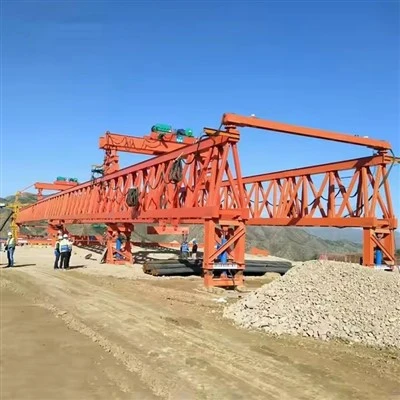


What Is a Beam Launcher?
A beam launcher (also called launching gantry, girder launcher, bridge building crane, and bridge-building machine, locally nicknamed the "Iron Monster") is a special-purpose mobile gantry crane used in bridge construction, specifically segmental bridges that use precast box girder bridge segments or precast girders in highway and high-speed rail bridge construction projects. The launching gantry is used to lift and support bridge segments or girders as they are placed while being supported by the bridge piers instead of the ground.
Features of Bridge Building Crane
Horizontal operation landing the beam in place at one time;
1
>>
Suitable for the construction of inclined(curved) bridges;
2
>>
Lightweight, convenient and quick transportation, installation, and removal;
3
>>
Safe and reliable work, small longitudinal cantilever deflection;
4
>>
The legs do not landed on the bridge deck when longitudinal moving, reducing the pressure on the beam/bridge deck.
5
Main Beam
The primary structural component of the beam launcher.
Front, Middle, And Rear Outriggers
These are used to support the beam launcher and maintain its stability during operation.
Auxiliary Brackets
These are used to support the precast concrete beams during the erection process.
Upper Beams
These are used to support the hydraulic machine and electrical systems.
Cranes
These are used to lift and position the precast concrete beams.
Traverse Rails
These are used to guide the cranes during the lifting and positioning of the precast concrete beams.
Hydraulic Machine Electrical Systems
These are used to power the hydraulic machine and electrical systems of the beam launcher.
Main Girders of Launching gantries
Launching gantries are often distinguished by the design of the main girders.
Honeycomb Girder
The honeycomb girder launching gantry was created in 1999 by ZZHZ and has proven suitable for a lifting range of 5 to 300 tonnes (5.5 to 330.7 short tons).
The main girder of a honeycomb girder is fabricated from welded plates, forming an isosceles triangle cross-section. Regular hexagonal holes are cut in the inclined web plates to reduce wind resistance. Because the honeycomb girder is formed by relatively long seam welds joining plates, the welds will not lose integrity easily due to small welding defects.
Truss Girder
The main girder of a truss girder is fabricated from welded steel poles. The welds in a truss girder are point-to-point (joining steel poles to other poles), which requires more stringent welding technology and technique. With small self-weight and large deflection, the truss girder launching gantry is suitable for highway bridge construction projects.
Box Girder
The main girder of a box girder also is fabricated from welded plates. This type of girder is usually used in high-speed railway bridge construction projects.

Bridge Crane / Overhead Crane
The core function of a bridge crane is to fix or build a bridge. It is mostly used when structuring the pillars of a bridge before putting the slabs in place. In particular, the bridge crane is very useful in the construction of larger bridges where other types of equipment may have limited use.
Excavators
An excavator is mostly used in the initial phase of bridge construction. This is because it is useful when it comes to removing dirt, rocks, or other debris that may be found at the base of the bridge. Although it may have limited use once the construction of the bridge is underway, it can still be used to transport dirt or rubble as the project continues.
Floating Crane
Also known as a crane vessel, a floating crane is a type of specialised ship that has a crane mounted onto it. While floating cranes are frequently used during bridge construction, they can also be used in loading or offloading loads from a ship. With the bigger cranes usually fitted with a lifting capacity of over 10,000 tonnes, some crane barges can transport an entire bridge in sections. In addition to this, crane vessels can be mounted onto the deck of a ship by fitting them on a swing base which can rotate.
Gantry Crane
A gantry crane is one of the many types of heavy machinery used at shipyards, scrap yards, and during bridge construction. Gantry cranes come in different designs to suit different needs, and some of the biggest gantry cranes are capable of lifting the world’s heaviest loads. Though gantry cranes have a similar design to bridge cranes, their main distinctive factor is their mode of mobility.
Hydraulic bridge Construction Equipment
Compared to other tools, hydraulic bridge construction equipment helps make hoisting and positioning bridge components easier and safer. They may also contribute significantly to important maintenance and demolition projects.
Hydraulic Torque Wrenches
Hydraulic torque wrenches and tensioners are crucial tools in bridge construction, providing precise torque for the final installation of precast spans and steel box beams. These tools are also helpful in demolition by efficiently loosening bolted connections between bridge sections.
SyncHoist
SyncHoist is a crane attachment used for accurately adjusting and aligning bridge sections during installation. It eliminates the need for using two separate cranes, making the process more efficient and safer.
Low-Height Hydraulic Cylinders
Low-height hydraulic cylinders are ideal for lifting large bridge spans and replacing bearings and other components. Despite their small size, these powerful tools can fit into small openings underneath the bridge structure.
Benefits of Using Beam Launcher
A beam launcher is a device that can lift, transport and place precast concrete beams on a bridge or viaduct. It is a fast, efficient and safe method of construction that has many advantages over conventional methods. Here are some of the benefits of using a beam launcher:
Reduced Construction Time
A beam launcher can place one beam every 15 minutes, which means it can complete a span of 120 meters in less than four hours. This reduces the overall construction time and minimizes the disruption to traffic and the environment.
Lower Cost and Maintenance
A beam launcher reduces the need for scaffolding, cranes, temporary supports and other equipment, which lowers the cost of construction. It also reduces the labor and material requirements, which saves money and resources. The precast concrete beams require less maintenance than cast-in-place concrete beams, which reduces the operational cost and environmental impact.

Improved Quality and Durability
The precast concrete beams are manufactured in a controlled environment, which ensures high quality and uniformity. The beams are also designed to withstand harsh weather conditions and heavy loads, which increases the durability and service life of the bridge or viaduct.
Enhanced Safety and Sustainability
A beam launcher eliminates the risks of working at heights, falling objects, accidents and injuries, which enhances the safety of workers and the public. It also reduces the noise, dust, waste and emissions generated by conventional methods, which improves the sustainability and social responsibility of the project.
How to cross spans for the beam launcher with no load?
As crossing spans for the beam launcher with no load, below steps shall be strictly followed to ensure a safe and normal operation and running.
After finishing commissioning of beam launcher, lifting trolleys move near to the rear bracket, stop the moving wheels with wooden wedge, at the same time connect moving wheels and main girder with steel wire rope to avoid instability of trolleys as the beam launcher moves longitudinally.
Cylinders of auxiliary middle support leg and rear bracket jack up to make the complete machine go up, the middle support leg moves forward 19m with its own hanging device, rear bracket draws back cylinder to move forward 19m, then the beam launcher falls down, lifting trolleys move near to the rear bracket, the complete machine is ready to move longitudinally to cross spans;
The complete machine moves forward 19m depending on roller institutions of front and middle support legs and rear roller, auxiliary front support leg supports on the front pier, and lifting trolleys at the same time move near to rear bracket.
Cylinders of auxiliary middle support leg and rear bracket jack up to make the complete machine go up, the middle support leg moves forward 5m with its own hanging device, rear bracket draws back cylinder to move forward 16m, then the beam launcher falls down, lifting trolleys move near to the rear bracket, the complete machine is ready to move longitudinally to cross spans;
Front support leg draws back cylinder to leave the pier and moves forward 40m with its hanging device to the proper position, then drop down moving gearbox and transverse moving rail (front support leg can set transverse moving rail), adjust them to required height, then connect front support leg and pier cap firmly.
The complete machine moves forward 21m to the proper position depending on roller institutions of front and middle support legs and rear roller, then make a preparation for installing girders;
After crossing spans, a comprehensive check must be done to ensure: Whether levelness of main longitudinal girder meets the demand; whether bolts and pin connection is firm; whether electric circuit is correct; whether electric wire is damaged and the hydraulic system works well; whether rail joints are smooth; whether jointing for launcher and trolley limited block is firm and stable; whether rail clamping device is in work; whether layout of sleepers is smooth and steady and rail gauge it correct, and other conditions.
Check for trial operation with no load of beam launcher must be done, especially check the rail layout before lateral moving of the machine; clean sundries at two sides of lateral moving rails, then make trial operation 2 times on the rail, check whether it will have rail gnawing as the beam launcher moves on the rail, solve it immediately if rail gnawing. The beam launcher can install girders after ensuring all works normally.
How to Maintain the Launching Gantry?
Correct using, regular checking, and suitable maintenance can make sure the bridge girder launcher works safely and prolongs its use life.
The Maintenance of Metal Structure
The main girder is the main force structure part of the metal structure. The maintenance can influence the function, safety, and life of the launching gantry directly. Therefore, we should pay more attention to the maintenance.
1)Start and break sharply must be avoided.
2)Checking the connection welding lines of girders, if chinks are found, stop using them and then welding again.
3)When the main girder has a little deformation or loses stability, stop using it immediately, and deal with it correctly.
4)All of the metal structures are painted two times every year. And oil stains, water, and other appendages should be cleared before painting.
The Maintenance of The Main Parts
1)open-type and close-type driving gears are painted with grease a time each month
2)The rope should lubricate regularly, the dirt is cleared before lubricating. It must be replaced if the broken cords are up to 6 pieces Girder Launcher
3)The bearings must be lubricated, lubricated regularly, and cleared cleanly before being oiled. If you find a high temperature or significant noise, check carefully, it should be replaced if it is damaged.
4)When the abrasion of wheels exceeds 15% of the thickness of the original state or breaks, it should be replaced.
5)The reducer can’t lack in oil, change regularly, and it should be overhauled when you find noise and unusual phenomena.
6)The brake of the lifting mechanism should be examined once a day and the brake of the running mechanism should be examined a time two or three days.
7)Drive bearings of the cart and trolley‘s walking boxes should fill the calcium-based grease a time every two years
The Maintenance of Electrical Equipment
In order to make sure launching gantry works safely, we must know the reasons for accidents and solutions.
1)Keeping the cleanliness of electrical equipment, such as a resistor, control panel, contactor, etc. Cleaning dust and dust from the interior to the outer to avoid electric leakage, dielectric puncture short circuits, etc.
2) Observe regularly whether the rotor sliding line of the motor and electric brush connect well or not.
3) Checking the sounds of the motor, electromagnet, electric relay, and magnetic switch.
Our Factory


Frequently Asked Questions About Beam Launcher
Q: What is a launching girder?
Q: What are the parts of a girder launcher?
Q: What is a beam launcher?
Q: What type of beam is used for girders?
Q: How does a launching gantry work?
Q: What is the history of beam launchers?
Q: How is a girder different from a beam?
Q: How does a beam bridge carry the load?
Q: What is the main use of bridge girder launcher?
Q: What is a full span launching gantry?