







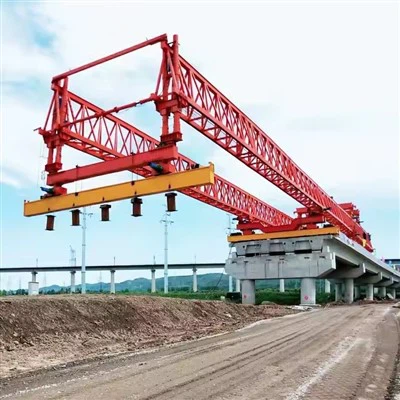
190 Ton Bridge Erection Machine
The 190-ton bridge erection machine is a heavy-duty piece of equipment used in the construction and installation of bridges, particularly for lifting and placing large bridge girders, segments, or precast concrete beams. These machines are essential in modern bridge construction, ensuring precision and safety when handling massive components.

Key Features
Key Features of a 190-Ton Bridge Erection Machine:
Lifting Capacity – Designed to handle loads up to 190 metric tons, making it suitable for large bridge girders and segments.
Span Reach – Adjustable booms or gantries to cover different bridge spans.
Mobility – Often mounted on rails or self-propelled modular transporters (SPMTs) for movement along the construction site.
Precision Control – Hydraulic or electric systems for smooth and accurate girder placement.
Safety Systems – Load monitoring, anti-sway mechanisms, and emergency brakes to ensure safe operations.
Modular Design – Some models can be disassembled and transported to different construction sites.
Specification
General Specifications
Type:
Self-launching girder erection machine (beam launcher) or segmental bridge gantry crane.
Lifting Capacity:
Maximum lifting capacity: 190 metric tons (may vary based on configuration).
Span Range:
Suitable for spans: 30m to 60m (adjustable based on project needs).
Working Width:
Adjustable to accommodate different bridge deck widths (e.g., 10m to 20m).
Travel Mechanism:
Self-propelled with hydraulic or electric drive system.
Travel speed: 3–10 m/min (adjustable).
Can move forward/backward and laterally (if required).
Structural Material:
High-strength steel (Q345B or equivalent) for durability.
Control System:
PLC-based automated control with manual override.
Remote operation capability (optional).
Safety sensors for overload, tilt, and alignment.
Power Supply:
Electric motor (380V/50Hz or as per project) or diesel-powered hydraulic system.
Support System:
Adjustable legs with hydraulic jacks for stability.
Foundation requirements: Precast pads or temporary supports.
Environmental Conditions:
Operating temperature: -20°C to +50°C.
Wind resistance: ≤ Level 6 (13.8 m/s) during operation; ≤ Level 12 when parked.

Pictures & Components
The 190-ton bridge erection machine is a heavy-duty equipment used for lifting and placing bridge segments, girders, or other structural components during bridge construction. Below are the key components of such a machine:
1. Main Structural Components
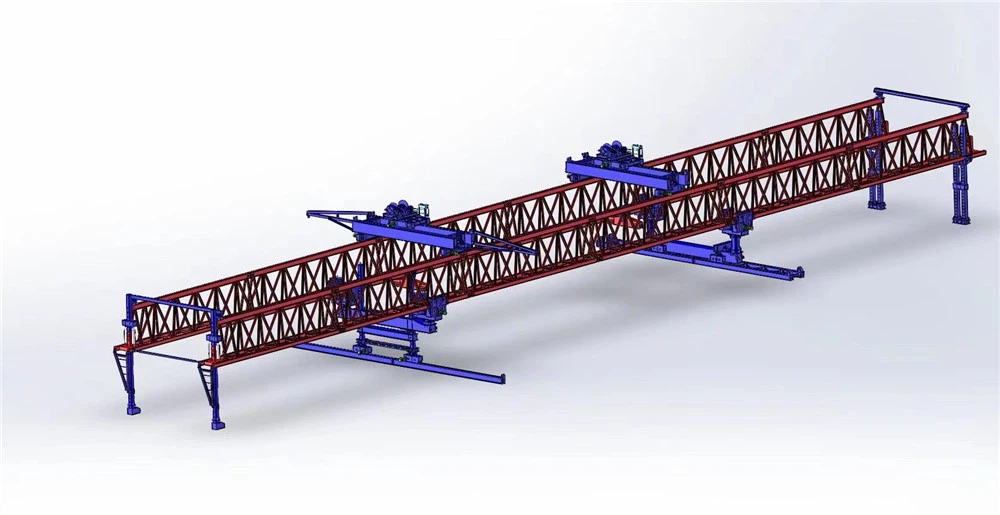
Main Girder/Beam – The primary load-bearing structure that spans the construction gap.
Support Legs/Outriggers – Provide stability and distribute the load to the ground or existing bridge sections.
Lifting Frame/Gantry – The framework that holds the hoisting mechanism.
Cross Beams – Connect the main girders for additional stability.
2. Hoisting & Movement System
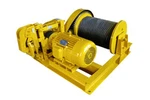
Winch System – Electric or hydraulic winches for lifting heavy loads (190-ton capacity).
Wire Ropes & Pulleys – High-strength cables for lifting operations.
Hydraulic Jacks – Used for precise positioning of bridge segments.
Trolley & Travel Mechanism – Allows horizontal movement along the main girder.
Crawler/Wheeled Undercarriage – Enables the machine to move along the construction site.
3. Power & Control System
Hydraulic Power Unit (HPU) – Provides hydraulic pressure for lifting and movement.
Electric Control Panel – Manages the operation of motors, winches, and hydraulics.
Remote Control System – Allows operators to control the machine from a safe distance.
4. Safety & Auxiliary Components
Braking System – Ensures controlled lowering and stopping of loads.
Load Sensors & Limit Switches – Prevent overloading and ensure safe operation.
Counterweights – Balance the machine during lifting operations.
Anchoring System – Secures the machine to the ground or bridge deck.
Emergency Stop System – For immediate shutdown in case of failure.
5. Optional Features
Self-Propelled Mechanism – Some models can move autonomously.
Adjustable Span – Allows adaptation for different bridge widths.
Modular Design – For easy assembly and disassembly.

Sketch

Advantages
The 190-ton bridge erection machine is a heavy-duty piece of equipment designed for constructing large bridges, viaducts, and other infrastructure projects. Here are some of its key advantages:
1. High Load Capacity
Can handle 190-ton precast segments or girders, making it suitable for large-span bridge construction.
Reduces the need for multiple lifts, improving efficiency.
2. Enhanced Stability & Safety
Equipped with advanced hydraulic systems and computer-controlled balancing to ensure stability during lifting.
Features anti-sway mechanisms and overload protection to prevent accidents.
3. High Precision & Control
Uses automated alignment systems for accurate girder placement.
Remote-controlled operations minimize human error.
4. Adaptability to Various Bridge Types
Suitable for segmental bridges, box girders, T-beams, and steel trusses.
Adjustable supports and booms allow work on different bridge widths and heights.
5. Time & Cost Efficiency
Speeds up construction by reducing manual labor and crane dependency.
Lowers project costs by minimizing equipment rentals and labor expenses.
6. Mobility & Ease of Assembly
Modular design allows quick assembly and disassembly.
Can be transported via road or rail to different construction sites.
7. Reduced Environmental Impact
Minimizes ground disturbance compared to traditional cranes.
Lower noise and vibration levels, making it suitable for urban areas.
8. Long-Term Durability
Built with high-strength steel and corrosion-resistant materials.
Requires low maintenance, ensuring long service life.
9. Versatility in Terrain
Can operate on uneven or challenging terrain with adjustable outriggers.
Suitable for river crossings, highways, and mountainous regions.
10. Compliance with Safety Standards
Meets international safety and engineering standards (ISO, OSHA, etc.).
Includes emergency braking and fail-safe mechanisms.

Application
he 190-ton bridge erection machine is a heavy-duty piece of equipment used in the construction and installation of bridges, particularly for lifting and placing large bridge girders, segments, or precast concrete elements. Below are key aspects of its application:
1. Primary Applications
Precast Girder Installation: Used to lift and position heavy precast concrete or steel girders (I-beams, box girders, etc.) during bridge construction.
Segmental Bridge Construction: Assists in placing precast segments for balanced cantilever or span-by-span construction methods.
Railway & Highway Bridges: Suitable for both rail and road bridge projects requiring heavy load handling.
Launching Girders: Can be part of a launching gantry system for incremental bridge deck placement.

Production Procedure
The production procedure for a 190-ton bridge erection machine involves several critical stages, from design and material procurement to assembly, testing, and commissioning. Below is a structured outline of the typical production process:
1. Design & Engineering
Requirement Analysis: Determine load capacity (190 tons), span length, mobility, and operational conditions.
Structural Design:
CAD modeling (e.g., SolidWorks, AutoCAD) for beams, booms, hydraulic systems, and stabilizers.
Finite Element Analysis (FEA) to validate stress distribution and safety factors.
Mechanical & Hydraulic Systems: Design winches, pulleys, hydraulic cylinders, and control systems.
Electrical Systems: PLC-based control for precision movements, sensors, and safety interlocks.
2. Material Procurement
High-Strength Steel: ASTM A572/A514 for main girders and booms.
Hydraulic Components: Pumps, valves, cylinders (brands like Bosch Rexroth or Parker).
Electrical Components: Motors, PLCs (Siemens/ABB), cables, and sensors.
Fasteners & Welding Consumables: High-tensile bolts, electrodes (e.g., E7018).
3. Fabrication & Machining
Cutting & Shaping:
Plasma/oxy-fuel cutting of steel plates.
CNC machining for precision parts (e.g., pivot joints).
Welding:
Submerged arc welding (SAW) for long seams.
Manual welding (SMAW/GMAW) for complex joints.
Non-destructive testing (NDT): Ultrasonic/X-ray inspection.
Surface Treatment: Sandblasting, primer, and anti-corrosion paint (e.g., epoxy coatings).
4. Assembly
Structural Assembly:
Erect main girders and outriggers using cranes.
Bolt/weld cross-beams and support frames.
Mechanical Integration:
Install winches, wire ropes, and counterweights.
Mount hydraulic cylinders and hoses.
Electrical Installation:
Wire control panels, sensors, and power distribution.
Test circuit integrity and emergency stops.
5. Testing & Quality Control
Load Testing:
Static test: 125% of rated load (237.5 tons) to check deformation.
Dynamic test: Simulate lifting/movement with 110% load (209 tons).
Functional Checks:
Verify hydraulic pressure, boom extension, and stability.
Test PLC controls and fail-safes (e.g., overload alarms).
Certification: Compliance with standards like ISO 4301, EN 13000, or OSHA.
6. Commissioning & Delivery
On-Site Assembly: Reassemble components at the construction site.
Operator Training: Safety protocols, maintenance, and troubleshooting.
Final Handover: Documentation (manuals, test reports, warranties).


Workshop View
The company has installed an intelligent equipment management platform, and has installed 310 sets (sets) of handling and welding robots. After the completion of the plan, there will be more than 500 sets (sets), and the equipment networking rate will reach 95%. 32 welding lines have been put into use, 50 are planned to be installed, and the automation rate of the entire product line has reached 85%.


Hot Tags: 190 ton bridge erection machine, China 190 ton bridge erection machine manufacturers, suppliers, factory
You Might Also Like


Send Inquiry