








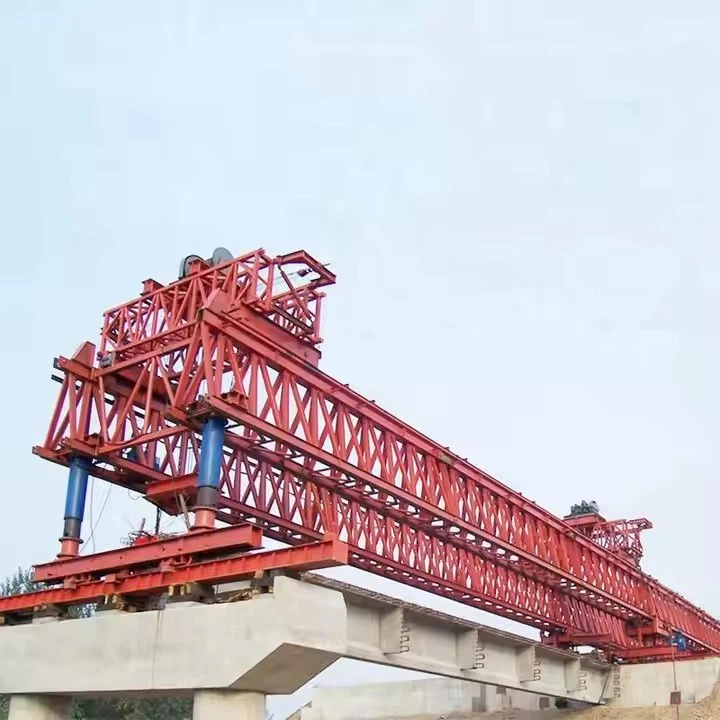

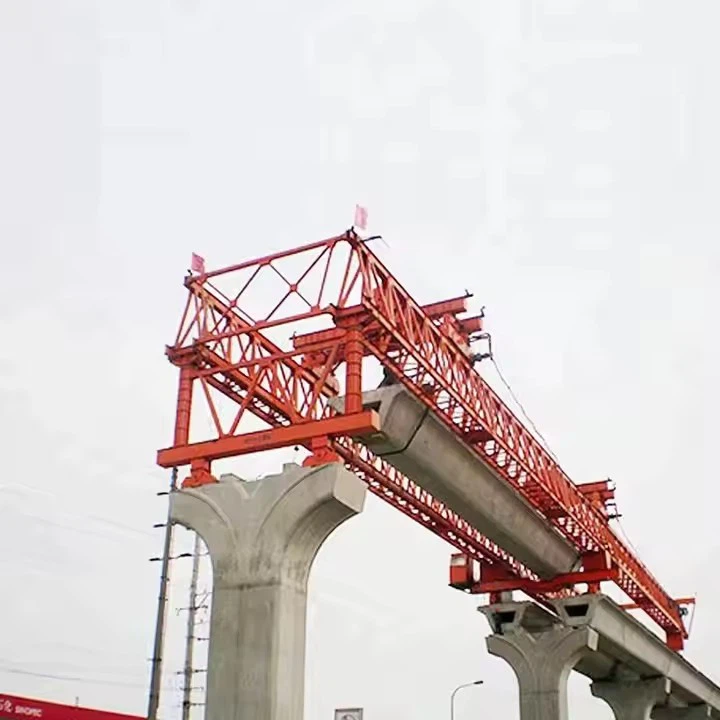


110 Ton Bridge Launcher Erection Machine
A 110-ton Bridge Launcher Erection Machine is a heavy-duty piece of equipment used in the construction of bridges, particularly for launching precast or assembled bridge segments into place. These machines are essential for large-scale infrastructure projects, enabling the precise placement of heavy bridge components.

Key Features
Key Features of a 110-Ton Bridge Launcher Erection Machine:
High Load Capacity – Can handle bridge segments weighing up to 110 tons.
Adjustable Span & Reach – Designed to accommodate different bridge widths and heights.
Precision Control – Hydraulic or electromechanical systems ensure accurate positioning.
Modular Design – Can be assembled on-site and adapted for various bridge configurations.
Safety Mechanisms – Includes load sensors, stabilizers, and emergency brakes.
Mobility – Some models are self-propelled or mounted on rails for movement along the bridge alignment.
Specification
Here are the typical specifications for a 110-ton Bridge Launcher Erection Machine used in bridge construction. Actual specifications may vary based on the manufacturer and project requirements.
General Specifications
Maximum Launching Capacity: 110 metric tons
Type: Modular, self-launching or track-mounted
Application: Precast segmental bridges, box girders, steel trusses, etc.
Structural & Mechanical Specifications
Main Girder Length: Adjustable (typically 50m–100m)
Launching Nose Length: 15m–30m (for reducing cantilever moments)
Lifting System: Hydraulic jacks or winches
Load Capacity per Segment: Up to 110 tons
Travel Mechanism: Self-propelled (wheel/track-based) or sliding system
Propulsion System: Hydraulic rams or motorized wheels

Pictures & Components
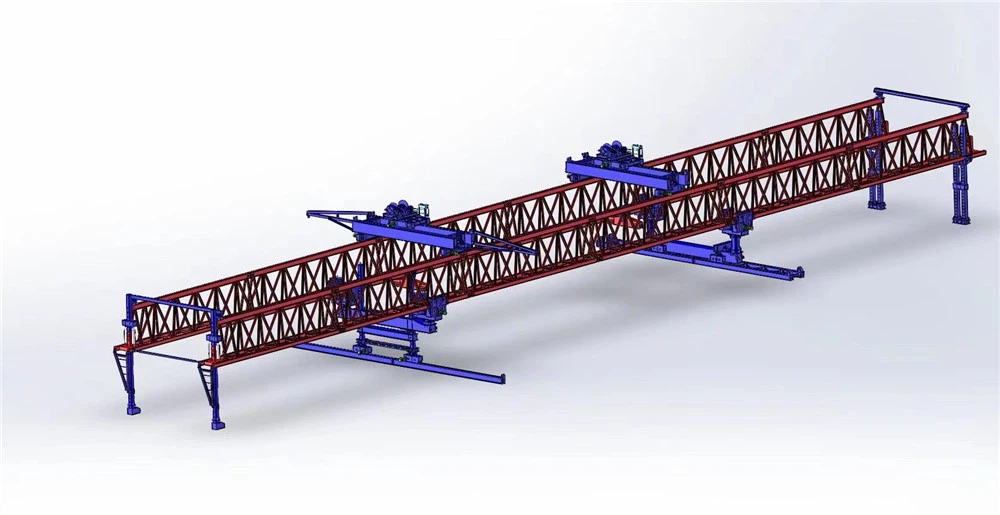
A 110-ton Bridge Launcher Erection Machine is a heavy-duty piece of equipment used in bridge construction to transport, position, and install precast bridge segments or girders. Below are the key components of such a machine:
1. Main Structural Components
Launching Nose/Gantry Boom – Extends forward to support the bridge segments during launching.
Main Girder/Beam – The primary load-bearing structure that spans the construction gap.
Support Legs/Temporary Piers – Provide stability during launching and segment placement.
Hydraulic Lift System – Adjusts the height and alignment of the launcher.
2. Movement & Positioning System
Crawler/Track System – Allows the machine to move along the bridge deck or ground.
Hydraulic Jacks – Used for precise positioning of segments.
Winch & Cable System – Assists in pulling or adjusting segments.
Rail/Trolley System – Some models use rails for longitudinal movement.
3. Lifting & Handling Mechanism
Hoist System (Crane or Winch) – Lifts and places bridge segments (typically 110-ton capacity).
Spreaders/Lifting Beams – Distributes load evenly when lifting heavy segments.
Clamps/Grippers – Secures precast segments during transport and installation.
4. Hydraulic & Power Systems
Hydraulic Pumps & Cylinders – Power the lifting, launching, and adjustment mechanisms.
Control Cabin – Houses operator controls for precise movements.
Power Unit (Diesel/Electric) – Provides energy for hydraulic and electrical systems.
5. Safety & Stabilization Components
Outriggers/Stabilizers – Prevent tipping during operations.
Anti-Slip Brakes – Lock the machine in place during lifting.
Load Sensors & Limit Switches – Ensure safe weight distribution and prevent overloads.
6. Auxiliary Systems
Alignment & Surveying Tools – Lasers or GPS for precise segment placement.
Weather Protection – Covers or shields for operation in harsh conditions.
Emergency Stop & Backup Systems – Fail-safes for power loss or malfunctions.

Sketch

Advantages
The 110-ton Bridge Launcher Erection Machine is a specialized piece of equipment used in the construction of bridges, particularly for launching girders, segments, or entire bridge spans. Here are some of its key advantages:
1. High Load Capacity (110 Tons)
Can handle heavy bridge components, reducing the need for multiple lifts or additional machinery.
Suitable for large-span bridges and heavy precast segments.
2. Efficient Bridge Construction
Speeds up the bridge erection process by launching girders or decks in a controlled manner.
Reduces manual labor and construction time compared to traditional methods.
3. Precision and Control
Equipped with hydraulic systems and computerized controls for accurate positioning of bridge segments.
Minimizes errors during placement, ensuring structural integrity.
4. Adaptability to Different Bridge Types
Works with various bridge designs, including beam bridges, box girders, and segmental bridges.
Adjustable supports and launching mechanisms allow customization for different project requirements.
5. Enhanced Safety
Reduces risks associated with manual lifting and assembly.
Stable and secure operation minimizes accidents on-site.
6. Reduced Need for Temporary Supports
Can launch bridge segments without extensive temporary scaffolding or falsework.
Lowers construction costs and simplifies logistics.
7. Mobility and Ease of Assembly
Modular design allows for quick assembly and disassembly.
Can be transported to different construction sites as needed.
8. Cost-Effective for Large Projects
While the initial investment may be high, it reduces long-term costs by improving efficiency and reducing labor requirements.
Ideal for repetitive bridge construction (e.g., highways, railways).
9. Environmentally Friendly Construction
Minimizes ground disturbance compared to traditional methods.
Reduces the need for heavy cranes and excessive material handling.
10. Automation and Remote Operation
Some models feature remote-controlled operation, improving precision and operator safety.
Reduces human error in critical lifting operations.

Application
The 110-ton Bridge Launcher Erection Machine is a heavy-duty piece of equipment used in the construction of bridges, particularly for launching precast segments, girders, or entire bridge spans. Below are its key applications and features:
Applications:
Precast Segment Erection – Used to lift and position precast concrete segments in balanced cantilever or span-by-span bridge construction.
Girder Launching – Installs precast or steel girders for highway, railway, or urban overpass bridges.
Full-Span Launching – Capable of placing complete bridge spans in one operation, reducing construction time.
Modular Bridge Construction – Ideal for accelerated bridge construction (ABC) projects where speed and precision are critical.
Overhead & Underslung Launching – Can operate in different configurations depending on bridge design (e.g., launching from above or below the deck).

Production Procedure
The production of a 110-ton Bridge Launcher Erection Machine involves a complex, multi-stage process requiring precision engineering, heavy fabrication, and rigorous quality control. Below is a structured production procedure:
1. Design & Engineering Phase
Conceptual Design: Define load capacity (110 tons), span length, mobility requirements, and operational conditions.
Detailed Engineering:
Structural analysis (FEA for stress, deflection, stability).
Hydraulic/pneumatic system design for launching mechanisms.
Electrical/control systems for automation.
Regulatory Compliance: Ensure adherence to standards (ISO, EN, AISC, OSHA, etc.).
Prototyping (if needed): Validate critical components via scaled models.
2. Material Procurement
Structural Steel: High-grade (e.g., ASTM A572) for booms, girders, and supports.
Hydraulic Components: Pumps, cylinders, valves (rated for 110+ tons).
Mechanical Parts: Winches, gears, bearings, tracks/wheels.
Electrical Systems: PLCs, sensors, motors, cables.
3. Fabrication & Machining
A. Structural Fabrication
Cutting: Plasma/laser cutting of steel plates/beams.
Welding: Submerged arc welding (SAW) for heavy sections; inspect via NDT (UT, RT).
Machining: CNC milling/drilling for high-tolerance connections.
B. Mechanical Assembly
Launching Mechanism:
Assembly of telescopic booms or launching noses.
Installation of rollers/tracks for bridge deck movement.
Hydraulic System:
Mounting cylinders, hoses, and power units.
Pressure testing (1.5× operating pressure).
C. Electrical/Control Systems
Wiring: Install sensors (load, position), PLCs, and HMI panels.
Integration: Link hydraulics/mechanics with control software.
4. Quality Control (QC)
Dimensional Checks: Laser alignment for structural components.
Load Testing: Static/dynamic tests up to 132 tons (120% of capacity).
Functional Tests: Simulate bridge launching cycles; verify safety interlocks.
5. Painting & Corrosion Protection
Surface Prep: Sandblasting (SA 2.5 standard).
Coating: Epoxy primer + polyurethane topcoat (or galvanizing for critical parts).
6. Final Assembly & Commissioning
On-Site Assembly (if modular): Erect main girders, install hydraulics/controls.
Field Testing:
Dry runs (no load).
Live load tests with calibrated weights.
Operator Training: Safety protocols, emergency procedures.
7. Delivery & Installation
Transport: Disassemble if oversized; use heavy haulage.
Installation: Crane-assisted setup at deployment site.
Handover: Documentation (manuals, certifications).
8. Maintenance & Support
Manual: Provide schedules for lubrication, bolt tightening, etc.
Remote Monitoring: IoT-enabled systems for predictive maintenance (optional).


Workshop View
The company has installed an intelligent equipment management platform, and has installed 310 sets (sets) of handling and welding robots. After the completion of the plan, there will be more than 500 sets (sets), and the equipment networking rate will reach 95%. 32 welding lines have been put into use, 50 are planned to be installed, and the automation rate of the entire product line has reached 85%.


Hot Tags: 110 ton bridge launcher erection machine, China 110 ton bridge launcher erection machine manufacturers, suppliers, factory
You Might Also Like


Send Inquiry