










Bridge Erecting Machine For Bridge Construction
Types of Bridge Erecting Machines
Gantry Bridge Erecting Machine
Used for launching precast concrete girders or steel beams.
Moves on rails or temporary supports along the bridge alignment.
Suitable for span-by-span construction.
Launching Gantry (Box Girder Erector)
Designed for segmental bridge construction.
Lifts and places precast box girder segments.
Often used in balanced cantilever construction.
Self-Propelled Modular Transporter (SPMT)
Wheel-based system for transporting heavy bridge components.
Used for moving large girders or full-span bridge decks.
Crane-Based Erectors
Heavy-duty cranes (like crawler cranes) used for lifting large bridge elements.
Common in steel truss or arch bridge construction.
Incremental Launching Machine
Pushes bridge segments incrementally from one end to the other.
Used for long continuous bridges (e.g., box girder bridges).
Key Features
Key Features of Bridge Erecting Machines
High Load Capacity – Can handle heavy precast segments (up to hundreds of tons).
Adjustability – Can adapt to different bridge widths and curves.
Precision Placement – Ensures accurate alignment of segments.
Safety Mechanisms – Includes anti-slip, overload protection, and stability controls.
Mobility – Some machines are self-propelled, while others require rail or temporary supports.
Specification
A Bridge Erecting Machine (BEM) is a specialized piece of equipment used in the construction of bridges, particularly for placing precast segments, girders, or box girders. Below are the typical specifications for a bridge erecting machine:
1. General Specifications
Type:
Gantry-type / Launching girder / Self-launching machine
Segment lifter / Girder launcher / Balanced cantilever machine
Application:
Precast segmental bridges
Box girder erection
Span-by-span or balanced cantilever construction
2. Load Capacity
Maximum Lifting Capacity: 100–1000 tons (depending on design)
Span Length Handling: 30–70 meters (adjustable based on project)
Working Load Limit (WLL): 1.25–1.5 times the maximum load (safety factor)
3. Structural Dimensions
Machine Length: 50–120 meters (adjustable for different spans)
Width: 6–12 meters (to accommodate bridge deck width)
Height: 8–20 meters (depending on clearance requirements)
Self-weight: 150–600 tons
4. Movement & Mobility
Travel Mechanism:
Crawler tracks / Rail-mounted / Wheel-based
Hydraulic propulsion system
Travel Speed: 5–15 m/min (adjustable)
Steering: Hydraulic slew system (if required)
Longitudinal Adjustment: Hydraulic jacks for precise positioning
5. Power System
Power Source: Diesel generator / Electric motor (400V, 50/60Hz)
Hydraulic System:
Pressure: 250–350 bar
Pump capacity: 50–200 L/min
Control System: PLC-based with remote operation
6. Safety Features
Overload Protection: Load cells & limit switches
Anti-sway System: For precise segment placement
Emergency Brakes: Hydraulic & mechanical failsafe
Wind Resistance: Up to 20 m/s (operational), 36 m/s (survival)
7. Environmental Conditions
Operating Temperature: -20°C to +50°C
Humidity: Up to 95% (non-condensing)
Wind Speed Limit: ≤ 12 m/s (for safe operation)

Pictures & Components
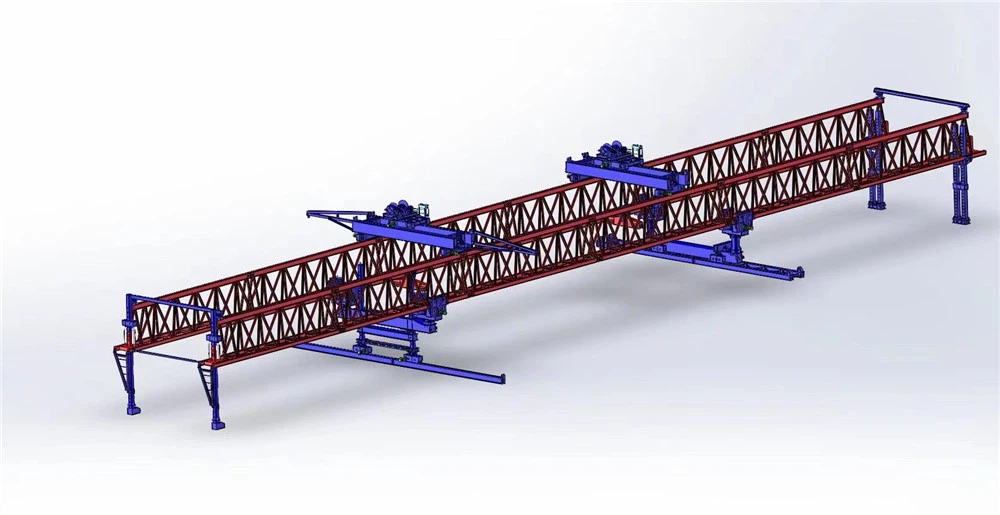
A bridge erecting machine (BEM) is a specialized piece of equipment used in the construction of bridges, particularly for placing precast segments or girders efficiently. Below are the key components of a typical bridge erecting machine:
1. Main Gantry / Frame
The primary structural framework that supports the entire machine.
Made of high-strength steel to withstand heavy loads.
May include adjustable legs or supports for stability.

2. Launching Nose / Front Support
Extends forward to provide temporary support during girder placement.
Helps balance the machine when moving forward.
3. Lifting System (Hoist / Winch)
Comprises hydraulic or electric winches, cables, and pulleys.
Used to lift and position precast concrete segments or steel girders.
4. Traveling Mechanism
Wheels, tracks, or sliding pads that allow the machine to move along the bridge deck or temporary rails.
May be self-propelled or use external propulsion.
5. Hydraulic System
Powers movements such as lifting, adjusting, and stabilizing.
Includes cylinders, pumps, and control valves.
6. Support Legs / Temporary Piers
Provide stability during construction.
Can be adjusted for height to accommodate different bridge elevations.
7. Control Cabin & Operator Console
Houses the control systems for precise operation.
Includes joysticks, monitors, and safety controls.
8. Segment Handling System (for Precast Segments)
Grippers or clamps to hold precast segments in place.
Alignment tools for accurate positioning.
9. Auxiliary Equipment
Safety railings, lighting, and emergency stop systems.
Sensors for load monitoring and alignment.
Sketch

Advantages
A bridge erecting machine (BEM) is a specialized piece of equipment used in bridge construction to efficiently assemble and install bridge segments, girders, or spans. These machines offer several advantages over traditional construction methods, making them essential for large-scale infrastructure projects. Here are the key advantages:
1. High Efficiency & Speed
Faster Construction: BEMs can quickly lift, transport, and position heavy bridge segments, reducing project timelines.
Continuous Workflow: They allow for sequential placement of segments, minimizing delays between construction phases.
2. Enhanced Safety
Reduced Worker Risk: Workers operate from secure platforms, minimizing exposure to heights and hazardous conditions.
Stability & Precision: The machine's controlled movements reduce accidents related to manual handling of heavy components.
3. Cost-Effectiveness
Lower Labor Costs: Requires fewer workers compared to traditional methods.
Reduced Temporary Supports: Eliminates the need for extensive scaffolding or falsework, saving material and setup costs.
4. High Precision & Quality Control
Accurate Alignment: Ensures precise placement of bridge segments, improving structural integrity.
Consistent Construction: Automated or semi-automated operations reduce human error.
5. Versatility
Adaptable to Different Bridge Types: Suitable for girder bridges, segmental bridges, box girders, and even arch bridges.
Works in Challenging Environments: Can be used over rivers, valleys, highways, and urban areas with minimal disruption.
6. Minimized Disruption to Traffic & Environment
Limited Road/Rail Closures: Since assembly happens above existing infrastructure, traffic interruptions are reduced.
Eco-Friendly: Less disturbance to the ground below, reducing environmental impact.
7. Heavy Load Capacity
Handles Massive Components: Capable of lifting and positioning precast segments weighing hundreds of tons.
Supports Long Spans: Enables the construction of bridges with large spans without intermediate supports.
8. Reduced Dependency on Cranes
Self-Launching Capability: Many BEMs can move forward independently, eliminating the need for multiple cranes.
Better Maneuverability: Designed to navigate tight spaces where traditional cranes may not fit.
9. Improved Project Scheduling
Predictable Timelines: Mechanized processes allow for better planning and fewer delays.
All-Weather Performance: Some BEMs can operate in various weather conditions, unlike crane-dependent methods.
10. Long-Term Economic Benefits
Extended Service Life: Properly constructed bridges using BEMs tend to have better durability.
Lower Maintenance Costs: Precision assembly reduces future structural issues.

Application
A bridge erecting machine (BEM) is a specialized piece of equipment used in bridge construction to efficiently and safely install precast concrete segments, girders, or full-span bridge sections. These machines are essential for constructing viaducts, highway overpasses, railway bridges, and other elevated structures, especially in challenging terrains or urban environments where traditional construction methods are impractical.
Key Applications of Bridge Erecting Machines
Precast Girder Installation
Used to lift and place precast concrete or steel girders onto piers or abutments.
Common in beam bridges, where individual girders are placed side by side.
Segmental Bridge Construction
For balanced cantilever construction, where segments are installed symmetrically from both sides of a pier.
Used in cable-stayed or box-girder bridges.
Full-Span Launching
Some BEMs can lift and install entire preassembled bridge spans in one operation, reducing construction time.
Ideal for high-speed rail and highway projects.
Launching Gantry Systems
Used in incremental launching methods, where bridge decks are constructed in sections and pushed forward over piers.
Urban and Restricted-Area Construction
Minimizes disruption in cities by reducing the need for heavy cranes and large work areas.
Used in flyovers, metro systems, and elevated highways.
Mountainous or River Crossings
Enables bridge construction over deep valleys, rivers, or difficult terrain without extensive scaffolding.

Production Procedure
1. Design and Engineering Phase
Structural analysis: Calculate load capacities and stress points
Mechanical design: Create detailed CAD models of all components
Hydraulic system design: Plan for lifting and movement mechanisms
Electrical system design: Develop control systems and safety features
Prototype testing: Validate design through scaled models or simulations
2. Material Procurement
High-strength steel for main structural components
Specialized alloys for moving parts
Hydraulic cylinders and pumps
Electrical components and control systems
Wear-resistant materials for contact surfaces
3. Fabrication Process
Main Structure Fabrication
Cutting and shaping of steel plates/beams using CNC machines
Welding of primary support structures
Machining of connection points and joints
Surface treatment (sandblasting, painting for corrosion protection)
Mechanical Components Production
Manufacturing of gears, bearings, and transmission systems
Assembly of telescopic sections (if applicable)
Fabrication of walking or launching mechanisms
Hydraulic System Assembly
Installation of hydraulic cylinders
Routing of hydraulic lines
Integration of pressure control systems
Testing for leaks and pressure integrity
4. Electrical System Integration
Installation of control panels
Wiring of sensors and limit switches
Programming of PLC (Programmable Logic Controller)
Integration of safety systems (emergency stops, overload protection)
5. Quality Control and Testing
Non-destructive testing of welds (X-ray, ultrasonic)
Load testing of structural components
Functional testing of all mechanical systems
Safety system verification
Operational testing under simulated conditions
6. Final Assembly
Integration of all subsystems
Alignment and calibration of moving parts
Final paint and protective coatings
Installation of safety features and warning systems
7. Factory Acceptance Testing
Full operational testing at manufacturer's facility
Verification against design specifications
Documentation of all test results
Client inspection and approval
8. Disassembly for Transport
Strategic breakdown into transportable modules
Protection of sensitive components
Preparation of detailed reassembly instructions
9. On-Site Assembly (at bridge construction location)
Foundation preparation (if required)
Step-by-step reassembly following manufacturer's procedures
Final calibration and testing on-site
Operator training and handover to construction team
10. Maintenance and Support
Development of maintenance schedules
Provision of spare parts
Technical support during operation
Periodic inspections throughout machine's service life
This production procedure ensures the bridge erecting machine meets all safety, performance, and durability requirements for complex bridge construction projects.


Workshop View
The company has installed an intelligent equipment management platform, and has installed 310 sets (sets) of handling and welding robots. After the completion of the plan, there will be more than 500 sets (sets), and the equipment networking rate will reach 95%. 32 welding lines have been put into use, 50 are planned to be installed, and the automation rate of the entire product line has reached 85%.


Hot Tags: bridge erecting machine for bridge construction, China bridge erecting machine for bridge construction manufacturers, suppliers, factory
You Might Also Like


Send Inquiry