










450 Ton Bridge Launcher Equipment
A 450 ton bridge launcher is a heavy-duty piece of equipment used in the construction of bridges, particularly for launching precast or assembled bridge segments into place. These machines are essential for large-scale infrastructure projects, such as highway overpasses, railway bridges, and viaducts.

Key Features
A 450-ton Bridge Launcher Equipment is a heavy-duty machine designed for the efficient installation of large bridge segments, typically used in infrastructure projects like highways, railways, and urban overpasses. Below are the key features of such equipment:
1. High Load Capacity
Can handle bridge segments weighing up to 450 tons, making it suitable for large-span bridge construction.
Adjustable for different load distributions to ensure stability during launching.
2. Modular & Adjustable Design
Modular components allow customization for various bridge types (e.g., box girders, T-beams, segmental bridges).
Adjustable supports and launching noses to accommodate different bridge geometries.
3. Advanced Hydraulic System
High-precision hydraulic jacks for smooth and controlled launching.
Synchronized lifting and pushing mechanisms to ensure even weight distribution.
4. Self-Propelled or Winch-Driven Movement
Some models use self-propelled mechanisms (crawlers or wheels), while others rely on winch-and-cable systems for forward movement.
Can operate on temporary tracks or existing bridge decks.
5. Computerized Control System
Automated monitoring of load distribution, alignment, and stress levels.
Real-time feedback to prevent overloading or misalignment.
6. Safety Mechanisms
Fail-safe braking systems to prevent accidental slippage.
Emergency stop functions and overload protection.
7. Versatility in Launching Methods
Can perform incremental launching (push-launching) or full-span launching depending on project requirements.
Suitable for straight, curved, or inclined bridge alignments.
8. Compact & Transportable
Designed for easy disassembly and transport between construction sites.
Some models feature quick-assembly mechanisms to reduce setup time.
9. Environmental Adaptability
Can operate in various terrains, including soft soil, steep slopes, or over water.
Weather-resistant materials for durability in harsh conditions.
10. Cost & Time Efficiency
Reduces the need for heavy cranes, lowering project costs.
Accelerates construction timelines by enabling continuous launching operations.
Specification
450-Ton Bridge Launcher Equipment – Technical Specifications
General Description
Purpose: Designed for launching precast concrete/steel bridge segments, girders, or full-span box girders up to 450 tons.
Type: Self-launching, modular, or gantry-based system.
Application: Suitable for highway, railway, and long-span bridge construction.
Main Technical Parameters
Maximum Launching Capacity: 450 tons (per segment/girder)
Span Range: Adjustable (typically 20m – 60m, depending on configuration)
Launching Speed: 3–10 m/min (hydraulic/electric drive)
Working Width: Adjustable to match bridge deck width (e.g., 10m – 20m)
Lifting Height: Adjustable (e.g., 5m – 30m above ground)
Power Supply: Diesel generator or external electric power (e.g., 380V, 50Hz, 100kW+)
Hydraulic & Electrical Systems
Hydraulic Pressure: 25–35 MPa
Pump Capacity: 50–100 L/min
Control System: Remote-operated with safety interlocks.
Sensors: Load monitoring, tilt sensors, and alignment feedback.
Safety Features
Overload protection (auto-shutoff at ≥110% capacity).
Emergency braking system.
Anti-slip locking mechanism.
Wind resistance: Stable up to Beaufort Scale 6 (12.5 m/s).
Mobility & Installation
Transportation: Modular design for easy disassembly (containerized).
Assembly Time: 7–14 days (depending on site conditions).
Track/Rail System: Optional for longitudinal movement.
Environmental & Operational Conditions
Operating Temperature: -20°C to +50°C.
Humidity: Up to 90% non-condensing.
Ground Bearing Pressure: ≤150 kPa (requires prepared foundation).
Compliance & Standards
Design Codes: EN 1993, AASHTO, BS, or project-specific standards.
Safety Standards: OSHA/CE certified.
Quality Control: NDT (UT/MT) for critical welds.

Pictures & Components
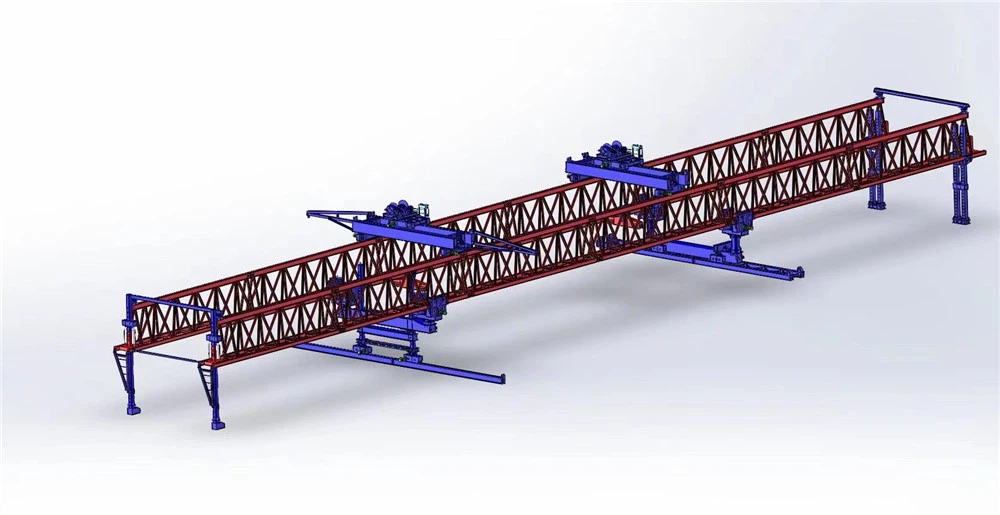
A 450-ton bridge launcher is a heavy-duty piece of equipment used in construction, particularly for launching girders or segments in bridge construction projects. Below are the key components typically found in such a system:
1. Main Launching Girder (Launching Nose)
The primary structural beam that supports and positions bridge segments.
Often modular for easy transport and assembly.
2. Hydraulic Launching System
Hydraulic jacks/pushers – Provide the thrust to move the launcher forward.
Hydraulic cylinders – Used for lifting and adjusting segments.
Pump station – Powers the hydraulic system.
3. Support & Bearing System
Temporary supports/piers – Hold the launcher during operations.
Sliding bearings – Allow smooth longitudinal movement.
Adjustable legs – For height and alignment corrections.
4. Lifting & Handling Equipment
Winches & hoists – For lifting precast segments.
Crane attachments – Auxiliary lifting mechanisms.
5. Guiding & Alignment System
Lateral guides – Ensure proper positioning.
Laser/optical alignment tools – For precision placement.
6. Control System
PLC (Programmable Logic Controller) – Automates movements.
Remote control – Allows operator adjustments from a safe distance.
Sensors & feedback systems – Monitor load, alignment, and stability.
7. Structural Framework
Trusses & girders – Provide rigidity and load distribution.
Connection pins & bolts – Secure modular sections.
8. Auxiliary Components
Outriggers/stabilizers – Prevent tipping during operation.
Walkways & safety rails – For worker access and safety.
Counterweights – Balance the system during launching.
9. Power Supply Unit
Diesel generator or electric motor – Powers hydraulic and control systems.
10. Transport & Erection Components
Transport trolleys – Move segments into position.
Launching trolleys – Assist in pushing bridge elements forward.

Sketch

Advantages
A 450-ton bridge launcher is a heavy-duty machine used for constructing bridges, especially in large-scale infrastructure projects like highways, railways, and urban transit systems. Here are some key advantages of using such equipment:
1. High Load Capacity
Can handle precast bridge segments, girders, and heavy materials (up to 450 tons), reducing the need for multiple cranes or supports.
Suitable for long-span bridges and heavy concrete/steel structures.
2. Efficiency & Speed
Rapid assembly and launching of bridge segments, accelerating project timelines.
Modular design allows quick adjustments for different bridge configurations.
Reduces manual labor and speeds up construction compared to traditional methods.
3. Precision & Safety
Computer-controlled hydraulic systems ensure accurate placement of bridge segments.
Minimizes human error and enhances structural alignment.
Stable and secure during operations, reducing risks of accidents.
4. Versatility
Adaptable to various bridge types (box girders, T-beams, segmental bridges).
Can work in different terrains (urban, mountainous, over rivers, or highways).
Adjustable supports and launching noses for varying bridge geometries.
5. Cost-Effectiveness
Reduces dependency on multiple cranes and support structures, lowering equipment rental costs.
Minimizes traffic disruptions (useful for urban projects) by enabling faster construction.
Long-term durability and reusability across multiple projects.
6. Reduced Environmental Impact
Less on-site concrete pouring (if using precast segments), reducing pollution.
Lower noise and vibration compared to traditional pile-driving methods.
Efficient material usage minimizes waste.
7. Automation & Remote Control
Some models feature automated segment handling and remote monitoring.
Enhances worker safety by reducing direct exposure to hazardous zones.

Application
The 450-ton Bridge Launcher Equipment is a heavy-duty machine used for constructing large-span bridges, particularly in precast segmental bridge construction, girder launching, and span-by-span erection. Below are its key applications and features:
Applications:
Precast Segmental Bridges
Used to launch precast concrete segments (weighing up to 450 tons) for viaducts, highway bridges, and railway bridges.
Common in balanced cantilever construction or span-by-span methods.
Girder Launching (Box Girders, I-Girders, U-Girders)
Handles heavy prestressed concrete girders or steel girders for long-span bridges.
Suitable for launching girders over rivers, valleys, or highways without intermediate supports.
Urban Elevated Highways & Metro Bridges
Efficient in congested urban areas where traditional cranes cannot operate.
Enables fast construction with minimal traffic disruption.
Mountainous & Complex Terrain Bridges
Ideal for uneven terrains, deep valleys, or high piers where conventional methods are impractical.
Can work with self-launching gantries for steep gradients.
Railway & High-Speed Rail Bridges
Used in high-speed rail projects requiring precision alignment of heavy bridge segments.

Production Procedure
The production of a 450-ton Bridge Launcher Equipment involves a complex, multi-stage manufacturing process requiring precision engineering, heavy fabrication, and rigorous quality control. Below is a structured production procedure:
1. Design & Engineering
Conceptual Design: Define load capacity (450 tons), span length, mobility, and deployment mechanism.
Detailed Engineering:
Structural analysis (FEA for stress, deflection, and dynamic loads).
Hydraulic/pneumatic system design (for launching mechanism).
CAD modeling (AutoCAD, SolidWorks, or similar).
Regulatory Compliance: Ensure adherence to AASHTO, EN 1993, or other bridge construction standards.
2. Material Procurement
High-Strength Steel: ASTM A572 Grade 50 or equivalent for main girders.
Hydraulic Components: Pumps, cylinders, and control valves.
Electronics: Sensors, PLCs, and remote control systems.
Welding Consumables: AWS-certified electrodes for high-strength joints.
3. Fabrication Process
A. Structural Fabrication
Cutting & Machining:
Plasma/oxy-fuel cutting of steel plates.
CNC machining for precision parts (pins, joints).
Girder Assembly:
Weld box girders or truss sections (submerged arc welding for thick plates).
Stiffener and diaphragm attachment.
Bogie & Chassis Fabrication:
Heavy-duty axles, wheels, and suspension systems.
B. Mechanical Systems
Launching Mechanism:
Assembly of hydraulic rams, winches, and rollers.
Installation of telescopic arms for incremental launching.
Drive System:
Engine/power pack integration (diesel or electric).
Gearbox and transmission setup.
C. Electrical & Control Systems
Wiring harness installation.
PLC programming for automated deployment.
Load monitoring sensors (strain gauges, pressure sensors).
4. Quality Control & Testing
NDT Inspections:
Ultrasonic testing (UT) or radiography for critical welds.
Magnetic particle inspection (MPI) for surface cracks.
Load Testing:
Static load test (1.25x design load, i.e., 562.5 tons).
Dynamic testing (simulated bridge launching cycles).
Functional Checks:
Hydraulic system pressure tests.
Control system fail-safes.
5. Assembly & Integration
Mount mechanical systems onto the chassis.
Connect hydraulic lines and electrical controls.
Final alignment checks for launching rails/beams.
6. Painting & Corrosion Protection
Surface Preparation: Shot blasting (SA 2.5 standard).
Coating:
Epoxy primer + polyurethane topcoat.
Zinc-rich coatings for high-corrosion areas.
7. Factory Acceptance Test (FAT)
Client inspection under operational conditions.
Documentation review (welding logs, test reports).
8. Transportation & Site Commissioning
Disassembly (if modular) for transport.
On-site reassembly and functional verification.
Operator training.


Workshop View
The company has installed an intelligent equipment management platform, and has installed 310 sets (sets) of handling and welding robots. After the completion of the plan, there will be more than 500 sets (sets), and the equipment networking rate will reach 95%. 32 welding lines have been put into use, 50 are planned to be installed, and the automation rate of the entire product line has reached 85%.


Hot Tags: 450 ton bridge launcher equipment, China 450 ton bridge launcher equipment manufacturers, suppliers, factory
You Might Also Like


Send Inquiry