










280 Ton Bridge Beam Launcher
Types of Bridge Girder Launchers
Girder Launching Gantry (GLG)
Used for launching precast concrete or steel girders.
Can span multiple piers and move forward as construction progresses.
Suitable for balanced cantilever construction.
Launching Nose (for Incremental Launching Method)
A temporary structure attached to the front of a girder to reduce deflection during launching.
Used in the incremental launching method where the bridge deck is constructed in segments and pushed forward.
Self-Propelled Modular Transporters (SPMTs)
Wheeled vehicles that transport heavy girders to the installation site.
Highly maneuverable and used for heavy girder placements.
Overhead Launching Gantry
Runs on top of already constructed bridge segments.
Lifts and positions new girders from above.
Underslung Launching Gantry
Moves beneath the bridge deck.
Often used in urban areas with height restrictions.
Key Features
The 280-ton Bridge Beam Launcher is a heavy-duty machine designed for the efficient installation of large bridge beams, girders, or segments in bridge construction projects. Below are its key features:
1. High Load Capacity
Designed to handle beams weighing up to 280 tons, making it suitable for large-span bridge construction.
Capable of supporting various beam types (T-beams, I-beams, box girders, etc.).
2. Adjustable Span & Height
Variable span width to accommodate different bridge widths.
Height adjustment for precise beam placement at varying elevations.
3. Self-Propelled & Mobility
Equipped with crawlers or rubber tires for smooth movement on construction sites.
Some models feature 360° rotation for flexible positioning.
4. Hydraulic Lifting System
Synchronized hydraulic cylinders ensure balanced lifting and lowering.
Precision control for accurate beam alignment.
5. Modular & Expandable Design
Can be extended or reconfigured for different project requirements.
Some versions allow multiple launchers to work in tandem for extra-long spans.
6. Stability & Safety Features
Outriggers or stabilizing legs to prevent tipping during operations.
Automatic load monitoring to prevent overloading.
Emergency braking system for safety.
7. Remote & Automated Control
Wireless remote control for operator safety and convenience.
Some advanced models include semi-automated positioning systems.
8. Adaptability to Terrain
Can operate on uneven or soft ground with proper stabilization.
Suitable for use in urban, highway, and railway bridge projects.
9. Fast Assembly & Dismantling
Modular components allow quick setup and teardown, reducing downtime.
10. Compliance with Standards
Meets international safety and engineering standards (ISO, OSHA, etc.).
Specification
Here's a general specification outline for a 280-ton Bridge Beam Launcher (also known as a gantry launcher or launching girder), commonly used in precast bridge construction. Actual specifications may vary depending on the manufacturer and project requirements.
280-Ton Bridge Beam Launcher – Technical Specifications
1. General Description
Type: Modular, self-launching gantry system
Purpose: Handling, transporting, and placing precast concrete beams (girders, box beams, T-beams, etc.)
Max Lifting Capacity: 280 metric tons
Suitable for Span Lengths: Typically 30m–60m (adjustable based on configuration)
2. Structural Components
Main Girder:
High-strength steel truss or box girder design
Adjustable length (modular sections for different spans)
Supporting Legs/Frames:
Hydraulic or mechanical lifting system for height adjustment
Outriggers for stability during beam placement
Launching Nose (if applicable):
Extendable front section for incremental launching
Trolley & Hoist System:
Electric or hydraulic winches with wire ropes/clamps
Lateral movement capability for precise positioning
3. Power & Drive System
Propulsion:
Electric or diesel-powered drive motors (crawler/wheel-based)
Self-propelled with remote/manual control
Hydraulic System:
For lifting, balancing, and adjusting the launcher
Control System:
PLC-based or manual controls with safety interlocks
4. Performance Parameters
Lifting Speed: ~0.5–2 m/min (adjustable)
Traveling Speed: ~3–10 m/min (unloaded)
Max Working Wind Speed: ≤ 13.8 m/s (Beaufort Scale 6)
Gradeability: ≤ 3% (depending on ground conditions)
5. Safety Features
Overload protection system
Anti-slip brakes and locking mechanisms
Emergency stop functions
Wind speed monitoring and alarms
6. Applications
Precast girder erection for highways, railways, and viaducts
Suitable for balanced cantilever construction (if designed for it)
7. Compliance Standards
EN 13001 (Crane safety)
OSHA/ASME B30 (Lifting equipment standards)
Project-specific safety regulations
Optional Features
Automated Positioning System (GPS/Laser-guided)
Adaptive Legs for uneven terrain
Remote Monitoring (IoT-enabled diagnostics)

Pictures & Components
A 280-ton bridge beam launcher is a heavy-duty machine used to install large precast concrete or steel bridge beams (girders) during bridge construction. Below are the key components of such a launcher:
1. Main Girder/Launching Nose
The primary structural frame that supports and transports the bridge beams.
Often made of high-strength steel trusses or box girders.
Extendable or adjustable to span between piers.
2. Beam Transport System
Trolley or Carrier: Moves the precast beam along the launcher.
Winch & Cable System: Pulls the beam into position.
Hydraulic Clamps/Grippers: Secures the beam during movement.

3. Support & Pier Interface
Temporary Supports (Towers or Falsework): Holds the launcher during beam placement.
Adjustable Legs or Jacks: Allows height and alignment adjustments.
Bearing Pads: Distributes load on bridge piers.
4. Hydraulic System
Launching Cylinders: Push/pull the launcher forward.
Lifting Jacks: Raise and position beams.
Stabilization Jacks: Prevent tilting during operation.
5. Movement & Propulsion System
Crawler Tracks or Wheels: Allows the launcher to move along the bridge deck.
Self-Propelled or Winch-Driven: Some launchers use winches to pull themselves forward.
6. Control System
Electric/Hydraulic Control Panel: Operator-controlled movements.
Sensors & Safety Systems: Monitors load distribution and stability.
7. Auxiliary Components
Counterweights: Balances the launcher during beam placement.
Outriggers/Stabilizers: Prevents tipping.
Work Platforms: Provides access for workers.
Sketch
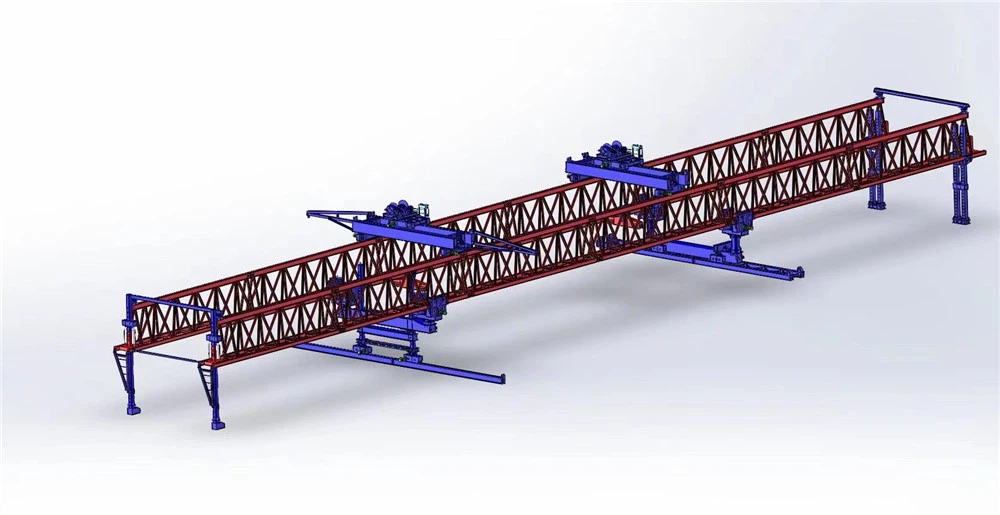

Advantages
A 280-ton bridge beam launcher is a heavy-duty machine used in the construction of bridges, particularly for placing precast concrete beams or girders. Here are its key advantages:
1. High Load Capacity
Can handle heavy bridge beams (up to 280 tons), making it suitable for large-span bridges, highways, and railway projects.
Reduces the need for multiple cranes or additional support systems.
2. Precision and Stability
Ensures accurate beam placement with controlled movements, minimizing errors.
Advanced hydraulic and electronic systems enhance stability during lifting and positioning.
3. Efficiency and Speed
Speeds up construction by quickly transporting and installing beams.
Reduces manual labor and shortens project timelines.
4. Adaptability
Works in various terrains, including uneven ground, rivers, and highways.
Adjustable supports and modular design allow customization for different bridge types.
5. Safety Enhancements
Minimizes risks associated with manual beam placement.
Equipped with anti-tip mechanisms, overload protection, and emergency brakes.
6. Cost-Effectiveness
Lowers labor and equipment costs by replacing multiple cranes or temporary supports.
Reduces downtime, improving overall project economics.
7. Reduced Site Disruption
Requires less space compared to traditional crane setups.
Ideal for urban or constrained environments where large cranes are impractical.
8. Automation and Remote Control
Some models feature automated controls for smoother operation.
Remote operation improves safety and precision in hazardous conditions.
9. Durability and Longevity
Built with high-strength materials to withstand heavy loads and harsh conditions.
Low maintenance requirements ensure long service life.
10. Environmental Benefits
Reduces the need for extensive temporary structures, lowering material waste.
Electric or hybrid models (if available) decrease fuel consumption and emissions.

Application
The 280-ton bridge beam launcher is a heavy-duty machine used in the construction of bridges, particularly for placing precast concrete or steel girders. Its primary function is to lift, transport, and accurately position large bridge beams during the construction of viaducts, highway overpasses, and railway bridges.
Key Applications of a 280-Ton Bridge Beam Launcher:
Highway & Expressway Construction
Used to install precast concrete beams for overpasses, flyovers, and elevated road sections.
Enables rapid construction of long-span bridges with minimal ground disruption.
Railway Bridge Erection
Places heavy girders for railway viaducts and high-speed rail projects.
Ensures precise alignment for track stability and safety.
Urban Infrastructure Projects
Facilitates the construction of metro bridges, light rail transit (LRT), and urban elevated roads.
Ideal for congested areas where traditional cranes may not be feasible.
Mountainous & River Crossings
Used in challenging terrains where beams must be placed over deep valleys or rivers.
Often paired with launching gantries for incremental launching methods.
Prefabricated Bridge Construction
Speeds up project timelines by placing large precast segments efficiently.
Reduces the need for extensive formwork and on-site casting.

Production Procedure
The production procedure for a 280-ton bridge beam launcher involves several critical stages, from design and material selection to fabrication, assembly, testing, and commissioning. Below is a detailed step-by-step procedure:
1. Design & Engineering
Requirement Analysis: Determine load capacity (280 tons), span length, mobility requirements, and compliance with standards (e.g., AASHTO, EN, or GB).
CAD Modeling: Create 3D models and finite element analysis (FEA) for stress, deflection, and dynamic loads.
Approvals: Finalize designs with client/regulatory approvals.
2. Material Procurement
High-Strength Steel: Primary material for structural components (e.g., beams, booms, supports).
Hydraulic Components: Cylinders, pumps, valves, and hoses rated for heavy loads.
Electrical Systems: Sensors, control panels, and motors for automation.
Welding Consumables: Certified electrodes/wires for high-strength joints.
3. Fabrication Process
A. Structural Components
Cutting & Shaping: Plasma/oxy-fuel cutting of steel plates/beams per CAD drawings.
Machining: Drill holes, mill surfaces for precision fits.
Welding:
Sub-assembly welding (e.g., girders, outriggers).
Full assembly welding with NDT (X-ray/ultrasonic testing).
Surface Treatment: Sandblasting, primer, and paint for corrosion resistance.
B. Hydraulic & Electrical Systems
Hydraulic Circuit Assembly: Install pumps, cylinders, and pipelines.
Electrical Wiring: Integrate sensors, PLCs, and control systems.
4. Assembly
Mechanical Assembly: Bolt/weld major sections (launching nose, main girder, supports).
Hydraulic Integration: Connect cylinders for lifting/telescoping.
Electrical Integration: Install control cabinets, limit switches, and safety interlocks.
5. Testing & Quality Control
Load Testing:
Static test at 110% capacity (308 tons) to check deflection.
Dynamic test with simulated beam launching.
Functional Tests:
Hydraulic system pressure/leak tests.
Control system calibration (remote/manual operation).
Safety Checks: Emergency stop, overload alarms, and stability tests.
6. Commissioning & Delivery
On-Site Assembly: Reassemble launcher at the construction site.
Operator Training: Teach safe operation, maintenance, and troubleshooting.
Final Handover: Documentation (manuals, test reports, warranties).
7. Maintenance & Support
Routine Inspections: Check welds, hydraulic leaks, and wear parts.
Lubrication: Grease moving parts (bearings, hinges).
Software Updates: Upgrade control systems as needed.


Workshop View
The company has installed an intelligent equipment management platform, and has installed 310 sets (sets) of handling and welding robots. After the completion of the plan, there will be more than 500 sets (sets), and the equipment networking rate will reach 95%. 32 welding lines have been put into use, 50 are planned to be installed, and the automation rate of the entire product line has reached 85%.


Hot Tags: 280 ton bridge beam launcher, China 280 ton bridge beam launcher manufacturers, suppliers, factory
You Might Also Like




Send Inquiry