










160 Ton Bridge Launcher Equipment
A 160-ton Bridge Launcher Equipment is a heavy-duty machine used to install precast bridge segments or girders efficiently.

Key keatures
🔩 Key Features of 160 Ton Bridge Launcher Equipment
High Load Capacity
Designed to handle 160 tons of girder weight.
Suitable for precast segmental and box girder bridges.
Modular and Customizable Design
Modular structure for easy assembly, disassembly, and transport.
Can be tailored to different bridge spans, usually 20m–50m.
Hydraulic System
Equipped with hydraulic jacks and cylinders for lifting, pushing, and aligning girders.
Ensures smooth and accurate positioning.
Double Girder Gantry Structure
Strong box-type girder design for high strength and stability.
Dual main girders support safe horizontal and vertical movement.
Bridge Span Capability
Capable of launching beams over multi-span bridges, including simply supported and continuous spans.
Intelligent Control System
PLC-controlled operation with remote control and manual options.
Real-time monitoring and safety interlocks.
Adjustable Launching Angle
Can operate on curved, skewed, and sloped bridges, thanks to adjustable angular movement.
Safety Systems
Includes overload protection, emergency brakes, limit switches, and fail-safe mechanisms.
Anti-collision system between components.
Efficient Launching Speed
Optimized for fast and safe girder launching, reducing bridge construction time.
Terrain Adaptability
Can operate on complex terrains including highways, railways, and mountain regions.
Environmental Protection Features
Low noise, energy-efficient motors, and dust-reducing mechanisms.
Compliance and Standards
Manufactured as per international safety and quality standards (e.g., FEM, ISO, CE).
Specification
| Item | Specification |
|---|---|
| Rated Lifting Capacity | 160 tons |
| Suitable Girder Type | Precast concrete beam (I-beam, T-beam, box girder) |
| Max Girder Span | Up to 50 meters |
| Girder Length Range | 20–50 meters |
| Max Girder Width | 3.0 meters |
| Trolley Lifting Height | 15–20 meters |
| Launching Method | Front/Rear Launch or Side Feed |
| Trolley Type | Motorized with winch lifting mechanism |
| Traveling Speed (Launcher) | 2–5 m/min (variable frequency drive) |
| Trolley Traveling Speed | 2–10 m/min |
| Lifting Speed | 0.5–1 m/min |
| Working Grade | A5 / A6 (based on FEM/ISO standards) |
| Control Mode | Remote control + cabin (dual mode) |
| Power Supply | 380V/50Hz, 3 Phase (or customized) |
| Total Power | Approx. 100–160 kW |

Pictures & Components
A 250-ton Bridge Launcher Equipment is a heavy-duty machine used to install precast bridge segments or girders efficiently. Here are its key components:
Main Components
Main Girder: Welded box or truss structure with high-strength steel (Q345B or equivalent)
Front & Rear Support Legs: Hydraulic/mechanical telescopic support
Hoisting Mechanism: Double-drum electric winch with steel wire rope
Trolley: Movable winch trolley with transverse and longitudinal motion
Travel Mechanism: Motorized wheel bogies with rubber or steel wheels
Hydraulic System: For leg lifting, adjustment, and pinning
Electrical System: Schneider/Siemens control components with overload protection
Safety Devices
Overload protection
Emergency stop system
Limit switches for traveling and lifting
Wind-proof anchoring system
Anti-falling protection for girders
Tilt & slope alarm system
LED warning lights and siren
Optional Features
Wireless remote control
CCTV camera system
Automatic positioning system
Anti-collision radar or laser sensors
Diesel generator set for field use

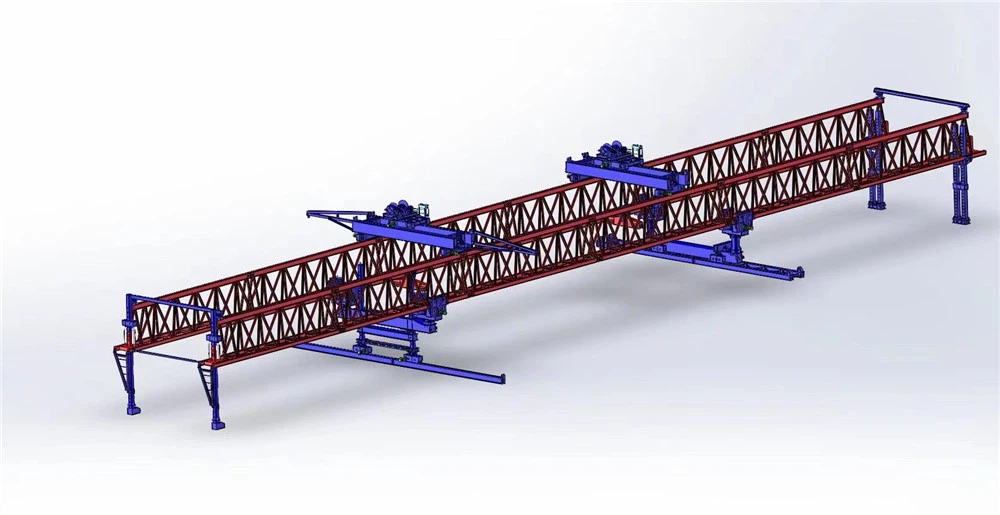
Sketch

Advantages
✅ 1. High Lifting Capacity
Designed to handle up to 160 tons, suitable for lifting heavy prefabricated concrete or steel girders used in highway and railway bridge construction.
✅ 2. Long Span Capability
Can erect large-span bridges efficiently, adapting to multiple span lengths such as 30m, 40m, 50m, and 60m beams.
Ideal for complex multi-span or continuous beam bridges.
✅ 3. Advanced Hydraulic & Mechanical Systems
Equipped with hydraulic walking, lifting, and self-balancing systems for high precision and safety.
Smooth operation during beam lifting, transverse movement, and longitudinal launching.
✅ 4. Strong Adaptability
Suitable for both highway and high-speed railway projects.
Works in straight, curved, or sloped bridge alignments.
Adaptable to various site conditions, including mountainous or urban areas.
✅ 5. High Construction Efficiency
Capable of installing 1–2 girders per day, depending on site conditions and girder type.
Reduces project duration compared to traditional crane methods.
✅ 6. Safety Features
Integrated limit switches, overload protection, tilt sensors, and emergency stop systems.
Ensures operator and equipment safety in complex work environments.
✅ 7. Modular Design for Easy Assembly & Transport
Modular structure allows quick on-site assembly/disassembly.
Components can be transported via standard trucks or containers.
✅ 8. Remote Control & Automation
Optional wireless remote control system enables safer and more efficient operation.
Some models offer semi-automatic or full automation for repetitive tasks.
✅ 9. Environmental Adaptability
Designed to operate under varied weather conditions, including rain, snow, and strong winds (with rated wind resistance).
Steel structure is corrosion-resistant and wear-resistant for long-term outdoor use.
✅ 10. Cost-Effective Long-Term Investment
High reuse value in multiple bridge projects.
Reduces the need for renting or moving large mobile cranes.

Application
160 Ton Bridge Launcher Equipment Application
The 160 Ton Bridge Launcher is a specialized heavy-duty equipment designed for the construction of large-scale bridges, particularly suitable for precast segmental and girder bridge projects. It is widely used in the following applications:
Highway and Railway Bridge Construction
Ideal for erecting precast concrete girders across elevated piers in highway and high-speed rail infrastructure projects.
Urban Elevated Road Projects
Suitable for building overpasses and viaducts in metropolitan areas, ensuring high efficiency in dense urban environments.
Long-Span Bridge Projects
Capable of handling heavy and long bridge segments, making it perfect for long-span and complex terrain bridge construction.
Mountainous and River-Crossing Projects
Equipped to operate in challenging terrains, including mountainous areas and river crossings, where conventional cranes are difficult to deploy.
Segmental Bridge Erection
Supports segment-by-segment girder installation, particularly for precast box girders and T-beams.
With its robust load capacity, high precision, and adaptability, the 160 Ton Bridge Launcher plays a critical role in modern bridge engineering, improving construction speed, safety, and overall efficiency.

Production Procedure
The production of a 250-ton Bridge Launcher Equipment (BLE) involves a complex, multi-stage process that integrates structural engineering, mechanical systems, hydraulics, and automation. Below is a detailed step-by-step production procedure:
1. Design & Engineering Phase
Requirement Analysis: Define load capacity (250 tons), span length, terrain adaptability, and mobility.
CAD Modeling: Use software like AutoCAD, SolidWorks, or CATIA for 3D design.
FEA Analysis: Conduct Finite Element Analysis (ANSYS, ABAQUS) to validate structural integrity.
Hydraulic & Electrical System Design: Plan hydraulic cylinders, pumps, and control systems.
2. Material Procurement
Structural Steel: High-grade steel (ASTM A572/A514) for beams, girders, and trusses.
Hydraulic Components: Pumps, cylinders, valves (Bosch Rexroth, Parker).
Electrical & Control Systems: PLCs, sensors, and remote-control modules.
Track/Launching Mechanism: Heavy-duty rollers or sliding bearings.
3. Fabrication Process
A. Main Girder Fabrication
Cutting & Shaping: Plasma/oxy-fuel cutting of steel plates.
Welding: Submerged arc welding (SAW) for longitudinal seams; robotic welding for precision.
Assembly: Bolt and weld segments into box girders or truss sections.
B. Support Structure (A-Frame/Tower)
Fabricate vertical supports using reinforced steel.
Assemble hydraulic lifting mechanisms.
C. Launching Nose & Rear Support
Construct the launching nose (temporary extension for bridge deployment).
Install rear support legs/stabilizers.
4. Hydraulic & Electrical Integration
Hydraulic System:
Install hydraulic cylinders for lifting and launching.
Connect pumps, hoses, and control valves.
Electrical System:
Wire PLCs, sensors, and control panels.
Test synchronization between hydraulic and motion systems.
5. Quality Control & Testing
NDT Testing: Ultrasonic/X-ray welding inspection.
Load Testing: Apply 125% of design load (312.5 tons) to verify safety.
Functional Testing: Simulate bridge launching under controlled conditions.
6. Assembly & Pre-Delivery Check
Assemble all modules (girders, supports, hydraulics).
Conduct final operational tests (extension/retraction, stability).
7. Transportation & Site Commissioning
Disassemble into transportable modules (if needed).
On-site reassembly and commissioning.
Operator training.


Workshop View
The company has installed an intelligent equipment management platform, and has installed 310 sets (sets) of handling and welding robots. After the completion of the plan, there will be more than 500 sets (sets), and the equipment networking rate will reach 95%. 32 welding lines have been put into use, 50 are planned to be installed, and the automation rate of the entire product line has reached 85%.


Hot Tags: 160 ton bridge launcher equipment, China 160 ton bridge launcher equipment manufacturers, suppliers, factory
You Might Also Like




Send Inquiry