










160 Ton Bridge Launcher
A 160-ton bridge launcher is a heavy-duty mobile system designed for rapidly deploying bridges in military, emergency, or civil engineering applications. These systems are crucial for enabling troops, vehicles, and supplies to cross obstacles like rivers, ravines, or damaged infrastructure.

Key Features
Key Features of a 160-Ton Bridge Launcher:
Capacity
Can deploy bridges capable of supporting loads up to 160 metric tons, allowing the passage of heavy military vehicles (e.g., tanks, armored personnel carriers) or civilian heavy machinery.
Mobility & Deployment
Mounted on a heavy transport vehicle (e.g., a modified tank chassis or multi-axle truck).
Hydraulic or mechanical launching mechanism for rapid deployment (often in minutes).
Some models feature automated unfolding for quick setup.
Bridge Specifications
Typically a modular or scissors-type bridge (e.g., Bailey bridge variants, Medium Girder Bridge, or custom designs).
Span length: Usually 15–30 meters (adjustable with extensions).
Materials: High-strength steel or aluminum alloys for durability.
Applications
Military: Used by engineering corps to support armored divisions in combat zones.
Disaster Relief: Rapidly restores connectivity after floods, earthquakes, or bridge collapses.
Civil Engineering: Temporary bridging for construction projects.
Examples of Similar Systems
M60 AVLB (Armored Vehicle-Launched Bridge) – Used by the U.S. military (supports up to 60 tons).
Leguan Bridge Layer – Used by NATO forces (modular bridges up to 80+ tons).
Chinese Type 84 Scorpion – A tank-based bridge layer with high load capacity.
Specification
160-Ton Bridge Launcher Specifications
1. General Characteristics
Type: Mobile bridge launching system (mechanized or vehicle-mounted)
Bridge Class: Supports up to 160-ton loads (e.g., MLC 96 military vehicles or equivalent)
Deployment Time: Typically 5–15 minutes (depending on configuration)
Recovery Time: Similar to deployment time
Operational Crew: 2–4 personnel
2. Bridge Specifications
Span Length:
Single-span: 20–30 meters (typical)
Multi-span capability (if modular)
Width: ~4 meters (allowing for vehicle traffic)
Material: High-strength aluminum or steel alloy
Surface: Non-slip decking, possibly with expansion joints
3. Launcher Vehicle/Platform
Chassis: Heavy-duty military truck or tracked vehicle
Engine Power: 400–600 HP (depending on mobility requirements)
Mobility:
On-road speed: ~70 km/h
Off-road capability: Yes (dependent on chassis)
Weight: ~40–60 tons (including launcher and bridge)
4. Deployment Mechanism
Launching Method: Hydraulic or mechanical extension
Control System: Manual, semi-automatic, or fully automated
Stabilization: Outriggers or hydraulic jacks for secure placement
5. Environmental & Operational Limits
Temperature Range: -30°C to +50°C
Wind Resistance: Up to 50 km/h during deployment
Terrain Compatibility: Soft ground, slopes (up to 10% gradient)

Pictures & Components
A 160-ton bridge launcher is a heavy-duty military engineering vehicle designed to deploy bridges quickly to overcome obstacles like rivers, trenches, or gaps in combat zones. Below are the key components typically found in such a system:
1. Chassis & Mobility System
Heavy-duty tracked or wheeled vehicle (often based on a tank or armored vehicle chassis).
Engine & transmission system (high-power diesel or hybrid).
Suspension system (to support heavy loads).
Driver's cabin (armored for protection).
2. Bridge Deployment Mechanism
Bridge Structure:
Foldable or telescopic bridge (scissor-type, horizontal launch, or modular).
Made of high-strength aluminum or composite materials.
Length: Typically 20–30 meters (depends on model).
Load capacity: 160 tons (supports tanks, trucks, and heavy combat vehicles).
Launching System:
Hydraulic or electro-mechanical actuators for extension/retraction.
Stabilizers/outriggers for balance during deployment.
Winch/cable system for controlled lowering.
3. Hydraulic & Power Systems
Hydraulic pumps & cylinders (for bridge movement).
Power take-off (PTO) from the engine or auxiliary power unit (APU).
Control valves & hoses.
4. Control System
Operator console (inside cabin or remote control).
Sensors for alignment & stability.
Automated or semi-automated deployment sequences.
5. Stabilization & Support Components
Outrigger legs/jacks (for stability during bridge launch).
Ground anchors (for soft terrain).
Leveling system (to adjust for uneven ground).
6. Safety & Recovery Features
Emergency stop mechanisms.
Backup manual controls.
Self-recovery winch (if vehicle gets stuck).
7. Optional Add-Ons
Armor plating (for protection in combat zones).
Smoke/obscurant launchers (for concealment).
NBC (Nuclear, Biological, Chemical) protection.

Sketch
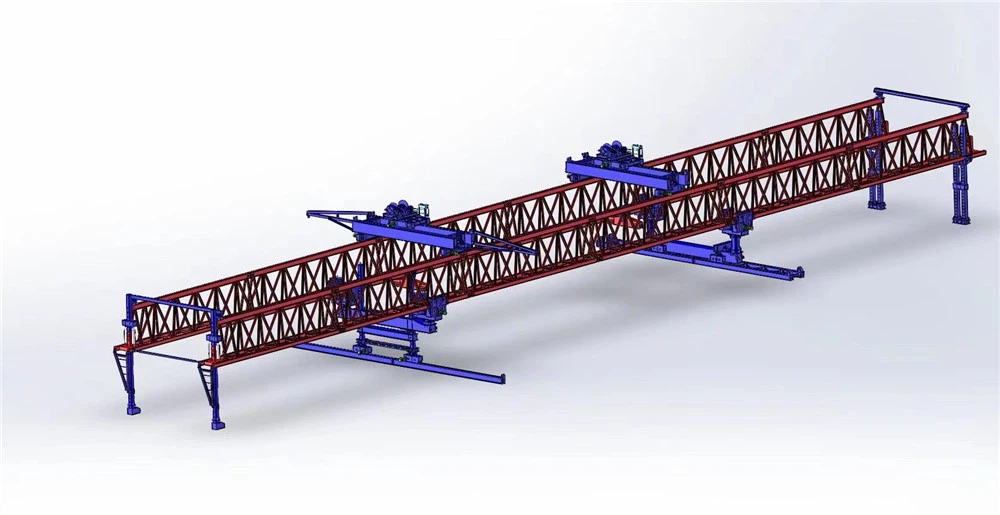

Advantages
A 160-ton bridge launcher is a heavy-duty military engineering vehicle designed to deploy bridges quickly to overcome obstacles like rivers, trenches, or gaps in combat zones. Here are its key advantages:
1. Rapid Deployment
Can launch bridges within minutes, allowing troops and vehicles to cross obstacles without lengthy construction.
Reduces downtime compared to traditional bridge-laying methods.
2. High Load Capacity
Supports heavy military vehicles (up to 160 tons or more), including main battle tanks (e.g., M1 Abrams, Leopard 2) and armored personnel carriers.
Ensures logistics and combat units can move without weight restrictions.
3. Enhanced Mobility & Maneuverability
Mounted on a mobile chassis (often tracked or heavy-duty wheeled), allowing it to keep pace with advancing forces.
Can operate in rough terrain where fixed bridges are impractical.
4. Increased Battlefield Survivability
Reduces the need for vulnerable engineer teams to manually assemble bridges under fire.
Some models feature armored protection for the crew against small arms and shell fragments.
5. Versatility in Bridge Types
Can deploy different bridge designs:
Scissor bridges (fast deployment).
Modular bridges (adjustable length).
Folding bridges (compact storage).
Adaptable to various gap lengths (typically 20–30 meters, depending on model).
6. Operational Flexibility
Used in both assault crossings (combat conditions) and humanitarian missions (disaster relief).
Can retrieve and reposition bridges if needed.
7. Reduced Need for Engineer Teams
Minimizes manual labor, allowing engineers to focus on other critical tasks.
Automated or semi-automated launching systems improve efficiency.
8. Compatibility with Modern Armored Columns
Integrates with NATO and other military standards, ensuring interoperability with different forces.
Often used alongside Armored Vehicle-Launched Bridges (AVLB) for layered bridging solutions.
9. Strategic Advantage in Offensive Operations
Enables fast breakthroughs by maintaining momentum in mechanized assaults.
Denies the enemy the advantage of natural barriers.
10. Cost-Effective in the Long Run
Reduces reliance on temporary bridges or ferries, which may require more resources and time.
Examples of 160-Ton Class Bridge Launchers:
Chinese TYPE 84 (supports up to 60-ton loads but has heavier variants).
German Leguan (modular, can handle heavy loads).
Russian MTU-90 (used by armored units).
Conclusion:
A 160-ton bridge launcher is crucial for modern armies, ensuring rapid mobility for heavy forces while maintaining operational tempo in both combat and disaster-response scenarios. Its ability to deploy bridges quickly under fire makes it a vital asset in high-intensity conflicts.

Application
A 160-ton bridge launcher is a heavy-duty piece of equipment used in construction, particularly for installing precast bridge segments, girders, or other large structural elements. These machines are essential for accelerated bridge construction (ABC) projects, allowing for rapid and precise placement of heavy components.
Key Applications of a 160-Ton Bridge Launcher
Precast Segmental Bridge Construction
Used to lift and position precast concrete segments for balanced cantilever or span-by-span construction.
Enables fast assembly of viaducts and long-span bridges.
Girder Launching for Highway & Railway Bridges
Installs prefabricated steel or concrete girders (I-beams, U-beams, box girders) onto piers.
Suitable for both simply supported and continuous span bridges.
Launching Heavy Bridge Decks
Places full-span or half-span precast deck sections in urban elevated roads or crossings.
Reduces on-site construction time compared to cast-in-place methods.
Overhead & Underslung Launching Methods
Can operate in overhead launching gantry (OHLG) or underslung launching gantry (USLG) configurations.
Adaptable to different bridge geometries and site constraints.
Rail & Metro Infrastructure Projects
Used in the construction of elevated metro lines and railway bridges where heavy precast segments are required.

Production Procedure
Here's a structured production procedure for a 160-ton bridge launcher, covering key stages from design to commissioning. This procedure ensures quality, safety, and compliance with engineering standards.
1. Design & Engineering
Conceptual Design: Define load capacity (160-ton), span length, mobility, and deployment method.
Detailed Engineering:
Structural analysis (FEA for stress, deflection, buckling).
Hydraulic/pneumatic system design (for launching mechanism).
CAD modeling (AutoCAD/SolidWorks).
Regulatory Compliance: Ensure adherence to standards (AASHTO, EN 1993, OSHA).
2. Material Procurement
Key Materials:
High-strength steel (ASTM A572 Grade 50/EN S355) for girders.
Hydraulic cylinders (ISO 6020/6022).
Wear-resistant bearings/pins (SAE 4140).
Supplier Qualification: Certify materials with Mill Test Reports (MTRs).
3. Fabrication Process
3.1 Structural Components
Cutting & Machining: CNC plasma/oxy-fuel cutting for precision.
Welding:
Submerged arc welding (SAW) for girders.
Weld inspection (UT/RT per AWS D1.1).
Assembly:
Bolt critical joints (Grade 8.8/10.9 bolts).
Align using laser levels (±2mm tolerance).
3.2 Mechanical Systems
Hydraulic System:
Install pumps, valves, and actuators.
Pressure test at 1.5× operating pressure.
Launching Mechanism:
Track/wheel system for mobility.
Load-test with 125% design load (200 tons).
4. Quality Control (QC)
Dimensional Checks: Laser alignment for straightness.
NDT: Ultrasonic testing (UT) for welds.
Functional Tests:
Deploy/retract bridge section 5+ times.
Verify synchronization of hydraulic cylinders.
5. Surface Treatment & Painting
Blasting: SA 2.5 (ISO 8501-1).
Coating:
Epoxy primer (75–100 µm).
Polyurethane topcoat (50–75 µm).
6. Final Assembly & Testing
Integration: Mount launcher on carrier vehicle (if mobile).
Load Testing:
Static test: 160 tons for 24 hours.
Dynamic test: Simulated traffic loads (per AASHTO HL-93).
7. Delivery & Commissioning
Documentation: Provide manuals (operation, maintenance).
On-Site Training: Operator/pafety protocols.
Field Deployment: Supervised first launch.
8. Maintenance Plan
Routine Checks: Hydraulic fluid levels, bolt torque, corrosion.
Annual Inspections: NDT for critical welds.


Workshop View
The company has installed an intelligent equipment management platform, and has installed 310 sets (sets) of handling and welding robots. After the completion of the plan, there will be more than 500 sets (sets), and the equipment networking rate will reach 95%. 32 welding lines have been put into use, 50 are planned to be installed, and the automation rate of the entire product line has reached 85%.


Hot Tags: 160 ton bridge launcher, China 160 ton bridge launcher manufacturers, suppliers, factory
You Might Also Like


Send Inquiry