










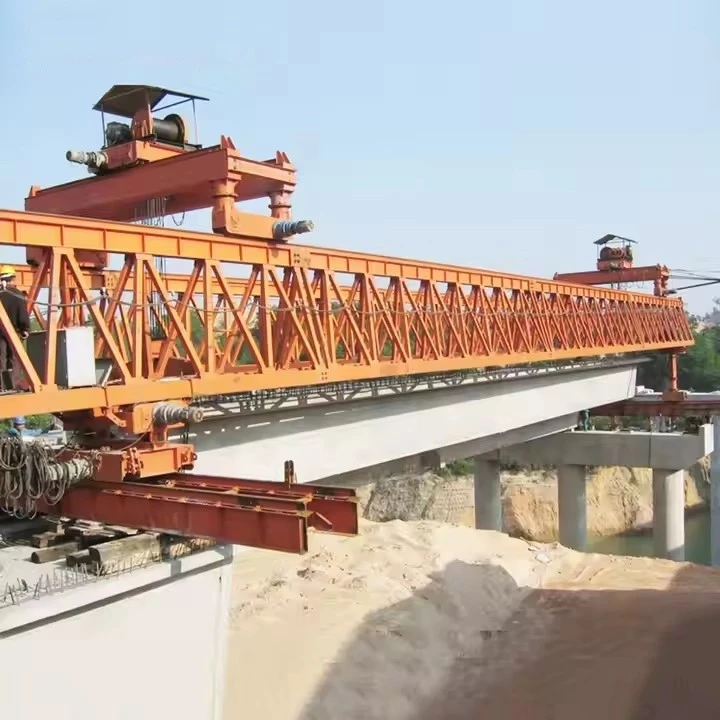

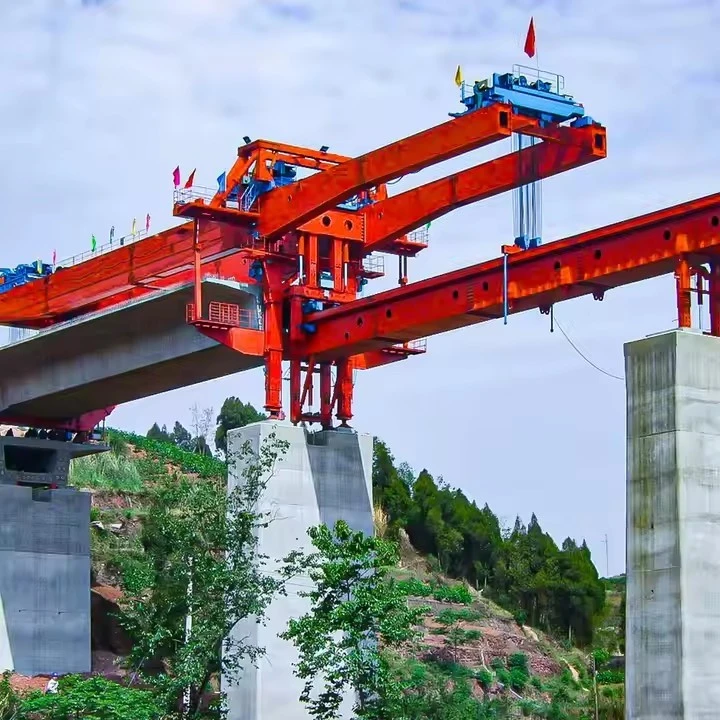

300 Ton Bridge Launcher Equipment
A 300-ton bridge launcher equipment is a heavy-duty machine used in the construction of bridges, particularly for launching precast or assembled bridge segments into place. These machines are essential for large-scale infrastructure projects, enabling the efficient and precise installation of bridge components.

Key Features
A 300-ton bridge launcher is a heavy-duty piece of equipment used in the construction of bridges, particularly for launching precast segments or girders into place. Below are its key features:
1. High Load Capacity
Designed to handle 300-ton loads, making it suitable for large bridge girders or segmental construction.
Can support long-span girders (typically 30m to 50m or more).
2. Modular & Adjustable Design
Often features modular components for easy transport and assembly.
Adjustable height and width to accommodate different bridge designs.
3. Self-Propelled or Launching System
Some models are self-propelled (with crawlers or wheels), while others use a launching gantry system.
Hydraulic or electric drive systems for smooth movement.
4. Precision Positioning
Equipped with hydraulic jacks and computer-controlled alignment for accurate girder placement.
May include laser-guided systems for real-time positioning.
5. Safety Features
Anti-tip mechanisms and load sensors to prevent overloading.
Emergency braking systems and redundant supports for stability.
6. Versatility
Can be used for precast girder launching, segmental bridge construction, and balanced cantilever methods.
Adaptable for different bridge types (highway, railway, viaducts).
7. Remote Control & Automation
Some models feature remote-controlled operation for safety and efficiency.
Automated synchronization of multiple launchers in large projects.
8. Durability & Weather Resistance
Built with high-strength steel to withstand harsh construction environments.
Weather-resistant components for outdoor use.
9. Fast Assembly & Dismantling
Designed for quick setup to minimize downtime.
May include quick-connect systems for rapid deployment.
10. Compliance with Standards
Meets international safety and engineering standards (e.g., EN, AASHTO, ISO).
Specification
300-Ton Bridge Launcher Equipment – Technical Specifications
1. General Specifications
Maximum Launching Capacity: 300 metric tons
Type: Modular/Launching Gantry System
Application: Precast segmental bridges, box girders, steel trusses, etc.
Operation Mode: Self-launching, hydraulic propulsion
Control System: Automated/PLC-controlled with manual override
2. Structural Components
Main Girder/Frame: High-strength steel (Grade S355/S460)
Launching Nose: Adjustable for different span lengths
Support Towers/Stands: Hydraulically adjustable for height & alignment
Moving Mechanism: Hydraulic jacks or wheeled trolleys with rail system
3. Hydraulic System
Propulsion Force: 300–400 tons (push/pull capacity)
Jacking Speed: 3–10 m/hour (adjustable)
Stroking Stroke: 500–1000 mm per cycle
Hydraulic Pressure: 350–700 bar
4. Electrical & Control System
Power Supply: 380V/50Hz or diesel-powered generator
Control Interface: Touchscreen HMI + remote control
Safety Features: Overload protection, emergency stop, synchronization monitoring
5. Mobility & Setup
Transportation: Modular design for easy disassembly
Assembly Time: 7–14 days (depending on site conditions)
Track/Gauge Width: Adjustable (typically 5–10 m)
6. Environmental & Operational Conditions
Working Temperature: -20°C to +50°C
Wind Resistance: Up to 15 m/s (operational), 30 m/s (survival)
Slope Capability: ≤ 3% (longitudinal), ≤ 1% (transverse)
7. Safety & Compliance
Certifications: ISO 9001, CE, EN 13001 (Crane Safety Standards)
Load Testing: 125% of rated capacity (before commissioning)
8. Optional Features
Laser Guidance System for precise alignment
Automated Segment Feeding System
Anti-slip & Anti-overturning Mechanisms

Pictures & Components
A 300-ton bridge launcher is a heavy-duty piece of equipment used in construction, military, or civil engineering to deploy modular bridges (such as Bailey bridges, Mabey Johnson bridges, or other portable bridging systems). Below are the key components typically found in such a system:
1. Main Structural Components
Launching Nose – A forward extension that helps guide the bridge during deployment.
Bridge Deck Panels – Modular sections that form the roadway.
Support Beams/Girders – Load-bearing elements that distribute weight.
Cross Beams & Bracing – Provide lateral and vertical stability.
2. Hydraulic & Mechanical Systems
Hydraulic Cylinders – Control the extension/retraction of the bridge.
Pump Unit – Powers hydraulic operations.
Winch & Cable System – Assists in pulling or positioning bridge sections.
Rollers/Tracks – Allow smooth movement during launch.
3. Mobility & Transport Components
Transport Chassis – Often mounted on a heavy-duty truck or trailer.
Outriggers/Stabilizers – Provide stability during launching operations.
Suspension System – Absorbs shocks during transport.
4. Control & Power Systems
Operator Cabin/Control Panel – Allows remote or manual control.
Power Pack (Diesel/Electric) – Supplies energy for hydraulic and electrical systems.
Sensors & Safety Systems – Monitor load, alignment, and stability.
5. Auxiliary Components
Anchoring Devices – Secure the bridge to the ground or abutments.
Jacking Systems – Adjust height and leveling.
Tool Kits & Spare Parts – For maintenance and adjustments.
6. Safety & Support Equipment
Guard Rails & Safety Barriers – Protect workers during operations.
Lighting & Signaling – For visibility in low-light conditions.
Load Monitoring System – Ensures the bridge is within safe capacity.

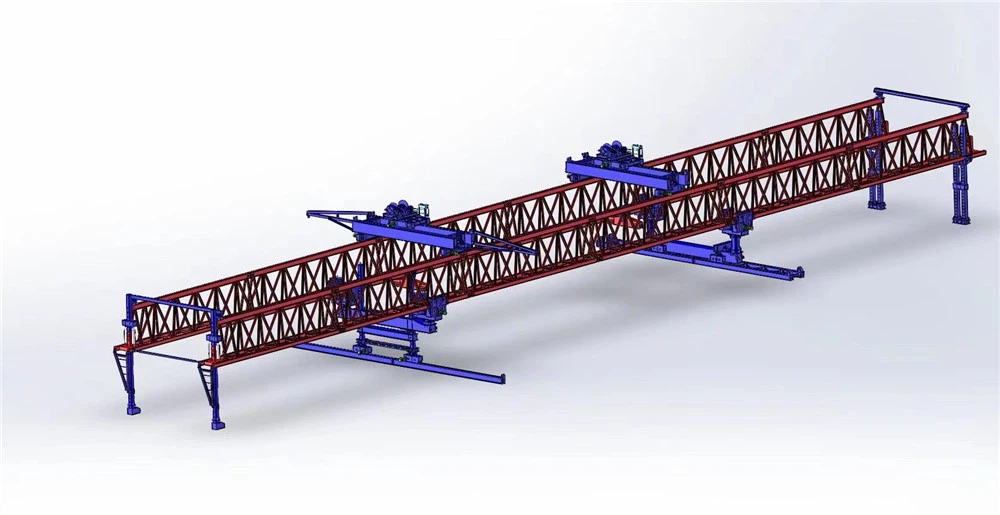
Sketch

Advantages
The 300-ton bridge launcher equipment is a heavy-duty machine used for constructing large bridges, especially for launching precast segments or girders. Its advantages include:
1. High Load Capacity
Can handle up to 300 tons, making it suitable for large bridge projects.
Supports heavy precast concrete segments, steel girders, and other massive components.
2. Efficient Construction Speed
Accelerates bridge construction by enabling rapid launching and positioning of segments.
Reduces manual labor and speeds up project timelines.
3. Precision and Stability
Ensures accurate alignment of bridge segments, minimizing errors.
Advanced hydraulic systems provide smooth and controlled movement.
4. Adaptability to Various Bridge Types
Works for girder bridges, box girder bridges, arch bridges, and cable-stayed bridges.
Adjustable supports and launching noses allow customization for different spans.
5. Enhanced Safety Features
Robust structural design prevents overloading and tilting.
Automated monitoring systems detect imbalances or misalignments in real time.
6. Reduced Need for Temporary Supports
Minimizes the use of falsework and scaffolding, lowering costs and site congestion.
Ideal for valleys, rivers, and highways where ground support is limited.
7. Cost-Effective for Long Spans
More economical than traditional cranes for long-span bridges.
Reduces the need for multiple heavy cranes, saving rental and operational costs.
8. Remote and Automated Control
Some models feature remote operation, improving safety and efficiency.
Automated systems ensure consistent and repeatable launching processes.
9. Durability and Long Service Life
Built with high-strength steel and corrosion-resistant materials.
Suitable for harsh environments, including coastal and high-altitude regions.
10. Environmental Benefits
Lowers noise and dust pollution compared to traditional methods.
Reduces disruption to surrounding areas, especially in urban settings.

Application
The 300-ton bridge launcher equipment is a heavy-duty machine used primarily in the construction of bridges, particularly for launching precast segments, girders, or entire bridge spans. Below are its key applications and features:
Applications:
Precast Segment Launching
Used to lift and position precast concrete segments for balanced cantilever or span-by-span bridge construction.
Ensures precise alignment before post-tensioning.
Girder Launching for Highway/Railway Bridges
Installs large steel or concrete girders (I-beams, U-beams, box girders) for viaducts and overpasses.
Suitable for simply supported or continuous span bridges.
Launching Full Span Decks
Places entire precast bridge decks in one operation, speeding up construction in urban or difficult terrains.
Overhead & Cable-Stayed Bridge Construction
Assists in placing heavy bridge components in complex structures where cranes have limited access.
Underwater or High-Altitude Bridge Projects
Operates in challenging environments where traditional cranes are impractical.

Production Procedure
The production procedure for a 300-ton bridge launcher equipment involves several critical stages, from design and material procurement to fabrication, assembly, testing, and commissioning. Below is a structured outline of the typical production process:
1. Design & Engineering
Conceptual Design: Define load capacity (300 tons), span length, mobility requirements, and operational conditions.
Detailed Engineering:
Structural analysis (FEA for stress, deflection, stability)
Hydraulic/pneumatic system design (for launching mechanisms)
Electrical/control system integration (automation, sensors)
Regulatory Compliance: Ensure adherence to standards (e.g., AASHTO, EN, ISO, or client-specific specs).
Prototyping (if applicable): Validate design via scaled models or simulations.
2. Material Procurement
Structural Steel: High-grade steel (e.g., S355, ASTM A572) for girders, trusses, and supports.
Hydraulic Components: Pumps, cylinders, hoses (rated for 300+ ton loads).
Mechanical Parts: Gears, bearings, winches, and track systems.
Electrical Systems: PLCs, sensors, motors, and cabling.
Corrosion Protection: Primer, paint, or galvanizing materials.
3. Fabrication Process
A. Structural Fabrication
Cutting: CNC plasma/oxy-fuel cutting of steel plates/beams.
Welding:
Submerged arc welding (SAW) for main girders.
Shielded metal arc welding (SMAW) for joints.
Non-destructive testing (NDT): Ultrasonic/X-ray inspection.
Machining: Drill holes, mill surfaces for precise assembly.
Sub-assemblies: Build modular sections (e.g., launching nose, support frames).
B. Mechanical Systems
Hydraulic Assembly: Install pumps, cylinders, and control valves.
Track/Wheel System: Fabricate rails/bogies for mobility.
Lifting Mechanisms: Integrate winches or jacks.
C. Electrical & Control Systems
Wiring: Install power and control circuits.
Automation: Program PLCs for synchronized operations.
Safety Systems: Overload sensors, emergency stops.
4. Assembly
Erection: Join sub-assemblies using cranes/jacks.
Alignment: Ensure geometric accuracy (laser alignment tools).
Fastening: Bolt critical connections; verify torque settings.
5. Testing & Quality Control
Load Testing:
Static test (110% of design load, i.e., 330 tons).
Dynamic test (simulate launching cycles).
Hydraulic Tests: Check for leaks, pressure stability.
Functional Tests: Verify control systems, sensors, and safety interlocks.
Inspection: Third-party certification (if required).
6. Surface Treatment & Painting
Blasting: Shot-blast to Sa 2.5 (ISO 8501-1).
Painting: Apply epoxy primer + polyurethane topcoat for corrosion resistance.
7. Packaging & Shipping
Disassembly (if needed): Modularize for transport.
Packaging: Protect sensitive components (e.g., hydraulics, electronics).
Logistics: Use heavy-duty trailers/ships for oversized parts.
8. On-Site Commissioning
Reassembly: Supervise on-site erection.
Final Testing: Operational checks under real conditions.
Training: Handover to client with operator/maintenance training.
9. Documentation & Handover
Manuals: O&M manuals, parts lists, wiring diagrams.
Certificates: Material test reports (MTRs), weld logs, load test results.
Warranty & Support: Define after-sales service terms.


Workshop View
The company has installed an intelligent equipment management platform, and has installed 310 sets (sets) of handling and welding robots. After the completion of the plan, there will be more than 500 sets (sets), and the equipment networking rate will reach 95%. 32 welding lines have been put into use, 50 are planned to be installed, and the automation rate of the entire product line has reached 85%.


Hot Tags: 300 ton bridge launcher equipment, China 300 ton bridge launcher equipment manufacturers, suppliers, factory
You Might Also Like


Send Inquiry