







Double Beam Industry Overhead Crane
Key Features
High Load Capacity
Supports loads from 5 tons to 800 tons, with some models capable of handling even heavier weights.
Suitable for bulk materials, molten metal, and containers (equipped with grabs or magnets).
Durable Construction
Reduced weight (15–30% lighter than traditional designs) and lower wheel pressure (10–35% reduction), minimizing structural demands on buildings.
Long lifespan (30–50 years) with high-strength steel girders and abrasion-resistant components.
Customizable Configurations
Options include explosion-proof, high-temperature-resistant, and frequency inverter speed control models.
Attachments like grabs, hooks, or magnets for diverse materials (e.g., coal, scrap metal).
Efficiency & Safety
High-speed operation: Lifting speeds up to 12.5 m/min, trolley speeds up to 75 m/min.
Safety features: Overload protection, limit switches, and remote/cabin control options.
Energy-Saving Technology
Modern designs incorporate frequency converters for smooth acceleration, reduced energy consumption, and precise positioning.
Advantages Over Alternatives
| Feature | Double Beam Crane | Single Beam Crane |
|---|---|---|
| Load Capacity | Up to 800+ tons | Typically ≤ 20 tons |
| Span | Up to 35 m | Limited to shorter spans |
| Durability | Heavy-duty, long lifespan | Lighter, less robust |
| Cost Efficiency | Lower long-term maintenance | Higher operational costs |
- Capacity: 5-500ton
- Span length: 4-35m
- Lifting height: 3-50m
- Work duty: A4, A5, A6,A7
- Raged voltage: 220V~690V, 50-60Hz, 3ph AC
- Work environment temperature: -25℃~+50℃, relative humidity ≤85%
- Crane control mode: Floor control / Remote control / Cabin room
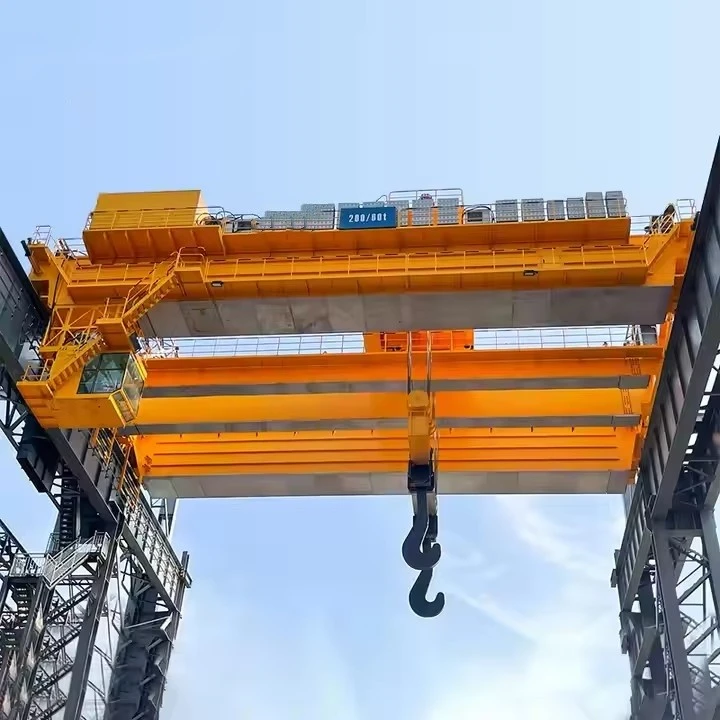
Pictures & Components
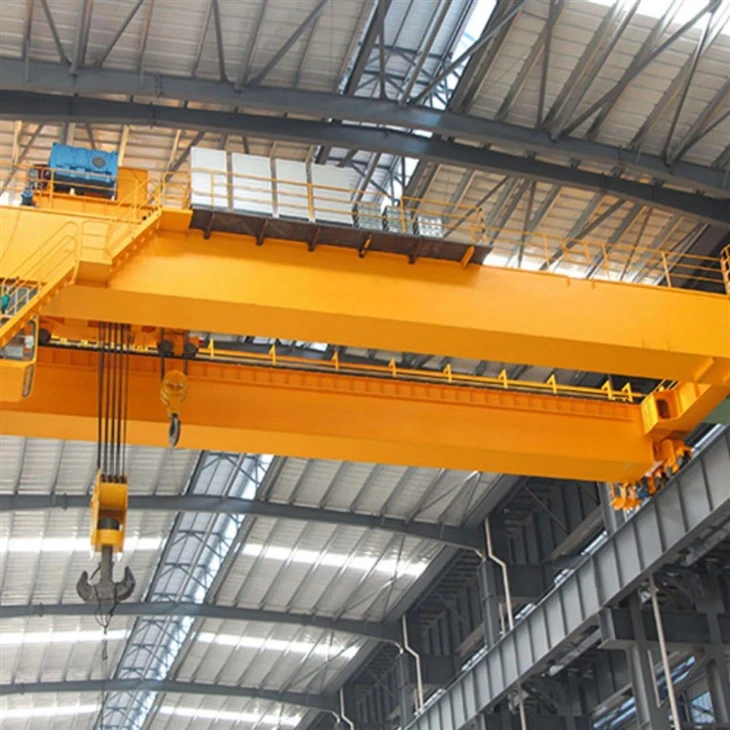
1. Bridge Structure (Main Load-Bearing Components)
Main Girders (2 parallel beams)
Box girder or truss design (box girder more common for heavy loads)
Made of high-strength steel (Q235B/Q345B) with welded construction
Includes reinforced end trucks for stability
End Trucks
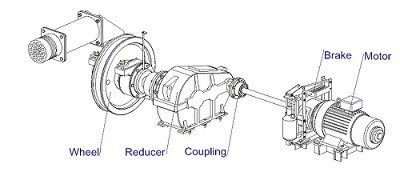
Wheel assemblies at each end of girders
Contains drive motors, gears, and anti-derailment guards
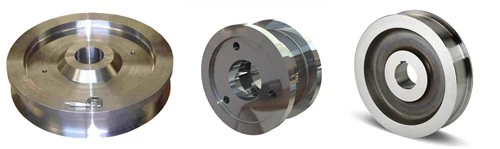
Wheels are often forged steel with heat-treated rims
2. Hoisting Mechanism
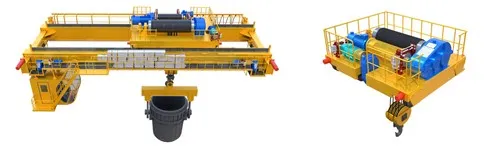
Electric Hoist
Gear-motor assembly with drum or chain system
Brake system (usually electromagnetic fail-safe type)
Rated for heavy-duty cycles (FEM M5-M8 classification)
Wire Rope/Chain
Rotation-resistant steel wire ropes (6x36WS+IWR construction common)
Load hooks with safety latches (swivel type available)
Sheaves and Drums
Machined grooves for precise rope alignment
Often equipped with rope guide systems

3. Trolley System
Trolley Frame
Steel construction with precision-machined rail contact surfaces
Includes cross-travel motor and gearbox
Trolley Wheels
Double-flanged for secure tracking
Often use sealed roller bearings
Bumper System
Hydraulic or spring buffers at travel limits
4. Runway System
Runway Rails
QU80/QU100/QU120 steel rails (depending on capacity)
Secured to runway beams with rail clamps
Runway Beams
Box section or I-beam construction
Includes conductor bars for power supply
5. Electrical Systems
Power Feed Systems
Festoon system (cable reels) or conductor bars (for long spans)
IP54 or higher protection for dust/water resistance
Control Systems
Pendant control (IP65 rated) or radio remote
Variable Frequency Drives (VFDs) for smooth acceleration
Safety Devices
Overload limiters (mechanical or electronic)
Emergency stop circuits
Anti-collision systems for multiple cranes

6. Additional Options
Cabin/Operator Station
Ergonomically designed with AC/heat
Full instrumentation and camera systems
Special Attachments
Magnet systems for steel handling
Grapple attachments for scrap
Spreader beams for containers
Automation Features
PLC control with position sensors
Automatic load weighing systems
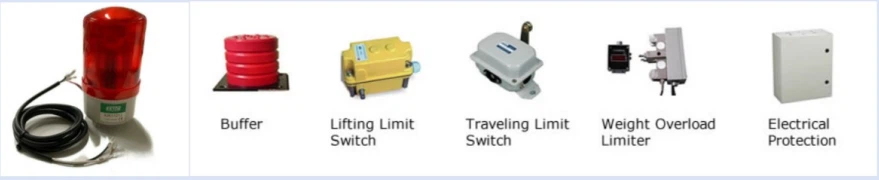
Material Specifications
Girders: ASTM A36 or equivalent steel
Wheels: 55Mn forged steel with HB300-380 hardness
Electricals: IEC or GB standards compliant
Maintenance Focus Areas
Wire rope inspection (weekly for cracks/deformation)
Wheel flange wear measurement (monthly)
Gearbox oil analysis (quarterly)
Electrical contact checks (bi-annually)

SKETCH
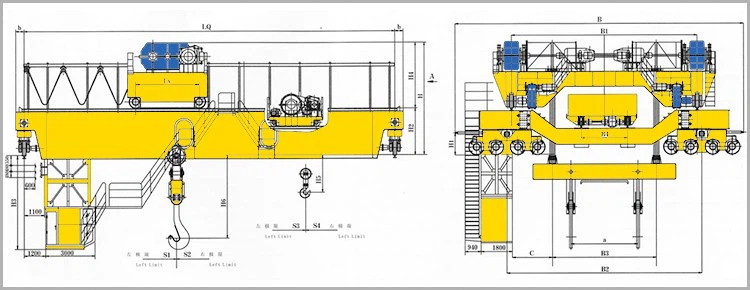
Main Technical Data
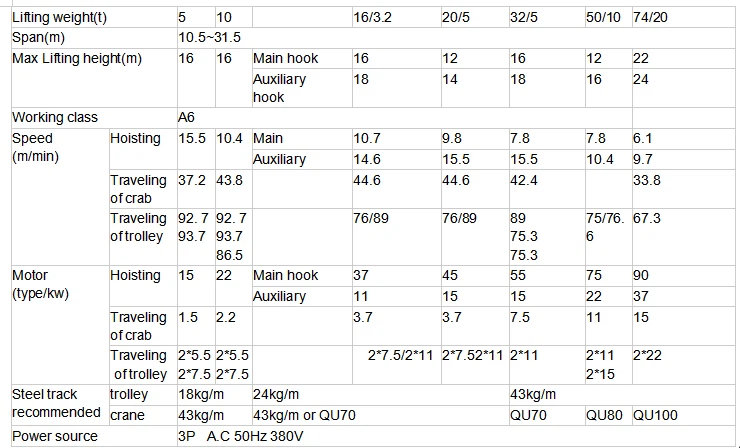
Advantages
Advantages of Double Beam Industrial Overhead Cranes
1. Superior Load Capacity & Stability
Higher load ratings (typically 5–550+ tons, with custom designs up to 800+ tons)
Dual-girder design provides greater rigidity and reduces deflection under heavy loads
Wider span capability (up to 35+ meters) compared to single-girder cranes
2. Enhanced Durability & Longevity
Heavy-duty steel construction (Q345B or equivalent) with corrosion-resistant coatings
30–50+ year lifespan with proper maintenance
Lower wheel pressure (10–35% reduction vs. single-girder) reduces building structural stress
3. Greater Operational Flexibility
Multiple lifting attachments (hooks, magnets, grabs, spreaders) for diverse materials
Customizable speeds:
Lifting: 1–12.5 m/min (VFD-controlled for precision)
Trolley traverse: 5–75 m/min
Bridge travel: 10–120 m/min
4. Improved Safety Features
Redundancy in load-bearing components (dual brakes, dual-hoist systems)
Advanced controls:
Anti-sway technology
Overload protection (mechanical + electronic)
Emergency stop systems (fail-safe brakes)
5. Energy Efficiency & Smart Operation
Regenerative braking in modern models recovers energy
Variable Frequency Drives (VFDs) reduce power consumption by 15–30%
Automation-ready (PLC controls, RFID positioning, collision avoidance)
6. Lower Lifetime Costs
Reduced maintenance (fewer structural stresses vs. single-girder)
Higher productivity (faster cycles, less downtime)
Application
Applications of Double Beam Overhead Cranes
1. Heavy Manufacturing & Steel Industry
Steel mills: Handling molten metal (up to 1,600°C with special coatings)
Coil handling: Lifting and positioning 20–40 ton steel coils
Machinery assembly: Precise placement of large components
2. Ports & Logistics
Container handling: Equipped with spreader beams (20–60 ton capacity)
Bulk material transfer: Clamshell grabs for coal/grains (5–30 m³ capacity)
3. Power & Energy Sector
Hydroelectric plants: Turbine installation/maintenance
Wind energy: Nacelle and blade handling (custom long-span designs)
4. Mining & Bulk Material Handling
Ore processing: Handling 50–100 ton raw material batches
Scrap yards: Electromagnetic cranes for ferrous metals
5. Aerospace & Automotive
Aircraft assembly: Lifting fuselage sections (high-precision positioning)
Press lines: Moving 50–500 ton dies with millimeter accuracy
6. Specialized Environments
Explosion-proof (Zone 1/21 for chemical plants)
High-temperature (foundries up to 65°C ambient)
Cleanroom (semiconductor fabs with low particulate emission)
Comparison with Alternatives
| Feature | Double Beam Crane | Single Beam Crane | Gantry Crane |
|---|---|---|---|
| Max Capacity | 800+ tons | ≤20 tons | 1,000+ tons |
| Span Range | 7–35m | 3–15m | 5–50m |
| Precision | High (VFD control) | Moderate | Moderate-High |
| Mobility | Fixed runway | Fixed runway | Rail/Mobile |
| Best For | Heavy industry | Light workshops | Outdoor yards |
Crane Production Procedure
1. Design Stage
Load Assessment: The crane design is based on the weight and size of the ladles (which can carry molten metal). Engineers calculate the lifting capacity, span, height, and duty cycle based on the specific requirements.
Safety Considerations: Safety is paramount in foundries. The crane should have features like redundant systems, emergency brakes, and safety sensors to prevent accidents in high-temperature environments.
Structural Design: This includes designing the crane bridge, hoist, trolley, and rail systems. The materials used in the crane must be heat-resistant and durable to withstand the harsh environment of a foundry.
Drive Systems: The crane must have powerful and reliable drive systems for hoisting, traveling, and trolley movement. These may include electric motors, gearboxes, and control systems.
2. Material Selection
High-Temperature Materials: The components that will come into direct contact with the molten metal or extreme heat should be made from heat-resistant materials such as steel with high thermal endurance.
Corrosion Resistance: Parts exposed to heat and metal slag may require corrosion-resistant coatings to prolong the crane's life.
3. Fabrication
Manufacturing the Frame: The crane's frame, including the bridge, trolley, and hoist system, is fabricated. The components are typically welded from steel sections or fabricated in a modular design for ease of installation and maintenance.
Hoist Assembly: The hoist system, including the lifting mechanism, is assembled with components like electric motors, gearboxes, and the lifting drum or pulley system.
Control System Integration: The control systems, including manual or remote operation panels, are integrated into the crane for smooth operation.
4. Assembly
The various components of the crane, such as the bridge, hoist, trolley, and electrical systems, are assembled at the factory or on-site depending on the complexity.
The lifting mechanism (hook or ladle handling attachments) is specifically designed to safely handle ladles and molten metal.
5. Testing and Quality Control
Load Testing: The crane undergoes load tests to ensure it can safely lift the required weight, including dynamic loading tests to simulate real-world conditions.
Functional Testing: The crane's movements (hoist, trolley, bridge) are tested to ensure smooth operation and compliance with safety standards.
Inspection: Final inspection is conducted to ensure all parts and systems are in working order and meet the engineering specifications.
6. Installation and Commissioning
Installation: The crane is installed in the foundry, which involves placing the crane on its designated rails, connecting the power supply, and ensuring proper alignment.
Commissioning: The crane is tested on-site to ensure everything is functioning correctly, and the control systems are calibrated.
7. Training and Handover
Operator Training: Operators are trained on the safe handling of ladles, especially with regard to molten metal handling, crane controls, and emergency procedures.
Safety Protocols: Safety protocols are established, including proper load handling, emergency stops, and maintenance schedules.
8. Ongoing Maintenance
Scheduled Inspections: Regular maintenance is critical in a foundry environment. Inspections for wear, tear, and stress on parts like cables, hooks, and hoists are performed periodically.
Preventive Maintenance: Lubrication, cleaning, and checking the alignment of moving parts are done regularly to avoid downtime and extend the crane's life.
9. Upgrades and Modifications
As technology and safety standards evolve, cranes might require upgrades or modifications to improve their performance or safety features.

Workshop View
The company has installed an intelligent equipment management platform, and has installed 310 sets (sets) of handling and welding robots. After the completion of the plan, there will be more than 500 sets (sets), and the equipment networking rate will reach 95%. 32 welding lines have been put into use, 50 are planned to be installed, and the automation rate of the entire product line has reached 85%.


Hot Tags: double beam industry overhead crane, China double beam industry overhead crane manufacturers, suppliers, factory, Casting Steel Overhead Crane, Steel Mill Overhead Cranes, Steel Factory Overhead Crane, Ladle Foundry and Casting Steel Mill Overhead Crane, Ladle Foundry Bridge Crane, Rolling Mill Overhead Crane
Previous
Foundry CraneYou Might Also Like


Send Inquiry