










Foundry Crane
A Foundry Crane is a heavy-duty overhead crane specifically designed for the demanding environments of foundries, steel mills, and metalworking facilities. These cranes handle molten metal, hot loads, and heavy castings with high precision, safety, and durability.
Key Features
High Heat Resistance
Heat-resistant materials and protective coatings to withstand extreme temperatures near molten metal.
Special insulation for hoists and electrical components.
Robust Construction
Heavy-duty steel structure for lifting extremely heavy loads (typically 10–500 tons or more).
Reinforced hooks, gears, and braking systems for safety.
Safety Mechanisms
Double braking system for fail-safe operation.
Overload protection and emergency stop functions.
Anti-sway technology for precise load positioning.
Customizable Options
Explosion-proof variants for hazardous environments.
Remote control operation for safer handling of molten metal.
Ladle handling attachments for foundry applications.
Smooth & Precise Operation
Variable frequency drives (VFD) for smooth acceleration/deceleration.
Low headroom designs for optimized workspace efficiency.
- Capacity: 5-500ton
- Span length: 4-35m
- Lifting height: 3-50m
- Work duty: A4, A5, A6,A7
- Raged voltage: 220V~690V, 50-60Hz, 3ph AC
- Work environment temperature: -25℃~+50℃, relative humidity ≤85%
- Crane control mode: Floor control / Remote control / Cabin room

Pictures & Components
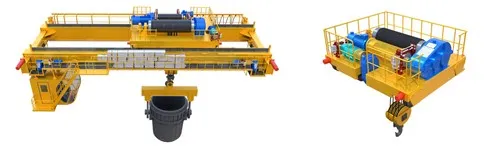
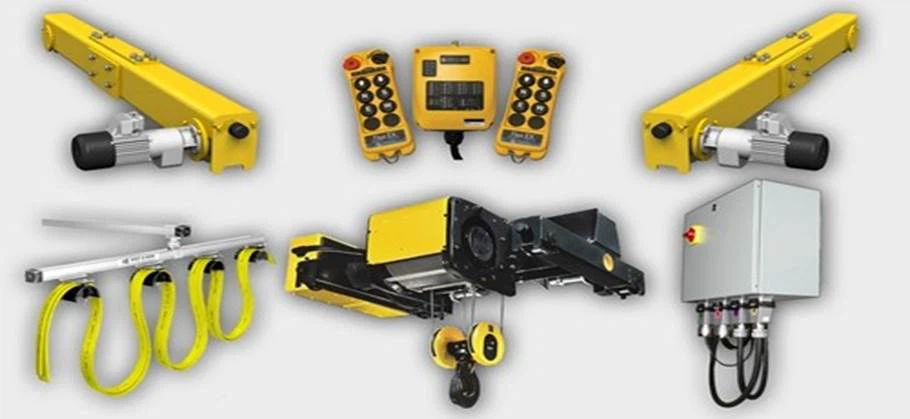
1. Whole set crane
A foundry crane is a specialized type of overhead crane designed for heavy-duty and high-temperature environments, commonly used in foundries, steel plants, and metalworking industries. These cranes handle molten metal, heavy castings, and other challenging loads with precision and durability.
Foundry Crane – Whole Set Crane Components
A complete foundry crane system typically includes the following key components:
1. Bridge Girder
Main load-bearing structure that spans the width of the workshop.
Designed with high heat resistance and durability for foundry conditions.
Single or double girder configuration based on capacity.
2. End Carriages & Wheels
Supports the bridge girder and allows movement along the runway.
Equipped with heavy-duty wheels and heat-resistant bearings.
3. Hoist & Trolley
Electric Hoist – Lifts and lowers loads (wire rope or chain hoist).
Trolley – Moves the hoist along the bridge girder.
Special heat-resistant motors and insulated wiring for high-temperature environments.
4. Runway System
Rails mounted on building columns or freestanding supports.
Ensures smooth crane movement along the length of the workshop.
5. Control System
Pendant control (push-button pendant) or radio remote control.
Variable frequency drives (VFD) for smooth operation.
Overload protection and emergency stop features.
6. Additional Foundry-Specific Features
Heat Shields – Protect electrical components from radiant heat.
Molten Metal Ladle Handling – Special hooks or attachments.
Explosion-Proof Options – For hazardous environments.
Dust & Splash Protection – Sealed motors and components.

2. Main girder
The main girder is a critical component of a foundry crane, responsible for supporting the load and ensuring the crane's structural integrity. Here's a detailed breakdown:
1. Function of the Main Girder in a Foundry Crane
Primary Load-Bearing Structure: Supports the hoist, trolley, and the lifted load.
Ensures Stability: Provides rigidity to prevent excessive deflection or vibration.
Facilitates Movement: Allows the trolley (and hoist) to travel along its length.
2. Design Considerations
Foundry cranes operate in harsh environments (high heat, dust, fumes), so the main girder must be designed for:
High Heat Resistance: Often made from heat-resistant steel or coated with protective materials.
Robust Construction: Heavy-duty design to handle molten metal, ladles, and slag pots.
Corrosion & Wear Resistance: Special coatings or materials to withstand abrasive and corrosive conditions.

3. Lifting System
A foundry crane is a specialized type of overhead crane designed for heavy-duty and often hazardous environments, such as metal foundries, steel mills, and other industrial settings with high temperatures, dust, and corrosive materials. The lifting system of a foundry crane is crucial for handling molten metal, heavy castings, and other challenging loads safely and efficiently.
Key Components of a Foundry Crane Lifting System
Hoist Mechanism
Typically uses a wire rope hoist or chain hoist with high heat resistance.
Designed for slow, precise movements to prevent spills (especially when handling molten metal).
May include dual hoists for redundancy and safety.
Lifting Hook & Safety Latch
Made of heat-resistant alloy steel to withstand high temperatures.
Equipped with a safety latch to prevent accidental release.
Trolley System
Moves the hoist along the bridge girder.
Can be motorized for precise positioning.
Some foundry cranes use double-girder designs for extra stability.
End Trucks & Runway System
Heavy-duty wheels and rails to support high loads.
May include heat-resistant coatings or cooling systems for extreme environments.
Control System
Pendant control (wired or wireless) for operator flexibility.
Variable frequency drives (VFDs) for smooth acceleration/deceleration.
Fail-safe brakes to prevent unintended movement.
Specialized Attachments (for Foundry Use)
Ladle hooks for molten metal handling.
Grab buckets for scrap or sand.
Electromagnets (for ferrous materials, if not handling molten metal).

4. End Carriages
End carriages are critical components of foundry cranes, serving as the structural framework that supports and guides the crane bridge along the runway rails. In the demanding environment of a foundry, these components must withstand extreme conditions including high temperatures, heavy loads, and potential exposure to molten metal.
Heat-Resistant Construction
Made from special heat-resistant steel alloys
Often equipped with thermal barriers or heat shields
May include cooling systems for extreme temperature applications
Heavy-Duty Wheels
Forged steel or specially hardened wheels
High temperature-resistant wheel bearings
Often double-flanged for extra security against derailment
Robust Drive Systems
Enclosed gear reducers to prevent contamination
Heat-protected motors and brakes
Frequency-controlled drives for precise positioning
Enhanced Safety Features
Thermal sensors to monitor component temperatures
Reinforced bumpers and buffers
Anti-derailment devices
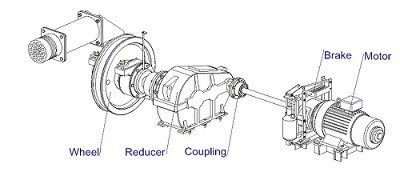
5.Crane traveling mechanism
The traveling mechanism of a foundry crane is a critical component that enables the crane to move along a predefined path, typically on rails installed on the workshop floor or elevated runway beams. This mechanism ensures smooth and precise movement for handling heavy loads in foundry environments, where high temperatures, molten metal, and harsh conditions are common.
Components of a Foundry Crane Traveling Mechanism
Traveling Wheels
Made of high-strength steel or forged alloy to withstand heavy loads.
Often equipped with double flanges to prevent derailment.
Heat-resistant materials may be used in foundry applications.
Drive Motors
Typically AC or DC electric motors with high torque for smooth acceleration/deceleration.
May include variable frequency drives (VFDs) for precise speed control.
Gearbox (Reducer)
Converts high-speed motor rotation into slower, high-torque movement.
Helical or bevel gear reducers are common for durability.
Braking System
Electromagnetic brakes or hydraulic disc brakes for safe stopping.
Fail-safe mechanisms to prevent unintended movement.
Rail System
Heavy-duty steel rails (usually QU80, QU100, or QU120 standards).
Rails are securely anchored to the floor or supporting structure.
Buffers & End Stops
Rubber or hydraulic buffers at rail ends to absorb impact.
Limit switches to prevent over-travel.
Lubrication System
Automatic or manual lubrication for wheels and gears to reduce wear.
6. Trolley traversing mechanism
The trolley traversing mechanism is a critical component of a foundry crane, responsible for moving the trolley (and the attached lifting device, such as a hoist or grab) horizontally along the crane bridge. This mechanism ensures precise positioning of loads within the foundry environment, where accuracy and reliability are essential.
Key Components of the Trolley Traversing Mechanism:
Drive Motor
Provides the power for trolley movement (typically AC or DC, with variable speed control for precision).
Often equipped with brakes for controlled stopping.
Gearbox / Reduction Unit
Reduces motor speed to achieve optimal trolley travel speed.
Enhances torque for smooth movement under heavy loads.
Wheels & Axles
Made of high-grade steel or forged alloy for durability.
May have flanged wheels to prevent derailment.
Rail System
Consists of hardened steel rails mounted on the crane bridge.
Rails must be precisely aligned to ensure smooth movement.
Bearings & Shafts
Heavy-duty bearings support the wheels and reduce friction.
Shafts must be robust to handle dynamic loads.
Control System
Includes limit switches for safe travel range.
Variable frequency drives (VFDs) for smooth acceleration/deceleration.
Remote or pendant control for operator use.
Buffers & End Stops
Prevent over-travel and absorb impact at rail ends.
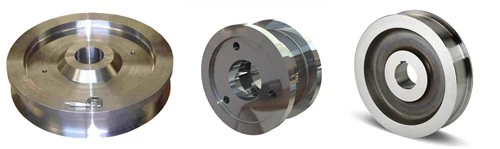
7. Crane wheel
Crane Wheels in Foundry Cranes
Crane wheels are critical components that allow the crane to move smoothly along the runway rails. In foundry cranes, the wheels must withstand:
High temperatures (due to proximity to molten metal)
Heavy loads (often several tons)
Abrasive conditions (dust, slag, and debris)
Types of Foundry Crane Wheels
Forged Steel Wheels
High strength and durability
Resistant to wear and deformation
Commonly used in heavy-duty foundry cranes
Heat-Treated Wheels
Hardened surfaces for better wear resistance
Suitable for high-temperature environments
Double-Flanged vs. Single-Flanged Wheels
Double-flanged wheels provide better rail alignment, reducing derailment risks.
Single-flanged wheels are used when one side needs guidance while the other runs freely.
Special Coatings or Materials
Some wheels have special coatings (e.g., ceramic or alloy treatments) to resist extreme heat and corrosion.
Key Considerations for Foundry Crane Wheels
Load Capacity – Must match the crane's maximum load, including impact factors.
Wheel Diameter – Larger wheels distribute load better and reduce wear on rails.
Material Hardness – Should be harder than the rail to prevent excessive wear.
Lubrication & Maintenance – Foundry conditions may require high-temperature lubricants
8. Crane hook
Key Features of Foundry Cranes:
Robust Construction – Built to withstand extreme heat, dust, and heavy loads.
Heat-Resistant Components – Specialized hooks, wire ropes, and electrical systems to handle molten metal.
High Lifting Capacity – Typically ranges from 5 tons to over 500 tons.
Double-Girder Design – Provides greater stability for heavy and hazardous loads.
Advanced Safety Features – Includes overload protection, emergency brakes, and heat shields.
Specialized Hook Path – Ensures precise handling of ladles and castings.
Foundry Crane Hook
The crane hook in a foundry setup is a critical component, often reinforced to handle extreme conditions:
Types of Foundry Crane Hooks:
Forged Steel Hooks – Standard heavy-duty hooks for general foundry use.
Heat-Resistant Hooks – Made from alloy steel to withstand high temperatures near molten metal.
Ramshorn Hooks (C-hooks) – Used for ladles and special lifting attachments.
Safety-Latched Hooks – Equipped with a latch to prevent load slippage.
Hook Specifications:
Material: High-grade alloy steel (e.g., DIN 15401 / ASTM A668).
Load Rating: Matches the crane's capacity (e.g., 20T, 50T, 100T+).
Safety Factor: Typically 4:1 or higher for foundry applications.

9. Motor
A foundry crane motor is a specialized electric motor designed to operate in the harsh environments of foundries, where high temperatures, dust, molten metal, and heavy loads are common. These motors power the hoisting, traversing, and long-travel movements of cranes used in metal casting, steel plants, and other heavy industrial applications.
Key Features of Foundry Crane Motors:
Heat Resistance – Designed to withstand high ambient temperatures (often up to 60°C or more) due to proximity to molten metal.
Dust & Moisture Protection – Typically rated IP55 or higher to prevent ingress of dust, metal particles, and humidity.
Robust Construction – Heavy-duty frames (often cast iron or steel) to endure mechanical stress and vibrations.
High Starting Torque – Essential for lifting heavy loads smoothly without stalling.
Thermal Protection – Equipped with thermal sensors or overload relays to prevent overheating.
Explosion-Proof Options (Ex d, Ex e) – Required in hazardous zones where flammable gases or dust may be present.
Voltage & Power Range – Commonly 380V, 415V, 480V, or 660V (3-phase AC), with power ranging from 5 kW to 500+ kW depending on crane capacity.
Duty Cycle – Designed for S3 (intermittent duty) or S4 (continuous duty with frequent starts) operation.
Types of Motors Used in Foundry Cranes:
AC Induction Motors (Squirrel Cage or Slip Ring) – Most common due to reliability and low maintenance.
Variable Frequency Drive (VFD) Motors – For smooth speed control and energy efficiency.
Brake Motors – Equipped with fail-safe brakes to hold loads securely.
Explosion-Proof Motors (ATEX/IECEx Certified) – For hazardous environments.

10. Sound and light alarm system & limit switch
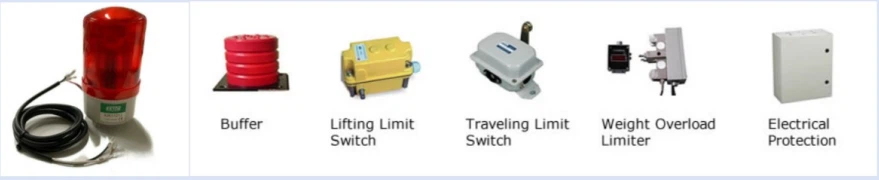
A foundry crane is a critical piece of equipment in heavy industrial environments, such as steel plants, foundries, and metalworking facilities. To ensure safe and efficient operation, it is equipped with a sound and light alarm system and limit switches. Below is an overview of these components:
1. Sound and Light Alarm System
The alarm system is designed to alert operators and nearby personnel about critical crane operations, malfunctions, or safety hazards.
Functions:
Warning Signals:
Audible alarms (horns, buzzers) and flashing lights activate when the crane starts, stops, or moves.
Alerts personnel when the crane is approaching a hazardous zone or overload condition.
Emergency Alarms:
Triggers in case of power failure, overheating, or system malfunctions.
Operational Status Indicators:
Different light colors (green, yellow, red) may indicate normal operation, caution, or emergency.
Components:
Rotating Beacon Lights (Red/Amber) – High visibility in dusty or dark environments.
Horn/Siren – Loud enough to be heard over industrial noise.
Control Panel Integration – Alarms are linked to the crane's PLC or control system.
2. Limit Switches
Limit switches are safety devices that prevent the crane and its components from moving beyond safe operational limits.
Types of Limit Switches in Foundry Cranes:
Hoisting Limit Switch
Prevents over-hoisting (prevents the hook block from crashing into the drum).
Cuts power when the hook reaches the upper safe limit.
Lowering Limit Switch
Stops the hook at a safe lower position to avoid cable slack or collision.
Trolley & Bridge Travel Limit Switches
Prevents the crane from moving beyond the runway ends.
Often includes buffers or shock absorbers for additional protection.
Load Limit Switch (Overload Protection)
Triggers if the crane exceeds its rated capacity.
May activate an alarm and cut off lifting power.
11. Safety Devices
1. Overload Limiter (Load Limit Switch)
Prevents the crane from lifting loads beyond its rated capacity.
Automatically cuts off power if the load exceeds a safe threshold.
2. Limit Switches (Travel Limiters)
Hoisting Limit Switch – Prevents over-hoisting (prevents the hook block from hitting the drum).
Lowering Limit Switch – Ensures the hook does not descend too far.
Trolley & Bridge Travel Limit Switches – Stops crane movement at the end of the runway.
3. Emergency Stop (E-Stop) Buttons
Installed at multiple locations (cabin, pendant, ground) for immediate shutdown in emergencies.
4. Anti-Collision System
Uses sensors or lasers to prevent collisions between multiple cranes or with obstacles.
5. Thermal Protection (for Motors & Electrical Systems)
Prevents overheating in motors, brakes, and electrical panels due to high ambient temperatures in foundries.
6. Insulated / Heat-Resistant Components
Special heat shields for wiring, hooks, and controls to withstand radiant heat from molten metal.
7. Double Braking System
Primary Brake – Mechanical brake for normal stopping.
Secondary (Emergency) Brake – Engages if the primary brake fails (especially crucial for hoisting mechanisms).
8. Load Weighing Indicator
Displays real-time load weight to the operator to prevent accidental overloading.
9. Voltage & Phase Monitoring Relay
Protects against power fluctuations and phase failures that could damage the crane.
10. Fire-Resistant & Explosion-Proof Features
Foundry cranes handling molten metal may have:
Flame-retardant cables.
Explosion-proof electrical enclosures (if hazardous gases are present).
11. Safety Guards & Covers
Protects moving parts (gears, chains, couplings) to prevent accidental contact.
12. Anti-Sway System (for Precise Load Handling)
Reduces load swinging, especially important when transporting molten metal.
13. Ground Fault Protection
Prevents electrical shocks by detecting insulation failures.
14. Manual Lowering Device (Emergency Lowering)
Allows safe lowering of the load in case of power failure.
15. Warning Alarms & Lights
Audible alarms and flashing lights alert workers before crane movement.
12. Control Mode
1. Pendant Control (Push Button Pendant)
Operation: The crane is controlled via a handheld pendant (wired or wireless) with buttons for hoisting, traversing, and trolley movement.
Applications: Suitable for general foundry operations where the operator needs to be near the load.
Advantages: Simple, cost-effective, and allows precise control.
Disadvantages: Limited range; operator must be in close proximity.
2. Radio Remote Control (Wireless)
Operation: Uses a wireless remote control (RF or infrared) for crane operation.
Applications: Ideal for hazardous or high-temperature foundry environments where the operator needs mobility.
Advantages: Greater flexibility, improved safety (operator can move freely).
Disadvantages: Requires battery management and signal reliability checks.
3. Cabin Control (Operator Cab)
Operation: The crane is operated from an enclosed or open cabin mounted on the crane or a fixed control station.
Applications: Used in heavy-duty foundry operations where visibility and long-duration control are needed.
Advantages: Better visibility, ergonomic controls, and protection from heat/fumes.
Disadvantages: Higher cost, requires proper cabin cooling/shielding in hot environments.
4. Semi-Automatic & Automated Control
Operation: Uses programmable logic controllers (PLCs) or automation systems for repetitive tasks (e.g., ladle handling, pouring).
Applications: Foundries with consistent production processes (e.g., molten metal transfer).
Advantages: Reduces human error, improves efficiency, and enhances safety.
Disadvantages: Higher initial cost, requires maintenance and programming expertise.
5. Dual Control Mode (Pendant + Remote or Cabin)
Operation: Allows switching between different control methods (e.g., pendant for maintenance, remote for normal operation).
Applications: Foundries needing flexibility in operation modes.
Advantages: Versatile, improves operational efficiency.
Disadvantages: More complex wiring/control system.

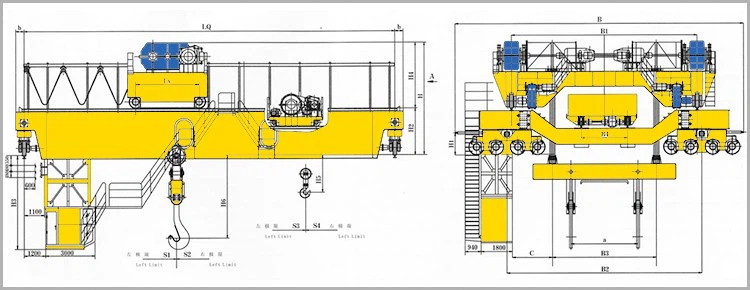
13. Sketch
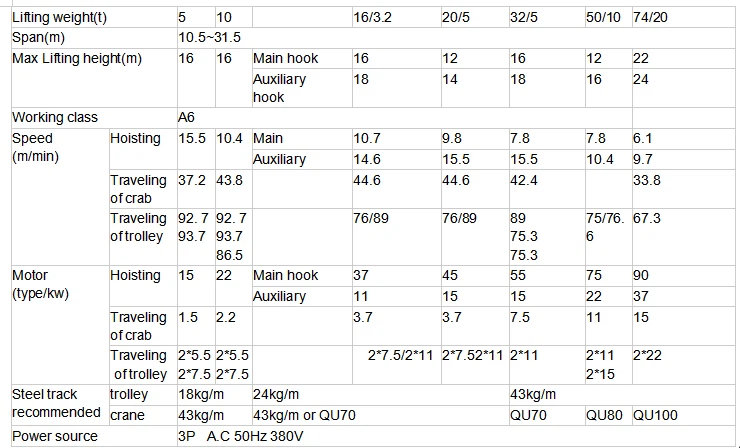
Main Technical Data
Advantages
1. High Heat Resistance
Designed to withstand extreme temperatures, often with heat-resistant materials (e.g., special steel, heat shields, and protective coatings).
Insulated components (e.g., motors, electrical systems) to prevent overheating.
2. Heavy Load Capacity
Built to handle extremely heavy loads (up to hundreds of tons), making them ideal for molten metal handling, ladles, and large castings.
3. Durability & Long Service Life
Robust construction with reinforced girders, wheels, and trolleys to endure harsh conditions.
Resistant to dust, slag, and corrosive fumes common in foundries.
4. Safety Features
Double Girder Design for better stability when lifting heavy, unbalanced loads.
Fail-safe brakes to prevent accidents in case of power failure.
Overload protection to avoid mechanical stress.
Anti-sway technology for precise handling of molten metal.
5. Precision & Control
Smooth and precise movement (via variable frequency drives) for safe handling of delicate or hazardous materials.
Remote control options to keep operators at a safe distance from high-temperature zones.
6. Customization for Foundry Applications
Special hooks (C-hooks, forged hooks) for ladles and crucibles.
Optional explosion-proof features for hazardous environments.
Heat-resistant wire ropes or chains for longevity.
7. Low Maintenance Requirements
Designed for minimal downtime with easy-to-access components for servicing.
High-quality bearings and lubrication systems to withstand harsh conditions.
8. Improved Efficiency in Metal Handling
Faster and safer transportation of molten metal compared to manual methods.
Reduces labor risks and increases productivity in casting processes.
9. Adaptability to Automation
Can be integrated with smart systems (IoT, automation) for Industry 4.0 foundries.
10. Compliance with Industry Standards
Meets international safety standards (ISO, FEM, OSHA, CMAA) for heavy-duty cranes.
Application
Handling Molten Metal
Transporting ladles containing molten steel or iron.
Pouring molten metal into molds (casting process).
Moving Heavy Loads
Lifting and transporting large castings, ingots, or scrap metal.
Handling dies, molds, and other heavy foundry equipment.
Steel Mills & Forging Shops
Moving billets, slabs, and rolled steel.
Assisting in forging and pressing operations.
Heat-Resistant Operations
Working in high-temperature environments near furnaces or kilns.
Crane Production Procedure
1. Design and Engineering:
Requirement Analysis: Understand the specific needs for the foundry crane, such as load capacity, span, lifting height, and environmental conditions (e.g., high temperatures, molten metal handling).
Detailed Design: The design team creates detailed plans and specifications for the crane, including the main girder, hoist, trolley, control system, and electrical wiring. The design will ensure the crane is sturdy enough to handle extreme conditions.
Structural Analysis: Perform stress analysis and load testing to ensure safety and reliability under the operating conditions typical in a foundry.
2. Material Selection:
High-Quality Steel: Materials like high-strength carbon steel and heat-resistant alloy steels are typically chosen for components that will be exposed to high temperatures.
Corrosion-Resistant Coatings: The components of the crane, especially those exposed to molten metal or corrosive atmospheres, are treated with special coatings to prevent damage.
3. Fabrication of Components:
Girder and Frame Fabrication: The main girder (the bridge part of the crane) is fabricated, often using heavy-duty welding techniques. It is typically fabricated in sections that will be assembled later.
Hoist and Trolley Construction: The hoisting mechanism (electric or hydraulic) is built, along with the trolley (the part that moves along the girder). These systems must be designed to handle the load safely, especially in a foundry environment.
Electrical and Control Systems: The electrical system, including wiring, motors, and control panels, is fabricated and assembled. Advanced safety and control mechanisms, including overload protection, are essential in a foundry crane.
4. Assembly of Components:
Pre-Assembly: The individual components, such as the girder, hoist, trolley, and control systems, are assembled in sections. This is done in a controlled factory environment to ensure all parts fit correctly.
Main Girder Assembly: The main girders are connected and tested for alignment and load-bearing capability.
Hoist and Trolley Mounting: The hoist and trolley systems are mounted onto the girder, and alignment checks are done to ensure smooth operation.
5. Welding and Structural Integrity Check:
Welding: The components are welded together, ensuring structural integrity and robustness. Special attention is paid to the joints, as they must withstand high loads.
Inspection: The welded joints and crane structure are thoroughly inspected for quality, using methods like ultrasonic testing, x-ray, or magnetic particle inspection.
6. Installation of Electrical and Safety Systems:
Electrical Installation: Wiring and the power supply system are installed. This includes motors for the trolley, hoist, and the lifting mechanism, as well as control panels.
Safety Features: Install safety features like emergency stop buttons, overload limiters, and anti-collision systems. Cranes used in foundries may also be equipped with heat shields to protect sensitive components from molten metal splashes.
7. Testing and Quality Control:
Load Testing: The crane is tested under controlled conditions to verify it can handle the specified load without issues. Load testing ensures that both the hoist and the trolley can move freely under full load.
Functional Testing: The crane's hoisting, trolley movement, and electrical systems are tested for functionality and reliability. This also includes testing safety systems.
Thermal Testing: In some cases, especially for foundry cranes, the crane may be tested in high-temperature conditions to ensure all components can withstand extreme heat.
8. Final Inspection:
A final inspection is conducted to ensure that all aspects of the crane meet design specifications, safety standards, and customer requirements.
The crane is checked for operational smoothness, proper functioning of all mechanisms, and safety features.

Workshop View
The company has installed an intelligent equipment management platform, and has installed 310 sets (sets) of handling and welding robots. After the completion of the plan, there will be more than 500 sets (sets), and the equipment networking rate will reach 95%. 32 welding lines have been put into use, 50 are planned to be installed, and the automation rate of the entire product line has reached 85%.


Hot Tags: foundry crane, China foundry crane manufacturers, suppliers, factory, Steel Mill Overhead Cranes, Steel Factory Overhead Crane, Ladle Foundry and Casting Steel Mill Overhead Crane, Ladle Foundry Bridge Crane, Rolling Mill Overhead Crane, Casting Steel Overhead Crane
You Might Also Like


Send Inquiry