










Metal Casting Ladle Overhead Crane
Metal casting ladle overhead cranes are made from high-quality cast steel, which provides exceptional strength and durability. They have a long service life and are highly resistant to wear and tear.
These overhead cranes are crucial for the safe and efficient handling of molten metal in industrial settings, ensuring both worker safety and operational productivity.
Some common features of metal casting ladle overhead crane include:
- High load capacity: These cranes can lift and move heavy loads, ranging from a few hundred kilograms to several tons.
- Smooth operation: They have precision controls and are easy to operate, ensuring smooth and safe movement of loads.
- Easy maintenance:Metal casting ladle overhead cranes are designed for easy maintenance and repair, reducing downtime and operating costs.
- High durability: The use of cast steel provides exceptional strength and durability, making these cranes suitable for heavy-duty applications.
- Versatility: They can be used in various industries and applications, such as manufacturing, construction, and transportation.
- Capacity: 5-800/50ton
- Span length: 4-35m
- Lifting height: 3-50m
- Work duty: A4, A5, A6,A7
- Raged voltage: 220V~690V, 50-60Hz, 3ph AC
- Work environment temperature: -25℃~+50℃, relative humidity ≤85%
- Crane control mode: Floor control / Remote control / Cabin room

Pictures & Components
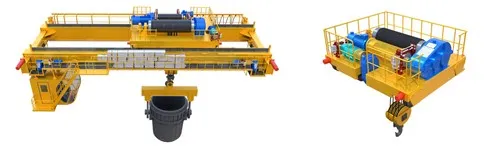
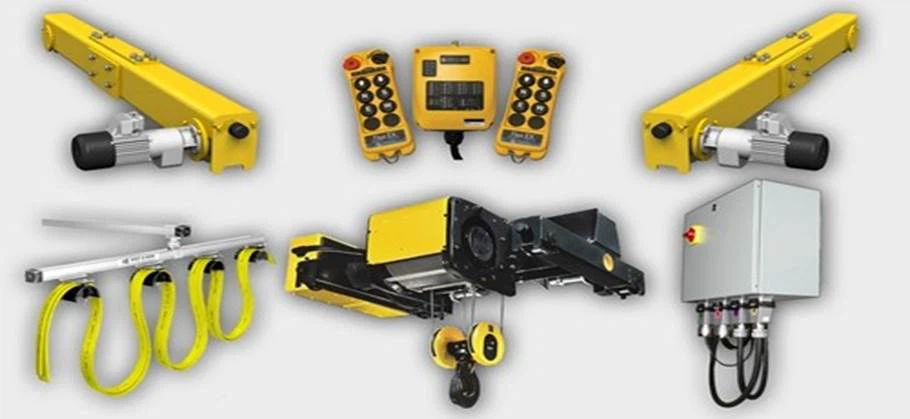
1. Whole set crane
A whole set crane of a metal casting ladle overhead crane typically refers to a complete system designed for safely lifting and moving heavy metal casting ladles in foundries or steel plants. These cranes are engineered for extreme loads and high temperatures.
The system usually consists of:
- Main Hoist: This is the primary lifting mechanism of the crane, which is designed to handle heavy ladles filled with molten metal.
- Bridge: The horizontal part of the crane that spans across the workstation or furnace area, allowing the ladle to move from one point to another.
- Trolley: This part moves the hoist along the bridge, typically powered by electric motors.
- Lifting Hook or Ladle Attachment: A custom lifting hook or specialized attachment is designed to securely hold the ladle. These attachments are heat-resistant and capable of handling molten metal.
- Electrical System: The entire system is powered by electric motors and controlled via a sophisticated control panel, often featuring wireless remote operation, safety features, and overload protection.
- Safety Features: Given the hazardous nature of working with molten metal, these cranes have safety mechanisms such as emergency stops, overload protection, and redundant brakes.

2. Main girder
The main girder of a metal casting ladle overhead crane is a crucial structural component that supports the entire load during operation. It is designed to bear heavy loads such as the metal ladle, which can weigh several tons, and to provide stability and durability for safe lifting and transport of molten metal.
Here are some key features of the main girder:
- Material: The main girder is typically made from high-strength steel or alloy steel to handle the high loads and extreme temperatures in the casting process.
- Design: It is usually designed as a box girder or I-beam to ensure strength while minimizing weight. The design depends on factors like the load capacity, span, and operational environment.
- Load Capacity: The main girder must be engineered to handle the weight of the ladle and the molten metal, with safety margins for overloads.
- Welds and Joints: Strong welds are used in the construction of the girder to ensure its integrity under heavy loads. Reinforcements may be added at critical points.
- Temperature Resistance: Given the high-temperature environment (molten metal handling), the girder must be resistant to heat and thermal expansion.
- Dimensions: The dimensions and thickness of the main girder vary depending on the crane's specifications, the size of the ladle, and the operational requirements.
- Support and Reinforcement: The girder is supported by the crane's end trucks or supports and often has additional reinforcements like diagonal braces to further enhance load distribution.

3. Lifting System
The lifting system of a metal casting ladle overhead crane typically consists of several key components designed to safely lift, transport, and pour molten metal. The components and their functions include:
- Hoist Mechanism: This includes an electric motor-driven winch or drum system with a wire rope or chain, responsible for raising and lowering the ladle. It typically features high lifting capacity to handle the heavy weight of molten metal.
- Ladle Hook: The ladle hook is used to hold the ladle securely during lifting. This is often designed with a special attachment to accommodate the shape and design of metal casting ladles, providing a safe grip.
- Trolley: The trolley runs along the overhead crane track and allows for lateral movement of the ladle. This is powered by an electric motor and controlled by the crane operator to position the ladle over the casting area.
- Bridge: The bridge is the main structural component that spans the area above the foundry, supporting the trolley and hoist mechanism. It allows for horizontal movement along the entire area of the casting floor.
- Safety Mechanisms: These include limit switches to prevent over-travel, emergency stop functions, load sensors to monitor the weight of the ladle, and safety brakes to prevent accidents in case of power failure.
- Controls: The lifting system is operated by a control panel or a remote system, allowing the crane operator to control the lifting, lowering, and horizontal movements of the ladle. In more advanced setups, the crane can be automated with programmable logic controllers (PLC) for precise control.
- Ladle Positioning System: To ensure the ladle is accurately positioned for pouring, these systems can include tilting devices that allow for controlled pouring of molten metal. The ladle may also be equipped with a hydraulic system that tilts it at specific angles for pouring.
- Electrical and Safety System: High-voltage electrical systems power the crane, while safety systems like overload protection, emergency braking, and fall protection are essential to prevent accidents.
4. End Carriages
The end carriages of a metal casting ladle overhead crane are a crucial part of the crane system. These carriages support the entire load and allow the crane to move the ladle (which is used to hold molten metal) efficiently and safely within the industrial environment.
Here are some key aspects of the end carriages:
Purpose: End carriages serve as the foundation for the bridge of the crane. They house the wheels and axles that allow the crane to travel along the runway beams.
Material and Design: The end carriages are often made of steel or other high-strength materials to handle heavy loads, especially in a metal casting environment where the ladle can be very heavy and hot.
Load Capacity: These carriages are designed to handle the weight of the ladle, which could range from several tons to over 100 tons depending on the crane and ladle specifications.
Wheel Assembly: The end carriages typically feature robust wheel assemblies designed to operate on either steel or concrete runway tracks. These wheels are engineered to handle high loads, reduce wear, and ensure smooth movement.
Safety Features: Given the hazardous nature of metal casting, the end carriages usually include safety mechanisms to prevent excessive movement, overspeed, or derailment. These mechanisms may include limit switches, overload sensors, and braking systems.
Motors and Drive Systems: The motors in the end carriages are often heavy-duty electric motors designed to provide enough power for the crane to move efficiently under full load. The drive system could be AC or DC motors, depending on the design.
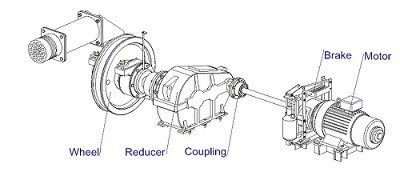
5. Crane traveling mechanism
The crane traveling mechanism of a metal casting ladle overhead crane is an essential part of the crane's operation, especially in industries like steel or metal casting. This mechanism allows the crane to move the ladle, which is a large container used to transport molten metal, along a track or beam system. The key components and operation of this mechanism include:
Traveling Wheels: These wheels are mounted on the sides of the crane and allow it to move along the overhead runway. The wheels are powered by motors and driven by a gear system that converts electrical energy into mechanical motion.
Drive Mechanism: A motor, usually electric, powers the movement of the crane. This motor is connected to a gearbox and a set of gears, which in turn drive the traveling wheels.
Rail System: The crane operates on a set of tracks or rails, which are installed along the overhead structure. The rails guide the crane's movement and provide stability while it travels along the length of the casting bay or furnace area.
Speed Control: The crane's speed can be controlled by adjusting the frequency of the electrical power supplied to the motor. Speed regulation is important for precise positioning of the ladle, especially when handling molten metal.
Braking System: Overhead cranes are equipped with emergency brakes and friction brakes to stop the crane safely. The braking system ensures that the crane can halt quickly when necessary, especially to prevent any accidents involving molten metal.
Safety Mechanisms: These may include limit switches to prevent over-travel (in case the crane reaches the end of its designated track), sensors to detect obstacles or irregularities, and overload protection systems to ensure the crane doesn't exceed its maximum load capacity.
Control System: The control system is typically a combination of manual and automatic controls. Operators use a pendant or wireless controller to operate the crane, but there might also be automated features for certain operations like moving the ladle to a specific position.
6. Trolley traversing mechanism
The crane wheel for a metal casting ladle overhead crane is a critical component used to support and guide the movement of the ladle, which is typically used in industrial foundries or steel mills for holding molten metal. These wheels are designed to handle heavy loads and withstand high temperatures.
Here are some key features and considerations:
Material: Crane wheels for overhead cranes, especially those used with metal casting ladles, are often made of high-quality steel, sometimes alloyed with specific elements to enhance strength, heat resistance, and durability. In some cases, heat-treated or wear-resistant materials are used to prolong the wheel's lifespan under heavy-duty conditions.
Load-bearing capacity: The wheels must support the ladle's weight, which can be substantial due to the molten metal inside, so they are designed to carry very high loads. This requires robust engineering to ensure safety and reliability.
Design and shape: The crane wheels are usually cylindrical in shape, often with a flange on the inside to help keep the ladle's track or rail in place. The profile of the wheel can be designed to ensure smooth movement along the rail and minimize wear and tear.
Temperature resistance: Since these cranes are often used in environments with extreme temperatures due to molten metal, the wheels must be resistant to thermal stress. High-performance coatings or alloy materials might be used to prevent deformation or failure due to heat exposure.
Safety and maintenance: The wheels must be designed for easy maintenance and replacement, as they experience significant wear over time, especially in high-stress applications like metal casting. Regular checks are essential to ensure smooth operation and prevent accidents.
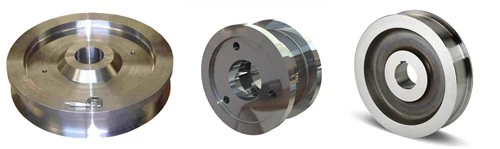
7. Crane wheel
The crane wheel for a metal casting ladle overhead crane is a critical component used to support and guide the movement of the ladle, which is typically used in industrial foundries or steel mills for holding molten metal. These wheels are designed to handle heavy loads and withstand high temperatures.
Here are some key features and considerations:
Material: Crane wheels for overhead cranes, especially those used with metal casting ladles, are often made of high-quality steel, sometimes alloyed with specific elements to enhance strength, heat resistance, and durability. In some cases, heat-treated or wear-resistant materials are used to prolong the wheel's lifespan under heavy-duty conditions.
Load-bearing capacity: The wheels must support the ladle's weight, which can be substantial due to the molten metal inside, so they are designed to carry very high loads. This requires robust engineering to ensure safety and reliability.
Design and shape: The crane wheels are usually cylindrical in shape, often with a flange on the inside to help keep the ladle's track or rail in place. The profile of the wheel can be designed to ensure smooth movement along the rail and minimize wear and tear.
Temperature resistance: Since these cranes are often used in environments with extreme temperatures due to molten metal, the wheels must be resistant to thermal stress. High-performance coatings or alloy materials might be used to prevent deformation or failure due to heat exposure.
Safety and maintenance: The wheels must be designed for easy maintenance and replacement, as they experience significant wear over time, especially in high-stress applications like metal casting. Regular checks are essential to ensure smooth operation and prevent accidents.
8. Crane hook
A crane hook for a metal casting ladle overhead crane is a specialized component designed to handle heavy molten metal ladles in industrial settings, such as steel mills or foundries. These hooks are part of the overhead crane system used to transport ladles filled with molten metal from one point to another, typically during the metal casting process.
Here are some key characteristics of a crane hook for a metal casting ladle overhead crane:
High Load Capacity: These hooks are designed to carry extremely heavy loads, often ranging from several tons to over 100 tons, depending on the size of the ladle and the crane system.
Heat Resistance: Since they deal with molten metal, the hooks are often made of materials with high heat resistance and durability, such as heat-treated steel or alloys designed to withstand the high temperatures of molten metal.
Reinforced Design: The hooks usually have a reinforced or thickened design to prevent failure under heavy loads and extreme conditions, ensuring safe lifting and movement of the ladle.
Safety Features: Some crane hooks are equipped with safety latches or other mechanisms to prevent accidental release of the ladle, ensuring the safety of workers and equipment.
Corrosion Resistance: The materials are typically selected for their resistance to corrosion, given the harsh environment and exposure to molten metal and industrial elements.
Customization: Depending on the specific needs of the metal casting facility, the crane hook may be custom-designed to fit the shape, size, and lifting requirements of the ladle and crane system.

9. Motor
The motor of a metal casting ladle overhead crane plays a critical role in lifting and transporting molten metal within a foundry or steel plant. This type of crane is specifically designed to handle heavy loads, including ladles filled with molten metal, and it operates in harsh environments, often subject to extreme temperatures and heavy-duty cycles. Here's an overview of the motor system used in such cranes:
Motor Type:
AC Motors: Most overhead cranes, including metal casting ladle cranes, use AC motors, often squirrel-cage induction motors, due to their simplicity, reliability, and ability to handle heavy loads.
DC Motors: In some cases, DC motors may be used for precise control of speed and torque, particularly in applications that require frequent starts and stops.

10. Sound and light alarm system & limit switch
Sound and Light Alarm System:
Purpose: The sound and light alarm system is used to enhance safety by alerting personnel to various crane activities or potential hazards, such as when the crane is in operation, or if there's an emergency or malfunction.
Components:
Sound Alarm (Horns or Bells): Typically, a loud horn or bell is used to indicate critical operations or potential hazards. For example, when the crane is approaching a limit, or the ladle is being moved to a dangerous position, the sound alarm warns workers in the vicinity.
Light Indicators (Flashing Lights or Beacons): These are installed on the crane or in the surrounding area. Flashing lights can indicate the crane is in operation, moving in a dangerous area, or signaling an emergency. They help to provide a visual warning in addition to the sound alert, which is especially useful in noisy environments like steel plants.
Operation:
Sound: Often triggered by sensors or control systems that detect certain crane motions or positions, or by emergency conditions such as a malfunction or overload.
Light: Flashing or steady light indicators are activated in specific sequences to convey different messages, such as when the crane is in motion, at maximum load capacity, or when maintenance is required.
Limit Switch:
Purpose: A limit switch is a safety device that prevents the crane from exceeding predefined movement limits, protecting both the crane and the personnel from potential accidents caused by overtravel or excessive load.
Operation:
Position Sensing: Limit switches are typically installed at critical positions along the crane rails, hoist, or trolley. They monitor the position of the crane and ensure it doesn't exceed certain predefined ranges, like the maximum height or length of travel for lifting the ladle.
Mechanical/Optical Types: Some limit switches work mechanically with physical contact, while others use optical sensors or proximity sensors to detect the crane's position without physical contact.
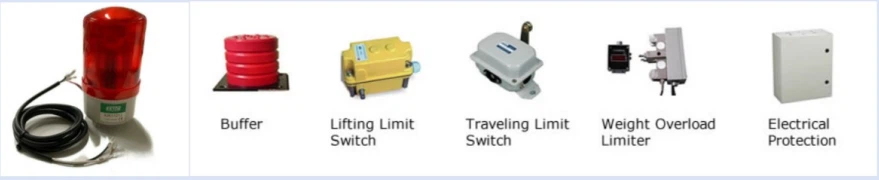
11. Safety Devices
Overload Protection Device:
This prevents the crane from lifting a load that exceeds its capacity. It helps avoid structural damage to the crane and potential accidents.
Limit Switches:
Limit switches are used to restrict the crane's movement to a certain range. These prevent the crane from over-traveling or operating beyond safe limits in all directions (vertical, horizontal).
Anti-Sway Mechanism:
This system helps to control the swinging of the ladle when lifting, preventing hazardous movement during transport.
Load Moment Indicator (LMI):
A load moment indicator is used to monitor the weight and distribution of the load. It signals if the crane is close to exceeding its safe working load.
Emergency Stop Button:
This is essential in an emergency situation to stop the crane's operation immediately, cutting power to avoid accidents.
Brake Systems:
Brakes are crucial for ensuring that the crane holds its position securely when lifting or lowering a ladle. This includes both the primary and backup braking systems.
Warning Lights and Horns:
Visual and auditory alarms are used to warn nearby personnel of crane movements, especially in busy or noisy environments.
Flame or Heat Protection:
Given that the ladle often carries molten metal, some cranes have heat-resistant components, like flame-retardant coatings or fire-resistant cables, to prevent overheating.
Pendant/Remote Control with Emergency Cutoff:
Operators can control the crane remotely, and emergency cutoffs are available in case the operator needs to stop all movement immediately.
12. Control Mode
1. Manual Control Mode:
Operated by an experienced crane operator using control levers, buttons, or joysticks to move the crane along its tracks.
Provides direct control of the crane's movements (lifting, lowering, and swinging).
Used when precise, human intervention is needed for specific tasks.
2. Semi-Automatic Control Mode:
A hybrid control mode where certain movements are automated, but the operator can intervene when necessary.
The crane can be pre-programmed for certain paths or lifts, but the operator still has control over some movements, typically through a joystick or similar interface.
It reduces operator workload and increases consistency.
3. Automatic Control Mode:
Fully automated operation where the crane follows predefined routes or lifting sequences without human intervention.
Often used in advanced systems with sensors and automation software that ensure accurate and safe handling of the ladle.
The system can be programmed to handle certain tasks, such as lifting molten metal from one location to another with minimal operator involvement.
4. Remote Control Mode:
The operator controls the crane from a distance using a wireless remote control, which is particularly useful in hazardous environments.
The remote provides full control over the crane's movements while keeping the operator at a safe distance from the hot molten metal.

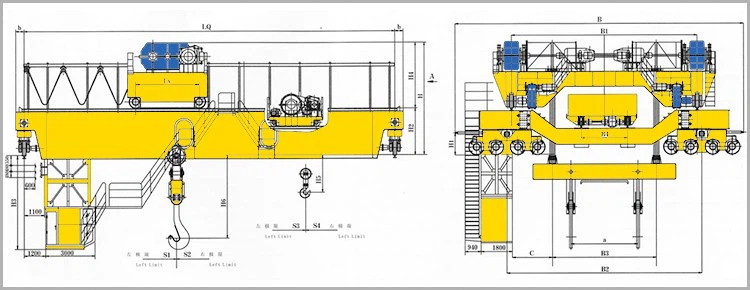
13. Sketch
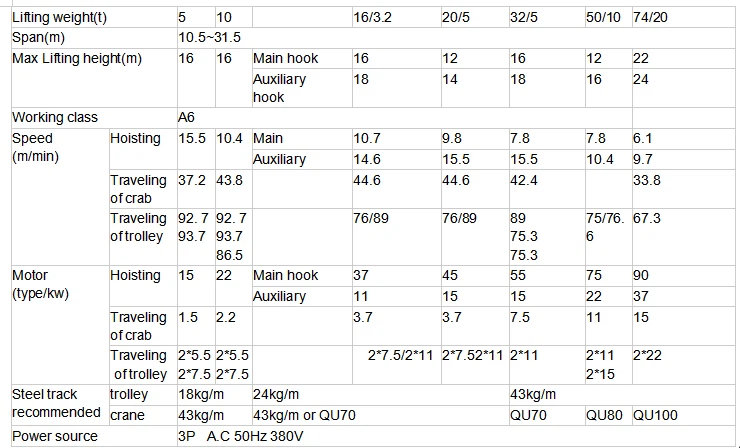
Main Technical Data
Advantages
Precision Handling: The overhead crane can precisely handle ladles containing molten metal, ensuring safe transfer from one area to another without spillage or accidents.
Enhanced Safety: With the ability to lift and move heavy loads with minimal human interaction, it reduces the risk of worker injury. The crane's design is built to withstand high temperatures, protecting operators from potential hazards.
Increased Productivity: The crane allows for fast and efficient movement of ladles, reducing downtime and speeding up the overall production process in metal casting.
Heavy Load Capacity: Metal casting ladle overhead cranes are designed to handle extremely heavy loads, often several tons of molten metal, which makes them indispensable in industries that deal with large volumes of metal.
Durability in Harsh Environments: These cranes are designed to function in high-temperature environments, resisting corrosion, heat, and wear, which increases their lifespan and reduces maintenance costs.
Automation Potential: Overhead cranes can be integrated with automation systems, allowing for unmanned operations, which increases efficiency and minimizes human error.
Space Efficiency: Being overhead, these cranes don't require significant floor space, making them ideal for use in environments where space is limited.
Application
Transporting Molten Metal: These cranes are designed to lift and move ladles containing molten metal, such as steel, aluminum, or iron, from one area to another. They can carry the ladle from the furnace to the pouring area or to a holding station.
Precision Handling: Overhead cranes for metal casting are engineered to handle heavy and extremely hot loads with precision. They are often equipped with sophisticated control systems, including load sensors, to ensure accurate positioning of the ladle.
Safety Features: These cranes are designed with several safety features to protect workers, including fail-safes, emergency stops, and specialized hooks or grabs to securely hold the ladle.
Automation and Remote Control: Many modern ladle overhead cranes are automated or can be operated remotely. This reduces the risk of human exposure to hazardous environments and increases the efficiency of the production process.
Durability and Heat Resistance: The cranes are built with materials that can withstand high temperatures and harsh conditions. The components, like the hoists, cables, and hooks, are made from heat-resistant alloys to handle the extreme heat generated during the metal casting process.
Crane Production Procedure
1. Design & Engineering
Specification Requirements: Identify the load capacity, span, lifting height, and operational environment (e.g., temperature, dust, humidity).
Structural Design: Engineering of the crane's frame, bridge, trolley, and hoisting system to ensure strength and stability.
Ladle Design Considerations: Special hooks, slings, or other attachments are designed to safely handle ladles, considering molten metal's temperature and weight.
Safety Features: Integration of safety features like overload protection, limit switches, emergency stops, and anti-collision systems.
2. Material Selection
Steel and Alloys: High-quality materials are selected for the crane's structure, including steel with high tensile strength to withstand the heavy load.
Corrosion Resistance: Materials resistant to high temperatures and corrosive environments may be selected, depending on the foundry's conditions.
3. Fabrication
Welding and Cutting: Raw materials like steel beams and plates are cut, welded, and formed to shape the crane's frame and structural components.
Machining: Precise machining is done to ensure proper fitting of components, such as rails, wheels, and bearings.
Assembly of Trolley and Hoist System: The trolley and hoisting mechanisms are assembled with attention to load balancing, efficiency, and safety.
4. Electrical and Control System Installation
Wiring: Installation of electrical wiring for motors, controls, lights, and sensors.
Control Panel: A control panel is installed for crane operation, with integration for manual or automatic control.
Drive Motors: Motors are installed for the trolley, hoist, and bridge movements, with suitable power ratings based on the crane's load capacity.
Safety Systems: Wiring and installation of safety features, including limit switches, emergency brakes, and overload sensors.
5. Testing & Quality Control
Static Load Testing: The crane is tested with a static load to ensure that all components handle the load without deformation or failure.
Dynamic Load Testing: Operational tests with varying loads and movements to confirm the crane's functionality.
Safety Tests: Testing of safety systems (emergency brakes, overload protection, etc.).
Final Inspection: A thorough inspection of all components for quality, safety, and compliance with design specifications.
6. Painting and Finishing
Surface Treatment: Steel components are cleaned, rust-proofed, and painted with high-temperature-resistant coatings.
Protective Coatings: The crane may be coated with anti-corrosion paint to prevent degradation due to exposure to high heat, moisture, or chemicals.
7. Installation & Commissioning
Installation: The crane is installed on-site, including the bridge rails, electrical connections, and final adjustments.
Commissioning: The crane undergoes final operational checks, calibration, and adjustments to ensure everything is running smoothly before handover to the client.
8. Operator Training & Handover
Training: Operators are trained on the crane's safe and efficient operation, including emergency procedures.
Documentation: Full documentation is provided, including user manuals, maintenance schedules, and warranty details.
Handover: Once all tests and training are completed, the crane is officially handed over to the customer for operational use.

Workshop View
The company has installed an intelligent equipment management platform, and has installed 310 sets (sets) of handling and welding robots. After the completion of the plan, there will be more than 500 sets (sets), and the equipment networking rate will reach 95%. 32 welding lines have been put into use, 50 are planned to be installed, and the automation rate of the entire product line has reached 85%.


Hot Tags: metal casting ladle overhead crane, China metal casting ladle overhead crane manufacturers, suppliers, factory, Ladle Foundry Bridge Crane, Steel Mill Overhead Cranes, Casting Steel Overhead Crane, Steel Factory Overhead Crane, Ladle Foundry and Casting Steel Mill Overhead Crane, Rolling Mill Overhead Crane
Previous
Foundry Overhead CraneYou Might Also Like


Send Inquiry