










Overhead Rail Crane
An overhead rail crane, also known as an overhead crane or bridge crane, is a type of lifting equipment commonly used in industrial environments for material handling. It consists of parallel runways with a traveling bridge spanning the gap. The hoist, which is the lifting component, moves along the bridge. Overhead cranes are typically used in factories, warehouses, shipyards, and large manufacturing plants to lift and transport heavy loads horizontally across a workspace.

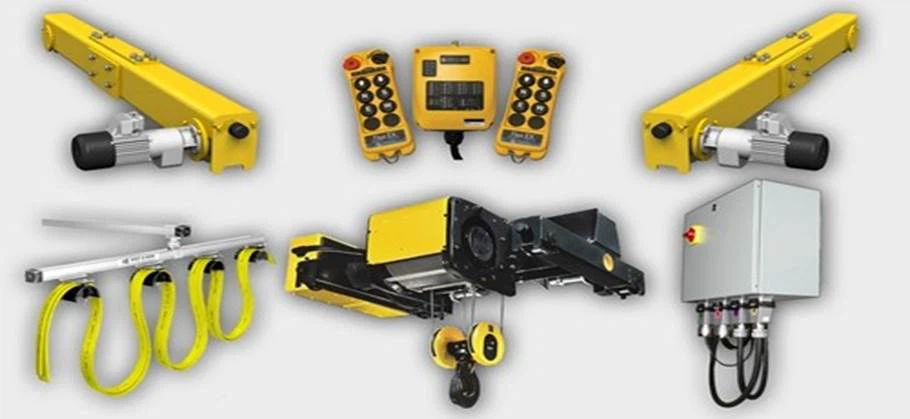
Pictures & Components
Bridge: A horizontal beam that moves along the runways.
Runways: Parallel rails or tracks fixed on the structure of the building.
Hoist: The lifting mechanism that raises and lowers the load.
Trolley: The unit that moves the hoist horizontally along the bridge.
End trucks: The supports on either end of the bridge that allow the crane to move along the runways.
1. Whole set crane
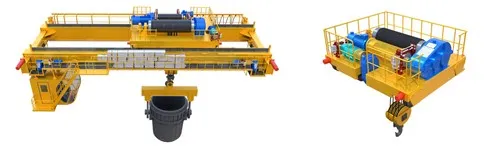
A whole set overhead crane with a hook designed for a foundry typically includes several components that work together for heavy lifting and transporting molten metal or large items within the foundry. Here's a breakdown of the key components:
Bridge: The bridge is the main horizontal structure of the crane that moves along the tracks on top of the runway. It's designed to support the entire weight of the load being lifted.
Hoist: The hoist is responsible for lifting and lowering the load. It's often equipped with a hook, which can be used to lift large items or containers. Foundry cranes typically have special hoists designed to handle extreme heat and heavy loads.
Hook: A heavy-duty hook attached to the hoist for gripping the load. Foundry crane hooks are often made from durable, heat-resistant materials to handle molten metal and high temperatures.
Runway: The runway is the track system that the bridge moves on. It is typically installed along the length of the foundry and can be either a single or double-girder system depending on the load requirements.
End Carriages: These are the wheels that support the bridge and allow it to move along the runway. The end carriages are designed to handle the heavy loads and are equipped with motors to power the crane's movement.
Controls: The control system for an overhead crane includes the operator's station (usually a pendant or remote control), which enables the operator to control the movement of the crane, the hoist, and the hook.
Electrical System: The crane's electrical system provides power to the motors, control panel, and hoist. It's often designed for heavy-duty operation with safety features like overload protection and emergency stops.
Safety Features: Overhead cranes used in foundries are typically equipped with various safety features, such as limit switches, overload sensors, anti-collision devices, and fire-resistant components.
Temperature-Resistant Materials: For foundry use, the crane components, especially the hook and hoist, are often made from materials that can withstand extreme temperatures.

2. Main girder
1) A ladle foundry and casting steel mill overhead crane main girder is a crucial component of a crane used in steel mills and foundries. The main girder is the long horizontal beam that spans the distance between the crane's supporting structures and carries the weight of the entire crane system.
2) In a steel mill or foundry setting, the main girder of an overhead crane is typically designed to handle heavy loads, such as molten steel or large ladles of liquid metal. The girder is usually made from high-strength steel and may be supported by multiple hoisting mechanisms.
3) The ladle foundry and casting steel mill overhead crane main girder is designed to withstand the extreme temperatures and heavy loads found in steel mills and foundries. To ensure optimal performance, the main girder must be inspected regularly for signs of wear and damage, and any problems should be promptly addressed to prevent failure or accidents.
4) Overall, the main girder plays a critical role in the safe and efficient operation of overhead cranes used in ladle foundries and casting steel mills. By choosing a high-quality, durable main girder, these facilities can ensure the longevity and reliability of their crane systems.

3. Lifting System
The lifting system of an overhead crane with a hook, particularly for a foundry, involves several key components designed to safely lift and move heavy materials, often molten metal, molds, and castings. Here's a breakdown of the typical lifting system:
Crane Structure:
The overhead crane typically consists of a bridge, trolley, and hoist system. The bridge spans across the foundry space, with the trolley moving along the bridge to position the hook.
Hoist:
The hoist is the motorized device responsible for lifting and lowering the load. It operates via a drum or chain system, powered by electric motors.
In a foundry, the hoist must be capable of lifting very heavy loads (e.g., molten metal ladles or molds), often with special high-temperature features.
Hook:
The hook is the part of the crane that directly interacts with the load. For foundries, the hook may be designed with heat-resistant materials or coatings to withstand the high temperatures of molten metal.
The hook can have special features, such as rotating hooks for precise positioning or clamshell-style hooks for handling certain types of molds or containers.
Trolley and Bridge:
The trolley is mounted on the crane bridge and moves along the length of the crane. It supports the hoist and hook, moving them to the desired position for lifting.
The bridge is the main horizontal structure that spans the foundry and provides the overhead track along which the trolley moves.
Power System:
Cranes typically operate on electrical power, with the motors driving the trolley, hoist, and bridge movements.
For safety in a foundry, cranes may have explosion-proof electrical components due to the presence of flammable materials or gases.
Safety Features:
Limit switches prevent the crane from moving beyond certain limits, ensuring the safety of the structure and operators.
Overload protection systems ensure that the crane doesn't lift more than its rated capacity, preventing accidents and damage.
Heat shields and insulation may be applied around the hoist and hook to protect against the extreme temperatures found in metal casting environments.
Control System:
The crane will have a control panel that allows operators to move the hook and adjust the lifting height, speed, and position.
In many foundries, cranes may be operated remotely or from a dedicated operator cabin for safety reasons.

4. End Carriages
End carriages of overhead cranes are crucial components of the crane's structure, allowing it to move along the tracks. When designed for foundries, these end carriages need to be durable and able to withstand the extreme conditions typically found in a foundry, including high temperatures, heavy loads, and potential exposure to molten materials.
In a foundry setting, the end carriages of overhead cranes with hooks would be designed to meet specific requirements, such as:
Heavy-duty construction: End carriages should be made of high-strength steel or alloys capable of carrying heavy loads without warping or cracking.
Heat resistance: Components of the crane, especially those near the hook and the trolley, should be heat-resistant or have protective coatings to resist the intense heat from molten metals or furnaces.
Corrosion resistance: Given the harsh, high-moisture environment of foundries, the materials used in the end carriages should also resist corrosion to ensure longevity.
Precision and stability: End carriages must be engineered for precise movement along the crane's tracks to avoid issues such as misalignment, which could lead to accidents or damage.
Strong hook design: The hook itself should be capable of handling the high loads typical in a foundry, and it may have additional features for safety, such as anti-sway mechanisms or heat-resistant coatings.
Safety features: These may include overload protection, emergency braking systems, and protection against unintended motion to ensure that workers are safe during operation.
5. Crane traveling mechanism
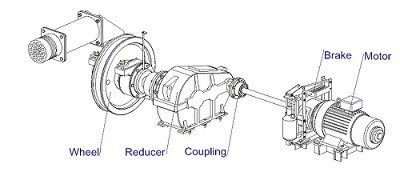
The crane traveling mechanism of an overhead crane with a hook foundry typically consists of several key components that work together to allow the crane to move horizontally along the rails. Here's an overview of how it functions:
1. Bridge Girder:
The bridge girder is the main structural component of the overhead crane, providing support for the hook and other mechanisms. It spans the entire width of the foundry or factory.
It is typically mounted on two end trucks (or wheels) and moves along the runway rails.
2. End Trucks:
The end trucks are the movable parts mounted on each end of the bridge girder. Each truck has a set of wheels that run along the runway rails.
The wheels are powered by electric motors, allowing the crane to travel horizontally (forward and backward) across the foundry.
3. Traveling Motor:
Electric motors are connected to the end trucks, providing the power needed to move the crane horizontally.
The motor drives a gearbox that connects to the wheels, ensuring smooth movement along the rails.
4. Runway Rails:
These are the tracks along which the overhead crane travels. They are installed on the floor of the foundry, parallel to the length of the facility, and are crucial for supporting and guiding the crane.
5. Trolley:
The trolley is mounted on the bridge girder and moves along it, supporting the hoist and hook assembly. It enables the load to be moved horizontally across the bridge girder, positioning it over a desired area.
6. Hoist Mechanism:
The hoist is used to lift and lower the load. It consists of a motor, gear system, rope, and hook.
The hoist operates vertically and can raise or lower the load, allowing the hook to position materials within the foundry for various operations.
7. Hook:
The hook is typically attached to the hoist and is used to grab, lift, and position materials, such as molten metal, molds, or castings, within the foundry.
The hook may be designed with specific features to handle high temperatures and heavy weights in a foundry environment.
8. Control System:
The crane's movement is controlled via a control panel, which may be a pendant, radio remote, or an automated control system. Operators can control both the horizontal and vertical movements, ensuring precise positioning of the load.
9. Brakes:
Brakes are essential for stopping the crane, especially when it's moving heavy or molten materials. They ensure that the crane halts safely and accurately at the required position.
10. Safety Features:
Overhead cranes, especially in foundries, are equipped with various safety features such as limit switches, overload protection, anti-collision devices, and emergency stops to ensure safe operation in a hazardous environment.
6. Trolley traversing mechanism
The trolley traversing mechanism of an overhead crane with a hook is a crucial component that ensures the crane can move horizontally along its runway to position the hook where it is needed. The mechanism is typically powered by motors and a system of rails, wheels, and gear systems to allow for smooth motion. Here's a general overview of the mechanism:
1. Trolley Structure:
The trolley is the moving part of the overhead crane that carries the hook. It is mounted on the bridge of the crane and moves along the rails (runway) installed on the sides of the crane.
It typically consists of a frame, wheels, and an electric motor.
2. Wheels:
The trolley has several wheels, usually made of high-strength steel, that run along the tracks (rails) of the crane. These wheels are attached to the sides of the trolley frame and support its movement.
The wheels are designed to distribute the weight of the trolley and load evenly, reducing friction and wear on the rails.
3. Drive Mechanism:
The trolley is powered by an electric motor, which is typically connected to a reduction gearbox to control the speed and torque.
The motor drives a gear mechanism, which is connected to one of the wheels (or a set of wheels) to provide the movement of the trolley.
In some cases, there may be two motors (one for each side of the trolley) for better stability and control during traversing.
4. Control System:
The trolley movement is controlled via a remote control or operator station, which allows the operator to move the trolley to the desired position.
Advanced cranes may include automated systems with sensors to track the trolley's position and ensure precise movements, especially when handling large and heavy loads.
5. Hook and Hoisting Mechanism:
The hook is attached to the hoisting mechanism, which moves vertically. The hoist is typically powered by a separate motor that works in coordination with the trolley.
The hook can be raised or lowered by the hoist, while the trolley moves along the crane's tracks to position the load.
6. Track and Rail System:
The track system is crucial for ensuring smooth movement of the trolley. Overhead cranes typically use I-beams or other types of heavy-duty rails for the trolley to travel on.
Proper alignment and maintenance of the tracks are vital to avoid operational issues and ensure safety.
7. Safety Features:
Overhead cranes are often equipped with safety features, such as limit switches to prevent over-traveling of the trolley, emergency stop buttons, and overload sensors.
Some systems may include anti-sway mechanisms to reduce load swinging when the trolley is in motion.
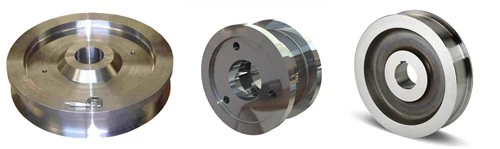
7. Crane wheel
The crane wheel of an overhead crane with a hook foundry is an essential component of the crane's hoisting system. It is typically designed for heavy-duty applications and must be durable and able to withstand significant loads and operational stresses. Here's a breakdown of key features:
Material: Crane wheels are usually made of high-quality steel, often alloyed with other metals to improve strength, wear resistance, and toughness. In some cases, materials like cast iron or forged steel are used depending on the weight and type of the crane.
Design: The design of the crane wheel is crucial for smooth operation. They are typically designed with a groove to fit the track rails, allowing for smooth movement of the crane along the rail system.
Functionality: The crane wheels support the weight of the crane and ensure that it moves along the runway. These wheels are subject to heavy forces, including the load being carried by the crane, and thus must be capable of bearing high levels of stress.
Types:
Solid Crane Wheels: Used for general-purpose cranes, offering durability and stability.
Grooved Wheels: Designed specifically for cranes that move along rail tracks. The groove ensures the wheel stays securely in place.
Foundry Application: In the context of a foundry, the crane wheels need to be durable enough to handle high temperatures, heavy molten metal, and extreme conditions. The hook foundry, in particular, might require cranes that are able to lift large and heavy items, including hooks, molds, or metal products.
Maintenance: Regular inspections are critical for ensuring the longevity of the crane wheels. These inspections focus on wear and tear, as the wheels can suffer from cracking or excessive wear if they are not maintained properly.
8. Crane hook
The crane hook of an overhead crane is a critical component used for lifting and moving heavy loads. It's typically made from high-strength materials like forged steel to handle the heavy weight and stresses associated with lifting operations. The hook is usually designed with a broad and deep throat to securely hold lifting slings, chains, or ropes.
In the context of a "hook foundry," it refers to a foundry or manufacturing facility where crane hooks are produced. These foundries use casting or forging techniques to shape and harden the steel or alloy used in the hooks. The manufacturing process typically involves:
Material Selection: High-strength steel or alloy materials are chosen for their durability, resistance to wear, and ability to withstand heavy loads.
Casting/Forging: The material is melted and poured into molds (for casting) or shaped through heat and mechanical force (for forging).
Heat Treatment: After forming, the hook undergoes heat treatment to enhance its strength and durability.
Inspection and Testing: Each hook is rigorously tested for safety and quality, including load testing and inspection for any defects.

9. Motor
An overhead crane motor with a hook for a foundry is typically a heavy-duty, electric motor used to lift and transport heavy loads, especially in environments like foundries, where molten metal or large heavy objects need to be moved safely and efficiently. Here are some key components and features that might be involved in such a system:
Crane Motor: A powerful motor (typically an induction motor) drives the crane's hoist system, which lifts and lowers loads. In a foundry, these motors are designed for high-duty cycles and often come with cooling systems to prevent overheating.
Hoist Mechanism: The motor drives a hoist that moves along rails. It uses a gear and drum system to raise and lower the load.
Hook: The hook is typically made of high-strength materials to withstand the weight and extreme conditions of a foundry. It is attached to the hoist system via a lifting chain or wire rope.
Safety Features: Foundry cranes often include features like limit switches, overload sensors, and emergency brakes to ensure safe operation, especially when handling molten metals or other hazardous materials.
Control System: The crane is typically operated via a pendant control or radio remote control system, offering precise movement control.
Durability and Heat Resistance: In a foundry, the environment can be harsh, with high temperatures and exposure to molten metal. The crane motor and other components are designed to be heat-resistant and to prevent damage from such conditions.

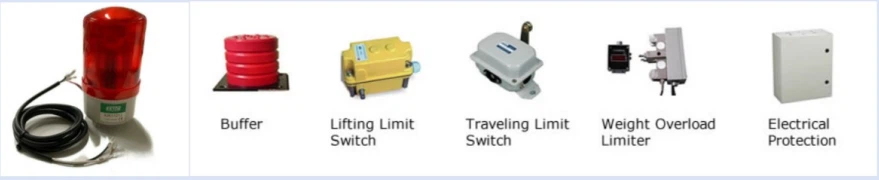
10. Sound and light alarm system & limit switch
Sound and Light Alarm System:
Purpose: These alarms serve as warning systems to alert nearby workers when the crane is in operation or approaching a hazardous area.
Sound Alarm: Typically, it is a loud horn or siren that signals crane movement, over-speeding, or the presence of a hazard.
Can be activated when the crane moves, lifts heavy loads, or when it reaches certain positions (e.g., nearing the end of its track).
Used in noisy environments to make sure workers hear it even over other machinery noise.
Light Alarm: Usually, a flashing light (such as a strobe or rotating beacon) is used in conjunction with the sound alarm to visually alert workers to crane movements or dangerous conditions.
Often mounted on the crane itself, indicating active operation.
Can have different colors to represent various alerts (e.g., red for danger, yellow for caution, green for safe operation).
Limit Switch:
Purpose: The limit switch is used to restrict the movement of the crane, preventing it from going beyond a certain position or force that could cause damage to the crane or the load.
Types of Limit Switches:
End of Travel Limit Switch: Prevents the crane from traveling too far along the track, ensuring it doesn't collide with walls, other equipment, or structures.
Overload Limit Switch: Stops the crane if it is carrying more than the rated load, protecting the hoist mechanism from damage.
Hook Position Limit Switch: Ensures the hook reaches the correct position before it stops or reverses direction.
Working Mechanism:
Limit switches are mechanical devices that trigger an electrical signal when the crane reaches a preset limit.
They can stop the motor or trigger an alarm when the crane reaches its maximum or minimum travel limits, reducing the risk of mechanical failure or accidents.
11. Safety Devices
1. Limit Switches
Purpose: Prevents over-travel of the crane in both horizontal and vertical directions.
Operation: When the crane reaches the end of its travel limit, the switch automatically halts the motion, preventing damage or potential accidents.
2. Overload Protection
Purpose: Protects the crane from lifting loads beyond its capacity.
Operation: The system will stop lifting or will trigger an alarm if the load exceeds the crane's rated capacity, reducing the risk of structural damage or failure.
3. Anti-Sway Systems
Purpose: Minimizes the swinging motion of the hook, which can be dangerous.
Operation: A sensor detects the swaying and adjusts the movement of the crane to stabilize the load.
4. Emergency Stop Button
Purpose: Provides a quick way to stop the crane in case of an emergency.
Operation: The button, usually red and highly visible, immediately cuts off power to the crane's motors to halt its operation.
5. Safety Sensors
Purpose: Detects obstacles or personnel in the crane's path.
Operation: If the sensor detects a person or obstacle, it can automatically stop the crane or trigger an alarm to prevent an accident.
6. Warning Alarms and Lights
Purpose: Warns operators and personnel of crane movements or hazardous conditions.
Operation: Audible alarms or flashing lights are activated when the crane is in motion or when it is carrying a heavy load.
7. Lockout/Tagout (LOTO) System
Purpose: Ensures that the crane cannot be operated while maintenance or repair work is being done.
Operation: The system allows authorized personnel to "lock out" the crane's power source to prevent unintentional operation.
8. Cranes with Explosion-Proof Design
Purpose: In foundries where flammable materials or gases are present, explosion-proof cranes ensure no sparks or electrical faults can cause an ignition.
Operation: Special construction methods, seals, and electrical components are used to make the crane safe for use in hazardous environments.
9. Load Moment Indicator (LMI)
Purpose: Prevents the crane from lifting loads that exceed safe operating limits.
Operation: The system constantly monitors the load weight and the crane's position, providing real-time feedback to the operator to avoid unsafe lifting.
12. Control Mode
1. Pendant Control
Description: The crane operator uses a wired pendant with buttons to control the movement of the crane. This allows the operator to be on the ground but still have direct control of the crane's hook and movement.
Advantages: Provides flexibility for the operator to move around and monitor the operation while controlling the crane from a safe distance.
Used for: General movement of loads, especially in environments where manual control is preferred.
2. Radio Control
Description: Similar to pendant control but the operator uses a wireless radio control system, which allows for greater mobility.
Advantages: Provides even more flexibility for the operator, as they can control the crane from a distance without being physically tied to a specific location.
Used for: Larger foundry operations where mobility and visibility of the load are important.
3. Cabin Control
Description: In this mode, the crane operator is located in a cabin positioned on the crane, from where they can control all crane functions, including hook movement, trolley travel, and bridge travel.
Advantages: Provides the operator with a complete view of the operation, allowing for precise control.
Used for: Heavy-duty applications in foundries or large facilities where precision and visibility are crucial.
4. Automatic or Semi-Automatic Control
Description: For tasks requiring repetitive and predictable movements, the crane may be operated in an automatic mode. The crane can follow pre-set paths or programmed actions. In semi-automatic mode, the operator can still intervene when necessary.
Advantages: Reduces the need for constant manual input, improving efficiency and reducing operator fatigue.
Used for: Automating repetitive tasks like moving materials within a foundry.
5. Load-Sensitive Control
Description: This control system adjusts the crane's movement based on the load it is carrying, ensuring stability. It's often integrated with safety systems that limit the speed and movement of the crane depending on the weight of the load.
Advantages: Improves safety by ensuring that the crane operates within its capacity, reducing the risk of accidents.
Used for: Foundries where the load being moved can vary greatly in size and weight, such as large castings.
6. Safety Controls
Description: This includes emergency stop functions, overload protection, and anti-collision systems to ensure safe operation in a foundry environment, which can be hazardous due to the presence of molten metal and heavy equipment.
Advantages: Ensures the safety of both the operator and the equipment in a high-risk environment.
Used for: Every crane operation, especially in foundries where heavy, hazardous materials are involved.

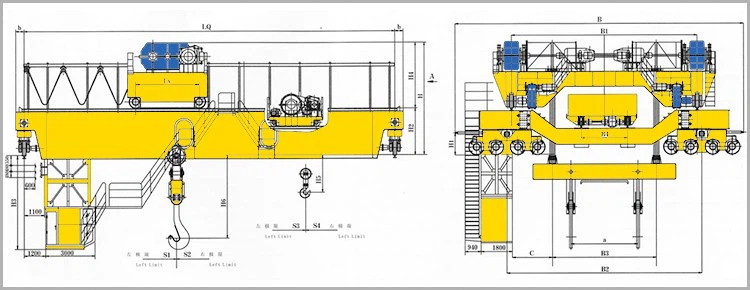
13. Sketch
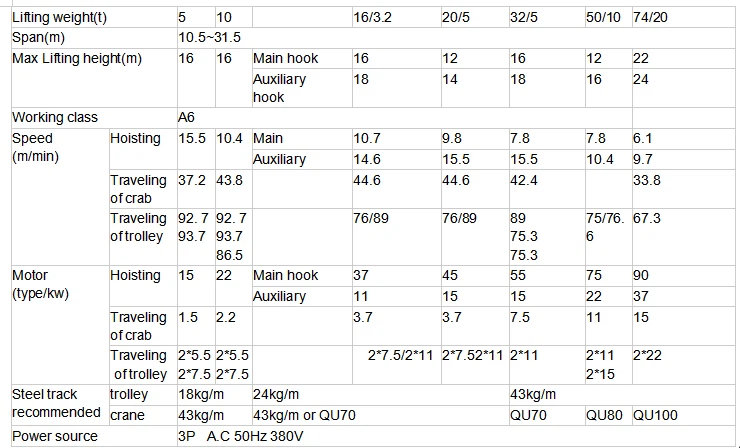
Main Technical Data
Advantages
Overhead rail cranes offer several advantages, especially in industrial environments where heavy loads need to be moved with precision and efficiency. Some key advantages include:
1. Efficient Material Handling
Increased load capacity: Overhead cranes can handle very heavy loads, ranging from a few tons to several hundred tons, depending on the crane's design.
Reduced labor costs: By automating material movement, overhead cranes can reduce the need for manual handling, improving productivity and lowering labor costs.
2. Maximized Space Utilization
No floor interference: Overhead cranes operate above the workspace, leaving the floor space free for other activities. This is especially beneficial in warehouses or manufacturing plants where maximizing floor space is crucial.
Long span coverage: They can cover large areas of a workspace, allowing access to almost every part of the working area without the need for forklifts or other ground-based equipment.
3. Enhanced Safety
Minimized risks of accidents: By eliminating the need for manual lifting of heavy items, overhead cranes help reduce the risks of workplace injuries.
Precision control: Operators have precise control over the crane's movements, reducing the chance of accidents or load damage during lifting and transportation.
4. Versatility and Flexibility
Wide range of applications: Overhead cranes are adaptable for different environments and industries, including manufacturing, construction, shipbuilding, steel mills, and warehouses.
Customizable designs: Cranes can be customized with specific features, like special hooks, magnets, or clamps, to meet the needs of different operations.
5. Durability and Low Maintenance
Long service life: These cranes are built for heavy-duty applications and can operate for long periods with minimal maintenance.
High reliability: Their robust design and construction ensure reliable performance, making them suitable for demanding environments.
6. Improved Workflow
Reduced downtime: By efficiently moving materials within a workspace, overhead cranes help streamline production processes and reduce workflow interruptions.
Speed and accuracy: The cranes offer smooth and quick transportation of loads, allowing materials to reach their destination faster and with higher accuracy.
Overall, overhead rail cranes provide an effective solution for industries that require the lifting, moving, and positioning of heavy or bulky materials with minimal interference, maximum space usage, and enhanced operational safety.
Application
Overhead rail cranes are widely used in a variety of industries where heavy materials need to be lifted, transported, and positioned efficiently and safely. Here are some key applications:
1. Manufacturing Facilities
Assembly lines: Overhead cranes are used to transport heavy parts or equipment between different sections of assembly lines, improving workflow and reducing manual labor.
Heavy machinery production: In industries producing large machines, cranes handle the movement of heavy components such as engines, turbines, and structural parts.
2. Warehousing and Logistics
Material storage and retrieval: Overhead cranes help in the storage and retrieval of heavy goods or raw materials, especially in environments where floor space is limited.
Container loading/unloading: In logistics centers, overhead cranes facilitate the loading and unloading of shipping containers and pallets.
3. Steel Mills and Foundries
Handling raw materials: In steel production, cranes are used to transport large volumes of raw materials, such as steel beams, coils, or billets, to different stages of the production process.
Molten metal handling: In foundries, overhead cranes are used to safely transport molten metal between furnaces, molds, and casting areas.
4. Shipbuilding and Marine Industry
Ship construction and repair: Overhead cranes are crucial in lifting and positioning large ship components such as hull sections, engines, and propellers.
Dockyard operations: In ports and dockyards, cranes handle the loading and unloading of heavy cargo from ships, including containers, large crates, and heavy machinery.
5. Construction Sites
Precast concrete elements: Overhead cranes are used to lift and place large precast concrete components, such as beams, columns, and panels, in building construction.
Material hoisting: They transport construction materials like steel structures, heavy machinery, and equipment across different parts of a construction site.
6. Aerospace Industry
Aircraft assembly: In aerospace manufacturing, overhead cranes are used to move large aircraft components such as wings, fuselages, and engines, providing precise placement for assembly.
Maintenance and repair: Overhead cranes assist in the handling of large, heavy parts during the maintenance and repair of aircraft.
7. Automotive Industry
Car assembly: Overhead cranes play a key role in transporting and positioning car frames, engines, and other components during the assembly of vehicles.
Tooling and equipment handling: They are also used to transport large dies, molds, and presses for manufacturing car parts.
8. Mining Industry
Material transportation: Overhead cranes are used to move large loads of extracted minerals, machinery, and tools in mining operations.
Maintenance of mining equipment: Cranes help in the maintenance and repair of heavy mining machinery, such as conveyor systems and drilling equipment.
9. Power Plants
Turbine and generator handling: Overhead cranes are commonly used in power plants for lifting and installing heavy turbines, generators, and other large equipment.
Maintenance: Cranes assist in routine maintenance, repair, and replacement of large machinery components.
10. Railway and Locomotive Maintenance
Train assembly and repair: In railway workshops, overhead cranes handle the assembly, maintenance, and repair of heavy locomotives and railway carriages.
Track maintenance: Cranes help in transporting and positioning railway tracks and other infrastructure components.
11. Paper and Pulp Industry
Paper roll handling: Overhead cranes are used to lift and transport heavy paper rolls during the production process in paper mills.
Machinery maintenance: Cranes help in maintaining large paper-making machinery and equipment, ensuring smooth operations.
These applications demonstrate the versatility and efficiency of overhead rail cranes in industries requiring precise, reliable, and safe handling of heavy materials and equipment.
Crane Production Procedure
1. Design and Engineering
Designing Specifications: The design is created based on the required lifting capacity, span, working environment, and other operational factors. This step involves engineering calculations to determine the structural strength, motor power, and other components.
Customization: If specific requirements are needed (e.g., special environmental conditions, speed, or additional features), customization is performed.
2. Material Selection
Structural Steel: High-quality steel is chosen for the crane's main body (girder, beams, columns) to ensure durability and strength.
Hook and Trolley Materials: Special attention is given to the hook's material to withstand high-load conditions and wear. It is often made from high-strength alloy steel.
Motors and Electrical Components: These parts are selected based on lifting capacity and environmental considerations.
3. Fabrication of Structural Components
Beam and Girder Fabrication: The main beams or girders are fabricated by cutting, welding, and assembling large steel sections.
Trolley and Hoist Assembly: The trolley that moves along the beam, and the hoist that lifts the load, are fabricated separately and are often tested for smooth operation.
Hook Fabrication: The hook is manufactured, often forged or cast, and carefully heat-treated to ensure the right balance of strength and flexibility.
4. Welding and Assembly
Welding: The structural components (beams, frames, etc.) are welded according to precise measurements and quality standards to ensure stability.
Assembly: After welding, the crane components are assembled into a functional structure. This step involves fitting the trolley, hoist, hook, control systems, and electrical wiring.
5. Installation of Motors and Electrical Systems
Motor Installation: The hoist motor, trolley motor, and bridge motor are installed and aligned to ensure efficient operation.
Electrical Wiring: Wiring for controls, safety systems, and power supply is installed. This includes the crane's control panel, push buttons, and limit switches.
Control Systems: The crane's control system (manual or automated) is installed and calibrated. This could involve pendant controls, radio controls, or integrated control systems.
6. Testing and Inspection
Load Testing: Before the crane is sent to the site, it undergoes load testing to verify its lifting capacity. The crane is tested under various load conditions to ensure safety and functionality.
Safety Check: Safety features, such as emergency stop functions, overload protection, and limit switches, are checked.
Operational Testing: The crane is tested for smooth operation, checking for any vibrations, noises, or malfunctions.
7. Surface Treatment and Painting
Surface Preparation: The crane structure is cleaned and prepared for painting. Any rust, grease, or contaminants are removed from the steel surfaces.
Painting: The crane is painted with a protective coating to ensure resistance against corrosion and harsh environmental conditions. Specialized coatings may be used for foundry environments.
8. Delivery and Installation
Transport: The crane is carefully disassembled into smaller parts (if necessary) for transport to the installation site.
Installation: Once on-site, the crane is reassembled and installed on its supporting structure (rails or overhead beams).
Final Commissioning: After installation, the crane is commissioned by the manufacturer's engineers to ensure that all components are functioning correctly.

Workshop View
The company has installed an intelligent equipment management platform, and has installed 310 sets (sets) of handling and welding robots. After the completion of the plan, there will be more than 500 sets (sets), and the equipment networking rate will reach 95%. 32 welding lines have been put into use, 50 are planned to be installed, and the automation rate of the entire product line has reached 85%.


Hot Tags: overhead rail crane, China overhead rail crane manufacturers, suppliers, factory, Ladle Foundry Bridge Crane, Rolling Mill Overhead Crane, Steel Factory Overhead Crane, Ladle Foundry and Casting Steel Mill Overhead Crane, Steel Mill Overhead Cranes, Casting Steel Overhead Crane
You Might Also Like


Send Inquiry