







Double Beam Bridge Crane
Products Description
A Double Beam Bridge Crane is an industrial lifting equipment that uses two main beams to support the hoisting mechanism. It is commonly used in heavy-duty applications in various industries, including construction, manufacturing, warehousing, and logistics, for moving heavy loads across a horizontal plane.
The crane has two parallel main beams (often referred to as girders), which provide excellent stability and support for heavy loads.The design allows for greater load capacity and is particularly suitable for large and heavy objects.
Double beam cranes are capable of handling loads ranging from several tons to hundreds of tons, depending on the specific design and requirements.They are ideal for lifting large components like steel coils, machinery, or other heavy materials.
The crane operates along a bridge track, allowing the trolley (which carries the hoist) to move across the entire span.The trolley can move horizontally across the bridge, while the hoist moves vertically, offering a wide range of motion.Made with high-quality steel and reinforced components, double beam cranes are known for their robustness and long operational life.Designed to withstand harsh working environments, such as high temperatures, corrosion, and heavy-duty usage.
The Double Beam Bridge Crane is a highly effective solution for industries that require the safe, efficient, and reliable lifting and transportation of heavy loads. Its robust construction, high load capacity, and adaptability make it a popular choice for a wide range of applications in demanding environments.
Place of Origin: China
Power Source:Electric
Warranty :1 Year
Weight (KG):10000 kg
Applicable Industries:Building Material Shops, Machinery Repair Shops, Manufacturing Plant, Food & Beverage Factory, Construction works , Energy & Mining, Other
Condition:New
Use Construction:Hoist
Machinery Test Report:Provided
Lifting capacity:5t-50t
Span:5m-31.5m
Lifting height:5m-35m
Power supply:380V 50Hz Three-phase
Working class A3-A7
Speed:Variable Speed
Electric devices:Crane traveling limit switch
Applicable Industries:Machinery Repair Shops, Manufacturing Plant, Energy & Mining
Pictures & Components
1.Main beam
The main beam of a double beam bridge crane is a critical structural component that supports the load and provides stability during crane operation. In a double beam crane, two main beams run parallel across the width of the bridge, supported by end trucks at each end. These beams are typically made of steel or other high-strength materials to handle the weight of the load being lifted, as well as the stresses and forces exerted during operation.
The main beam of a double beam bridge crane is usually made from steel, as it offers high strength and durability. Steel can also be easily welded or bolted to form the necessary structure.The beams are typically I-beams, box beams, or other shapes that offer both strength and resistance to bending under load.
The main beams support the trolley (which moves along the beams) and the hoisting mechanism (which lifts and lowers the load). The beams must be designed to carry both the dead load (the crane's weight) and the live load (the weight of the material being lifted).The beams are often braced for additional strength. This helps to prevent twisting, buckling, or sagging under heavy loads.
The main beams are mounted on end trucks, which move along rails on the bridge runway. The end trucks are powered (in powered cranes) and support the weight of the crane as it moves along the track.
In short, the main beam of a double beam bridge crane is essential for carrying and distributing the weight of both the crane's components and the loads it is designed to move. Proper design and construction of the main beams are crucial for the crane's safety and operational efficiency.
Lifting System
Motor: The motor of a lifting system in a double beam bridge crane is central to its ability to safely lift and lower heavy loads. It needs to be robust, reliable, and properly matched to the crane's specifications to ensure efficient and safe operation. Proper maintenance and regular inspection of the motor and associated components are essential to prevent failures and extend the crane's operational life.
2) Reducer: A Reducer (also called a gearbox or speed reducer) in the lifting system of a double beam bridge crane is a crucial component that reduces the motor's speed and increases the torque, enabling the crane to lift heavy loads safely and efficiently.
3) Drum: The drum of the lifting system in a double beam bridge crane (also called a double girder overhead crane) is a crucial component that plays a key role in the hoisting mechanism. It is part of the lifting system, which is responsible for lifting and lowering the load by winding and unwinding a wire rope or chain.
4) Wire rope: The wire rope used in the lifting system of a double beam bridge crane plays a critical role in supporting the loads during lifting and lowering operations. It needs to be strong, durable, and capable of withstanding the stresses associated with frequent use and heavy lifting.
5) Pulley block: A pulley block in a lifting system, particularly for a double beam bridge crane, is an essential component that facilitates the lifting and lowering of heavy loads by using a combination of pulleys, ropes, and mechanical advantages.
6) Lifting device: The lifting device in a double beam bridge crane is the component responsible for raising and lowering the load. It plays a central role in the overall operation of the crane.
 |
 |
3.End carriage
1) The end carriage of a double beam bridge crane is a key component in the crane's structural system. It typically consists of two main parts: the end carriage frame and the wheels that allow the crane to travel along the bridge beams.
2) The end carriage supports the bridge beams at either end and provides the necessary movement to transport the load across the crane's span. It also houses the drive mechanism for movement along the runway beams.
3) End Carriage Frame: The frame is a rigid structure designed to hold the crane's wheels, motors, and other components. It is made from strong steel to support heavy loads and resist wear and tear over time.The end carriages help distribute the load evenly across the crane's structure.They allow the crane to move across the span of the building or workspace, providing flexibility in operation.Properly designed end carriages help ensure the crane moves smoothly and safely, preventing issues like derailment or misalignment.
 |
 |
4.Crane travelling mechanism
1) Working principle
The crane travelling mechanism of a double beam bridge crane typically operates with a motor-driven trolley and track system. The beams (usually two parallel girders) are mounted on end trucks that run along rails on the crane runway. The motor drives the trolley along the bridge's length, allowing the crane to move horizontally. The movement is controlled by a series of gears, brakes, and electrical systems, enabling precise positioning of the load across the crane's span.
2) Functions of the crane operating mechanism
Movement along the runway:The traveling mechanism allows the entire crane (including the bridge structure and hoist) to move horizontally along the runway beams. This horizontal movement is typically powered by electric motors, which drive wheels or bogies that are mounted on the bridge's structure.
Load transportation:The mechanism supports and moves heavy loads horizontally across the workshop or factory, allowing the operator to position the load at various points within the crane's operational area.
Alignment and precision movement:The traveling mechanism ensures the crane moves along the correct path, maintaining the alignment of the bridge with respect to the runway. This is essential for precise load handling and positioning. The mechanism is designed to minimize wear and tear, reduce friction, and ensure smooth operation even under heavy loads.
5.Trolley travelling mechanism
1) Structural composition
Trolley Frame
The frame is the main structural support for the trolley. It houses and supports other components such as the hoist, wheels, and other mechanisms.
It is made of high-strength steel to ensure durability and stability under heavy loads.
The frame is designed to be rigid and resistant to deformation during operation.
Traveling Wheels
The traveling wheels are mounted on the trolley and run on the bridge beams. They ensure smooth movement along the length of the bridge.
These wheels are usually made of steel or alloy material for durability and wear resistance.
The wheels are designed with flanges to keep them aligned with the bridge rails or tracks, ensuring the trolley moves without deviation.
Wheel Axles
The wheel axles are the shafts that connect the wheels to the trolley frame, allowing the wheels to rotate.
Axles are typically made of high-strength materials like carbon steel to support the weight of the load and resist wear.
Trolley Drive Motor and Gearbox
The trolley is powered by a drive motor, typically an electric motor, connected to a gearbox that reduces the speed and increases the torque.
The motor provides the necessary power to move the trolley along the bridge beams.
Gearboxes are designed to transmit the motor's power to the wheels efficiently and smoothly.
Trolley Rail and Guide System
The trolley runs on a pair of rails or tracks mounted on the bridge girders. These rails are precisely aligned to ensure smooth travel.
Guide rollers or guide wheels are often installed to prevent lateral movement or deviation from the rail path, ensuring accurate positioning.
Electromagnetic or Mechanical Braking System
A braking system is necessary to stop the trolley at a precise location when needed.
Brakes may be electromagnetic, mechanical, or hydraulic in design, depending on the requirements of the crane system.
The braking system ensures the trolley is securely stopped when the load is positioned.
Trolley End Stops
End stops are used to prevent the trolley from moving beyond the designated travel limits.
They are usually placed at both ends of the trolley track and are designed to absorb the impact when the trolley reaches its maximum travel position.
Control System
The trolley is controlled by an electrical or wireless control system that allows the operator to move the trolley along the bridge.
The system may include limit switches, sensors, and position encoders to monitor the position of the trolley and ensure safe operation.
2) Function of the trolley operating mechanism
Horizontal Movement of the Trolley: The primary function of the trolley travelling mechanism is to move the hoisting trolley horizontally along the crane bridge. This allows the hoisting mechanism (the hook, lift, or other attachments) to cover a large working area along the bridge span.
Support and Stability: The mechanism provides support to the hoist and ensures that the trolley remains stable during its movement. This includes maintaining the balance of the hoisting load as the trolley moves along the beam.
Positioning and Precise Movement: It enables precise positioning of the trolley at any point along the span of the bridge. This is critical for accurate lifting and placing of heavy loads, as well as for maintaining safety during operation.
Drive Mechanism for Movement: The trolley travelling mechanism is driven by motors (usually electric), which are responsible for providing the necessary force to move the trolley. These motors are typically integrated with a system of gears, pulleys, or rails.
Speed Control: The trolley travelling mechanism often includes systems that regulate the speed at which the trolley moves, allowing operators to adjust the pace of the crane's operations based on the load, task, or environment.
Energy Efficiency: In modern designs, the trolley travelling mechanism is often designed with energy-efficient technologies, including regenerative drives that can recapture energy when the trolley slows down or brakes.
Automatic/Manual Control: The mechanism can be operated via manual controls or automated systems. In more advanced systems, the trolley can be programmed for automated travel along the bridge, improving operational efficiency and reducing human error.
Safety Mechanisms: It includes safety features like limit switches, overload protection, and emergency stop systems to ensure safe operation of the crane and prevent damage to the structure, hoist, or load.
Alignment and Synchronization: In some double-beam crane systems, the trolley travelling mechanism is synchronized with the movement of other components (e.g., the hoist or bridge) to ensure smooth operation and accurate coordination between lifting and moving the load.
6.Crane wheel
1) Function of wheels
Movement: The wheels enable the crane to move horizontally across the bridge's runway, allowing the load to be positioned as needed.
Support: They help support the weight of the crane and the load it is carrying, transferring this weight to the crane track or runway.
2) Design requirements
Material: The crane wheel is usually made from high-strength steel or cast iron to withstand the heavy loads and the wear caused by continuous movement.
Shape: Typically, the wheel has a V-shaped or grooved profile to fit into the track (rail) of the crane runway. This design helps maintain stability and reduce slipping.
Diameter: The size of the wheels depends on the weight of the crane, the load it handles, and the dimensions of the crane track. Larger wheels are used for heavier loads.

7.Crane Hook
1)Functionality:
Lifting: The crane hook is used to attach to the load to be lifted. It can move along the bridge crane's beams, controlled by the hoist, to position the load.
Securing the Load: The hook secures the load during lifting, ensuring stability and safety.
Load Rotation and Alignment: Some crane hooks come with swivels, allowing the load to rotate as the crane moves. This feature is useful for aligning loads or rotating them during the lift.
2)Types of Crane Hooks:
Single Hook: Typically used for smaller, less complicated lifts.
Double Hook: Used for heavier, more balanced lifting, often seen in double-beam bridge cranes.
Crane Hook Blocks: A combination of the hook and the sheave assembly used in hoisting and lowering.

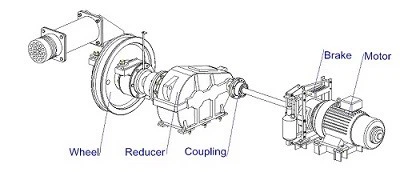
Motor
A double beam bridge crane typically uses an electric motor for the operation of its hoisting, trolley, and bridge movements.
2) Hoisting Motor: This motor is responsible for raising and lowering the load. It's typically a DC motor or AC motor, depending on the design and application. DC motors offer better speed control and high torque at low speeds, while AC motors are simpler and more durable in many industrial settings.Trolley Motor: This motor moves the hoist along the bridge girder. It is often an AC motor, sometimes with a frequency inverter to control the speed of the trolley movement.Bridge Motor: This motor moves the entire crane bridge along the rails. Like the trolley motor, it's typically an AC motor that can be fitted with a variable frequency drive (VFD) for controlling speed and ensuring smooth motion.
3)The power supply to these motors is often 3-phase AC, but can vary depending on the crane's size and location. The motor's power rating will depend on the crane's capacity, with larger cranes needing higher-rated motors.
.
Sound and light alarm system & limit switch
1) Sound and light alarm system
Sound Alarm:Typically a loud horn, siren, or buzzer that produces a sound in the event of an emergency, malfunction, or when certain parameters are exceeded (e.g., load limits, mechanical failure, or over-speed).Common frequencies range from 90 dB to 120 dB to ensure audibility over environmental noise.Can be triggered by various conditions like:
Crane overload.
Power failure or electrical malfunction.
Emergency stop activation.
Maintenance or inspection alerts.
Light Alarm:A set of warning lights that flash or stay on to visually signal an issue or condition.The light colors generally used are:
Red: for critical alerts or faults (e.g., overload, malfunction).
Yellow/Orange: for warnings or less critical issues (e.g., maintenance alert).
Green: for operational readiness or normal functioning.
2) Limit switch
A limit switch in a double beam bridge crane is a safety device used to control the movement of the crane's hoist, trolley, or bridge. It serves to limit the travel of the crane to a predetermined position, ensuring that the crane does not exceed its safe operating range.
Purpose of Limit Switches in Double Beam Bridge Cranes: End of Travel Protection: Limit switches are installed at the ends of the travel path to prevent the crane from moving beyond its designated travel limits, preventing mechanical damage to the crane or the structure.
Overload Prevention: In some cases, limit switches can help prevent overloads by cutting off the crane's power when it reaches certain thresholds.
Types of Limit Switches:
Mechanical Limit Switches: These are activated by physical contact with a part of the crane, such as the hoist or trolley. When the crane reaches the end of its track or other defined position, the switch is triggered to stop further movement.
Electronic Limit Switches: These use sensors, such as proximity sensors or optical sensors, to detect the position of the crane. They are more precise and can be integrated with the crane's control system for more complex operations.
Rotary Limit Switches: Used to detect the angular position of rotating parts, these are commonly used in cranes to limit the rotation of the hoist drum or other rotating components.
10.Safety Devices
Overload Protection:Prevents the crane from lifting weights beyond its rated capacity.Can be implemented via overload sensors or load limiters that automatically stop operation or issue alarms when the load exceeds safe limits.
Emergency Stop Button:Allows the operator to immediately halt crane operation in case of an emergency.Often installed at key locations, including the control panel, operator cabin, and other accessible points.
Limit Switches:Used to control the movement of the crane's hoist and trolley to prevent over-travel and mechanical damage.Includes upper and lower limit switches for the hook, and limit switches for horizontal travel of the trolley and bridge.
Anti-Sway Devices:Designed to reduce the sway of the load during hoisting and travel, ensuring smoother and more controlled operation.These devices typically adjust the speed of the crane to minimize swinging.
Emergency Power Off (EPO):A system that cuts off electrical power to the crane in case of a malfunction, electrical hazard, or other emergency situations.Can be activated manually by the operator or automatically in response to certain fault conditions.
Load Moment Indicator (LMI):Measures the real-time load and provides an alert if the crane is approaching its rated capacity, preventing overloading.Often integrated with the overload protection system to stop crane operation if the weight is too high.
Brakes and Hoisting Mechanism:Brakes are an essential safety feature for securing the load when the crane is not in operation.The hoisting mechanism must be fitted with reliable braking systems to prevent the load from dropping unexpectedly.
Crane Collision Avoidance Systems:These systems prevent the crane's trolley or bridge from colliding with other objects or structures.Could include sensors or proximity alarms that alert the operator to nearby obstacles.
Pendant or Remote Control with Emergency Stop:Provides the operator with the ability to control the crane from a safe distance, allowing for better visibility and control.Includes an emergency stop function to cut off power in case of malfunction.
Warning Lights and Alarms:Flashing lights and sound alarms are used to alert nearby personnel of crane movement or potential hazards.Often integrated with movement or overload detection systems.
Operator Safety Cabin:Some double beam bridge cranes come with a fully enclosed operator cabin, which is equipped with safety features like reinforced windows and a secure access system.Also, ergonomic controls ensure that the operator can work safely and efficiently.
Weather Protection and Safety for Outdoor Use:Cranes working outdoors may be equipped with additional features to safeguard against extreme weather conditions (e.g., high winds or lightning).These may include wind speed detectors, lighting protection, and special coatings to protect against corrosion.
Ground Fault Circuit Interrupters (GFCI):Protects the crane's electrical system from electrical shock hazards, especially in wet or hazardous environments.Automatically shuts off power if a ground fault is detected.
11.Control Mode
1. Pendant Control Mode
In this mode, the crane operator uses a hand-held control pendant to manage the crane's movements. The pendant is typically connected to the crane via a cable or, in some modern systems, wirelessly.
2. Cab Control Mode
This control mode involves an operator sitting in a cab mounted on the crane or on a separate platform. In this mode, the operator has full control over all crane movements.
3. Remote Control Mode
In this mode, the crane is controlled via a wireless remote control device. This mode is similar to pendant control, but it allows the operator to stand farther from the crane, providing greater flexibility and safety, especially in hazardous or restricted areas.
4. Automatic Control Mode
In some advanced systems, double beam bridge cranes may be equipped with automated control features. This can include pre-programmed movements for routine tasks or automated load handling. These systems often rely on sensors, PLCs (Programmable Logic Controllers), and sometimes AI or machine learning algorithms to perform operations with minimal human intervention.
5. Crane with Wireless/Joystick Control
A more advanced version of remote control, using joystick interfaces, enables operators to control the crane with more precision. This mode often includes feedback mechanisms such as vibration or haptic feedback to allow better control, especially when handling delicate or valuable loads.
6. Integrated Control Mode (PLC-Based)
Some modern double beam bridge cranes come with PLC-based control systems, where the crane can be controlled and monitored from a central control station or from the factory floor. The PLC system ensures the crane operates efficiently by integrating sensors, load cells, and other automation components to provide real-time feedback and ensure safety during operations.

12.Sketch

Main technical

Advantages
1. Increased Load Capacity
Double beam cranes have two beams (usually a top and bottom beam), which significantly increases the load-bearing capacity compared to single beam cranes. This makes them suitable for lifting heavier loads, often in the range of 10 tons or more.
2. Enhanced Stability
The two beams provide greater stability when lifting and moving loads. This design helps distribute the weight more evenly, reducing stress on any single part of the crane and preventing wobbling or tipping, which is crucial for safety.
3. Improved Durability
Due to the added structural support, double beam bridge cranes tend to be more durable and can withstand the harsh conditions of heavy-duty use. They are often built from high-quality materials designed to handle substantial wear and tear.
4. Larger Span
Double beam cranes can typically cover a larger area than single beam cranes because they can be designed with longer spans. This is beneficial for moving materials across wide facilities or long production lines.
5. Versatility in Operation
These cranes are often equipped with multiple hoists or lifting devices, allowing for a broader range of applications, from lifting heavy loads to more complex tasks such as precise positioning and movement in large facilities.
6. Better Safety Features
Due to the increased load capacity and stability, double beam cranes generally come with more advanced safety features, such as overload protection, anti-collision systems, and emergency stop functions, ensuring safer operation.
7. Efficient Operation
The dual-beam structure allows for better load distribution and less stress on individual components. This can lead to reduced maintenance costs, increased efficiency, and extended crane lifespan, as the system can handle heavier loads without compromising performance.
8. Increased Lifting Height
Double beam cranes often offer greater lifting heights because of their more robust structure, which is essential for lifting large or tall loads in warehouses, factories, and construction sites.
9. Smooth and Precise Lifting
The two-beam system allows for more precise control over the load, which is especially important in environments where the lifting process needs to be controlled with high accuracy, such as in manufacturing or assembly lines.
10. Customization Options
Double beam cranes can be customized with various hoisting mechanisms, control systems, and safety features to meet specific operational requirements. This makes them highly adaptable to different industrial needs.
Application:
1. Heavy Duty Lifting
Industrial Manufacturing: Double beam cranes are widely used in factories, assembly lines, and manufacturing plants for lifting heavy machinery, steel beams, or large components. The dual beams provide enhanced strength, making it possible to lift heavier loads than single-beam cranes.
Steel Mills: For moving heavy steel coils, billets, and slabs, double beam cranes provide the necessary lifting power and control.
2. Construction Projects
Precast Concrete: In construction yards or sites where heavy precast concrete elements (like beams, columns, or slabs) need to be lifted, double beam cranes are used due to their lifting capacity and stability.
Heavy Equipment Lifting: They are used on construction sites to move heavy machinery or large construction materials.
3. Shipyards
Ship Building: In shipyards, these cranes are essential for lifting large ship parts, such as hull sections, engines, or large equipment, into place.
Maintenance and Repair: They are also employed for lifting large components during repair work.
4. Ports and Logistics
Container Handling: Double beam cranes are crucial for loading and unloading heavy shipping containers, either on the dockside or from one transport system to another.
Heavy Cargo: In ports, they are used to handle other forms of heavy cargo, including large machines or oversized goods.
5. Warehouses and Distribution Centers
Load Movement: Large distribution centers and warehouses with high-volume inventory management use double beam cranes to move heavy goods, large pallets, or bulky machinery.
Material Handling: For applications requiring precise and heavy material handling, such as in automotive manufacturing plants or large storage facilities.
6. Power Plants
Maintenance of Large Equipment: In power plants, these cranes are often used to lift turbines, generators, and other heavy components for installation, maintenance, or replacement.
7. Aerospace Industry
Aircraft Assembly: Double beam cranes are used in aircraft manufacturing or assembly plants to lift and move large parts of aircraft, including fuselages, wings, and engines.
Advantages of Double Beam Bridge Cranes:
Higher Load Capacity: Due to the dual beams, these cranes can handle significantly higher loads than single beam cranes.
Increased Stability and Safety: The two beams ensure a balanced load distribution, reducing the risk of crane tipping.
Longer Span: Double beam cranes can cover a larger span, making them suitable for wider work areas or larger machines.
Reduced Deflection: With two beams supporting the load, deflection (bending) is minimized, enhancing performance.
Crane production procedure
1. Design and Planning
Customer Requirements: Initial discussions are held with the customer to understand their specific requirements for load capacity, span, height, and usage.
Engineering Design: Engineers design the crane based on customer specifications, ensuring compliance with safety standards and local regulations. They will design the main structural components, such as the beams, trolley, hoist, and control system.
3D Modeling: A 3D model of the crane is often created using CAD software for visualization and to check for any potential design flaws.
2. Material Selection
Steel Selection: Materials are selected based on the design specifications. For a double beam bridge crane, high-strength steel plates (like Q235 or Q345) are commonly used for structural components.
Other Components: Other materials, such as electrical components (motors, controllers, etc.), wheels, and ropes, are also sourced according to the design.
3. Fabrication of Components
Beam Fabrication:
The crane's double main beams are fabricated. Steel plates are cut, bent, and welded to form the beams. The beams are usually box-shaped to provide high strength and low weight.
The beam ends are then machined to fit the wheels and other components.
End Trucks: The end trucks, which allow the crane to move along the runway, are fabricated by welding steel sections together, with wheels mounted at each corner.
Trolley and Hoist: The trolley is the movable part that carries the hoist and moves along the main beams. The hoist system includes the motor, drum, rope, and hook, all of which are carefully assembled and tested.
Electrical System: The electrical components (including control panels, wiring, and motors) are assembled according to the crane's design.
4. Assembly
Main Structure Assembly: The main beams are transported to the assembly line, where they are mounted on the end trucks. The trolley and hoist system are installed onto the beams.
Installation of Wheels and Rail Systems: The crane's wheels are installed on the main beams, and they are then mounted on the rail tracks or runways that the crane will travel along.
Electrical Wiring: The electrical wiring for the motor, control system, limit switches, and safety devices is installed. This includes the connection of the motor to the drive system and the testing of control systems.
5. Testing and Inspection
Static Load Testing: The crane is tested with a static load to check the structural integrity of the frame and beams.
Dynamic Testing: The crane is tested with dynamic loads (i.e., moving loads) to check the operation of the trolley, hoist, and movement of the crane.
Control System Testing: The electrical control system is tested to ensure it operates smoothly. This includes verifying that the control system responds properly, and the limit switches and safety features are functional.
Safety Checks: All safety devices, such as emergency stops, overload protection, and limit switches, are verified for proper function.
6. Painting and Finishing
Surface Treatment: The crane's steel surfaces are cleaned, degreased, and primed. A final coat of paint is applied to prevent rust and provide a smooth finish.
Finishing Touches: Any remaining parts, such as the control buttons, hooks, and other accessories, are installed. Final assembly and adjustments are made.
7. Packaging and Delivery
Disassembly for Transport: Depending on the size of the crane, it may be disassembled into smaller parts for easier transport. Components like beams, motors, and trolleys may be sent separately.
Transport: The crane components are then packaged and delivered to the customer site, either by road, rail, or sea, depending on the distance and transportation needs.
8. Installation at Customer Site
Site Preparation: Before installation, the customer site must be prepared with the necessary foundation and runway tracks.
On-Site Assembly: The crane is reassembled at the customer's location. This may involve lifting heavy components into place and ensuring the proper alignment of the structure.
Final Testing: The crane is tested again at the site to ensure that all components are functioning properly and to check for any site-specific issues.
9. Handover and Training
Customer Training: The customer is trained on how to operate and maintain the crane safely.
Handover: Once all tests are passed, the crane is handed over to the customer for use.

Workshop view:
The company has installed an intelligent equipment management platform, and has installed 310 sets (sets) of handling and welding robots. After the completion of the plan, there will be more than 500 sets (sets), and the equipment networking rate will reach 95%. 32 welding lines have been put into use, 50 are planned to be installed, and the automation rate of the entire product line has reached 85%.



Hot Tags: double beam bridge crane, China double beam bridge crane manufacturers, suppliers, factory, Double Girder Bridge Crane with Electric Hoist, Bridge Crane
You Might Also Like




Send Inquiry