










Workshop For Overhead Crane
Products Description
A steel workshop for overhead cranes is a specialized facility designed to manufacture and assemble overhead crane systems, often used in industrial settings such as warehouses, factories, and construction sites. These workshops provide a controlled environment to ensure precision, safety, and efficiency during the fabrication process.The workshop is built with robust steel frameworks to support heavy equipment and large-scale crane components. It often includes reinforced floors capable of handling the weight of machinery.Different sections of the workshop are dedicated to tasks such as welding, machining, assembly, and testing of crane components (e.g., beams, hoists, trolley systems, and control units).Interestingly, many steel workshops for overhead cranes are equipped with their own large overhead cranes to handle the heavy materials and parts used in the production of new cranes. These cranes may include hoisting, lifting, and moving operations within the workshop.These workshops typically include advanced machinery for cutting, bending, welding, and coating the steel, as well as precision measuring tools for quality control.Given the complexity and risks associated with crane manufacturing, steel workshops are equipped with safety systems such as emergency stop buttons, safety nets, fire extinguishers, and personal protective equipment (PPE) stations.Some workshops feature environmental control systems for managing dust, noise, and temperature, ensuring the comfort of workers and preserving the quality of materials. After assembly, overhead cranes undergo rigorous testing to ensure functionality, safety, and compliance with standards such as ISO or CE regulations. This can include load testing, operational testing, and visual inspections.
Warranty:1 Year
Weight (KG):2000 kg
Video outgoing-inspection:Provided
Machinery Test Report:Provided
Color:Meet client's requirements
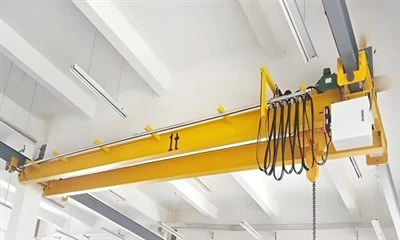
Crane feature:Easy Operated Girder Bridge Crane
Capacity:5-32t
Type:Double Girder Bridge Crane
Power supply:110V/220V/230V/380V/440V
Control Method:Ground Control/ Remote Control
MOQ:1 Set
Lifting mechanism:Eliectric Hoist Trolley
Work Duty:A3-A4

Pictures & Components
1.Main beam
1)The steel workshop for a double girder overhead crane main beam refers to a specialized facility designed to fabricate the main beam structure of a double girder overhead crane, which is a heavy-duty crane system commonly used in industrial environments for lifting and moving large loads. The main beam, or bridge, is a critical component that supports the hoisting mechanism and provides the necessary support for the crane's operation.
2)A double girder overhead crane features two parallel main beams that run across the length of the crane. These beams, usually made from high-strength steel, are the structural backbone of the crane and bear the load during lifting operations. They are designed to support both the hoisting mechanism and the trolley that moves across the crane's span.
3)The main beam is typically made from high-strength carbon steel or alloy steel, which is chosen based on the crane's load requirements.
Cutting and Shaping: In the workshop, steel plates or sections are cut, shaped, and prepped for welding into the final beam design. Advanced machinery like CNC plasma cutters or laser cutting systems are often used for precision.The individual steel pieces for the main beam are welded together by skilled welders using various techniques such as arc welding or MIG/TIG welding. This process is crucial for ensuring the structural integrity and strength of the beam.The main beam structure may consist of several segments, which are assembled into the final beam structure. This process requires careful alignment and the use of jigs to ensure the proper dimensions.

Lifting System
1)The lifting system of a steel workshop's double girder overhead crane is the critical component responsible for raising and lowering loads within the workshop. This system consists of several key components working together to ensure smooth and safe lifting operations.
2)The hoist is the primary lifting device in the crane's system. It is mounted on the trolley, which moves across the span of the crane.The hoist motor is typically electric and provides the power to lift the load. It drives the drum or chain sprockets to raise and lower the hook. For heavy lifting, the hoist may use a drum wrapped with steel wire rope. The drum rotates, causing the rope to spool in or out, lifting or lowering the load.For lighter to medium loads, chain hoists may be used, where a chain is driven to move the hook.The hook attaches to the load and is raised or lowered by the hoist. It may include additional accessories like lifting slings, hooks, or magnets depending on the load type.The trolley is a horizontal movement unit that runs along the double girder bridge (main beams) of the crane. It carries the hoist across the crane span.
 |
 |
3.End carriage
1)Mobility:
The end carriages allow the entire crane bridge (the main girders) to move along the workshop rails. This horizontal movement enables the crane to cover a large area and transport loads from one point to another within the workspace.
The drive motors and wheels on the end carriages enable precise, controlled movement. The crane operator can move the crane at varying speeds depending on the operation.
2)Support:
The end carriage supports the crane's bridge (the two main girders), ensuring stability while the crane is in motion and while lifting heavy loads.
It also ensures the proper alignment of the crane with the tracks, preventing misalignment during operation.
3)Load Distribution:
The end carriage helps evenly distribute the weight of the load being lifted, preventing excessive stress on any part of the crane structure.
Proper distribution of the crane's weight across the end carriages also ensures the crane operates smoothly without excessive strain or wear on individual components.
 |
 |
4.Crane travelling mechanism
1)Increased Mobility: The traveling mechanism allows the crane to cover a large area of the workshop, enabling it to handle materials across the full length and width of the facility.
2)Efficiency: By automating the horizontal movement, the crane can move materials quickly and safely, improving productivity.
3)Precision: With precise control over movement, the crane can handle even delicate or complex operations, especially with a dual drive and variable speed control system.
4)Load Distribution: The even distribution of weight across the end carriages and wheels ensures that heavy loads are transported without damaging the crane or tracks.
5)Durability: Heavy-duty motors, wheels, and gears ensure that the traveling mechanism can withstand continuous operation in harsh environments like steel workshops.
5.Trolley travelling mechanism
1)Precision: The trolley traveling mechanism allows for precise positioning of the hoist and load. This is especially important in steel workshops, where the lifting and moving of heavy, bulky materials requires accuracy.
2)Increased Mobility: The trolley increases the crane's ability to cover a large area horizontally, enabling materials to be transported across the entire span of the crane.
3)Efficient Load Handling: The trolley allows the hoist to move efficiently with heavy loads, maintaining stability and control throughout the operation.
4)Durability: Designed for high-strength materials, the trolley traveling mechanism is built to handle the stresses of continuous operation in a steel workshop, where loads can be heavy and conditions harsh.
5)Safety: The integration of features like limit switches and braking systems ensures safe operation by preventing over-travel and controlling the trolley's speed.
6.Crane wheel
1)The crane wheel is a critical component of a steel workshop's double girder overhead crane. It is responsible for supporting the entire crane structure and enabling it to move along the tracks or rails installed in the workshop. The wheel system is essential for the crane's traveling mechanism, as it ensures smooth and stable movement of both the crane bridge (the horizontal structure) and the trolley (the lifting mechanism that moves along the bridge).
2)The crane wheel system is fundamental to the safe and efficient operation of a double girder overhead crane in a steel workshop. The wheels ensure smooth, stable movement of the crane, support heavy loads, and help maintain precise positioning of the load during transport. Proper design, material selection, and maintenance of the crane wheels are crucial for ensuring the crane operates efficiently and safely in the demanding environment of a steel workshop.

7.Crane Hook
1)The crane hook is an essential component of a steel workshop's double girder overhead crane, serving as the primary attachment point for lifting and moving loads. It connects the lifting mechanism, typically a hoist, to the load being handled. The crane hook plays a crucial role in ensuring the safety, efficiency, and precision of the lifting process. The design and construction of the hook must accommodate the high demands of a steel workshop environment, where heavy, hot, and sometimes irregularly shaped materials are handled.
2)Load Attachment: The hook serves as the interface between the hoist and the load, allowing the crane to lift and transport heavy materials.
Load Stability: The hook is designed to hold the load securely during lifting, preventing it from slipping or falling while in transit.
Flexibility: The hook allows for different types of lifting, such as picking up materials directly from the ground, attaching slings or rigging, or manipulating large steel components.

Motor
1)The motor is a vital component in a double girder overhead crane used in a steel workshop, providing the power necessary to lift heavy loads, move the crane and trolley, and position materials with precision. The motor must be carefully selected based on the crane's load capacity, the operating conditions in the steel workshop, and the need for durability and safety. With considerations for power output, control features, and environmental conditions, the motor ensures the crane operates efficiently, safely, and continuously in the demanding environment of the steel workshop. Regular maintenance and proper motor management are crucial to maximizing the motor's lifespan and performance.
2)Key Functions of the Crane Motor:
Lifting Function: The motor provides the necessary power to the hoist mechanism, which raises and lowers the load.
Traveling Function: The motor powers the crane's traveling mechanism, which allows the crane bridge to move horizontally along the workshop's rails.
Trolley Movement: The motor drives the trolley traveling mechanism, which moves the hoist along the crane's main girder, positioning the load accurately over the desired location.

.
Sound and light alarm system & limit switch
1)Sound and Light Alarm System:
The sound and light alarm system serves as a safety measure to alert operators and personnel about potential hazards or the status of the crane operation. These alarms are typically activated during certain conditions, such as when the crane is in motion, reaching its maximum load capacity, or when there is a malfunction. They provide a visual and auditory warning to help avoid accidents or improper use of the crane.
2)Limit Switches:
Limit switches are critical safety devices that prevent the crane from exceeding its mechanical limits and damaging the equipment or causing safety hazards. They are typically positioned at both ends of the crane's runway and at various critical points in the crane's operation, such as the hoist mechanism or trolley movement.

10.Safety Devices
1)Overload Protection System:An overload protection system is designed to prevent the crane from lifting or moving loads that exceed its rated capacity, which could damage the crane or cause accidents.
2)Emergency Stop System:An emergency stop system allows the operator or any personnel in the vicinity to stop the crane immediately in case of an emergency.
3)Limit Switches:Limit switches are essential for controlling the crane's movement, ensuring it does not exceed certain travel or lifting boundaries, preventing damage to both the crane and the surrounding structure.
4)Anti-Sway System:The anti-sway system is designed to reduce or eliminate swinging motion of the load, which can be dangerous when lifting heavy materials or when operating in tight spaces.
5)Brake System:The brake system is vital to stopping the crane safely and accurately when required, especially when lifting or lowering loads.
6)Crane Hook Safety Devices:The crane hook is where the load is attached, so safety measures are critical to prevent accidents.
7)Operator Safety Systems:Safety features focused on the crane operator's protection are essential in preventing injuries during crane operation.
8)Collision Avoidance System:In busy steel workshops, multiple cranes may be operating at the same time. A collision avoidance system helps prevent accidents when multiple cranes or cranes and obstacles are in motion.
9)Electrical Safety Devices:Electrical safety is paramount in steel workshops due to the presence of large electrical systems and high-voltage machinery.
11.Control Mode
1)Pendant Control Mode
The pendant control is one of the most common and straightforward control methods for overhead cranes. It involves using a pendant control station (a wired control unit) connected to the crane.
2)Radio Remote Control Mode
The radio remote control is an advanced control mode that uses wireless technology to control the crane from a distance.
3)Cabin (Operator's Cabin) Control Mode
In large and high-capacity cranes, particularly in environments like steel workshops, an operator's cabin is installed for controlling the crane from an enclosed environment. The operator sits inside the cabin and uses various controls to operate the crane.
4)Automated (Auto Mode) Control
Automated control systems involve advanced technologies that allow the crane to operate with minimal human intervention. These systems can be used for specific tasks or in combination with manual control modes.
5)Pendant Control with Radio Remote Switch (Hybrid Control Mode)
A hybrid control mode combines both pendant control and radio remote control features, allowing the operator to switch between the two methods as needed.

12.Sketch

Main technical

Advantages
1. Increased Load Capacity
Higher Load Capacity: Double girder cranes are designed to carry much heavier loads compared to single girder cranes. The two parallel girders provide more structural support, which allows the crane to lift and transport larger and heavier materials, such as steel beams, ingots, or machinery, often required in a steel workshop.
2. Enhanced Lifting Span
Larger Span: The double girder design allows for a greater span between the rails, providing a larger working area. This is particularly useful for steel workshops where the crane needs to cover a wide area to move heavy materials across the facility.
3. Improved Durability and Longevity
Stronger Construction: Double girder cranes are more robust due to their dual-girder design. This makes them better suited for handling the heavy-duty operations of a steel workshop, where high loads, harsh conditions, and frequent use can take a toll on equipment.
4. Better Precision and Control
Smooth Operation: The design of a double girder overhead crane ensures smoother operation, particularly when handling precise movements or placing heavy loads in specific positions, which is essential in steel mills and workshops with complex layouts.
5. Flexibility and Versatility
Wide Range of Applications: Double girder overhead cranes are highly versatile and can be used for various tasks in a steel workshop, such as lifting, shifting, and loading materials, parts, and components. They are adaptable to a wide range of operations, including material handling, furnace feeding, and even maintenance tasks.
6. Increased Safety Features
Advanced Safety Systems: Double girder overhead cranes often come equipped with multiple safety features, such as overload protection, limit switches, sound and light alarms, anti-collision systems, and emergency stop buttons. These systems help reduce the risk of accidents, ensuring the safety of both operators and personnel in the steel workshop.
Application:
1. Material Handling
Material Loading and Unloading: The crane is employed to load raw materials (like scrap metal, ores, and alloys) into furnaces or to unload finished products such as steel sheets, beams, or structural components from delivery trucks or railcars. It efficiently moves large quantities of material in a short amount of time.
2. Furnace Feeding
Handling Molten Steel: Cranes are used to handle molten metal in specific applications like ladle handling, transferring the molten steel from the furnace to casting areas. These cranes can be equipped with specialized hooks, ladles, or containers to safely manage molten metal, which is highly dangerous and requires strict safety measures.
3. Steel Product Manufacturing
Steel Processing Equipment Handling: These cranes are also used to move heavy processing equipment, such as rollers, cut-to-length machines, and other steel-forming machinery. They may also handle parts during assembly, disassembly, and maintenance.
4. Heavy Equipment Maintenance
Routine Maintenance: In steel workshops, machinery such as rollers, crushers, and mills require periodic maintenance. Double girder overhead cranes are used to lift and transport these heavy pieces of equipment for inspection, repair, and replacement of parts.
5. Warehouse and Storage Handling
Loading and Unloading from Shelves: In steel workshops that have extensive material storage, a double girder crane is used for loading and unloading steel products from high storage racks. The crane's ability to lift heavy loads to great heights allows it to place or retrieve materials from upper shelves efficiently.
6. Foundry and Casting
Handling Casting Molds: Steel foundries use double girder overhead cranes to lift and transport casting molds, especially when they are filled with molten metal. These cranes play a key role in moving molds to and from cooling stations or sandblast areas.
7. Steel Structural Component Fabrication
Handling Steel Beams and Columns: Steel beams, columns, and girders are fabricated and processed in the steel workshop. Double girder cranes are used to transport these large structural components, lifting them from fabrication areas to the storage or shipping areas.
Crane production procedure
1. Design and Engineering
Engineers and designers create an initial design of the crane, taking into account the working conditions and ensuring it can handle heavy loads typical in steel workshops. The design also considers safety features, structural integrity, and compliance with relevant industry standards.
2. Material Procurement
Steel and Components: Once the design is finalized, materials such as high-strength steel plates, beams, and other components (like motors, control systems, and wheels) are sourced. Vendors or in-house production may provide these parts.
Quality Control of Materials: All materials undergo quality checks for strength, dimensional accuracy, and conformance to specifications. Non-compliant materials are rejected and replaced to ensure structural integrity.
3. Fabrication of Main Components
The main girders (the primary load-bearing structures of the crane) are fabricated from heavy-duty steel plates, cut, welded, and machined to the required dimensions.The main girders and other structural parts are welded according to the approved design. The welding process is closely monitored to ensure no structural weaknesses.After welding, the components are machined to ensure precise dimensions, smooth surfaces, and proper alignment for assembly.The end carriages (the structures that support the crane and house the wheels) are fabricated. These include the frame, wheel brackets, and the drive mechanisms. The wheels, bearings, and drive systems are assembled to the end carriages to allow smooth travel along the tracks.
4. Fabrication of Lifting Mechanism
The hoist unit, which includes the motor, gear system, wire rope or chain, drum, and hook, is assembled. The hoist mechanism is tested to ensure it can lift heavy loads efficiently and safely.The hoist is tested with loads that are close to its rated capacity to check its lifting speed, load stability, and safety mechanisms (e.g., overload protection).
5. Assembly and Integration
Main Beam Assembly: The fabricated main girders are joined together with the end carriages and trolley to form the full crane structure. The crane's structural components are carefully aligned and bolted together.
Traveling Mechanism Installation: The crane's traveling mechanism (the system that moves the crane along the rails) is assembled and connected to the end carriages. The wheels, drive motors, and brakes are tested for smooth movement along the tracks.
Control Systems: The crane's electrical control system (including wiring, panels, switches, and safety features like limit switches) is installed. Depending on the design, the crane may have a radio control, pendant control, or cabin control.
Testing of Control Systems: The crane's electrical systems are rigorously tested to ensure that all functions (lifting, traveling, and hoisting) respond correctly to the operator's input.
6. Safety Systems Integration
Limit Switches and Alarms: The limit switches, which prevent over-travel of the crane, and the sound and light alarm system for warning operators of crane movement or overload conditions, are installed and calibrated.
Emergency Stop Features: The emergency stop system, which halts the crane's movement immediately in case of an unsafe condition, is tested.
Overload Protection: The overload protection system (which ensures the crane does not exceed its rated load capacity) is installed and calibrated.

Workshop view:
The company has installed an intelligent equipment management platform, and has installed 310 sets (sets) of handling and welding robots. After the completion of the plan, there will be more than 500 sets (sets), and the equipment networking rate will reach 95%. 32 welding lines have been put into use, 50 are planned to be installed, and the automation rate of the entire product line has reached 85%.


Hot Tags: workshop for overhead crane, China workshop for overhead crane manufacturers, suppliers, factory, Bridge Crane, Double Girder Bridge Crane with Electric Hoist
You Might Also Like


Send Inquiry