







Underhung Double Girder Bridge Crane
Products Description
The Underhung Double Girder Bridge Crane is a type of industrial overhead crane designed for heavy-duty lifting applications within manufacturing facilities, warehouses, and production lines. This crane type has two parallel girders that provide extra stability and strength, which allows it to lift and move heavier loads compared to single-girder configurations. The "underhung" design indicates that the crane is mounted on the bottom of the runway beams rather than on top, allowing for efficient use of space and improved maneuverability in tight or restricted areas.
Double Girder Construction: With two girders, these cranes offer enhanced load capacity, stability, and a larger lifting range. Underhung Design: The crane's suspension beneath the runway beams maximizes headroom and floor space, making it ideal for facilities with height constraints.
Efficient Load Distribution: Load is distributed across two girders, reducing stress on each girder and extending the system's lifespan. Smooth Operation: Designed for seamless, horizontal movement, enabling precise load positioning.Customizable Capacity: Load capacities can range widely, from a few tons up to 20 tons or more, based on specific application needs. Easy Installation and Maintenance: The modular design simplifies installation and makes routine maintenance more efficient, reducing downtime.
4)The underhung double girder bridge crane is a robust, versatile solution for industries needing a reliable and efficient heavy-lifting system in low-clearance environments. With its unique design and double-girder structure, it meets the demands of various heavy-duty applications, ensuring safety, efficiency, and flexibility in material handling.
Core Components:Engine, Motor
Place of Origin:Henan, China
Warranty:2 years
Weight (KG):1000 kg
Video outgoing-inspection:Provided
Machinery Test Report:Provided
After-sales Service Provided:Field installation, commissioning and training
Control Method:cabin control/wire rope remote control
Lifting speed:5-15M/MIN
Color:On request
Power Supply:380V 50Hz or on request
Crane running speed:50-100M/MIN
Protection grade:IP54
Insulation grade:F
Working duty:A6

Pictures & Components
1.Main beam
1) The main beam of an underhung double girder bridge crane is a critical structural component designed to support the load and provide stability across the span of the crane.
The The main beam of an underhung double girder bridge crane consists of two parallel beams (girders) that run across the span of the crane. The two girders work together to provide greater load capacity and stability than a single girder design.Material of main beam typically, high-strength steel is used to construct the girders, ensuring durability and resistance to bending under heavy loads.
3) The double-girder design distributes the weight of the load across both girders, reducing stress on each individual girder and allowing the crane to lift heavier loads than a single-girder system.These beams are designed with enough stiffness to minimize deflection while lifting, but also enough flexibility to handle dynamic loads smoothly.
2.Lifting System
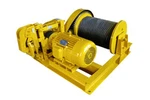
Motor: The hoist motor powers the lifting and lowering of loads. It is designed for high torque, as it has to lift heavy loads, and it typically features a braking system to hold the load securely when stopped.The trolley motor drives the movement of the trolley, which carries the hoist along the bridge.The bridge motors control the entire crane's horizontal movement along the runway rails.
Reducer: In a double girder underhung bridge crane system, reducing the load and weight of the lifting system can involve a few strategic changes to optimize efficiency and reduce the overall load on the supporting structures. With variable speed drives, motors can be controlled for smoother acceleration and deceleration. This limits the peak forces on the structure, allowing for lighter support frames and reducing stress.
Drum: The drum is a cylindrical component that is typically mounted horizontally and is used to wind or unwind the lifting cable or wire rope. This movement enables the crane to lift and lower loads.The drum is powered by a motor and connected to the hoisting mechanism, which drives its rotation. The wire rope is wound around the drum in an organized pattern to avoid overlapping, which helps in smooth lifting operations.
Wire rope: Wire rope is made from multiple strands of steel wire twisted together, providing high tensile strength.The construction allows the rope to bend and move easily, which is necessary for lifting and lowering loads.Wire ropes are designed to resist abrasion, corrosion, and fatigue, making them suitable for outdoor environments. Regular inspection and maintenance of wire ropes are crucial to ensure safe operation and prevent accidents.
Pulley block: The underhung double girder bridge crane lifting system utilizes a set of pulleys and a block assembly to facilitate the lifting and lowering of heavy loads.
Lifting device: The lifting device of an underhung double girder bridge crane system plays a critical role in hoisting and moving heavy loads across a workspace. In terms of the lifting system, the combination of the hoist, trolley, and bridge allows for precise control over heavy loads, making the underhung double girder crane suitable for industries that require heavy lifting and high precision, such as manufacturing, warehouses, and construction.
 |
 |
3.End carriage
1) The end carriage of an underhung double girder bridge crane is an essential component of the crane's structure. It serves as the mechanism that supports and moves the entire crane bridge along the runway beams. In the case of an underhung crane, the bridge is suspended from the trolley, which runs along the girders below the runway beams.
2) The end carriage typically includes wheels that allow the crane to travel along the rails of the building's runway. It supports the girder and helps to facilitate lateral movement of the entire crane assembly along the track. In an underhung system, the trolley (which holds the hoist) runs under the bridge, and the end carriages are attached at either end of the girder. These carriages are typically mounted with wheels that run on the runway beams to ensure smooth movement. The end carriages are generally made of steel and designed to bear the load of the crane's girder, hoist, and any material being lifted. The wheels on the end carriages are designed to minimize friction, ensuring smooth movement. Bearings are often used to reduce wear and tear.
3) The end carriages are usually driven by motors that control the movement of the crane along the runway. Depending on the crane's size and design, it may be driven by a single motor, or each end carriage may have its own motor to allow for better control and load distribution.The end carriages include features such as limit switches to prevent the crane from traveling beyond the end of the runway, as well as emergency braking systems to ensure safety during operation.
 |
 |
4.Crane travelling mechanism
1) Working principle
The crane travels on rails or tracks mounted on the top of the building structure or a fixed framework. These girders are supported at both ends by the end trucks or end carriages, which are mounted on the rails.The girders are typically steel and are designed to support the weight of the load being lifted.The end trucks are the mechanisms that support the two girders and allow them to travel along the runway rails.Each end truck is powered by electric motors and includes wheels or rollers that run along the track.The wheels are typically equipped with flanges to ensure smooth and accurate motion along the track.The crane's traveling mechanism is powered by electric motors, which drive the wheels on the end trucks.The motors can be synchronized or controlled individually to provide precise motion of the crane along the runway.Braking systems are integrated into the end trucks to stop the crane safely. The crane operator uses a control system (joystick or pendant control) to manage the speed, direction, and positioning of the crane.The electric motors rotate the wheels of the end trucks, causing the entire crane structure (comprising the girder and trolley) to move along the tracks.
2) Functions of the crane operating mechanism
Safety and Emergency Stopping:The traveling mechanism is equipped with safety features, such as limit switches or sensors, that prevent the crane from exceeding its travel limits.
Energy Efficiency:Depending on the design of the crane's travel mechanism, energy efficiency is a key aspect.
Smooth Operation:The crane traveling mechanism is designed to provide smooth, vibration-free operation.
5.Trolley travelling mechanism
1) Structural composition
The trolley frame is the main structure that supports the hoist and other components like the lifting mechanism and the travel wheels. It is usually made of steel to ensure strength and durability.These wheels are located at the corners of the trolley frame and allow the trolley to travel along the girder track. The wheels are often made of steel or other durable materials to withstand the forces applied during operation. The motor provides the power necessary to move the trolley across the girder. To control the movement of the trolley, an electromagnetic brake is often used to stop or hold the trolley in place once the power supply is cut off or when precise positioning is required. The underhung rails are the parallel tracks (or girders) along which the trolley moves. These rails are usually installed along the lower flange of the double girder, with the trolley wheels running along them to provide controlled movement.
2) Function of the trolley operating mechanism
The trolley mechanism allows the hoist to move along the full length of the bridge girders, facilitating lifting and lowering operations at different points within the crane's operational area. The trolley is mounted below the bridge girders, as opposed to being on top (as in an overhung design). This configuration minimizes the height of the crane and can be especially useful in spaces with lower headroom.The trolley typically has a drive motor and reduction gears that provide power to the wheels, enabling the trolley to move. The wheels of the trolley are designed to ride along these rails while maintaining stability.The trolley traveling mechanism must operate smoothly and precisely to ensure the safe movement of heavy loads.The mechanism supports the hoist or lifting device, allowing it to pick up and position loads across the span of the bridge.
6.Crane wheel
For the double girder bridge crane, two parallel beams (girders) support the trolley, and the crane wheel plays a key role in guiding the trolley as it moves along the length of the bridge. These wheels are typically mounted on the end trucks (the wheels on each side of the crane's bridge structure) and help the crane travel along the runway beams.Underhung double girder cranes are commonly used in environments where overhead space is limited or when the crane needs to be mounted in such a way that it avoids obstruction from overhead components, allowing for better space utilization in facilities.

7.Crane Hook
1) The underhung double girder bridge crane typically features a crane hook that is designed for lifting heavy loads in industrial settings. The hook is part of the hoist mechanism, which is mounted on the bridge and runs along the two girders of the crane.Crane hooks in underhung double girder cranes are used in various industrial environments, such as warehouses, manufacturing plants, and construction sites, where heavy materials or equipment need to be lifted and moved with precision.
2) In an underhung system, the crane hook travels along the underside of the two bridge girders. This allows for efficient and precise movement of loads in tight spaces.The hook generally has a curved, U-shaped design with a point at the bottom that forms the lifting surface. This is where the load is attached using slings or other rigging devices.The hook might be single or double and can include a latch or safety catch to prevent the load from slipping out.

Motor
An underhung double girder bridge crane is a type of overhead crane where the bridge and trolley are suspended from two parallel beams (the girders) mounted above the crane's span. The motor in such a crane system drives the movement of the trolley and the hoisting mechanism, typically being an electric motor.
The Motor for Trolley Movement:Drives the trolley along the bridge girders, allowing it to move horizontally.Typically an electric motor, which may be a DC motor (for speed control and torque efficiency) or AC motor (for better robustness and simpler design).Often involves a frequency inverter or soft starter to control the speed and smoothness of movement.
The Motor for Hoisting Mechanism: Powers the winch or hoist mechanism, raising and lowering the load.Similar to the trolley motor, an electric motor is used, with torque capacity suitable for the weight of the load. These motors are generally AC motors but can also be DC motors for more precise control.Hoist motors may come with additional braking systems, including dynamic braking and fail-safe brakes, to ensure controlled lowering and prevent free fall under load.

.
Sound and light alarm system & limit switch
1) Sound and light alarm system
The sound and light alarm system of an underhung double girder bridge crane is an important safety feature designed to enhance operational safety by alerting personnel to potential hazards, abnormal operations, or critical conditions during crane operations.
Sound Alarm:Sound Alarm (Audible Alert)'s purposeis to notify workers in the vicinity of the crane of important events, such as movement, load lifting, or malfunctions.
Light Alarm: Light Alarm (Visual Alert)'s purpose is to provide a clear, visible warning to operators and personnel in areas of the crane's operation.
Purpose of the System: Enhanced Safety: The alarm system helps prevent accidents by alerting workers to crane movements and potential hazards.Reduced Response Time: Operators and ground personnel are made aware of the crane's status immediately, which helps in taking precautionary actions.Compliance: Ensures the crane operates within safety regulations, reducing the risk of accidents and equipment damage.
2) Limit switch
A limit switch on an underhung double girder bridge crane is a safety device that serves to prevent overtravel of the crane's trolley, hoist, or bridge in any direction. It ensures that the crane's components do not move beyond their safe operational limits, which could lead to mechanical failure or damage to surrounding structures.
Functions: It prevents the trolley, hoist, or bridge from moving past the designated limits at the end of their travel path. This helps avoid mechanical damage or accidents.If a part of the crane reaches its limit, the limit switch triggers a safety shutdown, stopping the movement of the crane before further damage occurs.It protects various crane components, like motors and gears, from running beyond their designed range, which could cause wear or damage.
Types: There are various types of limit switches, including mechanical, proximity, and electrical Limit switches. The choice depends on the specific application and environment.

10.Safety Devices
Overload Protection System prevents the crane from lifting beyond its rated load capacity.
Limit Switches prevents the crane's motion from going beyond its designed range of travel.
Emergency Stop (E-Stop) allows the crane to be immediately stopped in case of an emergency or malfunction.
Safety Rails and Guardrails provides physical protection for workers operating or walking near the crane.
Anti-Collision System prevents collisions with other cranes, obstacles, or structures within the operating area.
Overheating Protection prevents damage to the crane due to excessive heat, typically from motor overload.
Rope Slack Detection detects if there is slack or failure in the hoisting ropes, preventing accidents from rope breakage or disconnection.
Load Sway Control reduces the swinging of loads, especially when lifting heavy or large items.
Crane Interlocks ensures safe operation by preventing movements of parts (such as the trolley and hoist) at the wrong times.
Warning Alarms and Lights alerts operators and surrounding workers to the crane's operation.
Operator Cab Safety provides a safe environment for crane operators.
Load Weight Indicators displays the weight of the load being lifted in real-time to ensure operators do not exceed the crane's safe lifting capacity.
11.Control Mode
1. Pendant Control Mode: In this mode, the crane is controlled via a wired pendant that the operator holds. The pendant has buttons or joysticks that control the movement of the hoist, trolley, and bridge.
2. Radio Remote Control Mode: This mode allows the operator to control the crane from a distance using a radio-frequency remote control. This provides greater mobility and flexibility than a pendant.
Control Features: Similar to pendant control but wirelessly, with buttons or joysticks for controlling each movement (hoist, trolley, and bridge). Often, these systems can also include advanced features such as speed control.
3. Cab Control Mode: In this mode, the operator controls the crane from a cabin attached to the crane's bridge or trolley. The cabin usually has a variety of levers, buttons, and displays to control the movements of the crane.
4. Automatic Control Mode: In fully automated control mode, the crane operates based on pre-programmed settings or through sensors. The system can be integrated with a supervisory control system or PLC (Programmable Logic Controller) to execute specific tasks with minimal human intervention.
5. Joystick Control Mode: Some cranes may use joysticks for controlling various motions. Joysticks can be integrated into a pendant, radio remote, or cab control systems. They provide smoother, more responsive control.
6. Dual Control Mode: This mode allows two operators to control the crane simultaneously, typically in situations where heavy or precise loads need to be handled.
7. Driver Assistance Mode: Some advanced cranes may include driver assistance systems that provide feedback to the operator and make suggestions to improve safety and efficiency.
8. Manual Mode: In manual mode, the operator is fully responsible for controlling every aspect of the crane's movement using the control system, with no automation or safety features enabled beyond basic mechanical limits.

Sketch

Main technical

Advantages
1. Space Efficiency:Underhung double girder cranes maximize lifting height as the hoist is positioned between the bridge girders, which allows it to reach closer to the ceiling, an ideal solution for spaces with low headroom.By mounting beneath the runway beam, these cranes require less vertical space and make full use of the building's height.
2. Enhanced Load Distribution: Because the bridge girder is hung from a roof structure or existing overhead support, the crane doesn't add significant weight to the runway support structure. This reduces the load on the building structure, saving on construction and support costs.Having two girders allows the crane to distribute loads more evenly, resulting in better stability and safer handling of heavier loads.
3. Flexibility in Design: Underhung cranes can be designed to follow a curved path, or even a more complex track, which is beneficial in irregularly shaped buildings or facilities requiring cranes to maneuver through multiple work areas. These cranes can be installed with multiple runways, allowing a crane to transition between various sections of the workspace, improving workflow efficiency.
4. Operational Versatility: With its underhung design, the crane moves along the entire floor area beneath the runway, providing access to more areas. This is useful in crowded workshops or facilities with machinery, allowing materials to be transported around obstacles.
5. Cost-Effectiveness: With fewer structural reinforcements required and the potential to utilize existing building support structures, installation and structural costs can be significantly reduced.Double girder designs offer a more balanced load distribution, which can reduce wear on the crane components, potentially resulting in lower maintenance costs over time.
6. Improved Safety: The underhung double girder design allows the hook to come closer to the walls, which maximizes workspace use and enhances safety by reducing the need to move heavy items over workstations or near personnel.The double girder design provides additional load stability, decreasing sway and improving safety when lifting and moving loads across distances.
Application:
Manufacturing and Assembly Lines: Underhung double girder cranes are common in production facilities where precise positioning and material handling are required. They allow efficient loading, unloading, and movement of components along production lines.
Warehousing and Distribution Centers: These cranes are used in warehouses to move heavy goods and pallets, especially when maximizing floor space is essential.
Aerospace and Automotive Industries: The aerospace and automotive sectors use these cranes for assembling large, complex structures like airplane components and car bodies. The double-girder design supports heavier loads, which is essential in these industries.
Machinery Maintenance and Repair: Underhung double girder bridge cranes are frequently used for lifting and positioning machinery in workshops and maintenance facilities. Their overhead design allows work on the floor without hindrance.
Shipyards and Marine Applications: These cranes can lift heavy parts for ship construction and repair, particularly where precise and stable load positioning is necessary.
Crane production procedure
1. Design and Engineering
Requirement Gathering: Determine crane specifications based on client needs, including load capacity, span, lifting height, and application environment. Engineers design the crane structure using CAD software. This includes the bridge girders, end trucks, hoisting mechanism, and underhung support system.Conduct stress analysis to ensure the structure can handle the specified load. Finite element analysis (FEA) is often used to test the design virtually.Select materials for components based on strength, durability, and environmental requirements.
2. Material ProcurementAcquire high-quality materials (like structural steel for girders, alloy steel for hooks, etc.) from approved suppliers.
Ensure materials meet the required standards through quality control checks.
3. Cutting and Fabrication
Structural steel is cut into the required shapes for girders, end trucks, and other components using CNC plasma or laser cutters. Welders assemble the crane girders, trolley, and end trucks. Specialized jigs ensure accurate alignment during assembly. Precision machining is done for specific components like the end trucks, bearing housings, and shafts to ensure smooth operations.Sandblasting or shot blasting is performed to remove rust and other impurities from metal surfaces.
Apply anti-corrosive and wear-resistant paint to protect the crane from harsh environments.
4. Machinery and Component Assembly
Install the hoist mechanism, which includes the motor, gearbox, drum, and wire rope or chain.Integrate the electrical control systems, wiring, and control panels. The electrical system includes safety features like overload protection, emergency stop, and limit switches.Mount motors, gears, and drive systems on the crane structure to control bridge movement and lifting operations.
5. Quality Control and Testing
Load Testing: Test the crane with static and dynamic loads to ensure it can handle its rated capacity. This includes both lifting and traversing tests.
Operational Testing: Run the crane through operational tests to ensure smooth movement, proper alignment, and functioning of all safety features.Verify that the crane meets local safety standards and industry certifications.
6. Inspection and Final Adjustments
Inspect the crane for any surface imperfections, structural misalignment, or dimensional deviations.Adjust the hoisting and travel mechanisms to ensure precise and reliable operation. Calibration is done to align the crane with manufacturer specifications.
7. Packaging and Shipping
For larger cranes, disassemble the components for easier transportation.Properly package each component to prevent damage during transportation. Prepare the crane components for delivery to the installation site, including ensuring all tools, manuals, and installation guides are provided.
8. On-Site Installation and Commissioning
Once on site, assemble the crane and install it on the runway or support structure.Perform a final test to ensure the crane functions properly after installation. Hand over the crane to the client with instructions on usage, maintenance, and safety protocols.

Workshop view:
The company has installed an intelligent equipment management platform, and has installed 310 sets (sets) of handling and welding robots. After the completion of the plan, there will be more than 500 sets (sets), and the equipment networking rate will reach 95%. 32 welding lines have been put into use, 50 are planned to be installed, and the automation rate of the entire product line has reached 85%.


Hot Tags: underhung double girder bridge crane, China underhung double girder bridge crane manufacturers, suppliers, factory, Bridge Crane, Double Girder Bridge Crane with Electric Hoist
Previous
Workshop For Overhead CraneYou Might Also Like


Send Inquiry