










Electric Grab Bridge Crane
1.An electric grab bridge crane is a type of overhead crane designed for handling and transporting bulk materials using a grab bucket or clamshell attachment. It combines the functionality of a bridge crane with an electric grab mechanism, making it ideal for environments where efficient material handling of loose or bulk materials is required.
2.Overview An electric grab bridge crane is used in industries such as steel manufacturing, construction, mining, and port facilities for the efficient handling of materials such as coal, ore, grain, and other bulk commodities. The crane consists of a bridge that spans the width of the work area, supported by end carriages that allow it to travel along parallel runways. The electric grab, or clamshell bucket, is used to scoop, lift, and transport bulk materials.
3.Conclusion An electric grab bridge crane is a highly effective solution for bulk material handling in various industrial settings. With its robust construction, efficient electric grab mechanism, and comprehensive control system, it offers enhanced productivity, safety, and flexibility for managing large volumes of materials. Whether in ports, steel plants, mining operations, or construction sites, this crane plays a crucial role in optimizing material handling processes.
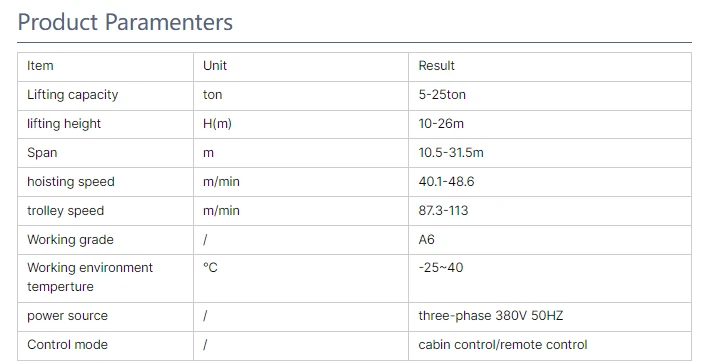
Max. Lifting Height:30m
Rated Lifting Moment:/
Max. Lifting Load:50t
Span:10.5~31.5m
Rated Lifting Moment:/
Lifting mechanism:Electric Trolley
Power Source:3 Phase 380V 50hz
Lifting speed:1-15M/MIN
Trolley running speed:5-40M/MIN
Crane running speed:5-100M/MIN

Pictures & Components
1.Main beam
1.The main beam of an electric grab bridge crane is a critical structural component that supports the entire crane system, including the electric grab mechanism and hoisting equipment. It spans the width of the work area and allows the crane to travel across the runway beams.
2.The main beam of an electric grab bridge crane is a vital component that provides structural support and enables the crane to perform its material handling functions. Its design and construction must meet rigorous standards to ensure safety, durability, and efficient operation. Proper fabrication, regular maintenance, and adherence to safety protocols are essential to maintaining the performance and reliability of the main beam in an electric grab bridge crane.

Lifting System
1.The lifting system of an electric grab bridge crane is designed to efficiently handle and transport bulk materials using a grab bucket or clamshell attachment. This system includes several key components that work together to lift, lower, and move materials with precision and reliability.
2.This system typically consists of several key components:
Hoisting Mechanism: This mechanism includes one or more electric hoists, each equipped with a motor that drives the drum or hoist wheel around which the wire rope is wound. When the motor is activated, it winds the rope onto the drum, lifting the hook and any load attached to it. The reverse action lowers the hook.
Wire Ropes: These are high-tensile steel cables that connect the hoist drum to the hook. They must be strong enough to support the maximum load capacity of the crane without stretching or breaking.
Hook Block: The hook block is a set of sheaves or pulleys through which the wire ropes pass. It serves to direct and distribute the force from the wire ropes to the hook, increasing the mechanical advantage and allowing for more significant loads to be lifted with less effort.
3.The lifting system of an electric grab bridge crane is designed for efficient and precise material handling. It includes the electric hoist, grab bucket, trolley, and control systems, each playing a crucial role in lifting and transporting bulk materials. Ensuring that each component is properly maintained and inspected is vital for safe and reliable operation.

3.End carriage
1.The end beam of an electric grab bridge crane is a crucial component. It's part of the bridge structure that spans across the rail tracks or runway beams, providing support for the crane's movement. This end beam often houses various electrical and mechanical components, including the drive mechanisms and control systems. It ensures stability and alignment of the crane as it operates.
2.The end beam provides structural support for the bridge crane, enabling it to traverse the length of the runway or rail tracks. It helps distribute the load and maintain stability during operation.
3.The end beam often contains control panels and electrical systems for operating the crane. This includes control for the hoisting mechanisms and the grab bucket.
4.In summary, the end beams of of an electric grab bridge crane play a crucial role in providing stability, distributing load stresses, and supporting the movement of the crane. They are an integral part of the crane's superstructure, ensuring safe and reliable operation when lifting and transporting heavy loads.

4.Crane travelling mechanism
1.As an important part of electric grab bridge crane, crane travelling mechanism is responsible for driving the entire crane to move left and right along the track beam. The design and performance of the crane travelling mechanism directly affect the working efficiency and safety of the crane.
2.The crane travelling mechanism of electric grab bridge crane usually includes a drive device, a wheel set, a rail clamp, a brake device, etc.
When the crane needs to move left and right, the control system sends instructions to the drive device of the crane travelling mechanism, the motor receives the instructions and starts to work, drives the reducer and gears to rotate, then drives the wheel set to roll on the track beam, so that the crane can move to the designated position. When it needs to stop, the brake device works immediately to ensure the accuracy of the stopping position of the crane.The crane travelling mechanism of electric grab bridge crane needs to have stable speed, accurate positioning, reliable braking and other performance, in order to ensure the smooth progress of loading and unloading operations. At the same time, it also needs to have good adaptability, able to work normally under different environmental conditions.
In summary, the crane travelling mechanism of electric grab bridge crane plays an extremely important role in the entire crane. Only by understanding its structure, working principle, performance requirements and maintenance methods, can we better use and maintain this equipment, thus improving the working efficiency of the crane and ensuring production safety.
5.Trolley travelling mechanism
1.The trolley travelling mechanism of an electric grab bridge crane is a crucial component for transporting materials in industrial and logistics settings. This mechanism enables the smooth horizontal movement of the grab along the bridge crane, allowing precise positioning and efficient material handling.
2.The trolley travelling mechanism typically consists of a drive unit, wheels, a braking system, and a support frame. The drive unit usually includes an electric motor and a gearbox that provide the necessary torque and speed control. The wheels are mounted on the bridge rails and facilitate the movement of the trolley. The braking system ensures safe operation by preventing unintended motion.When the crane operator or control system initiates a move command, the electric motor in the trolley's drive unit activates. This power, after being reduced through the gearbox to suitable speed and torque levels, turns the wheels, propelling the trolley along the bridge. Advanced controls can adjust the speed and direction of the trolley, enabling precise placement of the grab.
3.In summary, the trolley travelling mechanism of an electric grab bridge crane plays a vital role in material handling operations. Its reliable and precise operation is critical for maintaining productivity and safety in industrial environments. By understanding its structure, working principles, and maintenance requirements, operators and maintenance personnel can ensure the dependable performance of this crucial equipment.
6.Crane wheel
1.The crane wheel of an electric grab bridge crane is a fundamental component that allows the crane to move along the rails or beams it is mounted on. These wheels are specifically designed to bear the heavy weight of the crane and its payload, ensuring smooth and reliable movement.
2.Crane wheels can be made from various materials such as steel, cast iron, or even synthetic materials depending on the application and environmental conditions. Steel wheels are common due to their strength and durability, while cast iron wheels are preferred for their ability to absorb shock and noise.Wheels are typically fitted into wheel hubs that are then attached to the crane's body. They may be fixed or rotating, depending on the design of the crane. Some cranes have wheels that can swivel to accommodate slight changes in track alignment, ensuring smoother operation and reducing wear and tear.
3.In summary, the crane wheels of an electric grab bridge crane are critical components that require careful selection, maintenance, and periodic replacement to ensure the crane's reliability and safety. Proper attention to these elements helps to maximize the crane's efficiency and longevity in industrial applications.
 |
 |
 |
7.Crane grab
1.The crane grab, also known as the gripper or grabber, is a crucial component of an electric grab bridge crane. It is used for Crawl, lifting, and releasing various materials, especially in industries such as scrap yards, recycling facilities, ports, and construction sites.
2.Crane grabs typically consist of a frame, claws or fingers, a closing mechanism, and connecting hardware that attaches it to the crane's hoisting mechanism. The closing mechanism may be powered mechanically, hydraulically, or pneumatically, depending on the design and requirements. When activated, the closing mechanism pulls the claws or fingers together, securing the material for lifting. Release is achieved by reversing the mechanism, opening the claws or fingers.
3.In summary, the crane grab of an electric grab bridge crane is a specialized tool designed for grabbing, lifting, and manipulating a wide range of materials. Its design, operation, and maintenance are critical for ensuring the efficiency and safety of material handling operations in industrial environments. By selecting the right type of grab and maintaining it properly, users can optimize their crane's performance and extend its service life.
·
 |
 |
·
Motor
The motor of an electric grab bridge crane is a critical component that provides the power necessary for lifting and moving loads. It is responsible for converting electrical energy into mechanical motion, which drives the various mechanisms of the crane, including the hoisting mechanism that operates the grab and the trolley that moves it along the bridge.
There are several types of motors used in electric grab bridge cranes, including:
AC motors: These are commonly used due to their simplicity, reliability, and ease of control. They can be either induction motors or synchronous motors.
DC motors: Historically more prevalent, they offer precise speed control and were often used when variable speed was required. However, with advances in AC motor control technology, DC motors have become less common.
Inverter duty AC motors: These are designed to work with variable frequency drives (VFDs), which allow for precise speed control and improved energy efficiency.
The size of the motor must be matched to the crane's capacity and duty cycle. It needs to generate enough power to lift the specified load at the required speed without overheating or exceeding its design limits.
Modern electric grab bridge cranes often use advanced control systems like VFDs or adjustable frequency drives (AFDs). These systems can precisely control the motor's speed and torque, improving operational efficiency, safety, and reducing wear on the crane's components.
In summary, the motor of an electric grab bridge crane plays a vital role in powering the crane's operations. Advances in motor technology, such as the use of VFDs and energy-efficient designs, have significantly improved the performance and safety of these cranes. Proper selection, maintenance, and operation of the motor are essential for ensuring the crane's reliability and efficiency in handling materials in industrial.

.
Sound and light alarm system & limit switch
The sound and light alarm system and limit switches are important safety features of electric grab bridge cranes. They are designed to alert operators and surrounding personnel to potential hazards and to automatically stop the crane when it approaches the end of its travel path or in case of certain faults.
Sound and Light Alarm System
The sound and light alarm system is used to provide audible and visual warnings in potentially dangerous situations. This system is especially crucial in environments where the crane operates in close proximity to workers or other equipment.
The alarm system may be activated manually by the crane operator or automatically by safety systems when certain conditions are met, such as when the crane approaches the end of its tracks or if there's a potential collision detected.
The alarm system alerts nearby workers to the crane's presence and operation, ensuring they can take necessary precautions.
Limit Switches
Limit switches are automatic control devices that stop the crane when it reaches the end of its travel or when certain operational limits are encountered.
As the crane approaches the end of its travel path or reaches a predefined operational limit, the corresponding limit switch is triggered.
Upon triggering, the limit switch automatically cuts power to the motor(s) controlling the crane's movement, stopping it immediately.
Some limit switches are also linked to the control system to send signals to the crane operator's console, indicating that a limit has been reached.
In summary, both the sound and light alarm system and limit switches are essential safety features of electric grab bridge cranes. They serve to alert and protect personnel, prevent equipment damage, and ensure that the crane operates within its designated limits. Regular inspection and maintenance of these components are necessary to maintain their effectiveness and uphold safety standards.

10.Safety Devices
Overload Protection Devices
Load Cells or Weight Indicators: Used to measure the load being lifted and provide feedback to the operator. If the load exceeds the crane's capacity, the system can automatically restrict operation.
Overload Limit Switches: These automatically disconnect power to the hoist motor if the load exceeds the crane's rated capacity.
Travel Limit Switches
As mentioned earlier, these switches stop the crane at the end of its travel path to prevent it from going beyond safe limits and potentially causing structural damage or collisions.
Lifting Limit Switches
These control the maximum height the load can be lifted to and the lowest point it can descend to, preventing operational excesses that might lead to accidents or damage.
Anti-collision Devices
Crane Anti-collision Systems: In multi-crane environments, systems may be installed to detect the presence of other cranes or obstacles in the path of the bridge crane and alert the operator or automatically stop the crane.
Ground Level Alerts: Warning systems to alert ground workers of moving cranes, often integrated with the sound and light alarm system.
Emergency Stops
Emergency Stop Buttons: Located within easy reach of the crane operator, these buttons allow for immediate power cutoff to all motors in case of emergencies.
Remote Emergency Stops: In some cases, emergency stops can also be activated remotely, allowing other personnel to stop the crane if the operator is unable to do so.
Movement and Speed Control Devices
Speed Monitors: Devices that monitor the speed of the crane's movement to ensure it does not exceed safe operational speeds.
Dynamic Braking Systems: Used to control the lowering of loads smoothly and prevent any sudden drops or jerks that could cause injury or damage.
Electrical Safety Devices
Insulation Monitors: Devices that check for proper insulation and grounding to protect against electrical faults.
Fault Current Indicators: These devices detect abnormal current levels which might indicate an electrical fault, triggering a shutdown to prevent further issues.
11.Control Mode
1.Ground Control
Similar to remote control, ground control systems allow the operator to control the crane from a stationary or mobile ground control station. This can be through a wired connection or wireless technology. Ground control stations often have a panel with multiple control elements similar to those found in a cab. This setup is advantageous for situations where the operator needs to be on the ground, such as in port operations or when moving large or hazardous materials.
2.Cab Control
Cab control involves operating the crane from within an enclosed operator's cab mounted on the crane itself. The cab is equipped with control levers, buttons, or a joystick to manipulate the crane's functions. This setup provides the operator with a more comfortable environment and can include additional controls for auxiliary functions like grab rotation or opening and closing. Cab control also allows for better visibility and protection from environmental conditions but may limit the operator's visibility of the load and surrounding area compared to ground-based controls.
3.Remote Control
Remote control systems allow the operator to control the crane from a distance using a remote control unit, which could be a radio or wired remote. This method increases safety by removing the operator from potentially hazardous areas. It also improves visibility as the operator can position themselves for the best view of the load and surroundings. However, it may require a more complex control system to ensure reliable communication between the remote and the crane.

12.Sketch

Main technical
Advantages
1. Versatility
Electric grab bridge cranes can be used for a wide range of materials, including grains, scrap metal, coal, and other bulk materials. The grab mechanism allows for efficient picking up and releasing of these materials, making the crane suitable for diverse industrial applications.
2. Precision and Control
With advanced control systems, electric grab bridge cranes offer precise positioning and controlled movement of loads. This precision reduces the risk of accidents and damage to both the materials being handled and the surrounding environment.
3. High Lifting Capacity
These cranes are designed to handle heavy loads efficiently. They typically have high lifting capacities, making them suitable for operations where large volumes of material need to be moved regularly.
4. Space Efficiency
Electric grab bridge cranes are mounted on rails or runways, allowing them to span large areas while minimizing ground space occupation. This feature makes them ideal for facilities with limited space.
5. Improved Safety
Modern electric grab bridge cranes come equipped with various safety features, including limit switches, overload protection, emergency stops, and anti-collision systems. These safety devices help prevent accidents and protect operators and other personnel in the work area.
6. Energy Efficiency
Compared to some older or less efficient crane models, electric grab bridge cranes are designed to operate with lower energy consumption. This can lead to cost savings in energy expenses over time.
7. Maintenance and Reliability
Electric grab bridge cranes are generally easier to maintain than mechanically operated cranes. Their electric components can be serviced and replaced more easily, contributing to the overall reliability of the equipment.
8. Environmental Considerations
As electric machines, these cranes do not emit exhaust fumes or pollutants, making them a more environmentally friendly option compared to fuel-powered machinery.
Application:
1. Shipping and Port Operations
In ports and shipping yards, electric grab bridge cranes are used for loading and unloading cargo such as grains, coal, scrap metal, and other bulk materials from ships to storage areas and vice versa.
2. Industrial and Manufacturing Plants
These cranes are employed in factories and manufacturing plants for handling raw materials like ores, coal, and minerals. They move materials from storage to processing areas or conveyor systems, ensuring continuity in the production process.
3. Recycling Facilities
Electric grab bridge cranes are utilized in recycling facilities to sort and transfer recyclable materials, including metals and plastics, facilitating their preparation for reprocessing.
4. Power Plants
In power generation plants, especially those using fossil fuels, electric grab bridge cranes handle coal and other fuel materials, moving them from storage to the furnace or processing area.
5. Agricultural Industry
In agriculture, these cranes are used for handling grains and other农产品, moving them from storage silos to transportation vehicles or vice versa.
6. Construction Sites
Construction sites use electric grab bridge cranes for handling aggregates, sand, and碎石, moving these materials to different parts of the site as needed for various construction activities.
7. Warehousing and Storage
In warehouses and storage facilities, electric grab bridge cranes are used for organizing and moving stored goods, particularly those that are not packed in units but are stored in bulk form.
8. Mining Operations
In mining, these cranes can be used for loading and unloading ores and minerals from mining sites to processing plants or transport vehicles.
9. Cement and Building Materials Industry
The cement and building materials industry uses electric grab bridge cranes for handling raw materials and other ingredients before they are processed into cement.
Crane production procedure
1.Design and Engineering
Requirement Analysis: The process begins with a detailed analysis of the customer's requirements, including load capacity, outreach, lifting height, and specific applications.
Design: Based on the requirements, engineers design the crane, including its structural components, the grab mechanism, and the electrical system. This stage may involve computer-aided design (CAD) software to create detailed plans and models.
2. Material Procurement and Preparation
Material Sourcing: Appropriate materials such as steel, electrical components, and grab mechanisms are sourced based on the design specifications.
Material Preparation: Steel sections are cut, shaped, and prepared for welding and assembly according to the design blueprints.
3. Fabrication and Assembly
Structural Assembly: The metal structures, such as the bridge, end trucks, and girders, are assembled using welding and bolting techniques.
Mechanical Assembly: The grab mechanism, hoists, and other mechanical components are assembled onto the structure.
Electrical Assembly: Electrical components such as motors, control systems, and wiring are installed according to the electrical design.
4. Painting and Finishing
Surface Preparation: The crane components are sandblasted or primed to prepare the surface for painting.
Painting: The crane is painted with industrial paint for corrosion protection and aesthetics.
5. Quality Control and Testing
Inspection: Each component and the overall crane are inspected to ensure they meet quality standards and design specifications.
Load Testing: The crane undergoes a series of load tests to verify its lifting capacity and operational safety.
Function Testing: The crane's grabbing function, movement, and control systems are tested to ensure they operate correctly.
6. Installation and Commissioning
Site Preparation: The installation site is prepared, including the installation of runway beams or rails that the crane will move along.
Onsite Installation: The crane is transported to the site and installed on the prepared runways.
Commissioning: The crane is tested in its operational environment to ensure it meets the desired performance criteria.
7. Training and Handover
Operator Training: Operators are trained on how to use the crane safely and efficiently.
Handover: The completed and tested crane is handed over to the customer with all relevant documentation, including operating manuals and maintenance guides.
8. Post-Installation Support
Maintenance Agreements: Maintenance and service agreements are established to ensure the crane continues to operate safely and efficiently over its lifespan.
Customer Support: Manufacturers often provide ongoing customer support to help with any operational issues or maintenance needs.

Workshop view
Material Inspection
Quality Inspection: Strict quality inspection is carried out on the purchased raw materials to ensure that they meet the design requirements and national standards.
Material Storage: Qualified materials are stored according to classification to prevent corrosion or damage.
Cutting and Forming
Steel Cutting: Use plasma cutting, laser cutting or flame cutting and other technologies to cut the steel according to the size of the design drawing.
Forming Processing: Form the steel plate through bending, rolling, welding and other processes to manufacture the main beam, end beam and other structural parts.
Welding
Component Welding: The cut and formed steel parts are welded into the main structures such as the main beam, end beam and trolley. The welding process needs to be strictly controlled to ensure the structural strength and welding quality.
Weld Inspection: Use non-destructive testing technology (such as ultrasonic testing, radiographic testing) to inspect the welds to ensure that there are no cracks or other defects.
Machining
Precision Machining: Precision machining is performed on the key components of the crane, such as wheel sets, bearing seats, pulleys, etc., to ensure their dimensional accuracy and surface quality.
Assembly of the whole machine
General assembly: On the basis of pre-assembly, the overall assembly of the crane is carried out, including the final installation of the main beam, end beam, lifting mechanism, walking mechanism, etc.
Commissioning and testing
Under dynamic conditions, the operating performance of the crane is tested, including the testing of lifting, walking, steering and other functions. The overall size of the assembled bridge crane is checked to ensure that all dimensions meet the design requirements.
Spraying and anti-corrosion treatment
Surface treatment Rust removal: Rust removal on the surface of the crane, common methods include sandblasting, pickling, etc. Primer spraying: Spray anti-corrosion primer on the treated surface to prevent metal oxidation and corrosion. Topcoat spraying Color spraying: Spray topcoat according to customer requirements or industry standards to give the crane a protective and decorative effect. Marking: After spraying, mark the crane's identification information in accordance with the specifications, such as model, rated load, etc.
Factory and installation
Packaging and transportation
Packaging protection: Protectively package the key components of the crane to prevent damage during transportation. Transportation arrangement: According to the equipment size and transportation conditions, select a suitable transportation method to transport the crane to the customer's site.
Acceptance and delivery
Customer acceptance
On-site acceptance: The customer conducts on-site acceptance of the crane according to the contract requirements and technical specifications to check the performance and quality of the equipment.
Problem rectification: If any problems are found, the manufacturer needs to rectify them in time to ensure that the equipment fully meets the customer's requirements. Delivery and use Operation training: The manufacturer usually trains the customer's operators to ensure that they can operate the crane correctly and safely.


Hot Tags: electric grab bridge crane, China electric grab bridge crane manufacturers, suppliers, factory, Bridge Crane, Double Girder Bridge Crane with Electric Hoist
You Might Also Like



Send Inquiry