










480 Ton Bridge Erecting Machine
A 480-ton Bridge Erecting Machine (BEM) is a heavy-duty piece of equipment used in the construction of large bridges, particularly for lifting and placing precast segments, girders, and other structural components.

Key Features
1. High Load Capacity
Designed to handle up to 480 tons, making it suitable for large-span bridge construction.
Can lift and position heavy precast concrete segments, steel girders, and box girders.
2. Modular & Adjustable Design
Often features a modular structure, allowing customization for different bridge widths and spans.
Adjustable booms and supports to accommodate varying bridge geometries.
3. Advanced Hydraulic System
Equipped with high-precision hydraulic cylinders for smooth lifting and positioning.
Ensures stability and control during heavy load operations.
4. Self-Propelled & Mobile
Some models are self-propelled with crawler or wheeled undercarriages for easy movement along the bridge deck.
Can traverse completed bridge sections to reach new work areas.
5. Computerized Control System
Integrated PLC (Programmable Logic Controller) for automated operations.
Real-time monitoring of load distribution, alignment, and stress.
6. Safety Mechanisms
Overload protection systems to prevent accidents.
Emergency braking and locking systems for secure operations.
7. Multi-Functional Attachments
Compatible with various attachments like lifting frames, grippers, and clamps for different bridge components.
Can be used for segmental launching, incremental launching, or balanced cantilever construction.
8. High Stability & Support
Outriggers or stabilizing legs to ensure balance during lifting.
Reinforced steel structure to withstand dynamic loads.
9. Adaptability to Different Bridge Types
Suitable for box girder bridges, cable-stayed bridges, viaducts, and railway bridges.
Can work in urban, mountainous, or over-water environments.
10. Efficient Assembly & Dismantling
Designed for quick on-site assembly using cranes or other lifting equipment.
Reduces downtime between projects.
Specification
Environmental Conditions
Operating Temperature: -20°C to +50°C
Wind Resistance: Stable up to 15–20 m/s (depending on configuration)
Weather Protection: Can operate in light rain/snow (with precautions)
Dimensions & Weight
Machine Length: Adjustable (e.g., 60–120 m, depending on span)
Width: ~6–10 m (fits within bridge deck)
Self-Weight: ~200–400 tons (depends on configuration)
Compliance & Standards
Design Codes: EN 1991, AASHTO, BS, or other relevant bridge construction standards
Certifications: CE, ISO 9001, or project-specific approvals

Pictures & Components
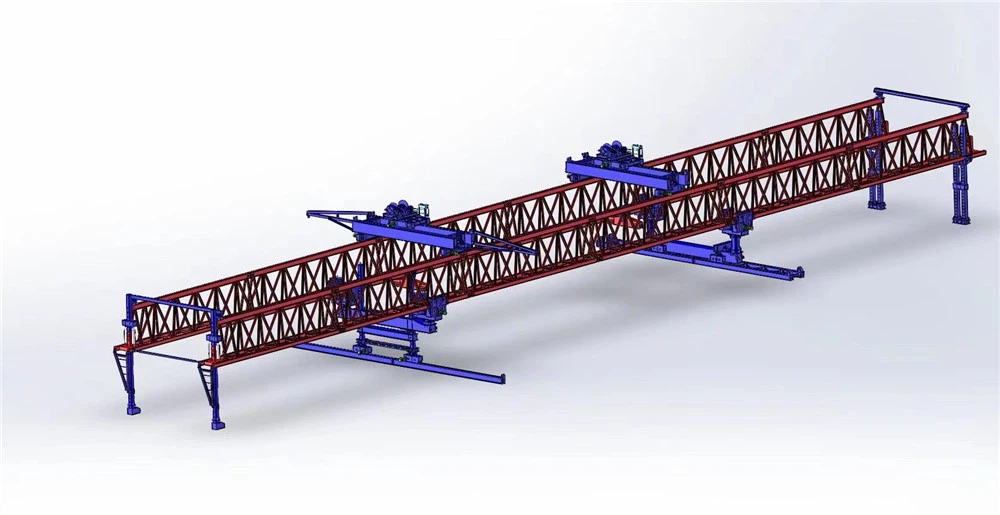
A Bridge Erecting Machine (BEM) is a heavy-duty piece of equipment used to construct bridges, particularly for placing precast segments or girders. A 480-ton Bridge Erecting Machine would be a large-capacity machine designed for heavy lifting and precise placement of bridge components. Below is a breakdown of its key components:
1. Main Load-Bearing Structure
Gantry Frame/Truss Structure – Provides structural support and stability.
Main Beams/Girders – Support the lifting mechanism and distribute loads.
Support Legs/Outriggers – Ensure stability during lifting operations.
2. Lifting & Handling System
Hoisting Mechanism (Winches & Cables) – Typically includes hydraulic or electric winches with high-strength steel cables.
Spreaders/Lifting Frames – Distribute lifting forces evenly across precast segments.
Hydraulic Jacks – For fine adjustments in positioning bridge segments.
3. Movement & Positioning System
Self-Propelled System (Wheels/Tracks) – Allows the machine to move along the bridge deck or temporary rails.
Hydraulic Translation System – Adjusts the machine's position laterally for precise placement.
Slewing Mechanism – Rotates the lifting system for alignment.
4. Hydraulic & Power System
Hydraulic Power Unit (HPU) – Powers lifting, movement, and adjustments.
Electric Generators – Provide power for control systems and auxiliary functions.
5. Control & Monitoring System
PLC-Based Control System – Ensures precise operation.
Load Monitoring Sensors – Prevent overloading.
Laser/GPS Alignment Systems – Ensure accurate positioning of bridge segments.
6. Auxiliary Components
Counterweights – Balance the machine during heavy lifts.
Safety Devices – Emergency brakes, anti-collision systems, and wind resistance mechanisms.
Temporary Supports/Falsework – Used during segment assembly.

Sketch

Advantages
A 480-ton Bridge Erecting Machine (BEM) is a heavy-duty piece of equipment used in the construction of large bridges, particularly for lifting and placing precast segments, girders, and other structural components. Here are its key advantages:
1. High Load Capacity
Can handle heavy bridge segments (up to 480 tons), reducing the need for multiple lifts or additional equipment.
Suitable for large-span bridges (e.g., box girders, segmental bridges, and steel trusses).
2. Efficiency & Speed
Fast assembly and erection, reducing project timelines.
Precision placement minimizes alignment errors and rework.
Automated controls enhance operational efficiency.
3. Adaptability
Works in various terrains (urban, mountainous, over rivers).
Adjustable span and height to accommodate different bridge designs.
Can be used for both launching girders and placing precast segments.
4. Safety & Stability
Robust structural design ensures stability during heavy lifts.
Advanced safety systems (anti-sway, overload protection, real-time monitoring).
Reduces manual labor in high-risk operations.
5. Cost-Effectiveness
Reduces crane dependency, lowering rental and labor costs.
Minimizes disruption to traffic or waterways (useful in busy or environmentally sensitive areas).
Long-term usability across multiple projects.
6. Environmental Benefits
Lower noise and vibration compared to traditional cranes.
Reduced carbon footprint due to optimized operations.
7. Versatility in Bridge Types
Suitable for box girders, T-beams, steel arches, and cable-stayed bridges.
Used in highway, railway, and urban overpass constructions.
Conclusion
A 480-ton BEM is ideal for large-scale bridge projects, offering high efficiency, safety, and cost savings while handling massive loads with precision. It is particularly valuable in complex terrains and fast-track construction projects.

Application
A 480-ton Bridge Erecting Machine (BEM) is a heavy-duty piece of equipment used in the construction of large bridges, particularly for lifting and placing precast segments, girders, or full-span bridge sections. Below are some key applications and features of such a machine:
Applications of a 480-ton Bridge Erecting Machine
Precast Girder Installation
Used to lift and place heavy precast concrete or steel girders (I-beams, U-beams, or box girders) onto piers or abutments.
Suitable for highway, railway, and urban overpass bridges.
Segmental Bridge Construction
Installs precast concrete segments in balanced cantilever or span-by-span construction methods.
Commonly used for cable-stayed bridges, viaducts, and long-span bridges.
Full-Span Launching
Can lift and position entire pre-assembled bridge spans (up to 480 tons) in one operation, speeding up construction.
Ideal for projects with tight schedules or restricted work zones.
Heavy Modular Bridge Construction
Used in Accelerated Bridge Construction (ABC) to place large prefabricated bridge modules.
Reduces on-site construction time and traffic disruptions.
Railway & Metro Viaducts
Deploys heavy concrete or steel segments for elevated rail tracks and metro lines.

Production Procedure
1. Design & Engineering Phase
Requirement Analysis: Define load capacity, span length, mobility, and operational conditions.
Structural Design: CAD modeling (using software like AutoCAD, SolidWorks, or CATIA) for beams, booms, supports, and hydraulic systems.
Simulation & Validation: Finite Element Analysis (FEA) to test stress, deformation, and fatigue resistance.
Regulatory Compliance: Ensure adherence to international standards (ISO, EN, AISC, etc.).
2. Material Procurement
High-Strength Steel: ASTM A572 Grade 50 or equivalent for main girders and booms.
Hydraulic Components: Pumps, cylinders, and valves from certified suppliers.
Electrical & Control Systems: PLCs, sensors, and motors for automation.
Welding Consumables: High-grade electrodes/flux for structural integrity.
3. Fabrication Process
A. Structural Fabrication
Cutting: CNC plasma/oxy-fuel cutting of steel plates.
Bending & Forming: Roll bending for curved sections (e.g., arches).
Welding:
Submerged arc welding (SAW) for thick plates.
Shielded Metal Arc Welding (SMAW) for field joints.
Ultrasonic/X-ray testing for weld integrity.
Machining: Drilling, milling for precision parts (e.g., pivot points).
B. Hydraulic & Electrical Systems
Hydraulic Assembly: Integration of cylinders, hoses, and pumps.
Electrical Wiring: Installation of control panels, sensors, and power distribution.
4. Sub-Assembly
Boom Sections: Fabricate and pre-assemble telescopic/cantilever arms.
Support Legs: Manufacture outriggers/stabilizers for ground support.
Gantry Frames: Build modular segments for easy transport.
5. Main Assembly
Erection of Main Girder: Join sections using high-strength bolts or welding.
Integration of Hydraulics: Mount cylinders for lifting/lowering mechanisms.
Installation of Controls: Fit PLCs, HMI panels, and safety systems (limit switches, overload protection).
Painting & Coating: Apply anti-corrosion layers (e.g., epoxy primer + polyurethane topcoat).
6. Testing & Commissioning
Load Testing:
Static test at 120% of rated capacity (576 tons).
Dynamic test with simulated bridge segments.
Hydraulic Tests: Check for leaks, pressure stability, and response time.
Functional Tests: Verify movement (launching, rotation, lifting) via control system.
Safety Checks: Emergency stop, overload alarms, and stability under wind loads.
7. Disassembly & Packaging
Modular Breakdown: Dismantle into transportable sections (max. 40-ton units for road transport).
Secure Packaging: Protect sensitive components (e.g., electronics) during shipping.
8. On-Site Reassembly & Final Inspection
Foundation Preparation: Ensure ground stability for machine setup.
Reassembly: Bolt/weld major components on-site.
Calibration: Fine-tune sensors and control parameters.
Client Training: Operational and safety training for end-users.
9. Documentation & Delivery
As-Built Drawings: Updated CAD models reflecting final modifications.
Certificates: Material test reports (MTRs), weld logs, and load test certificates.
User Manuals: Detailed operation, maintenance, and troubleshooting guides.


Workshop View
The company has installed an intelligent equipment management platform, and has installed 310 sets (sets) of handling and welding robots. After the completion of the plan, there will be more than 500 sets (sets), and the equipment networking rate will reach 95%. 32 welding lines have been put into use, 50 are planned to be installed, and the automation rate of the entire product line has reached 85%.


Hot Tags: 480 ton bridge erecting machine, China 480 ton bridge erecting machine manufacturers, suppliers, factory
You Might Also Like



Send Inquiry