







Girder Launching Equipment
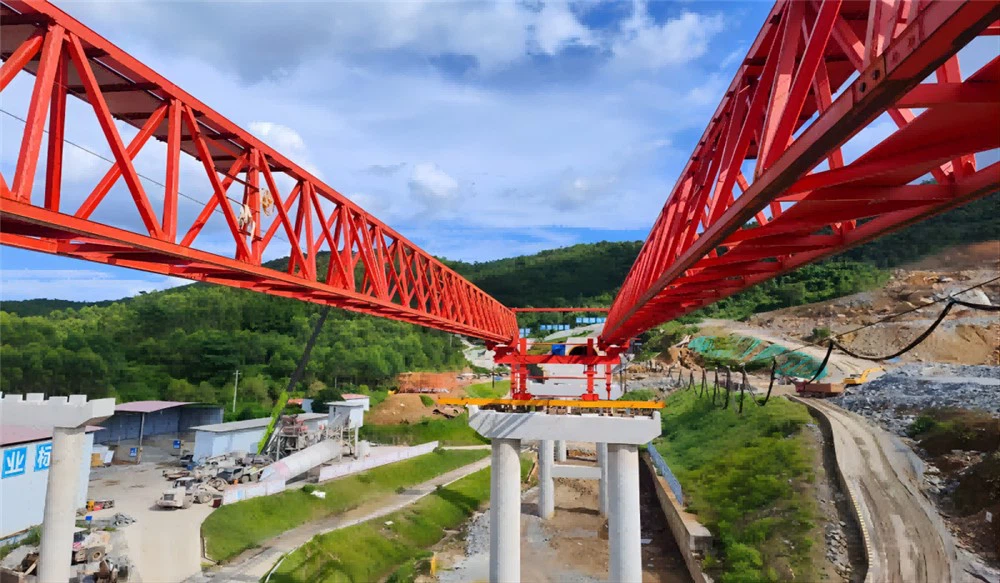
Girder launching equipment is specialized machinery used in bridge construction to lift, transport, and position girders (large horizontal beams) into place. This equipment ensures safe and efficient installation, especially in challenging environments like highways, rivers, or deep valleys.

Key Features
Girder launching equipment is essential in bridge construction for the safe and efficient placement of girders. Here are the key features of modern girder launching equipment:
1. High Load Capacity
Designed to handle heavy girders (precast concrete, steel, or composite) with capacities ranging from 100 to 1000+ tons.
Robust structural design to ensure stability during lifting and launching.
2. Modular & Adjustable Design
Modular components allow customization for different bridge spans and girder types.
Adjustable booms, supports, and trolleys to accommodate varying girder lengths and weights.
3. Self-Launching & Self-Propelled Mechanisms
Some systems feature self-launching capabilities, reducing the need for additional cranes.
Hydraulic or electric propulsion for controlled movement along the bridge deck or piers.
4. Precision Positioning & Control
Hydraulic systems for smooth and precise girder placement.
Remote-controlled operation for safety and accuracy.
Laser or GPS-guided alignment for exact positioning.
5. Safety Systems
Overload protection sensors to prevent exceeding weight limits.
Anti-slip and anti-tip mechanisms for stability.
Emergency braking and fail-safe locking systems.
6. Versatility for Different Bridge Types
Suitable for simply supported, continuous, and cantilever bridges.
Can be used for segmental launching in incremental bridge construction.
7. Fast Erection & Time Efficiency
Reduces construction time compared to traditional crane-based methods.
Enables continuous girder placement without frequent repositioning.
8. Low Ground Footprint
Minimal ground support required, ideal for constrained or elevated work sites.
Some systems operate from previously placed girders, eliminating the need for ground-based cranes.
9. Compatibility with Launching Gantries & Lifters
Often integrated with launching gantries, lift frames, or transporters for seamless operation.
10. Durability & Weather Resistance
Built with high-strength steel and corrosion-resistant coatings.
Operates effectively in harsh weather conditions.

Specification


Pictures & Components
Girder launching equipment is used in bridge construction to lift, transport, and place girders (precast concrete or steel beams) into their final positions. The components vary depending on the type of launching method (e.g., launching gantry, beam launcher, or lifting frame), but generally include the following key elements:
1. Main Gantry/Launching Girder
The primary structural frame that spans the bridge piers or supports.
Typically made of high-strength steel trusses or box girders for rigidity.
Moves along the bridge alignment using a propulsion system.
2. Support Legs/Outriggers
Provide stability during girder placement.
Adjustable legs that rest on bridge piers or temporary supports.
Some systems have front and rear supports for balanced weight distribution.
3. Lifting System (Hoists/Winches)
Hydraulic or electric winches with wire ropes/chains for lifting girders.
May include spreader beams to ensure even load distribution.
Some systems use hydraulic jacks for precise positioning.
4. Launching Nose (Optional)
A temporary extension attached to the front of the girder during incremental launching.
Reduces cantilever stresses by providing temporary support.
5. Propulsion System (Travel Mechanism)
Wheels, tracks, or sliding pads for moving the gantry along the bridge.
Powered by hydraulic rams, electric motors, or winches.
6. Hydraulic/Power Pack
Provides hydraulic pressure for lifting, propulsion, and adjustments.
Includes pumps, control valves, and hoses.
7. Control System
Operator cabin or remote control for precise girder placement.
Sensors and monitoring systems for load, alignment, and stability.
8. Temporary Bearings & Guides
Supports the girder during placement until permanent bearings are installed.
Alignment guides ensure accurate positioning.
9. Safety Components
Anti-slip devices, overload protection, and emergency brakes.
Wind bracing for stability in adverse weather.

Sketch


Advantages
Girder launching equipment is widely used in bridge construction for the efficient installation of girders (precast concrete or steel beams). Here are some key advantages of using girder launching equipment:
1. High Efficiency & Speed
Rapid Installation: Enables quick placement of multiple girders in a single operation, reducing construction time.
Continuous Workflow: Minimizes interruptions compared to traditional crane-based methods.
2. Enhanced Safety
Reduced Manual Labor: Limits workers' exposure to heights and hazardous conditions.
Stable Operation: The equipment is designed to handle heavy loads with precision, reducing the risk of accidents.
3. Cost-Effective
Lower Labor Costs: Requires fewer workers compared to conventional methods.
Reduced Need for Multiple Cranes: Eliminates the cost of mobilizing large cranes for each girder placement.
4. Versatility
Adaptable to Different Bridge Types: Suitable for various girder types (I-beams, box girders, U-beams).
Works in Challenging Terrains: Effective in areas with limited access (over rivers, highways, or uneven ground).
5. Precision & Control
Accurate Positioning: Ensures girders are placed correctly with minimal adjustments.
Controlled Launching Process: Reduces the risk of misalignment or damage during installation.
6. Minimal Site Disruption
Reduced Traffic Interference: Ideal for urban areas or over active roadways/railways.
Lower Environmental Impact: Less noise and ground disturbance compared to heavy cranes.
7. High Load Capacity
Handles Heavy & Long Girders: Capable of launching large-span girders that conventional cranes may struggle with.
8. Modular & Reusable Design
Easy Assembly & Dismantling: Can be transported and reused for multiple projects.
Scalable for Different Spans: Adjustable for varying bridge lengths and heights.

Application
Girder launching equipment is essential in bridge construction, particularly for placing precast or steel girders efficiently and safely. Below are key applications and considerations:
1. Applications
Precast Concrete Girders: Used for highway, railway, and pedestrian bridges.
Steel Girders: Common in long-span bridges, such as box girders or I-beams.
Segmental Bridge Construction: For incremental launching of bridge decks.
Launching Over Obstacles: Useful when cranes cannot access the site (e.g., rivers, highways, or valleys).
2. Types of Girder Launching Equipment
Launching Gantry Systems:
Modular gantries with self-propelled capabilities.
Used for balanced cantilever or span-by-span construction.
Self-Propelled Modular Transporters (SPMTs):
Hydraulic trailers for moving heavy girders.
Launching Beams & Winch Systems:
Temporary beams with winches to slide girders into place.
Incremental Launching Method (ILM) Equipment:
Hydraulic jacks and sliding bearings for pushing girders sequentially.
Production Procedure
The production procedure for Girder Launching Equipment (used in bridge construction to lift and position girders) involves several critical stages to ensure safety, precision, and reliability. Below is a structured outline of the typical manufacturing process:
1. Design & Engineering
Conceptual Design: Based on project requirements (span length, girder weight, site conditions).
Detailed Engineering:
Structural analysis (load capacity, stress distribution).
Hydraulic/pneumatic system design (for launching mechanisms).
CAD modeling & simulation (Finite Element Analysis for critical components).
Regulatory Compliance: Ensure adherence to standards (AASHTO, EN, ISO, etc.).
2. Material Procurement
Key Materials:
High-strength steel (for beams, booms, and supports).
Hydraulic cylinders, motors, and control systems.
Wear-resistant alloys (for sliding parts).
Quality Checks: Material certifications (ASTM/EN), UT/MT testing for defects.
3. Fabrication of Components
A. Structural Components
Cutting: Plasma/Oxy-fuel or laser cutting of steel plates.
Welding:
Submerged arc welding (SAW) for thick sections.
Shielded Metal Arc Welding (SMAW) for joints.
Post-weld NDT (X-ray, ultrasonic testing).
Machining: CNC milling/drilling for precision holes and connections.
B. Mechanical Systems
Hydraulic Assembly:
Pump, valves, cylinders, and hoses.
Pressure testing (leak checks).
Track/Launching Mechanism:
Fabrication of rails or launching noses.
Gear/winch systems for movement.
C. Electrical & Control Systems
Sensors (load, alignment).
PLC-based control panel for automation.
4. Assembly & Integration
Sub-Assembly: Joining smaller components (e.g., boom sections).
Full Assembly:
Erecting the main frame.
Installing mechanical/hydraulic systems.
Wiring control systems.
Alignment Checks: Ensure all moving parts operate smoothly.
5. Testing & Quality Control
Load Testing:
Static test (110% of max design load).
Dynamic test (simulated girder launch).
Functional Tests:
Hydraulic system performance.
Emergency brakes/safety interlocks.
Final Inspection: Dimensional accuracy, weld integrity, paint coating.
6. Surface Treatment & Painting
Blasting: Shot blasting to remove rust/impurities.
Priming/Coating:
Zinc-rich primer for corrosion resistance.
Polyurethane topcoat (weatherproofing).
7. Packaging & Shipping
Disassembly (if required for transport).
Packaging: Anti-rust treatment for sea shipments.
Documentation: Manuals, test reports, certifications.
8. On-Site Installation & Commissioning
Reassembly at the construction site.
Trial runs with actual girders.
Operator training.
Workshop View
The company has installed an intelligent equipment management platform, and has installed 310 sets (sets) of handling and welding robots. After the completion of the plan, there will be more than 500 sets (sets), and the equipment networking rate will reach 95%. 32 welding lines have been put into use, 50 are planned to be installed, and the automation rate of the entire product line has reached 85%.


Hot Tags: girder launching equipment, China girder launching equipment manufacturers, suppliers, factory
You Might Also Like


Send Inquiry