










Bridge Launcher Equipment For Bridge Construction
Bridge launcher equipment is essential for the efficient construction of bridges, particularly for segmental and precast concrete bridges. These machines enable the rapid and precise placement of bridge segments, reducing construction time and improving safety.

Key Features
Bridge launchers are specialized machines used in the construction of precast segmental bridges, box girder bridges, and other long-span structures. They enable efficient and safe placement of bridge segments without the need for extensive ground support. Below are the key features of bridge launcher equipment:
1. Modular & Adjustable Design
Can be customized for different bridge widths, spans, and geometries.
Adaptable to varying construction site conditions (e.g., curves, inclines).
2. Self-Launching Capability
Moves forward autonomously using hydraulic systems or winches.
Reduces dependency on cranes or other heavy lifting equipment.
3. Heavy Load Handling
Capable of lifting and placing precast concrete segments (weighing up to hundreds of tons).
Equipped with strong support beams and stabilizing mechanisms.
4. Hydraulic & Mechanical Systems
Precision-controlled hydraulic jacks for segment alignment.
Winches, trolleys, and gantries for smooth segment transportation.
5. Safety & Stability Features
Outriggers and counterweights to prevent tipping.
Fail-safe braking and locking systems.
Real-time monitoring of loads and structural integrity.
6. Fast & Efficient Construction
Reduces construction time compared to traditional methods.
Enables continuous progress with minimal interruptions.
7. Remote & Automated Control
Some models feature semi-automated or remote-controlled operations for precision and safety.
8. Mobility & Transportability
Can be disassembled and transported to new construction sites.
Some models are rail-mounted or use wheeled transporters.
9. Compatibility with Different Bridge Types
Suitable for balanced cantilever, span-by-span, and incremental launching methods.
10. Environmental & Cost Benefits
Minimizes ground disturbance and temporary works.
Lowers labor and material costs compared to conventional scaffolding or falsework.

Specification


Pictures & Components
Bridge launcher equipment is a specialized machine used in the construction of bridges, particularly for launching precast segments, girders, or full-span bridge components into their final positions. These systems are essential for accelerated bridge construction (ABC), minimizing disruption to traffic and reducing construction time.
Bridge launcher equipment is essential for the efficient construction of bridges, particularly for segmental and precast concrete bridges. These systems enable the rapid and precise placement of bridge segments, reducing construction time and improving safety. Below are the key components of bridge launcher equipment:
1. Main Girder (Launching Truss or Beam)
The primary structural framework that spans the bridge construction gap.
Typically made of high-strength steel for durability and load-bearing capacity.
Supports the weight of segments and construction loads during launching.
2. Front Support (Nose or Launching Nose)
Extends ahead of the main girder to provide stability during launching.
Helps distribute loads and prevents excessive deflection.
Often adjustable to accommodate different bridge geometries.
3. Rear Support (Tail or Anchorage System)
Provides counterbalance and stability during the launching process.
Anchored to the completed bridge sections to prevent tipping.
May include hydraulic jacks or sliding mechanisms for controlled movement.
4. Launching Gantry (Traveler or Erection Gantry)
Moves along the main girder to lift and position precast segments.
Equipped with hoists, winches, or hydraulic systems for segment handling.
Can be self-propelled or moved using external machinery.
5. Hydraulic Jacks and Winches
Used for lifting, pushing, or pulling the launcher and bridge segments.
Provide controlled movement during launching operations.
May include synchronization systems for precise alignment.
6. Sliding or Rolling Mechanism
Allows the launcher to move forward as the bridge progresses.
Can use sliding bearings, rollers, or skid tracks.
Often powered by hydraulic or electric motors.
7. Segment Handling Equipment
Cranes, lifting frames, or vacuum lifters for transporting precast segments.
Ensures safe and precise placement of bridge deck segments.
8. Control System
Automated or manual control for synchronized launching operations.
Includes sensors, PLCs (Programmable Logic Controllers), and monitoring devices.
Ensures alignment and stability during construction.
9. Temporary Supports (Falsework or Piers)
Intermediate supports used during launching to reduce span lengths.
Removed after the bridge deck is completed and self-supporting.
10. Safety Systems
Fall protection, emergency brakes, and overload sensors.
Ensures safe operation for workers and equipment.

Sketch


Advantages
Bridge launcher equipment is a specialized machine used in the construction of precast segmental bridges, viaducts, and other long-span structures. It offers several advantages over traditional bridge construction methods, including:
1. Faster Construction Speed
Enables rapid assembly of precast segments, reducing project timelines.
Continuous launching process minimizes delays compared to conventional methods.
2. High Precision and Quality Control
Ensures accurate placement of segments, improving alignment and structural integrity.
Reduces human error with automated or semi-automated operations.
3. Reduced Labor and Cost Efficiency
Requires fewer workers compared to traditional scaffolding or crane-based methods.
Lowers overall construction costs due to faster execution and less manual labor.
4. Enhanced Safety
Minimizes risks associated with working at heights and heavy lifting.
Provides a stable platform for workers during segment installation.
5. Minimal Disruption to Traffic and Environment
Ideal for urban areas or overpasses, as it reduces the need for extensive ground support.
Less noise and vibration compared to conventional construction techniques.
6. Adaptability to Complex Geometries
Suitable for curved, inclined, or variable-width bridges.
Can handle different span lengths and segment types efficiently.
7. Reduced Need for Temporary Supports
Eliminates or minimizes the use of temporary piers or falsework, saving time and materials.
8. Improved Load Distribution
Distributes construction loads evenly, reducing stress on the bridge structure during assembly.
9. Suitable for Challenging Terrains
Effective in difficult locations such as rivers, valleys, or densely built areas where traditional methods are impractical.
Conclusion
Bridge launcher equipment enhances efficiency, safety, and precision in bridge construction, making it a preferred choice for modern infrastructure projects. Its ability to accelerate construction while maintaining high-quality standards makes it invaluable for large-scale bridge developments.

Application
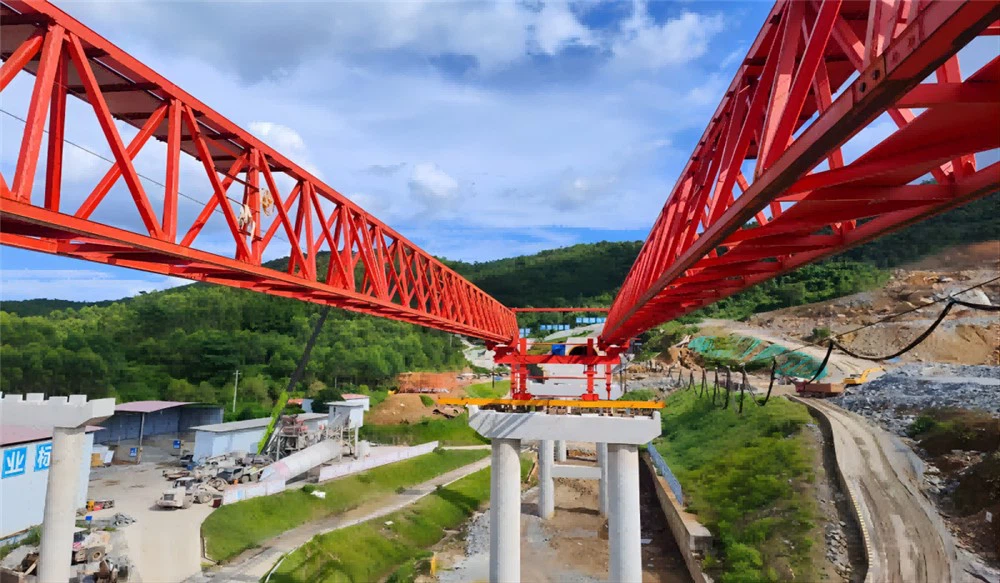
Bridge launcher equipment is a specialized machine used in the construction of precast segmental bridges, particularly for span-by-span or balanced cantilever methods. It enables the efficient and precise placement of bridge segments, reducing construction time and improving safety. Below are its key applications and features:
Applications of Bridge Launcher Equipment
Segmental Bridge Construction
Used for launching precast concrete segments in viaducts, highway bridges, and railway bridges.
Suitable for both span-by-span and balanced cantilever construction methods.
Launching Girders for Precast Segments
Transports, lifts, and positions precast segments with high precision.
Ensures proper alignment before post-tensioning.
Overhead and Underslung Launching
Overhead Launchers: Gantry systems that carry segments from above (common for high piers).
Underslung Launchers: Support segments from below (used for lower heights).
Urban and Challenging Terrain Construction
Ideal for bridges over rivers, valleys, highways, or densely populated areas where traditional cranes are impractical.
Accelerated Bridge Construction (ABC)
Reduces on-site construction time by prefabricating segments off-site and launching them rapidly.
Production Procedure
1. Design Phase
Engineering Analysis: Structural and mechanical engineers analyze bridge specifications to determine launcher requirements
CAD Modeling: 3D modeling of the entire launching system including:
Main girder/launching nose
Support systems
Hydraulic/pneumatic systems
Control mechanisms
Load Calculations: Determining maximum load capacities and stress points
2. Material Procurement
High-strength steel for structural components
Specialized hydraulic cylinders and pumps
Precision bearings and sliding mechanisms
Electrical and control system components
Wear-resistant materials for contact surfaces
3. Fabrication Process
Structural Components
Main Girder Fabrication:
Cutting and shaping of steel plates
Welding of box girders or truss structures
Heat treatment for stress relief
Precision machining of mating surfaces
Support Frames:
Fabrication of temporary piers or supports
Construction of sliding mechanisms
Assembly of adjustable components
Mechanical Systems
Hydraulic system assembly:
Cylinder manufacturing
Pump and valve installation
Hose routing and connections
Bearing and roller system installation
Launching nose construction
Electrical Systems
Control panel assembly
Sensor installation (position, load, alignment)
Wiring and cable management
Safety system integration
4. Quality Control
Non-destructive testing (NDT) of welds
Dimensional verification of critical components
Hydraulic pressure testing
Load testing of structural elements
Functional testing of control systems
5. Assembly and Pre-commissioning
Sub-assembly of major components
Integration of mechanical, hydraulic and electrical systems
Factory acceptance testing (FAT):
Simulated launching operations
Emergency stop testing
Alignment verification
Load capacity verification
6. Surface Treatment
Sandblasting for surface preparation
Application of protective coatings:
Primer
Intermediate coats
Top coats (often in project-specific colors)
Specialized coatings for wear surfaces
7. Documentation
Preparation of operation manuals
Maintenance schedules
Spare parts lists
Certification documents
As-built drawings
8. Transportation Planning
Disassembly for transport (if required)
Special transport arrangements for oversized components
Route surveys and permits
9. Site Commissioning
Reassembly on construction site
Final alignment checks
Operational testing with actual bridge segments
Operator training
Workshop View
The company has installed an intelligent equipment management platform, and has installed 310 sets (sets) of handling and welding robots. After the completion of the plan, there will be more than 500 sets (sets), and the equipment networking rate will reach 95%. 32 welding lines have been put into use, 50 are planned to be installed, and the automation rate of the entire product line has reached 85%.


Hot Tags: bridge launcher equipment for bridge construction, China bridge launcher equipment for bridge construction manufacturers, suppliers, factory, Wheels, Double Girder Overhead Travelling Crane, Forged Crane Wheels, Gantry Crane, Single Beam Explosion Proof Overhead Crane, Steel Rail Wheels
You Might Also Like


Send Inquiry