










500 Ton Bridge Launcher Equipment
A 500-ton bridge launcher is a heavy-duty piece of equipment used in the construction of large bridges, particularly for launching precast or cast-in-place bridge segments. These machines are essential for projects involving long-span bridges, viaducts, or elevated highways where traditional cranes or falsework systems are impractical.

Key Features
Key Features of a 500-Ton Bridge Launcher:
High Load Capacity – Designed to handle segments weighing up to 500 tons.
Self-Launching Mechanism – Moves forward along the bridge deck as construction progresses.
Modular Design – Adjustable for different bridge widths and spans.
Hydraulic Systems – For precise positioning of heavy segments.
Computer-Controlled Operation – Ensures accuracy in segment placement.
Safety Systems – Includes stabilizers, anti-slip mechanisms, and overload protection.
Specification
500-Ton Bridge Launcher Equipment – Technical Specifications
1. General Description
Purpose: Designed for launching precast or assembled bridge segments (girders, decks, etc.) up to 500 tons.
Application: Highway/railway bridges, military bridging, modular bridge construction.
Type: Self-propelled, modular, or rail-mounted depending on design.
2. Load Capacity
Maximum Launching Capacity: 500 metric tons (including bridge segment + equipment weight).
Span Length: Adjustable (typically 30m–60m per launch).
Lifting System: Hydraulic jacks or winches with synchronized control.
3. Structural Components
Launching Nose/Gantry: Telescopic or modular for adjustable reach.
Supporting Frame/Beams: High-strength steel (e.g., ASTM A572 Grade 50).
Hydraulic System:
Pump Capacity: ≥ 500 bar pressure.
Cylinders: Synchronized multi-point lifting.
Travel System:
Wheels/Tracks: Self-propelled with heavy-duty bearings.
Rail Guidance (if applicable): Precision alignment system.
4. Power & Control
Power Source: Diesel engine (e.g., 300–400 kW) or electric motor (for fixed installations).
Control System: PLC-based with remote operation capability.
Safety Features: Load sensors, emergency brakes, anti-slip mechanisms.
5. Mobility & Setup
Transport: Modular design for disassembly/transport via trucks.
Assembly Time: ≤ 48 hours (with crane support).
Launching Speed: 5–10 m/hour (adjustable).
6. Environmental & Operational Conditions
Operating Temperature: –20°C to +50°C.
Wind Resistance: Stable up to 15 m/s (operational), 25 m/s (parked).
Ground Pressure: ≤ 150 kPa (with outriggers/ground mats).
7. Compliance & Standards
Design Codes: EN 1993 (Eurocode 3), AASHTO, or project-specific.
Safety: OSHA/ISO 13849 (machine safety).

Pictures & Components
A 500-ton bridge launcher is a heavy-duty piece of equipment used in bridge construction to lift, transport, and place large bridge segments. Below are the key components of such a system:
1. Main Structural Components
Launching Gantry (Main Frame) – The primary steel structure that spans the construction area and supports the launching mechanism.
Front & Rear Supports – Temporary supports that stabilize the launcher during segment placement.
Launching Nose (Optional) – An extendable front section that helps guide the bridge segments into position.
2. Lifting & Handling System
Hydraulic Jacks (500-ton capacity) – High-capacity jacks for lifting and positioning bridge segments.
Winches & Hoists – Electric or hydraulic systems for moving segments horizontally.
Trolley & Travel Mechanism – Allows movement of the lifting system along the gantry.
3. Movement & Propulsion System
Hydraulic Push/Pull System – Moves the launcher forward along the bridge alignment.
Track or Rail System – Provides a guided path for the launcher's movement.
Skidding Beams/Pads – Support surfaces for smooth sliding during launching.
4. Hydraulic & Power Systems
Hydraulic Power Unit (HPU) – Supplies pressurized oil to jacks and cylinders.
Control Panel (PLC-based or Manual) – Manages operations like lifting, launching, and alignment.
Electric Generators – Provide power for motors, controls, and lighting.
5. Alignment & Positioning Systems
Surveying & Monitoring Sensors – Laser guides or GPS for precise segment placement.
Adjustable Supports – Fine-tune the launcher's position for accuracy.
Leveling Jacks – Ensure stability on uneven terrain.
6. Safety & Auxiliary Components
Anti-Slip Brakes & Locking Pins – Prevent unintended movement.
Emergency Stop Systems – For immediate shutdown in case of failure.
Work Platforms & Access Ladders – For operator access during assembly and maintenance.
7. Transportation & Assembly Components
Modular Sections – Allows disassembly for transport to new sites.
Crane Attachment Points – For lifting and assembling the launcher.

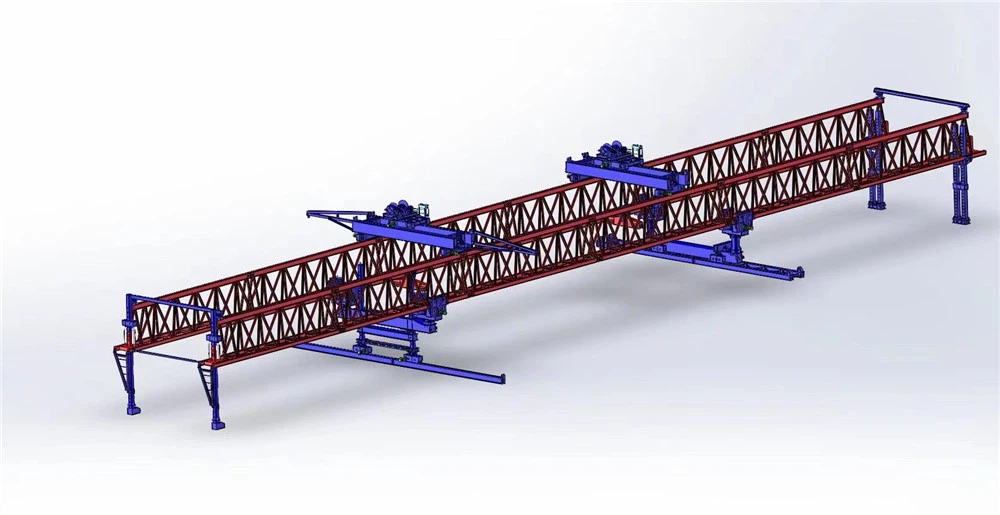
Sketch

Advantages
A 500-ton bridge launcher is a heavy-duty piece of equipment used in the construction of bridges, particularly for launching precast segments, girders, or entire bridge spans. Here are its key advantages:
1. High Load Capacity
Can handle up to 500 tons, making it suitable for large-span bridges, highway viaducts, and railway bridges.
Reduces the need for multiple cranes or support structures, improving efficiency.
2. Precision and Control
Equipped with hydraulic or computerized control systems for accurate positioning of bridge segments.
Ensures smooth and safe placement of heavy components.
3. Time and Cost Efficiency
Speeds up construction by launching large segments in a single operation.
Reduces labor and equipment costs compared to traditional methods like crane lifting.
4. Adaptability to Various Bridge Types
Works for box girders, T-beams, segmental bridges, and steel trusses.
Adjustable supports and modular design allow use in different terrains (urban, mountainous, or over water).
5. Enhanced Safety
Minimizes risks associated with manual lifting and assembly.
Stable support systems prevent accidents during launching.
6. Reduced Environmental Impact
Requires fewer temporary supports, minimizing ground disturbance.
Lower noise and vibration compared to multiple heavy cranes.
7. Long-Distance Launching Capability
Can launch bridge segments over long spans (50m to 100m+) without intermediate supports.
Ideal for crossing rivers, valleys, or highways without disrupting traffic below.
8. Automation and Remote Operation
Some models feature automated synchronization for balanced load distribution.
Remote monitoring improves efficiency and safety.
9. Durability and Low Maintenance
Built with high-strength steel and wear-resistant components for long-term use.
Requires minimal downtime for maintenance.
10. Versatility in Construction Methods
Supports incremental launching, balanced cantilever, and full-span launching techniques.
Can be used for both precast and cast-in-situ bridge construction.
Conclusion
A 500-ton bridge launcher is a highly efficient, safe, and cost-effective solution for modern bridge construction, particularly for large-scale infrastructure projects. Its ability to handle massive loads with precision makes it indispensable for engineers working on viaducts, overpasses, and long-span bridges.

Application
The 500-ton bridge launcher equipment is a heavy-duty machine used primarily in the construction of bridges, particularly for launching precast or cast-in-place bridge segments. Below are its key applications and features:
Applications:
Precast Segment Launching – Used to lift and position precast concrete segments for girder bridges, viaducts, and cable-stayed bridges.
Span-by-Span Construction – Facilitates the incremental launching of bridge decks over supports.
Balanced Cantilever Construction – Assists in placing segments symmetrically in cantilever bridge construction.
Heavy Lifting in Confined Spaces – Ideal for urban or constrained environments where cranes have limited access.
Rail & Highway Bridges – Commonly used in large-scale infrastructure projects.

Production Procedure
The production of a 500-ton bridge launcher is a complex process involving design, material procurement, fabrication, assembly, testing, and commissioning. Below is a structured production procedure for such heavy-duty bridge launching equipment:
1. Design & Engineering Phase
Requirement Analysis: Define load capacity (500 tons), span length, mobility, and terrain adaptability.
Structural Design: CAD modeling (AutoCAD, SolidWorks) for trusses, launching nose, support frames, and hydraulic systems.
Simulation & Validation: Finite Element Analysis (FEA) for stress, deflection, and dynamic load testing.
Regulatory Compliance: Ensure adherence to standards (AASHTO, EN, ISO, or client-specific specs).
2. Material Procurement
High-Strength Steel: ASTM A572 Grade 50 or equivalent for main girders.
Hydraulic Components: Pumps, cylinders (500-ton capacity), and control valves.
Mechanical Parts: Gears, bearings, winches, and bogies (self-propelled or rail-mounted).
Electrical & Control Systems: PLCs, sensors, and remote operation modules.
3. Fabrication Process
A. Structural Fabrication
Cutting & Shaping: CNC plasma/oxy-fuel cutting for steel plates.
Welding: Submerged arc welding (SAW) for girders; certified welders (AWS/EN standards).
Machining: Drilling, milling for precise bolt-hole alignment.
B. Hydraulic & Mechanical Assembly
Hydraulic Circuit Assembly: Integration of pumps, hoses, and cylinders.
Bogie & Traction System: Installation of wheels, motors, and braking systems.
C. Electrical & Control Systems
Wiring & Sensors: Load cells, position sensors, and emergency stops.
Control Panel: PLC programming for synchronized launching.
4. Assembly & Integration
Sub-Assembly: Join girders, launching nose, and support frames.
Full Integration: Mount hydraulic systems, bogies, and control cabinets.
Alignment Checks: Laser alignment for track/wheel parallelism.
5. Testing & Quality Control
Load Testing: Apply 110% of design load (550 tons) in a controlled environment.
Functional Tests: Verify hydraulic extension/retraction, bogie movement, and stability.
Safety Checks: Emergency stop, overload protection, and fail-safes.
6. Painting & Corrosion Protection
Surface Preparation: Sandblasting (SA 2.5 standard).
Coating: Epoxy primer + polyurethane topcoat for weather resistance.
7. Disassembly & Packaging
Modular Breakdown: Dismantle into transportable sections (max. 40ft containers).
Protection: Anti-corrosion wraps for sea/road shipping.
8. On-Site Installation & Commissioning
Reassembly: Guided by assembly manuals.
Field Testing: Trial launch with incremental loads (50% → 100% → 110%).
Operator Training: Hands-on sessions for deployment and maintenance.
9. Documentation & Handover
As-Built Drawings: Updated CAD models.
Manuals: Operation, maintenance, and troubleshooting guides.
Certificates: Material test reports (MTRs), weld inspections, and load test records.


Workshop View
The company has installed an intelligent equipment management platform, and has installed 310 sets (sets) of handling and welding robots. After the completion of the plan, there will be more than 500 sets (sets), and the equipment networking rate will reach 95%. 32 welding lines have been put into use, 50 are planned to be installed, and the automation rate of the entire product line has reached 85%.


Hot Tags: 500 ton bridge launcher equipment, China 500 ton bridge launcher equipment manufacturers, suppliers, factory
You Might Also Like



Send Inquiry