










Double Girder Truss Gantry Crane
A double girder truss gantry crane consists of two parallel girders (typically box-type or truss-style) supported by legs that travel along ground rails. The truss design provides high strength-to-weight ratios, making it ideal for heavy-duty applications.
Key Components:
Main Girders: Constructed from Q345B steel for durability.
Hoist System: Equipped with low-headroom wire rope hoists or winches.
End Trucks: Feature forged steel wheels and bogie systems for smooth travel.
Control Systems: Options include pendant, remote, or cabin control with variable frequency drives.
Advantages Over Single Girder Cranes
Greater Stability: Dual girders minimize load sway for precision lifting.
Higher Efficiency: Supports dual-hoist systems for simultaneous operations.
Customization: Adaptable for explosion-proof or corrosion-resistant environments.

Key Features
Here are the key features of a double girder truss gantry crane:
1. Heavy-Duty Load Capacity
Capacity Range: Typically 5–600 tons, with some models exceeding 1,000 tons for specialized industries.
Long Span: Supports spans up to 45 meters (extendable with custom designs).
2. Truss Girder Design
High Strength-to-Weight Ratio:
Uses Q345B steel for durability.
20–30% lighter than solid-web girders while maintaining rigidity.
Reduced Deflection: Minimizes load sway for precision lifting.
3. Enhanced Stability & Mobility
Bogie Wheel System: Distributes load evenly, reducing rail pressure by 15–20%.
Forged Steel Wheels: Heat-treated for wear resistance in high-duty cycles.
Rail Options: Works with P24–P50 rails or customized tracks.
4. Advanced Hoisting System
Dual-Hoist Capability: Allows tandem lifting for oversized loads.
Low-Headroom Design: Maximizes vertical workspace.
Hoist Types:
Wire Rope Hoists (for heavy loads, e.g., NHA-D European hoists).
Chain Hoists (for lighter, frequent lifts).
5. Precision Control & Automation
Variable Frequency Drives (VFDs): Enable smooth acceleration/deceleration.
Control Options:
Pendant (IP65-rated for harsh environments).
Radio Remote (up to 100m range).
Operator Cabin (with ergonomic controls).
6. Safety Systems
Overload Protection: Automatic cut-off at 110% of rated capacity.
Anti-Collision Sensors: Infrared or laser-based for multi-crane zones.
Fail-Safe Brakes: Dual disc brakes on hoist and travel mechanisms.
Emergency Stop: Instantly halts all operations.
7. Customization Options
Explosion-Proof: For oil/gas or chemical plants.
Corrosion-Resistant: Galvanized or stainless steel for marine environments.
Outdoor Kits: Includes rain covers, windproof anchors, and snow-clearing blades.
8. Energy Efficiency
Regenerative Braking: Recovers energy during deceleration.
IE3/IE4 Motors: High-efficiency European standards.
9. Compliance & Certifications
Standards: FEM 1.001, DIN 15018, ISO 8306.
Certifications: CE, GOST, CMAA (for North America).

Specification
A 120-ton bridge beam launcher is a specialized piece of heavy machinery used for erecting precast concrete beams in bridge construction. Here are its typical specifications:
1. General Parameters
Lifting Capacity: 120 tons
Applicable Bridge Span: 20–50 meters (varies by model)
Applicable Beam Type: Precast concrete beams (T-beam, box girder, I-beam, etc.)
Structure Type: Truss or box girder launcher
2. Mechanical Specifications
Main Girder Length: 35–55 meters (customizable)
Launching Speed: 3–5 m/min (varies)
Beam Erection Method: Balanced cantilever or full-span assembly
Track Type: Rail-mounted or rubber-tired
3. Hoisting Mechanism
Lifting Winch Capacity: 120 tons
Lifting Speed: 0.5–5 m/min
Number of Winches: 2 or 4 (based on design)
4. Traveling Mechanism
Transverse Moving Speed: 2–6 m/min
Longitudinal Moving Speed: 3–8 m/min
Power Source: Hydraulic or electric motor
5. Power Supply
Voltage: 380V/50Hz (customizable)
Control Mode: Remote control + manual operation
6. Safety Features
Overload protection
Emergency stop system
Anti-derailment protection
Wind resistance up to 10 m/s


Pictures & Components
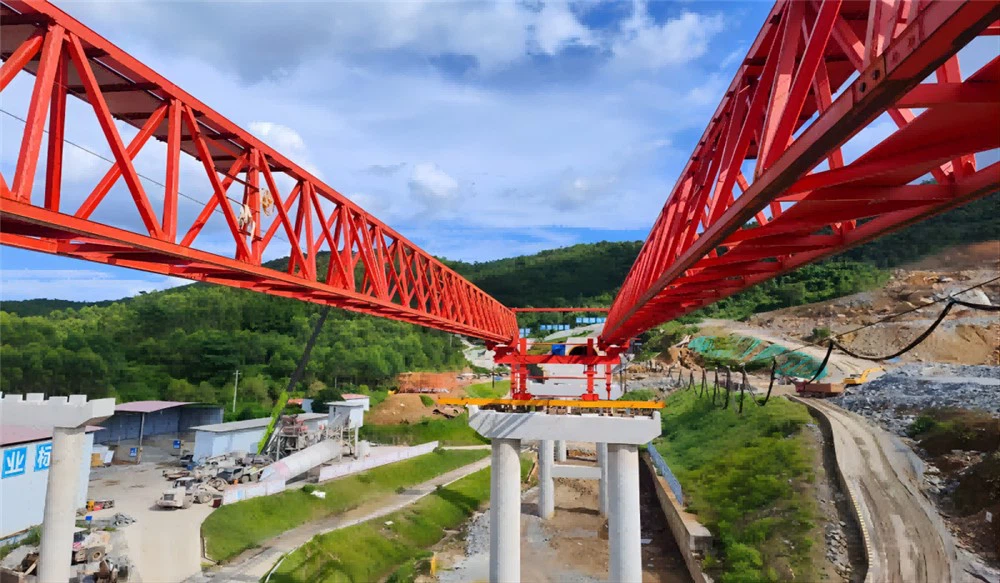
A 120-ton bridge beam launcher (also known as a bridge girder launcher or bridge erection crane) is a specialized construction machine used for erecting precast concrete or steel girders for bridges. It consists of several key components:
1. Main Structure
Main Girder: The primary load-bearing beam that spans the bridge supports.
Support Legs (Front and Rear): Adjustable legs that support the launcher on the piers.
End Beams: Located at both ends, connecting the main girder to the support legs.
2. Lifting and Hoisting System
Winches and Hoists: Used to lift and position the precast girders.
Wire Ropes and Pulleys: Essential for controlling lifting and movement.
Hydraulic System: Provides power for lifting and positioning.
3. Traveling Mechanism
Rail or Track System: Allows the launcher to move along the bridge alignment.
Trolley Mechanism: Moves the hoisting system back and forth.
Drive Motors and Gear System: Provides movement and positioning.
4. Safety and Control System
Electric Control System: PLC (Programmable Logic Controller) for automation.
Remote Control Panel: Allows operators to control the launcher safely.
Sensors and Limit Switches: Ensure safety and prevent overloading.
Braking System: Prevents uncontrolled movement.
5. Power Supply System
Electric or Hydraulic Power Unit: Provides the necessary energy for lifting and movement.
Cables and Connectors: Ensure reliable power transmission.
6. Support and Stability Components
Counterweights: Balances the structure and prevents tilting.
Adjustable Supports: Ensures stability on different terrains.

Sketch


Advantages
1. Superior Load Capacity & Span
Handles 5–600+ tons, making it ideal for heavy-duty lifting (e.g., steel coils, ship parts, transformers).
Long spans (up to 45m) without mid-support, suitable for wide work areas.
2. High Strength with Lightweight Design
Truss structure reduces weight by 20–30% compared to solid-web girders while maintaining rigidity.
Less stress on rails & wheels, extending equipment lifespan.
3. Enhanced Stability & Precision
Dual girders minimize load sway, ensuring safer and more accurate positioning.
Bogie wheel system distributes weight evenly, reducing rail wear.
4. Customizable for Harsh Environments
Corrosion-resistant coatings for marine or chemical industries.
Explosion-proof options (ATEX certified) for oil & gas sectors.
Outdoor kits (windproof, rain covers, snow-clearing blades).
5. Advanced Safety & Control
Overload protection (110% cutoff).
Anti-collision sensors & emergency stop.
Smooth operation with VFDs (Variable Frequency Drives).
6. Energy Efficient
Regenerative braking reduces power consumption.
High-efficiency (IE3/IE4) motors comply with European standards.
7. Low Maintenance & Long Lifespan
CNC-cut steel & NDT welding ensure structural integrity.
Modular design simplifies repairs and part replacements.

Application
1. Steel & Metal Industry
Lifting steel coils, slabs, and molds in rolling mills.
Handling ladles in foundries.
2. Shipbuilding & Ports
Assembling ship hulls & engines.
Loading/unloading heavy containers & machinery.
3. Power Plants & Heavy Machinery
Installing turbines, generators, and transformers.
Moving large industrial equipment.
4. Construction & Infrastructure
Prefabricated bridge segment installation.
Heavy material handling in large-scale projects.
5. Mining & Cement Plants
Transporting bulk materials & heavy machinery.
Maintenance of large crushers & kilns.
6. Railway & Aerospace
Lifting locomotives & railcar components.
Aircraft assembly & engine handling.
Production Procedure
1. Design & Engineering
Confirm project specifications (span, lifting capacity, site conditions).
Structural and mechanical design (CAD drawings, FEM analysis).
Electrical and hydraulic system design.
2. Material Procurement
High-strength structural steel (Q345B or equivalent).
Hydraulic system components (pumps, cylinders, hoses).
Motors, winches, and lifting mechanisms.
Electrical control systems (PLC, sensors, wiring).
Fasteners, welding materials, and safety equipment.
3. Fabrication & Manufacturing
3.1 Steel Structure Fabrication
Cutting: CNC cutting of steel plates.
Welding: Full penetration welding for key joints.
Machining: Precision drilling and shaping of components.
Surface Treatment: Sandblasting, rust-proof coating, and painting.
3.2 Mechanical & Hydraulic Assembly
Installation of main lifting mechanisms (winches, pulleys, hooks).
Integration of hydraulic cylinders and piping system.
Motor and gearbox assembly.
3.3 Electrical System Integration
Installation of PLC control system.
Wiring and sensor placement.
Emergency stop and safety features.
4. Assembly & Pre-Testing
Pre-assembly of sections in the factory.
Load test on individual components.
Functional test of hydraulic and electrical systems.
5. Factory Load Testing
No-load test: Checking movement and alignment.
Static load test: Testing with 120-ton equivalent weight.
Dynamic load test: Operation under simulated conditions.
6. Disassembly & Transportation
Marking all components for easy reassembly.
Packing and transportation to the site.
7. On-Site Installation & Commissioning
Gantry erection and alignment.
Final assembly of bridge launcher.
Testing under real-site conditions.
8. Training & Handover
Operator training for safe operation.
Maintenance guidance and troubleshooting.
Final handover and documentation.

Workshop View
The company has installed an intelligent equipment management platform, and has installed 310 sets (sets) of handling and welding robots. After the completion of the plan, there will be more than 500 sets (sets), and the equipment networking rate will reach 95%. 32 welding lines have been put into use, 50 are planned to be installed, and the automation rate of the entire product line has reached 85%.


Hot Tags: double girder truss gantry crane, China double girder truss gantry crane manufacturers, suppliers, factory
You Might Also Like


Send Inquiry