








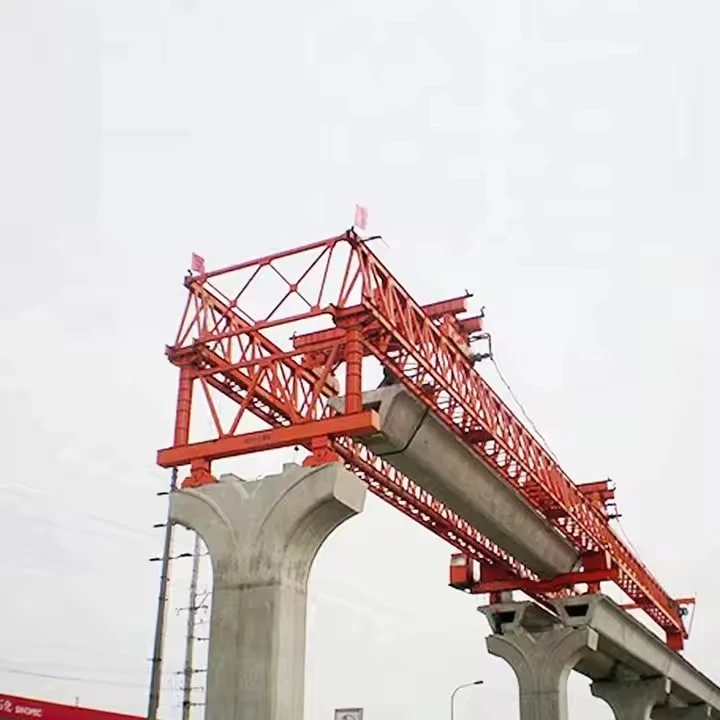


250Ton Bridge Launcher Equipment
A 250-ton Bridge Launcher Equipment is a heavy-duty machine used to install precast bridge segments or girders efficiently.

Key Features
Key Features of a 250-Ton Bridge Launcher:
High Load Capacity – Can lift and position bridge segments weighing up to 250 tons.
Adjustable Span & Reach – Customizable for different bridge widths and heights.
Self-Propelled or Modular Design – Some models are self-propelled on rails or wheels, while others are modular and require assembly on-site.
Precision Placement – Equipped with hydraulic or electronic controls for accurate alignment of bridge segments.
Safety Systems – Includes overload protection, anti-sway mechanisms, and emergency braking.
Adaptability – Can be used for various bridge types (girder, box girder, segmental, etc.).
Remote Control Operation – Some models allow for remote-controlled maneuvering for enhanced safety and efficiency.
Specification
1. General Specifications
Model/Type: 250-ton Bridge Launcher
Application: Precast segmental bridge construction, girder launching, span-by-span erection
Max Launching Capacity: 250 metric tons
Launching Method: Self-launching, modular, or gantry-based
Control System: Automated/PLC-controlled with manual override
2. Structural Specifications
Main Girder/Frame: High-strength steel (Grade S355/S460)
Span Length: Adjustable (e.g., 30m–60m typical)
Width: Adjustable to suit bridge deck width (e.g., 10m–20m)
Height: Adjustable (e.g., 6m–12m)
Support System: Hydraulic jacks, temporary piers, or sliding bearings

Pictures & Components
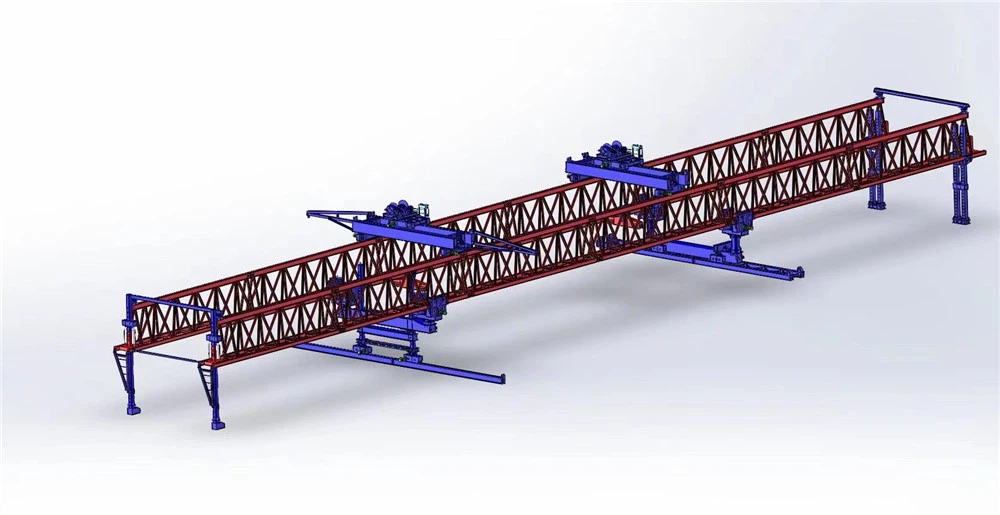
A 250-ton Bridge Launcher Equipment is a heavy-duty machine used to install precast bridge segments or girders efficiently. Here are its key components:
1. Main Structural Components
Launching Nose (Front Boom) – Extends forward to guide the bridge segments during placement.
Main Beam/Girder – The primary load-bearing structure supporting the bridge segments during launching.
Supporting Towers/Piers – Temporary or permanent supports to stabilize the launcher during operation.
Rear Support Frame – Anchors the launcher to the completed part of the bridge.
2. Hydraulic & Mechanical Systems
Hydraulic Jacks – Provide lifting and pushing force to move the bridge segments.
Push/Pull Mechanism – Slides the launcher forward or backward along the bridge alignment.
Winches & Cables – Assist in positioning and stabilizing segments.
3. Movement & Positioning Systems
Traveling Wheels/Tracks – Allows the launcher to move along the bridge deck or ground.
Adjustable Supports – Enable height and alignment corrections for precise placement.
Slewing Bearing – Allows rotation for curved bridge alignment (if applicable).
4. Control & Safety Systems
PLC Control System – Automated controls for synchronized operations.
Load Monitoring Sensors – Ensure weight distribution remains within safe limits.
Emergency Brakes & Locks – Prevent accidental movements during operation.
5. Auxiliary Components
Work Platforms & Access Ladders – Provide safe access for operators.
Counterweights – Balance the launcher during heavy lifts.
Power Pack (Hydraulic & Electric) – Supplies energy for hydraulic and electrical systems.
6. Optional Features
Self-Propelled Module (SPM) – For independent movement without external cranes.
Adaptive Steering System – For complex bridge geometries.
Remote Control Operation – Enhances safety in hazardous conditions.
This equipment is crucial for launching large-span bridges, viaducts, and precast segmental constructions efficiently.

Sketch

Advantages
The 250-ton Bridge Launcher Equipment is a heavy-duty machine designed for rapid and efficient deployment of large bridges, typically used in military, emergency, and infrastructure projects. Here are its key advantages:
1. Rapid Deployment
Can quickly install bridges in minutes, reducing downtime in critical situations (e.g., military operations or disaster relief).
Automated or semi-automated launching systems minimize manual labor.
2. High Load Capacity
Supports 250 tons, allowing the passage of heavy military vehicles (tanks, trucks) or civilian transport.
Ensures stability and safety for continuous heavy traffic.
3. Mobility & Versatility
Mounted on a mobile carrier (wheeled or tracked), enabling transport to remote or rugged locations.
Adaptable to various bridge types (Bailey bridges, modular bridges, etc.).
4. Reduced Manual Labor
Hydraulic or mechanical systems handle heavy components, reducing the need for large crews.
Minimizes risks associated with manual bridge construction.
5. Enhanced Safety
Precision-controlled deployment reduces accidents during installation.
Built-in stabilization systems ensure secure bridge placement.
6. Military & Civilian Applications
Military: Rapid bridge deployment for troop and vehicle movement in combat zones.
Civilian: Emergency bridge repair after natural disasters (floods, earthquakes) or infrastructure projects.
7. Cost-Effective
Reduces long-term costs by speeding up construction and minimizing labor.
Reusable equipment for multiple deployments.
8. Durability & Reliability
Built to withstand harsh environments (extreme weather, rough terrain).
Low-maintenance design for prolonged field use.
Conclusion
The 250-ton Bridge Launcher is a crucial asset for both military and civilian engineering, offering speed, strength, and efficiency in bridge deployment operations. Its ability to handle extreme loads while ensuring rapid installation makes it indispensable in critical scenarios.

Application
A 250-ton bridge launcher is a heavy-duty piece of equipment used in the construction of bridges, particularly for launching precast segments, girders, or entire bridge spans into place. Below are its key applications, features, and considerations:
Applications:
Precast Girder Launching – Used to lift and position large precast concrete or steel girders (up to 250 tons) onto piers or abutments.
Segmental Bridge Construction – Deploys precast segments in balanced cantilever or span-by-span methods.
Launching Trusses & Arches – Assists in placing large steel trusses or arch sections for long-span bridges.
Rail & Highway Bridges – Commonly used in both railway and highway bridge projects where heavy lifting is required.
Overhead & Underslung Launching – Can be configured for launching girders from above (overhead gantry) or below (launching nose).

Production Procedure
The production of a 250-ton Bridge Launcher Equipment (BLE) involves a complex, multi-stage process that integrates structural engineering, mechanical systems, hydraulics, and automation. Below is a detailed step-by-step production procedure:
1. Design & Engineering Phase
Requirement Analysis: Define load capacity (250 tons), span length, terrain adaptability, and mobility.
CAD Modeling: Use software like AutoCAD, SolidWorks, or CATIA for 3D design.
FEA Analysis: Conduct Finite Element Analysis (ANSYS, ABAQUS) to validate structural integrity.
Hydraulic & Electrical System Design: Plan hydraulic cylinders, pumps, and control systems.
2. Material Procurement
Structural Steel: High-grade steel (ASTM A572/A514) for beams, girders, and trusses.
Hydraulic Components: Pumps, cylinders, valves (Bosch Rexroth, Parker).
Electrical & Control Systems: PLCs, sensors, and remote-control modules.
Track/Launching Mechanism: Heavy-duty rollers or sliding bearings.
3. Fabrication Process
A. Main Girder Fabrication
Cutting & Shaping: Plasma/oxy-fuel cutting of steel plates.
Welding: Submerged arc welding (SAW) for longitudinal seams; robotic welding for precision.
Assembly: Bolt and weld segments into box girders or truss sections.
B. Support Structure (A-Frame/Tower)
Fabricate vertical supports using reinforced steel.
Assemble hydraulic lifting mechanisms.
C. Launching Nose & Rear Support
Construct the launching nose (temporary extension for bridge deployment).
Install rear support legs/stabilizers.
4. Hydraulic & Electrical Integration
Hydraulic System:
Install hydraulic cylinders for lifting and launching.
Connect pumps, hoses, and control valves.
Electrical System:
Wire PLCs, sensors, and control panels.
Test synchronization between hydraulic and motion systems.
5. Quality Control & Testing
NDT Testing: Ultrasonic/X-ray welding inspection.
Load Testing: Apply 125% of design load (312.5 tons) to verify safety.
Functional Testing: Simulate bridge launching under controlled conditions.
6. Assembly & Pre-Delivery Check
Assemble all modules (girders, supports, hydraulics).
Conduct final operational tests (extension/retraction, stability).
7. Transportation & Site Commissioning
Disassemble into transportable modules (if needed).
On-site reassembly and commissioning.
Operator training.


Workshop View
The company has installed an intelligent equipment management platform, and has installed 310 sets (sets) of handling and welding robots. After the completion of the plan, there will be more than 500 sets (sets), and the equipment networking rate will reach 95%. 32 welding lines have been put into use, 50 are planned to be installed, and the automation rate of the entire product line has reached 85%.


Hot Tags: 250ton bridge launcher equipment, China 250ton bridge launcher equipment manufacturers, suppliers, factory
You Might Also Like




Send Inquiry