










560ton Bridge Girder Erection Machine For Bridge
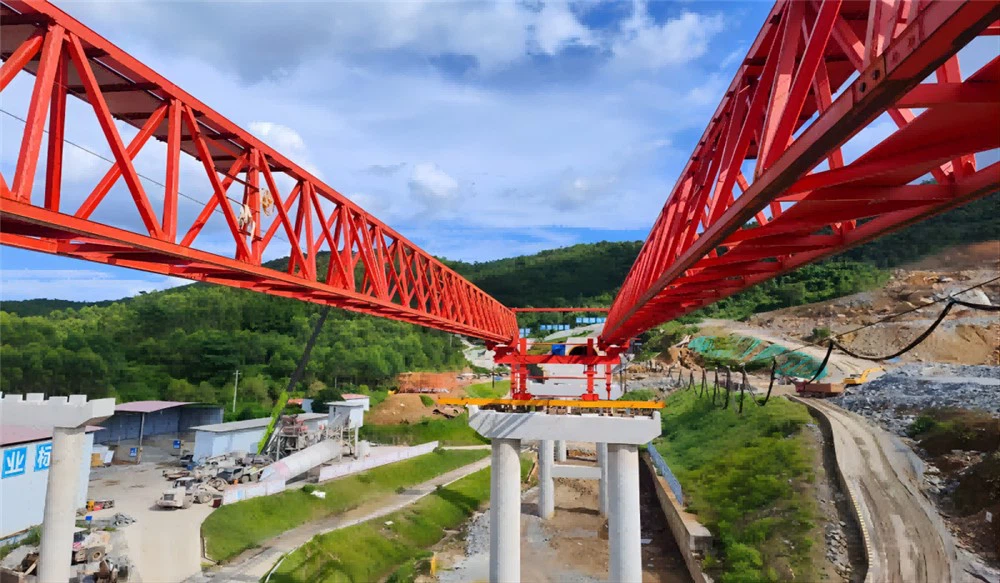
A 560 ton bridge girder erection machine is a heavy-duty piece of equipment designed for lifting and placing large bridge girders during the construction of viaducts, highways, and railway bridges. These machines are essential for precast segmental construction, balanced cantilever erection, and full-span launching of bridge decks.

Key Features
Key Features of a 560-Ton Bridge Girder Erection Machine:
High Load Capacity – Can lift and position girders weighing up to 560 metric tons.
Adaptability – Suitable for various girder types (T-beams, box girders, U-beams, etc.).
Self-Propelled or Crawler-Based – Moves along the bridge deck or on temporary supports.
Precision Control – Hydraulic or electric systems ensure accurate girder placement.
Modular Design – Can be adjusted for different span lengths and girder configurations.
Safety Systems – Overload protection, anti-sway mechanisms, and emergency brakes.

Specification


Pictures & Components
A 560t bridge girder launcher is a heavy-duty machine used to lift and place large bridge girders during construction. Here are its key components:
1. Main Structural Components
Main Girder/Beam – The primary load-bearing structure that spans the construction gap and supports the lifting mechanism.
Supporting Legs/Outriggers – Provide stability and distribute the load to the piers or temporary supports.
Portal Frame – A rigid frame structure that holds the lifting mechanism and moves along the bridge deck.
2. Lifting Mechanism
Hoisting Winches – Electric or hydraulic winches with high-capacity cables for lifting girders.
Lifting Beams/Spreader Beams – Ensure even load distribution when picking up heavy girders.
Hydraulic Jacks – Used for fine adjustments during girder placement.
3. Movement & Positioning System
Traveling Mechanism – Wheels or tracks that allow the machine to move along the bridge deck or temporary rails.
Longitudinal & Transverse Adjustment – Hydraulic or mechanical systems for precise girder alignment.
Rotation Device – Allows girder rotation for correct positioning.
4. Power & Control System
Hydraulic Power Unit (HPU) – Provides hydraulic pressure for lifting and movement.
Electrical Control System – Includes PLC (Programmable Logic Controller) and remote control for safe operation.
Sensors & Monitoring Systems – Load sensors, tilt sensors, and laser alignment for safety and precision.
5. Auxiliary Components
Counterweights – Used to balance the machine during lifting operations.
Safety Devices – Limit switches, emergency brakes, and overload protection.
Temporary Supports & Falsework – Used to stabilize the machine during erection.

Sketch


Advantages
A 560 ton bridge girder erection machine is a heavy-duty piece of equipment designed for lifting and placing large bridge girders during construction. Such machines offer several advantages in bridge construction, including efficiency, safety, and precision. Below are the key advantages:
1. High Load Capacity (560 Tons)
Can handle extremely heavy girders, reducing the need for multiple lifts or additional equipment.
Suitable for long-span bridges (e.g., box girders, steel trusses, or precast concrete segments).
2. Enhanced Efficiency & Speed
Reduces construction time by lifting and positioning large girders in a single operation.
Minimizes the need for manual assembly on-site, speeding up project timelines.
3. Precision Placement
Equipped with advanced hydraulic and control systems for accurate girder alignment.
Ensures proper positioning, reducing errors and rework.
4. Safety Improvements
Reduces the risk of accidents associated with manual girder handling.
Stable and secure lifting mechanisms prevent girder drops or misplacements.
5. Adaptability to Various Bridge Types
Works with different girder types (steel, precast concrete, composite girders).
Adjustable supports and booms allow for use in various bridge configurations (e.g., highway, railway, or pedestrian bridges).
6. Reduced Labor & Equipment Dependency
Lowers the need for extensive labor and multiple cranes.
Can operate in confined spaces where traditional cranes may not fit.
7. Cost-Effectiveness in Large Projects
Although expensive upfront, it reduces long-term costs by accelerating construction and minimizing delays.
Fewer equipment rentals and labor costs compared to conventional methods.
8. Minimal Traffic Disruption
Enables faster girder installation, reducing road or rail closures.
Useful in urban areas where prolonged construction is undesirable.
9. Remote & Automated Control Options
Some models feature remote operation, improving operator safety and control precision.
Automated systems can optimize lifting paths for efficiency.
10. Durability & Long Service Life
Built to withstand heavy-duty use in harsh construction environments.
Can be reused across multiple projects, offering long-term value.
Applications:
Highway & Railway Bridges – For long-span viaducts and overpasses.
Segmental Bridge Construction – Handling large precast segments.
Steel Arch & Suspension Bridges – Lifting heavy structural components.
Conclusion:
A 560-ton bridge girder erection machine significantly enhances construction efficiency, safety, and precision, making it ideal for large-scale bridge projects. Its ability to handle massive loads with accuracy reduces labor, time, and costs while improving overall project quality.

Application
The 560t Bridge Girder Launcher is a heavy-duty machine used in the construction of large bridges, particularly for placing precast concrete or steel girders. It is designed to handle girders weighing up to 650 metric tons, making it suitable for long-span bridges, viaducts, and elevated highway projects.
Precast Girder Installation – Lifting and placing precast concrete or steel girders.
Segmental Bridge Construction – Handling large precast segments in balanced cantilever bridges.
Launching Girders – Used in Incremental Launching Method (ILM) for pushing girders into position.
Railway & Highway Bridges – Suitable for heavy girder erection in infrastructure projects.
Production Procedure
A 560ton bridge girder erection machine is a heavy-duty piece of equipment used in the construction of large bridges, particularly for lifting and placing precast concrete or steel girders. Below is an outline of the bridge production procedure involving such a machine:
1. Pre-Construction Planning
Design Review: Ensure girder dimensions, weight (up to 560 tons), and support points match the machine's capacity.
Route Survey: Check ground conditions, access roads, and crane positioning areas.
Risk Assessment: Evaluate lifting stability, wind conditions, and potential hazards.
2. Machine Setup & Calibration
Transport to Site: The machine is delivered in modules and assembled on-site.
Foundation Preparation: Ensure stable ground or temporary supports for the machine.
Testing: Perform load tests to verify stability and lifting capacity.
3. Girder Transportation
Precast Girder Fabrication: Girders are cast in a factory or on-site yard.
Transport to Erection Site: Heavy transporters move girders to the bridge location.
Temporary Supports: Use piers or falsework to hold girders before lifting.
4. Girder Lifting & Placement
Positioning the Erection Machine: The machine aligns over the girder pickup point.
Lifting: Hydraulic jacks or winches hoist the girder (up to 560 tons).
Alignment & Placement: The girder is carefully positioned on bearings or piers.
Securing: Bolted or welded into place, depending on design.
5. Post-Installation Checks
Surveying: Verify girder alignment and elevation.
Grouting/Shimming: Fill gaps between girder and support if needed.
Load Testing (if required): Ensure structural integrity before further construction.
6. Machine Movement & Repositioning
The machine advances to the next span using self-propelled mechanisms or auxiliary equipment.
7. Deck Construction (After Girder Placement)
Formwork installation (for cast-in-place decks) or precast slab placement.
Concrete pouring (if applicable) and curing.
Waterproofing and finishing works.
Workshop View
The company has installed an intelligent equipment management platform, and has installed 310 sets (sets) of handling and welding robots. After the completion of the plan, there will be more than 500 sets (sets), and the equipment networking rate will reach 95%. 32 welding lines have been put into use, 50 are planned to be installed, and the automation rate of the entire product line has reached 85%.


Hot Tags: 560ton bridge girder erection machine for bridge, China 560ton bridge girder erection machine for bridge manufacturers, suppliers, factory
You Might Also Like


Send Inquiry