










650t Bridge Girder Launcher
A 650t Bridge Girder Launcher is a heavy-duty machine used in the construction of bridges to lift, transport, and precisely place large precast concrete or steel girders, typically weighing up to 650 metric tons. These machines are essential for building viaducts, highway overpasses, and railway bridges, especially in elevated or difficult-to-access areas.

Key Features
Key Features of a 650t Bridge Girder Launcher:
High Load Capacity – Designed to handle girders up to 650 tons, making it suitable for large-span bridge construction.
Self-Propelled & Modular – Moves along the bridge deck or temporary supports, often using rails or crawlers.
Adjustable Span & Height – Can be configured for different girder lengths and bridge heights.
Precision Placement – Equipped with hydraulic or winch systems for accurate girder positioning.
Stability & Safety Systems – Includes outriggers, counterweights, and sensors to prevent tipping or overloading.
Remote Control Operation – Often operated via remote for safety and precision.

Specification


Pictures & Components
A 650t bridge girder launcher is a heavy-duty machine used to lift and place large bridge girders during construction. Here are its key components:
1. Main Girder/Launching Nose
The primary load-bearing structure that supports the girder during launching.
Often telescopic or modular for adjustable length.
2. Lifting System (Hoisting Mechanism)
Includes winches, cables, and hydraulic jacks to lift and position girders.
May have multiple hoists (e.g., 2 × 325t or 4 × 162.5t for balanced lifting).
3. Support Towers/Piers
Temporary or permanent supports that stabilize the launcher during girder placement.
Adjustable for varying bridge heights.
4. Launching Gantry (Self-Propelled or Crawler Type)
Moves the launcher along the bridge deck or temporary tracks.
Uses hydraulic rams or wheels for propulsion.
5. Hydraulic System
Powers lifting, launching, and adjustment mechanisms.
Includes pumps, cylinders, and control valves.
6. Control Cabin & Electrical System
Operator cabin with PLC controls for precise girder placement.
Sensors for load monitoring and alignment.
7. Counterweights & Stability System
Ensures balance during lifting operations.
May include outriggers or ballast weights.
8. Auxiliary Equipment
Guide rollers for smooth girder movement.
Safety locks to prevent accidental drops.
Anchoring systems to secure the launcher during operation.
9. Transport System (If Mobile)
Crawler tracks or modular transporters for relocation.

Sketch


Advantages
A 650t Bridge Girder Launcher is a heavy-duty machine used in bridge construction to lift, transport, and precisely place large bridge girders. Here are its key advantages:
1. High Load Capacity (650 Tons)
Can handle extremely heavy and long-span girders, reducing the need for multiple smaller cranes.
Suitable for large-scale infrastructure projects like highways, railways, and viaducts.
2. Precision Placement
Ensures accurate girder positioning, critical for alignment and structural integrity.
Reduces manual adjustments, saving time and labor costs.
3. Improved Safety
Minimizes risks associated with manual lifting and girder installation.
Stable and controlled operations reduce accidents on-site.
4. Time and Cost Efficiency
Speeds up construction by quickly transporting and installing girders.
Reduces dependency on multiple cranes or temporary supports, lowering project costs.
5. Adaptability to Various Bridge Types
Works with different girder types (precast concrete, steel, or composite girders).
Adjustable for varying bridge heights and spans.
6. Reduced Ground Disruption
Operates along the bridge alignment, minimizing ground preparation compared to traditional cranes.
Ideal for congested or environmentally sensitive areas.
7. Automation & Remote Control
Modern launchers feature automated controls for smoother operations.
Remote monitoring enhances precision and reduces operator fatigue.
8. Long-Span Capability
Can install girders over rivers, valleys, or highways without intermediate supports.
9. Lower Environmental Impact
Reduces the need for extensive temporary structures, decreasing material waste.
10. Enhanced Project Scheduling
Enables faster girder installation, keeping large projects on track.
A 650t bridge girder launcher improves efficiency, safety, and precision in large-scale bridge construction, making it essential for modern infrastructure projects.

Application
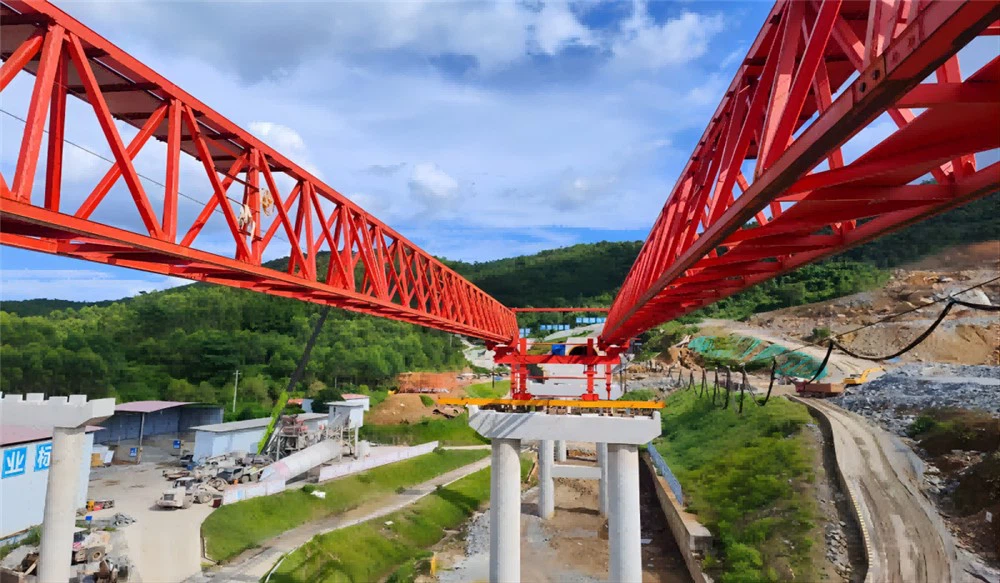
The 650t Bridge Girder Launcher is a heavy-duty machine used in the construction of large bridges, particularly for placing precast concrete or steel girders. It is designed to handle girders weighing up to 650 metric tons, making it suitable for long-span bridges, viaducts, and elevated highway projects.
Key Applications of a 650t Bridge Girder Launcher:
High-Speed Rail & Railway Bridges
Used to install heavy precast girders for high-speed rail tracks and conventional railway bridges.
Ensures precise alignment and placement for smooth rail operations.
Highway & Expressway Viaducts
Deploys large-span girders for elevated roadways and flyovers.
Reduces construction time compared to traditional methods.
Mega Bridge Projects
Suitable for long-span river or valley crossings where girders exceed 500t.
Often used in conjunction with launching gantries for incremental launching.
Urban Overpasses & Interchanges
Facilitates rapid girder installation in congested urban areas with minimal disruption.
Special Bridge Types
Used for segmental bridges, box girder bridges, and steel truss bridges.
Can handle both simply supported and continuous span configurations.
Production Procedure
The production procedure for a 650t bridge girder launcher involves several critical stages, from design and fabrication to assembly and testing. Below is a structured outline of the typical production process:
1. Design & Engineering
Requirements Analysis: Determine load capacity (650t), span length, mobility, and site conditions.
CAD Modeling: Create 3D models (using software like AutoCAD, SolidWorks, or Tekla) for structural components.
Stress Analysis: Perform FEA (Finite Element Analysis) to validate strength, stability, and fatigue resistance.
Regulatory Compliance: Ensure adherence to standards (e.g., EN 1993, AASHTO, or local bridge codes).
2. Material Procurement
Steel Selection: High-grade steel (e.g., S355, Q345B) for main girders, booms, and supports.
Hydraulic/Pneumatic Systems: Procure cylinders, pumps, and control valves from certified suppliers.
Electrical Components: Motors, sensors, PLCs for automation and safety systems.
3. Fabrication of Components
A. Main Girder
Cutting: Plasma/laser cutting of steel plates to required dimensions.
Welding: Submerged arc welding (SAW) for longitudinal/transverse joints; ultrasonic testing (UT) for weld integrity.
Machining: Drill holes for bolts, pins, and connections with CNC precision.
B. Support Legs & Outriggers
Fabricate telescopic legs with hydraulic locking mechanisms.
Reinforce critical joints with gusset plates.
C. Launching Nose & Auxiliary Parts
Assemble the front guiding nose (often lighter to reduce cantilever stress).
Fabricate trolleys, winches, and counterweight systems.
4. Assembly & Integration
Frame Assembly: Erect the main girder on supports; bolt/weld cross-beams.
Mechanical Systems: Install hydraulic jacks, winches, and traction systems.
Electrical Systems: Wire control panels, limit switches, and sensors for synchronized movement.
Safety Features: Add anti-slip platforms, guardrails, and emergency brakes.
5. Quality Control & Testing
Dimensional Checks: Verify tolerances (±2mm per 10m span).
Non-Destructive Testing (NDT): Radiography (RT) or magnetic particle inspection (MPI) for welds.
Load Testing:
Static Test: Apply 1.25× design load (812.5t) for 24 hours.
Dynamic Test: Simulate launching with incremental loads to check stability.
6. Surface Treatment & Painting
Blasting: Shot-blast steel to SA 2.5 standard.
Priming/Painting: Apply epoxy zinc primer + polyurethane topcoat for corrosion resistance.
7. Factory Acceptance Test (FAT)
Demonstrate full functionality: launching, retracting, and steering.
Verify PLC-controlled synchronization of hydraulic systems.
8. Disassembly & Packaging
Dismantle into transportable modules (marked for easy site reassembly).
Protect sensitive components (e.g., hydraulics) with waterproof covers.
9. On-Site Installation & Commissioning
Reassemble on-site using cranes and alignment tools.
Perform final load tests and operator training.
Workshop View
The company has installed an intelligent equipment management platform, and has installed 310 sets (sets) of handling and welding robots. After the completion of the plan, there will be more than 500 sets (sets), and the equipment networking rate will reach 95%. 32 welding lines have been put into use, 50 are planned to be installed, and the automation rate of the entire product line has reached 85%.


Hot Tags: 650t bridge girder launcher, China 650t bridge girder launcher manufacturers, suppliers, factory
You Might Also Like


Send Inquiry