






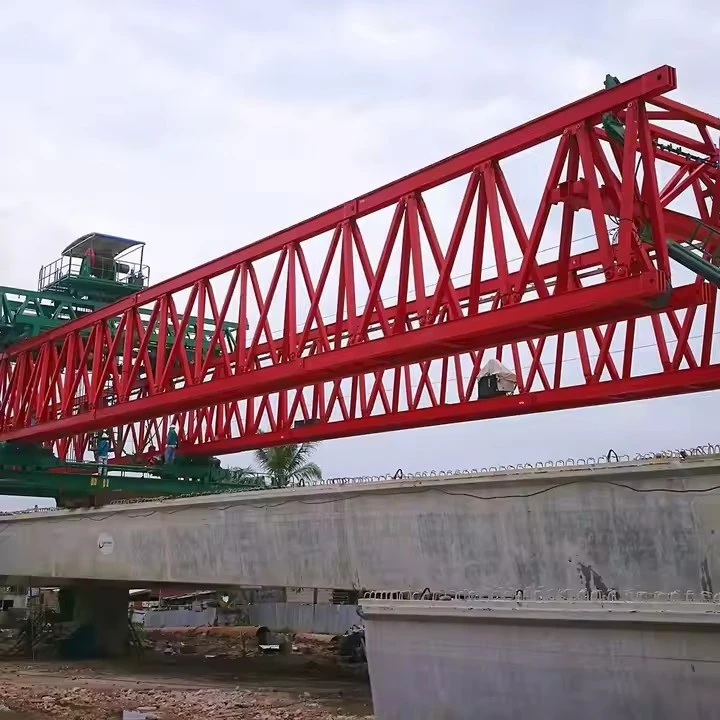
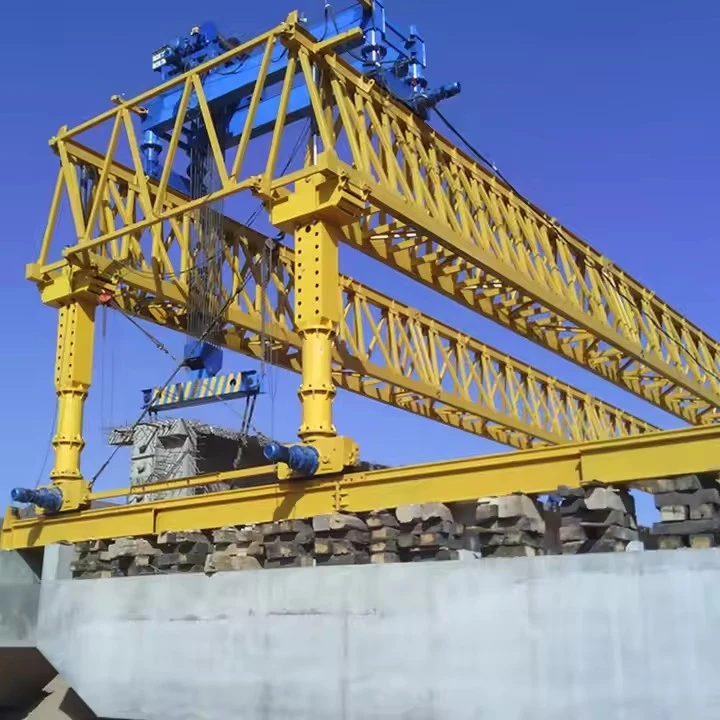
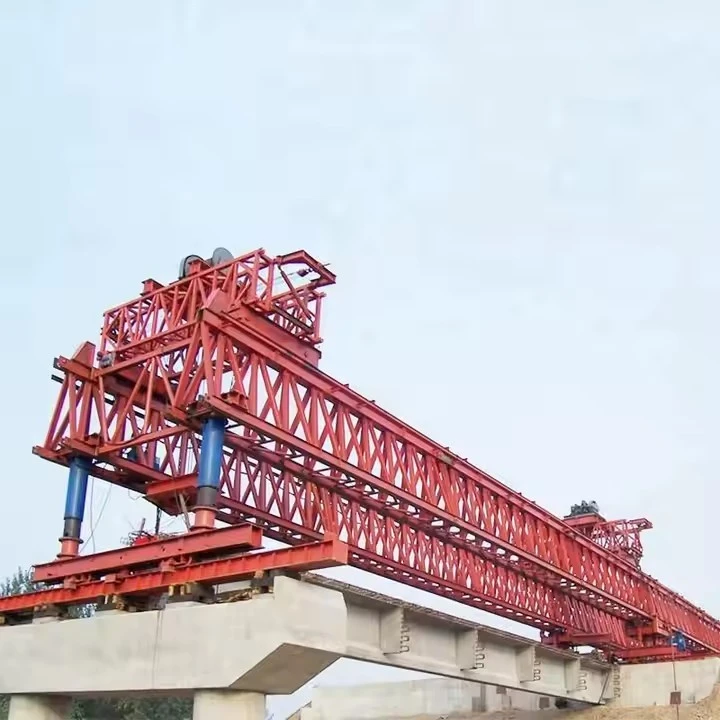
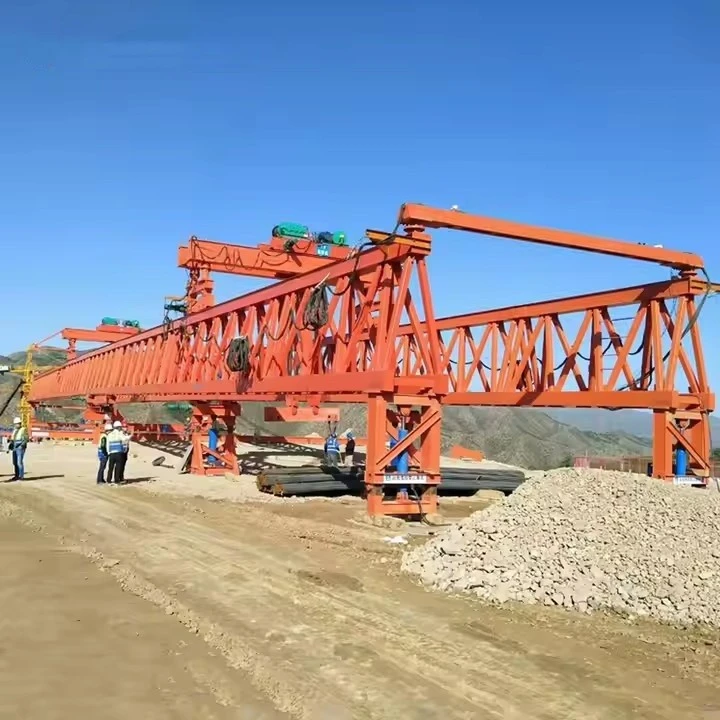
160t Bridge Construction Gantry Crane
🏗️ What It Is and How It Works
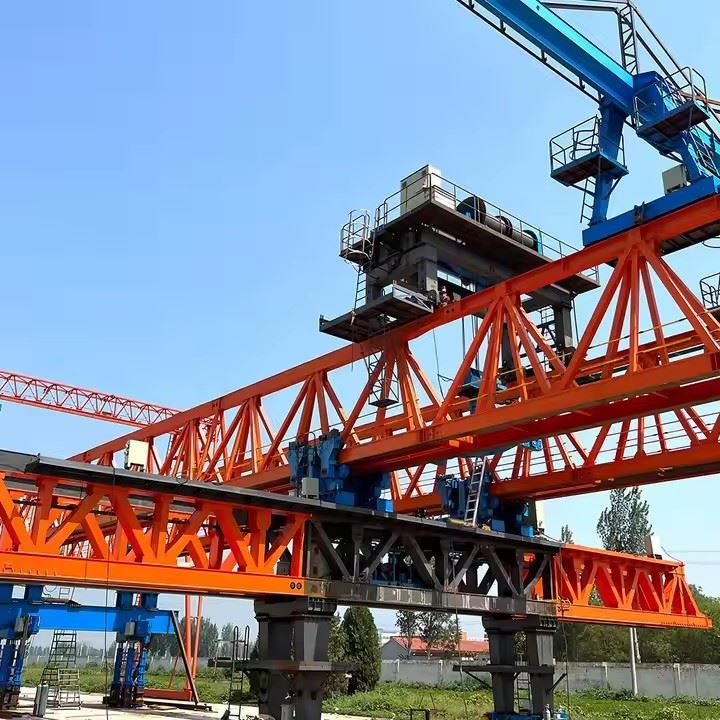
Unlike standard cranes, these are often "launching gantries" designed to move along the bridge span itself. They consist of a large steel truss main girder supported by legs that can straddle the bridge piers. A trolley system with hoists travels along the main girder to lift and position the beam. Many models are equipped with hydraulic systems and telescopic legs to handle variable spans and skew angles (curved bridges).

Key Specifications
| Parameter | Specification |
|---|---|
| Rated Lifting Capacity | 160 tons |
| Adaptable Bridge Span | 30–50 m (customizable) |
| Working Duty | A5–A7 |
| Power Supply | 3-phase AC 380V, 50Hz |
| Lifting Speed | 0.8–1.5 m/min (frequency control) |
| Longitudinal Travel Speed | 0–6 m/min |
| Lateral Travel Speed | 0–3 m/min |
| Adaptable Longitudinal Slope | ≤ 2–5% |
| Minimum Curve Radius | R ≥ 150–350 m |
| Skew Bridge Angle | 0–15° |

Pictures & Components
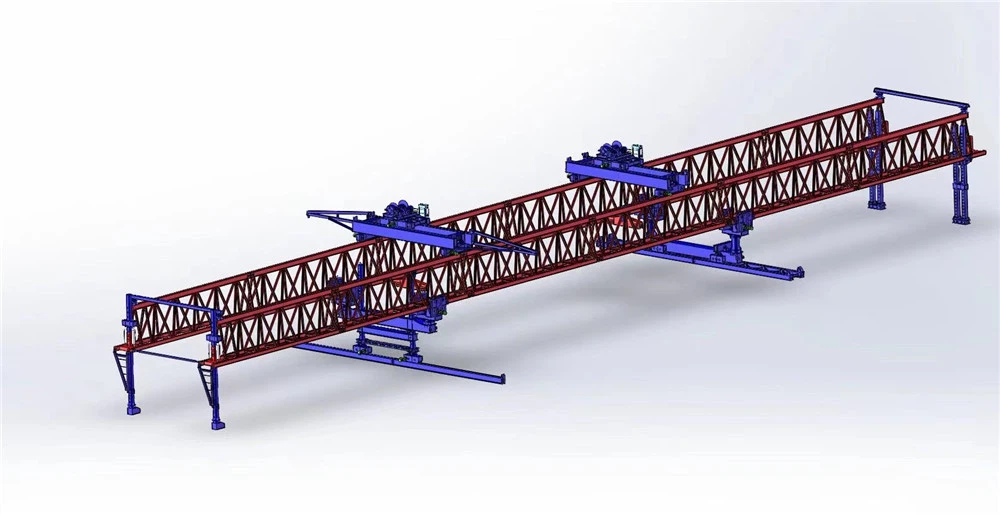
Main Girder (or Main Beam): The large horizontal structure spanning the bridge piers. It serves as the track for the lifting trolley. For a 160t crane, it is often a triangular truss structure made of steel sections for high strength and relatively low weight . It can also be a steel box girder .
Support Legs (Front, Middle, Rear): The vertical columns that support the main girder and transfer the load down to the ground or bridge piers.
Front Legs are often designed to be adjustable (e.g., telescopic or hydraulic) to accommodate different pier heights and bridge slopes .
Rear and Middle Legs provide stability and support during the lifting and forward-moving process .
Cross Beams / Tie Beams: These connect the parallel main girders (in a double-girder design) or connect the legs, forming a rigid frame to prevent twisting and ensure overall stability .
Lifting Trolley (or Crane Trolley): A set of wheels and a frame that travels along the main girder. It carries the hoisting mechanism. A 160t crane often uses a double-trolley system for better stability and precise positioning of long bridge beams .
Hoisting Mechanism (Winch): Mounted on the trolley, this consists of electric motors, reducers, wire rope drums, and steel wire ropes. It is responsible for the vertical lifting and lowering of the load .
Traveling Mechanism (Longitudinal & Transverse): The systems that move the entire crane forward/backward along the bridge (longitudinal travel) or side-to-side (transverse travel). This includes the motorized wheel assemblies located at the bottom of the support legs .
Electrical Control System: Includes the PLC (Programmable Logic Controller), variable frequency drives (VFDs), and the operator's cabin or remote control. It manages all movements and safety interlocks .
Hydraulic System: Used extensively on modern bridge gantry cranes to power the telescopic movements of the legs, steering mechanisms (for tire-mounted versions), and sometimes the trolley traverse. It allows for smooth, high-force adjustments .
Safety Devices: Critical components for a 160t lift include overload limiters, height limiters, wind speed sensors, anti-sway systems, and rail clamps to prevent the crane from tipping or sliding .
Pin Connections & Bolted Splices: The main girder and legs are often assembled on-site. High-strength bolts and pin joints are used to connect the sections securely while allowing for relatively quick assembly and disassembly .
Walking Rails / Track: The track on the ground or on the bridge deck that the crane's legs travel along .
onents
Sketch

Advantages
🚀 Enhanced Construction Efficiency
The crane streamlines the erection process by integrating lifting and placement, significantly shortening project timelines.
Faster Erection Speed: Compared to traditional cast-in-place construction, using a 160t launching gantry can reduce overall construction duration by roughly 30%. The "pass-through" (moving the crane to the next span) speed can be up to 50% faster than conventional equipment.
Reduced On-Site Work: Because the crane handles precast beams, it eliminates the need for extensive on-site concrete casting and curing, which is particularly beneficial for urban viaducts where minimizing traffic disruption is critical.
Labor and Resource Savings: Advanced models require fewer operating personnel and can reduce the number of transport vehicles needed by about 50%, directly lowering labor and logistics costs.
🛡️ Superior Safety and Stability
Modern 160t gantries often incorporate self-balancing designs and intelligent controls to mitigate the risks inherent in lifting massive loads at height.
Self-Balancing Technology: Some models use sensor-controlled dual-guide-beam structures that automatically adjust the center of gravity. This prevents issues like shaking or tipping that can occur with older, counterweight-dependent machines, resulting in a higher safety factor.
Intelligent Control Systems: Integrated PLC and hydraulic systems allow for precise, synchronized movements. Features like real-time monitoring, overload protection, and anti-sway systems ensure the beam is placed accurately without dangerous swings.
Reduced High-Altitude Risk: By mechanizing the lifting and positioning process, the crane minimizes the amount of manual work and time spent directly over piers or in precarious positions.
🗺️ Exceptional Adaptability
A 160t crane is versatile enough to handle the geometric complexities of modern bridge designs.
Handling Complex Geometries: These cranes are built to navigate curved bridges (cross curves), skewed bridges (up to 45°), and variable spans. This flexibility allows a single machine to work on a project with changing alignment without needing major reconfiguration.
Variable Span Adjustment: The support legs and main girder are often adjustable, enabling the crane to switch between different beam lengths (e.g., 32m and 24m beams) on the same bridge project with relative ease.
Site Flexibility: Some designs, particularly those with pin connections, allow for relatively quick assembly and disassembly, which is advantageous when moving between different construction sites or working in constrained spaces.
In summary, the primary advantage is the combination of speed and safety-allowing contractors to erect heavy precast girders quickly and accurately while minimizing the manpower and risk associated with traditional methods.


Application
A 160t bridge construction gantry crane is primarily used for erecting precast concrete girders in highway, railway, and urban viaduct projects. Its core application is to lift heavy precast beams (such as T-beams or box girders) from transport vehicles or the ground and precisely place them onto bridge piers, span by span.
🏗️ Core Application Scenarios
Highway & Expressway Viaducts: This is the most common application. The crane is used to erect precast concrete beams for road bridges, including large-scale infrastructure like ring roads and expressway expansions. For instance, a JQJ160t-40 model was deployed in the Kinshasa ring road project to erect 30-meter, 82-ton precast T-beams.
Railway & High-Speed Rail Bridges: These cranes are essential for building railway viaducts, where they handle the precise placement of heavy box girders or T-beams that form the rail bed. They are designed to meet the high stability and precision requirements of rail construction.
Urban & Complex Interchanges: In dense urban environments, launching gantries are used to construct viaducts over existing roads or in constrained spaces. Their ability to work from above minimizes disruption to traffic below and is suitable for complex interchange projects.
🗺️ Handling Complex Bridge Alignments
Beyond simple straight bridges, a 160t crane is often chosen for its ability to adapt to challenging geometries:
Curved and Skewed Bridges: Many models can handle skew angles up to 45° and navigate curved alignments, making them suitable for ramps and interchanges where the bridge path is not straight.
Variable Spans: The crane can be adjusted to erect beams of different lengths (e.g., switching between 30m and 40m spans) on the same project, providing flexibility for varying pier spacing.

Production Procedure
📐 Phase 1: Engineering & Design
This is the foundation of the production procedure, where the crane is tailored to the specific bridge project.
Requirement Analysis: Engineers define critical specifications including span length, pier height, bridge geometry (curvature/skew), and the exact weight of the precast girders to be lifted.
Structural Design: Using Finite Element Analysis (FEA), the main girder and support legs are designed to withstand the 160t load plus dynamic forces. This phase determines whether a truss or box girder structure is optimal.
Detailed Drawings: Manufacturing drawings, a bill of materials, and welding specifications are finalized for the fabrication team.
🏗️ Phase 2: Material Preparation & Fabrication
This stage transforms raw steel into the crane's structural skeleton.
Material Sourcing & Testing: High-strength steel plates are procured. Incoming materials undergo inspection (including ultrasonic testing) to detect internal flaws before use.
Cutting & Profiling: CNC plasma or oxy-fuel cutting machines are used to precisely cut steel plates. Bolt holes are drilled using CNC machines to ensure perfect alignment during assembly.
Welding & Assembly: This is a critical step. Qualified welders assemble the main girders and support legs according to strict Welding Procedure Specifications (WPS). The fabrication of the main girder (often a triangular truss) requires precise jig fixtures to maintain alignment and control deformation.
Non-Destructive Testing (NDT): Critical welds are inspected using Magnetic Particle (MT), Dye Penetrant (PT), or Ultrasonic Testing (UT) to ensure there are no surface or internal defects that could compromise safety.
Post-Weld Treatment: Components may undergo stress-relief heat treatment to remove residual stresses from the welding process. The structure is then shot-blasted to SA 2.5 standard and painted with protective primer and topcoats.
⚙️ Phase 3: Mechanical & Electrical Assembly
The fabricated structure is fitted with the systems that provide power and control.
Sub-Assembly: Winches, hydraulic power units, and trolley frames are assembled separately. The electrical control panels (with PLCs and VFDs) are also wired and tested independently before integration.
Mechanical Installation: The lifting trolleys, hoisting winches, and hydraulic cylinders (for leg adjustment) are mounted onto the main structure.
System Integration: The electrical and hydraulic systems are connected. Sensors for load, wind speed, and alignment are installed to feed data to the central control system.
🧪 Phase 4: Factory Acceptance Testing (FAT)
Before disassembly and shipping, the crane must prove it can perform safely under load.
Dimensional & Visual Checks: The assembled crane is verified against drawings. All mechanical connections and paint quality are inspected.
No-Load Functional Tests: All movements-trolley travel, hoisting, and gantry propulsion-are tested to ensure smooth operation, correct limit switch function, and emergency stop effectiveness.
Load Testing: This is the most critical test. The crane is subjected to static and dynamic load tests (often exceeding the rated 160t capacity by a safety margin) to verify structural integrity, braking performance, and stability.
📦 Phase 5: Disassembly, Shipping & Site Reassembly
Due to their massive size, 160t cranes are shipped in modular sections.
Disassembly: The crane is broken down into transportable sections (main girder segments, legs, trolleys) for shipping to the construction site.
On-Site Erection: At the site, the crane is reassembled. This procedure usually involves installing the track, assembling the main girders using cranes, and then installing the legs and trolley system. A final site acceptance test is performed after reassembly to ensure the crane is ready for operation.


Workshop View
The company has installed an intelligent equipment management platform, and has installed 310 sets (sets) of handling and welding robots. After the completion of the plan, there will be more than 500 sets (sets), and the equipment networking rate will reach 95%. 32 welding lines have been put into use, 50 are planned to be installed, and the automation rate of the entire product line has reached 85%.


Hot Tags: 160t bridge construction gantry crane, China 160t bridge construction gantry crane manufacturers, suppliers, factory
You Might Also Like


Send Inquiry