







100 Ton Bridge Launching Gantry
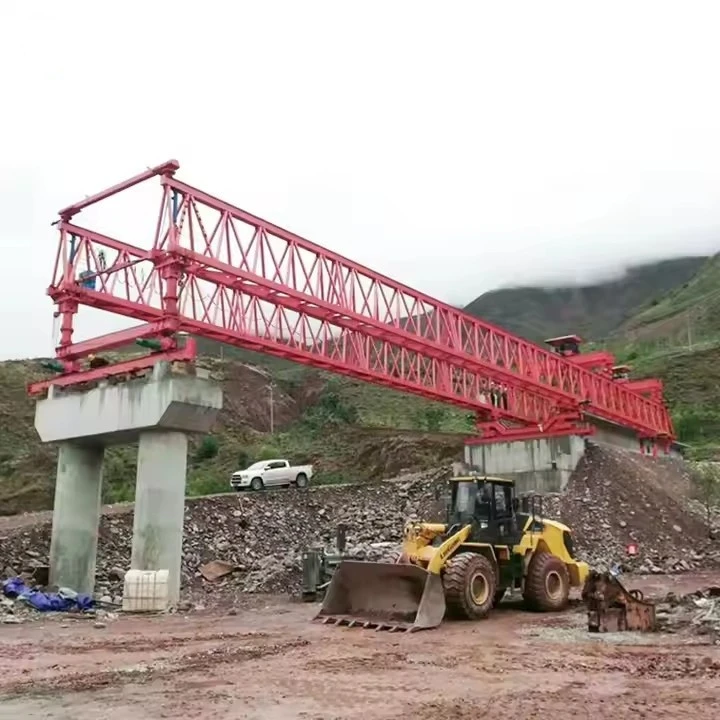
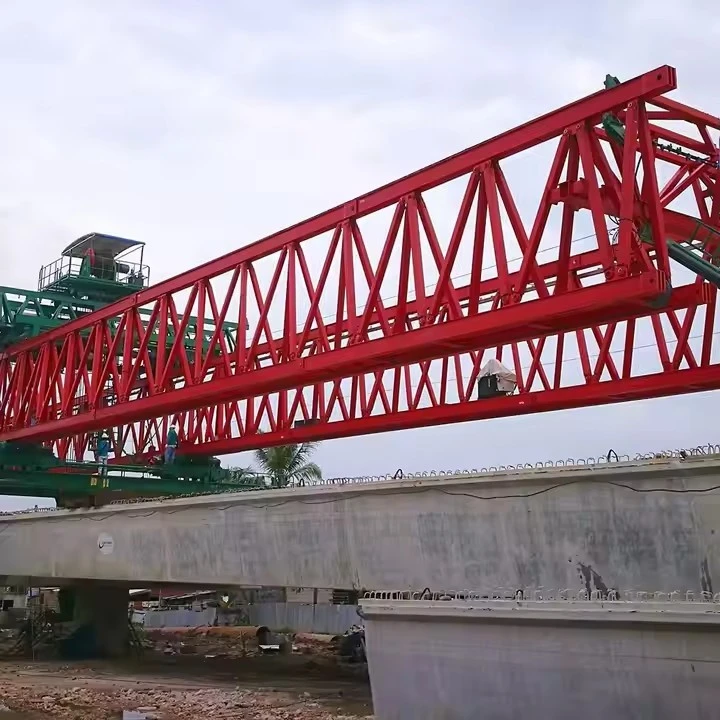
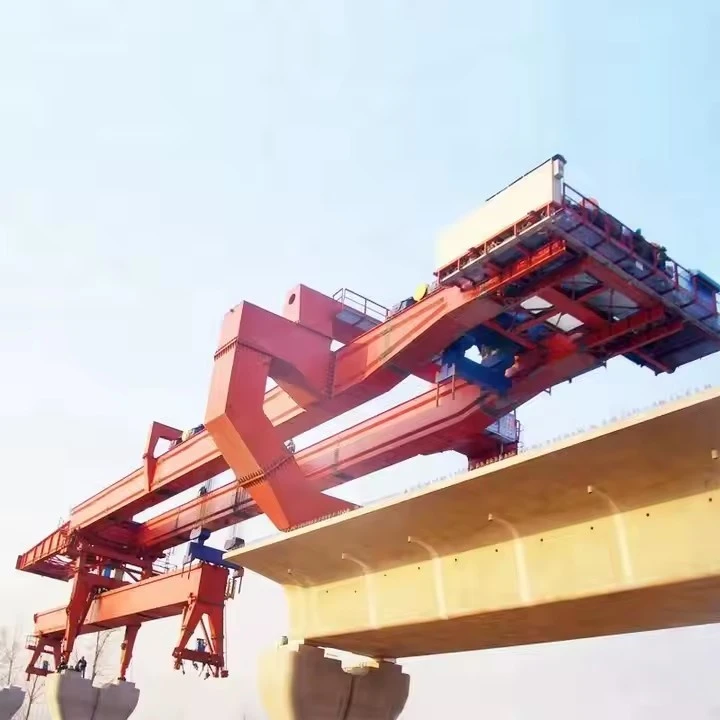
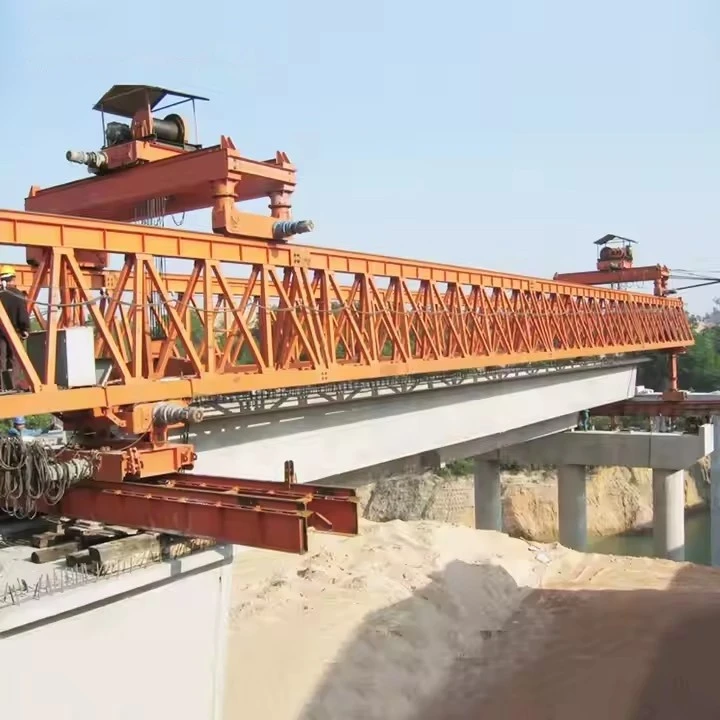
A 100-ton bridge launching gantry (also referred to as a beam launcher or girder launcher) is a specialized mobile gantry crane used in the construction of highway and railway bridges. Its primary function is to lift, transport, and accurately position precast concrete or steel bridge girders onto bridge piers and abutments . This class of equipment is particularly suited for medium-span bridges, typically ranging from 20 to 40 meters, making it a versatile and cost-effective solution for a wide range of infrastructure projects .

Key Specifications
| Parameter | Specification |
|---|---|
| Rated Lifting Capacity | 100 tons |
| Adaptable Bridge Span | 30–50 m (customizable) |
| Working Duty | A5–A7 |
| Power Supply | 3-phase AC 380V, 50Hz |
| Lifting Speed | 0.8–1.5 m/min (frequency control) |
| Longitudinal Travel Speed | 0–6 m/min |
| Lateral Travel Speed | 0–3 m/min |
| Adaptable Longitudinal Slope | ≤ 2–5% |
| Minimum Curve Radius | R ≥ 150–350 m |
| Skew Bridge Angle | 0–15° |

Pictures & Components
Here is the English version of the components breakdown for a 100 Ton Bridge Launching Gantry.
🏗️ Main Load-Bearing Structure
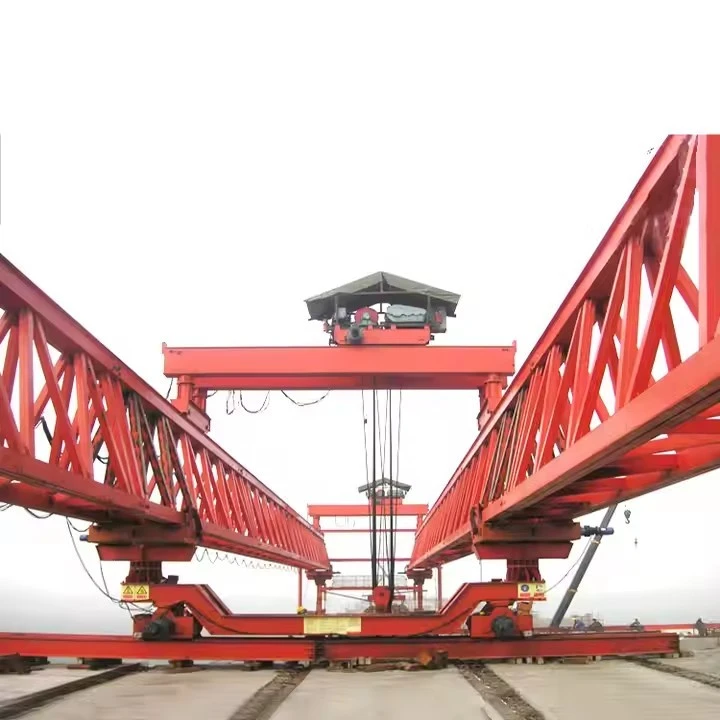
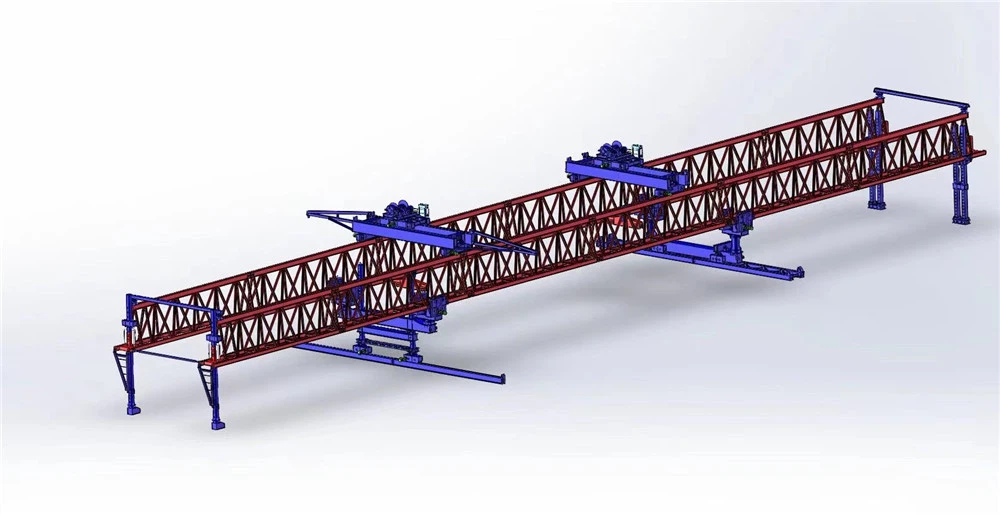
The Main Girder (or Machine Arm) is the core load-bearing member that directly supports the lifting load and transfers it to the legs . For a 100-ton class machine, the girder is typically a single box-girder design, divided into modules for easy transport by road . The girder includes upper and lower ear beams that serve as running tracks for the lifting trolleys and support components during launching . In some designs, the main girder is a triangular truss structure made of standardized military-style beams, which offers flexibility in assembly and disassembly .
🦵 Support and Travel System
The Legs (or Columns) are the critical supports that transfer the gantry's weight and the lifted load to the bridge piers or the already-erected girders. A standard configuration includes:
Front Leg (Zero Column): A gantry-type structure that supports the front end of the machine on the pier. It often has a telescopic or folding design to accommodate slopes and facilitate passage through tunnels .
Middle and Rear Legs (Middle/Rear Cars): These travel along the deck of the already-constructed bridge, providing the drive for the machine's longitudinal launching (moving forward to the next span) .
Leg Structure: Legs are often telescopic sleeves driven by hydraulic cylinders to adjust height for varying pier heights or gradients .
🎣 Lifting and Trolley System
The Lifting Trolleys (or Hoisting Gantries) run on tracks along the top of the main girder . They are responsible for hoisting the beam segments and moving them longitudinally. A typical setup includes:
Front and Rear Lifting Trolleys: Two trolleys work in tandem. They can also serve as counterweights during the launching process .
Traverse Trolley: A secondary trolley on the main hoist frame allows for lateral (transverse) movement, which is essential for precisely aligning the beam with the bridge's design position .
Hoisting Mechanism: Consists of winches and pulley blocks to perform the up-and-down lifting motion .
⚙️ Auxiliary and Power Systems
Beyond the structural components, the launching gantry relies on several integrated systems for operation:
Hydraulic System: Provides power for leg telescoping, steering, and other adjustments. It is a key part of the machine's flexibility .
Electrical and Control System: Includes the power supply (often 380V three-phase), control panels, and safety monitoring systems (such as overload protection, limit switches, and anti-collision devices) .
Running and Travel Mechanisms: Trolleys and legs are equipped with wheel assemblies and gear drives to move along rails and tracks .
For a 100-ton model, these components are scaled down compared to their 900-ton counterparts, but the fundamental architecture remains the same .

Sketch

Advantages
Here are the key advantages of a 100-ton bridge launching gantry compared to other bridge erection methods.
🎯 Optimal Capacity-Scenario Fit
A 100-ton launching gantry hits the sweet spot for medium-span bridge construction, which accounts for over 60% of highway, railway, and municipal bridge projects.
Vs. smaller gantries (under 50t): It can handle heavier girders like 40m T-beams (80–95t) or 25m box girders (up to 90t) in a single lift, eliminating the need for risky two-machine "tandem lifting".
Vs. larger gantries (200t+): It avoids paying for redundant capacity. A 200t machine costs 50–60% more to purchase or rent, yet offers no practical benefit for standard 20–40m spans.
🏃 Flexibility & Site Adaptability
The 100-ton class is significantly more maneuverable than its heavy-duty counterparts.
Lighter & Faster to Deploy: Weighing 150–250 tons (vs. 500+ tons for large gantries), it can be disassembled and reassembled 30–50% faster, making it ideal for mountainous or urban sites with limited access.
Easier Relocation: It often requires no large auxiliary cranes for transfer between sites. In multi-bridge projects, relocation efficiency is 20–30% higher than large gantries.
Compact Design: Some models feature a low-profile, narrow structure that can pass through tunnels and even erect girders inside them-a critical capability for tunnel-adjacent bridges.
💰 Cost Efficiency
The economic advantage is substantial for small-to-medium projects.
Lower Initial Investment: Purchase or rental cost is roughly half that of a 200t gantry.
Lower Operating Costs: It pairs with smaller transport vehicles (100–120t) and consumes 25–40% less energy. Maintenance is also cheaper, with annual costs around 40–50% of a large gantry's.
⚡ Operational Efficiency
Despite its smaller size, a 100-ton gantry is highly productive.
Fast Cycle Times: A single girder can be erected in 1–2 hours, compared to 2–3 hours for tandem-lift operations.
High Daily Output: Under good conditions, it can erect 6–8 girders per day.
Precision Control: Variable frequency drives enable smooth starts and stops, with synchronization errors as low as ≤5mm, which is crucial for accurate girder placement.
🛡️ Safety & Simplicity
Simpler Risk Management: The machine's structure is less complex than massive gantries, making daily inspections and risk assessments easier to execute.
No Tandem Lifting: By handling girders in a single lift, it eliminates the high-risk "multi-machine coordination" required by smaller equipment.


Application
Here are the primary application scenarios for a 100-ton bridge launching gantry, drawn from real-world construction cases and manufacturer specifications.
🛣️ Highway and Municipal Bridge Construction
The 100-ton class is a workhorse for medium-span highway and municipal viaducts, where precast girders typically weigh between 60 and 95 tons.
Typical Use Cases:
Secondary Roads and Provincial Highways: Bridges with standard spans of 20–30 meters, often featuring 30m prestressed concrete T-beams weighing around 85 tons per piece.
Urban Viaducts and Interchange Ramps: Projects like the Zhengzhou South Fourth Ring Road, where 100-ton gantry systems handled precast girder lifting for segmental splicing across the full width of a four-lane, dual-direction viaduct.
Standard Highway Girders: The gantry is commonly rated for 40m T-beams (typically 80–95 tons) and 25m box girders (up to 90 tons) in a single lift, avoiding risky tandem-lifting operations.
🏗️ Segmental Bridge Erection
For bridges built using the balanced cantilever or span-by-span method with precast segments, a 100-ton gantry is a common choice.
Real-World Example:
Guangfo West Ring Project (Guangzhou): The DP100/40 segmental launching gantry, with a rated capacity of 100t and maximum span of 40m, was deployed to erect 112 spans of segmental girders using a "building blocks" assembly method. This approach reduced temporary land use and mitigated dust and noise in densely populated areas.
🌊 Cross-River and Difficult Terrain
The machine's compact size and adaptability make it suitable for sites where large gantries cannot access or where ground conditions are poor.
Case Study - River Crossing (Jiangxi):
Project: A 150m bridge over a non-navigable river, with 30m spans and 84-ton T-beams.
Challenges: Soft riverbed silt, no permanent piers mid-channel, and strong crosswinds over the water.
Solution: A 100t/30m walking-type gantry was used with a temporary steel pipe pile support in the middle of the main span. The gantry's electronic anti-sway system and wind speed monitor enabled safe lifting despite water-surface gusts, completing the crossing within a tight dry-season window.
⛰️ Restricted Access and Mountainous Areas
The relatively low self-weight (typically 150–250 tons vs. 500+ tons for large gantries) allows for deployment in constrained sites.
Typical Challenges Addressed:
Tunnel Portals: Low-profile or narrow designs can pass through tunnels and erect girders in the immediate vicinity of tunnel exits.
Steep Terrain: Shorter assembly/disassembly time (30–50% faster than large gantries) makes it viable for scattered bridge groups in mountainous regions.
Limited Staging Areas: Some 100-ton gantry models can be assembled on the completed bridge deck itself, requiring only a small area at the abutment.
🚂 Light Railway and Specialized Applications
While the 100-ton class is less common for heavy mainline rail (where 900-ton machines dominate), it is used for light rail, industrial rail sidings, and precast segment erection in rail viaducts. A 100-ton gantry is also specified for railway bridge girder erection where lighter precast members are involved.

Production Procedure
Based on available public information, detailed "production procedure" documents for a specific 100-ton bridge launching gantry are scarce. However, the typical production flow can be understood by looking at the on-site assembly sequence and the broader manufacturing context for this class of equipment.
🏗️ On-Site Assembly Procedure
The "production" of the machine at the construction site primarily involves assembling pre-fabricated modules. The standard sequence is outlined below :
Preparation: Before assembly begins, the site must be prepared. The ground needs to be level (longitudinal slope not exceeding 3%) and compacted to support the heavy loads . All incoming components, parts, and tools must be thoroughly inspected .
Foundation and Track Laying: The track for the front and middle legs is laid. This involves cleaning the foundation, laying the rails, and ensuring they are level and firmly supported .
Leg Assembly: The front, middle, and rear legs are positioned and connected to their respective trolleys on the tracks. Cable hoists or wind ropes are often used to temporarily secure the leg structures to the ground .
Main Girder Assembly: The main girders and guide beams are pre-assembled on the ground. They are then hoisted into position on top of the legs using mobile cranes, often one side at a time .
Frame and Trolley Installation: Cross-connection frames are installed to link the parallel main girders into a single, rigid unit. After this, the hoisting trolleys (and any auxiliary trolleys) are installed on the main girder tracks .
Systems Integration and Commissioning: The final step is the installation and debugging of the hydraulic and electrical control systems. This is a critical phase where the machine's functions are tested .
🏭 Manufacturing Context
While on-site assembly is the visible "production" step for the user, the actual manufacturing happens in a factory. For a 100-ton class machine, this involves:
Design and Engineering: Creating the design based on project specifications (span, load, curve radius, etc.). These machines must comply with standards like GB/T 26470 (General Technical Conditions for Bridge Erectors) and GB 26469 (Safety Code) .
Fabrication: This includes the welding of steel structures (like the truss or box girders) and CNC machining of precision parts like the anti-roll mechanism . Companies like Nante Machinery note that welding specifications follow international standards like ISO 15614 and AWS D14.1 .
Component Integration: The manufacturer assembles and integrates the various purchased systems, such as the winches (NWC or European standard), hydraulic systems, and electrical control panels with monitoring capabilities .


Workshop View
The company has installed an intelligent equipment management platform, and has installed 310 sets (sets) of handling and welding robots. After the completion of the plan, there will be more than 500 sets (sets), and the equipment networking rate will reach 95%. 32 welding lines have been put into use, 50 are planned to be installed, and the automation rate of the entire product line has reached 85%.


Hot Tags: 100 ton bridge launching gantry, China 100 ton bridge launching gantry manufacturers, suppliers, factory
You Might Also Like




Send Inquiry