







Bridge Girder Construction Launcher
Types of Bridge Girder Launchers
Girder Launching Gantry (GLG)
Used for launching precast concrete or steel girders.
Can span multiple piers and move forward as construction progresses.
Suitable for balanced cantilever construction.
Launching Nose (for Incremental Launching Method)
A temporary structure attached to the front of a girder to reduce deflection during launching.
Used in the incremental launching method where the bridge deck is constructed in segments and pushed forward.
Self-Propelled Modular Transporters (SPMTs)
Wheeled vehicles that transport heavy girders to the installation site.
Highly maneuverable and used for heavy girder placements.
Overhead Launching Gantry
Runs on top of already constructed bridge segments.
Lifts and positions new girders from above.
Underslung Launching Gantry
Moves beneath the bridge deck.
Often used in urban areas with height restrictions.
Key Features
The Bridge Girder Construction Launcher is a specialized machine used for the efficient installation of precast concrete or steel girders in bridge construction. Below are its key features:
1. High Load Capacity
Designed to handle heavy precast girders (concrete or steel) with capacities ranging from 100 to 1000+ tons, depending on the model.
Equipped with heavy-duty hydraulic lifting systems for precise girder placement.
2. Modular and Adjustable Design
Adjustable span length to accommodate varying bridge widths.
Modular components for easy assembly, disassembly, and transportation between job sites.
3. Self-Launching & Self-Propelled Mechanism
Can move forward autonomously along the bridge deck using hydraulic jacks or rails.
Some models feature crawler tracks or wheeled systems for mobility.
4. Precision Placement System
Computer-controlled hydraulic systems for millimeter-level accuracy in girder positioning.
Laser-guided alignment ensures proper girder placement.
5. Safety Features
Anti-tip and anti-sway mechanisms to prevent accidents during lifting.
Emergency braking systems and overload protection.
Fall arrest systems for operator safety.
6. Multi-Functional Capabilities
Can handle different girder types (I-girders, box girders, U-beams).
Some models integrate formwork and deck placement systems for accelerated construction.
7. Remote & Automated Control
Wireless remote operation for safer and more efficient girder handling.
Automated sequencing for repetitive girder installations.
8. Adaptability to Terrain
Can operate on uneven or inclined surfaces with stabilizing legs or outriggers.
Suitable for river crossings, highways, and urban viaducts.
9. Reduced Construction Time
Enables faster girder installation compared to traditional cranes.
Minimizes traffic disruptions in urban areas.
10. Environmental & Cost Efficiency
Lower carbon footprint compared to large cranes due to optimized material handling.
Reduced labor costs through automation and efficiency.
Specification
Bridge Girder Construction Launcher Specification
1. General Requirements
Purpose: Designed for the erection and placement of precast concrete girders or segments in bridge construction.
Compliance: Meets international standards (e.g., AASHTO, EN, BS, or project-specific codes).
Design Life: Minimum 20 years or as per project demands.
2. Technical Specifications
Load Capacity:
Maximum lifting capacity: ___ kN (e.g., 1,000 kN per girder).
Total launch weight (including self-weight): ___ kN.
Span Range: Adjustable for spans of ___ m to ___ m.
Launching Speed: ___ m/min (typical range: 3–10 m/min).
Alignment Control:
Horizontal tolerance: ±___ mm.
Vertical tolerance: ±___ mm.
Power System:
Hydraulic/electric drive with backup power.
Remote control operation with manual override.
3. Structural Components
Main Beam: High-strength steel (e.g., Grade S355) with corrosion-resistant coating.
Supporting Towers/Frames: Adjustable height (range: ___ m to ___ m).
Launching Nose: Detachable, reduces cantilever moments during launching.
Hydraulic Jacks: Synchronized system for lifting/pushing (capacity: ___ kN each).
Temporary Bearings: PTFE sliding bearings or elastomeric pads.
4. Safety Features
Overload Protection: Sensors with automatic shutdown at 110% of rated capacity.
Anti-Slip Mechanism: Brakes on all moving parts.
Emergency Stop: Redundant systems (mechanical + electrical).
Wind Resistance: Stable up to ___ m/s (e.g., 20 m/s during operation; 40 m/s parked).
5. Environmental Conditions
Operating Temperature: -20°C to +50°C.
Weather Protection: Covers for sensitive components (e.g., hydraulics).
6. Installation & Maintenance
Assembly Time: ≤ ___ days (site-dependent).
Inspection Intervals: Daily checks before operation; major maintenance every ___ months.
Lubrication: Automatic/manual systems for moving parts.
7. Documentation & Testing
Design Certificates: FEM 1.001 or equivalent analysis.
Load Testing: Proof load test at 125% of max working load.
As-Built Drawings: Provided post-commissioning.
8. Optional Features
Automation: GPS-guided alignment, real-time monitoring (strain, deflection).
Modularity: Expandable for varying girder widths/heights.

Pictures & Components
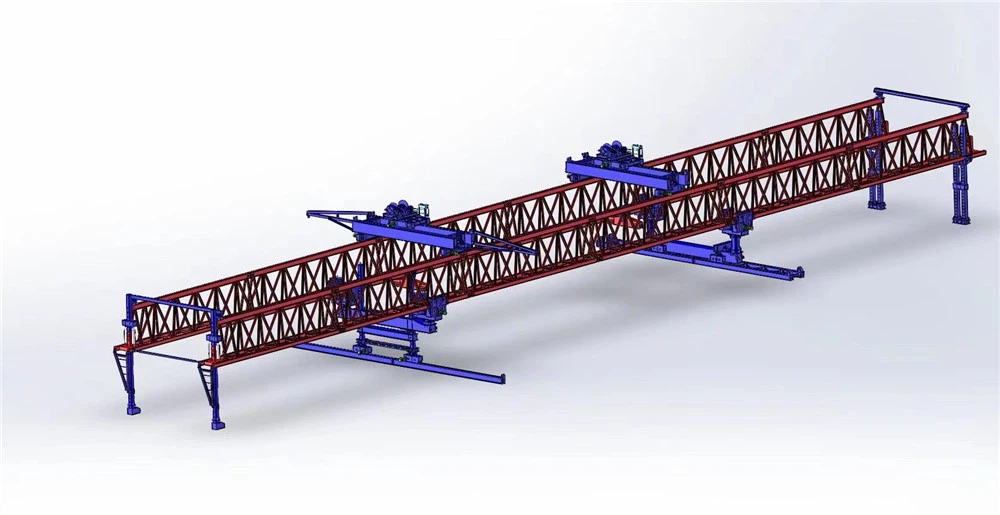
A Bridge Girder Construction Launcher is a specialized machine used to erect precast concrete or steel girders during bridge construction, especially for segmental or span-by-span construction. Below are the key components of such a launcher:
1. Main Launching Girder (Gantry Beam)
The primary structural frame that spans the construction gap and supports the entire launching system.
Typically made of high-strength steel trusses or box girders.
2. Front & Rear Supports (Temporary Piers)
Front Support (Launching Nose): Extends ahead to provide stability during girder placement.
Rear Support: Anchors the launcher to the completed bridge deck or piers.

3. Lifting Mechanism (Hoisting System)
Hydraulic Jacks/Winches: Lift and position girders.
Trolley & Crane System: Moves girders longitudinally and transversely.
4. Launching Carriage (Travelling System)
Moves precast girders from the assembly area to the installation position.
Runs on rails or sliding beams.
5. Hydraulic System
Powers the lifting, pushing, and adjustment mechanisms.
Includes pumps, cylinders, and control valves.
6. Adjustment & Alignment System
Horizontal & Vertical Jacks: Fine-tune girder positioning.
Guiding Rails: Ensure precise placement.
7. Anchoring & Stabilizing System
Temporary supports and tie-downs to prevent movement during launching.
Counterweights or tie rods for balance.
8. Control Cabin & Automation System
Operator cabin with joystick/computer controls.
Sensors and PLCs for automated adjustments.
9. Auxiliary Components
Safety Devices: Emergency brakes, limit switches, and overload protection.
Power Pack: Diesel or electric power supply.
Deck Formwork (for segmental bridges): Supports cast-in-place concrete segments.
Sketch

Advantages
The Bridge Girder Construction Launcher is a specialized machine used in the construction of precast segmental bridges, box girder bridges, and other long-span structures. It offers several advantages over traditional construction methods, including:
1. Speed and Efficiency
Rapid Construction: The launcher enables faster assembly of bridge segments, reducing project timelines.
Continuous Workflow: It allows for the sequential placement of girders without the need for extensive temporary supports.
2. Cost-Effectiveness
Reduced Labor Costs: Automation minimizes the need for manual labor in girder placement.
Lower Temporary Works: Eliminates or reduces the need for costly falsework and scaffolding.
3. Safety Improvements
Minimized On-Site Risks: Workers operate from a stable platform, reducing exposure to heights and hazardous conditions.
Controlled Installation: Precise handling of heavy girders decreases the risk of accidents during lifting and placement.
4. Enhanced Precision and Quality
Accurate Alignment: The launcher ensures precise positioning of girders, improving structural integrity.
Consistent Construction: Automated processes reduce human error in segment placement.
5. Adaptability to Challenging Sites
Suitable for Difficult Terrain: Ideal for bridges over valleys, rivers, highways, or urban areas where traditional cranes are impractical.
Minimal Ground Disruption: Requires less ground preparation compared to conventional methods.
6. Reduced Environmental Impact
Less Site Disturbance: Smaller work footprint minimizes ecological disruption.
Lower Material Waste: Efficient use of precast segments reduces construction waste.
7. Versatility
Compatible with Various Bridge Types: Works with box girders, I-girders, and segmental bridges.
Adjustable for Different Spans: Can be configured for varying bridge lengths and geometries.
8. Economical for Long Spans
Optimal for Large Projects: More cost-effective than traditional methods for long viaducts or multi-span bridges.
Conclusion
The Bridge Girder Construction Launcher is a highly efficient, safe, and cost-effective solution for modern bridge construction, particularly for long-span and elevated structures. Its ability to accelerate construction while maintaining precision makes it a preferred choice in large infrastructure projects.

Application
Common Applications
Segmental bridge construction (balanced cantilever method)
Precast girder erection for viaducts and overpasses
Launching of box girders in incremental launching methods
Construction of long-span bridges with precast elements

Production Procedure
The production procedure for a Bridge Girder Construction Launcher (also known as a Launching Gantry or Girder Launching Machine) involves several key stages, from design and fabrication to assembly and testing. Below is a detailed step-by-step procedure:
1. Design & Engineering
Requirement Analysis: Determine load capacity, span length, girder type (precast, box girder, T-beam, etc.), and site conditions.
Structural Design:
CAD modeling of the launcher structure (main beams, supports, hydraulic systems, etc.).
Finite Element Analysis (FEA) for stress and stability verification.
Mechanical & Hydraulic System Design:
Launching mechanism (sliding, lifting, or incremental launching).
Hydraulic jacks, winches, and propulsion systems.
Control System Design: Automation for synchronized movement and safety interlocks.
2. Material Procurement
High-strength steel for main girders and supports.
Hydraulic cylinders, pumps, and control valves.
Motors, gearboxes, and electrical components.
Wear-resistant materials for sliding surfaces.
3. Fabrication of Components
A. Structural Fabrication
Main Girder/Beam: Fabricated in segments (if modular) using welded steel plates.
Supporting Towers/Frames: Built with stiffened steel sections for stability.
Launching Nose (if applicable): Lightweight but rigid structure to aid girder placement.
B. Mechanical & Hydraulic Systems
Assembly of hydraulic jacks, rollers, and pushing/pulling mechanisms.
Installation of guide rails and alignment systems.
C. Electrical & Control Systems
Wiring of sensors (load, displacement, alignment).
PLC-based control panel for automated operations.
4. Assembly & Integration
Erection of Main Structure:
Bolt or weld segments of the main girder.
Install support legs/towers on the bridge piers.
Mounting Mechanical Systems:
Attach hydraulic jacks and propulsion systems.
Install rollers/tracks for girder movement.
Electrical & Control Integration:
Connect sensors and control systems.
Test synchronization of multiple actuators.
5. Testing & Commissioning
A. Factory Acceptance Tests (FAT)
Static Load Test: Verify structural integrity under maximum load.
Dynamic Test: Simulate launching movements.
Hydraulic System Test: Check for leaks and pressure stability.
Control System Test: Ensure automation functions correctly.
B. On-Site Testing
Trial run with a dummy girder to verify alignment and stability.
Calibration of sensors and safety systems.
6. Transportation & Site Installation
Disassemble into transportable modules (if required).
Transport to the construction site using heavy trailers.
Reassemble on-site using cranes and temporary supports.
7. Operation & Launching Process
Positioning: Align the launcher with the bridge axis.
Girder Loading: Place the precast girder on the launcher.
Launching:
Hydraulic jacks push the girder forward incrementally.
Support towers adjust height as needed.
Placement: Lower the girder onto bearings using jacks.
Retraction: Return the launcher to the starting position for the next girder.
8. Maintenance & Dismantling
Regular lubrication of moving parts.
Inspection of hydraulic systems and structural welds.
Dismantling after project completion (if reusable).


Workshop View
The company has installed an intelligent equipment management platform, and has installed 310 sets (sets) of handling and welding robots. After the completion of the plan, there will be more than 500 sets (sets), and the equipment networking rate will reach 95%. 32 welding lines have been put into use, 50 are planned to be installed, and the automation rate of the entire product line has reached 85%.


Hot Tags: bridge girder construction launcher, China bridge girder construction launcher manufacturers, suppliers, factory
You Might Also Like


Send Inquiry