










140 Ton Bridge Construction Machine
In summary, a 140 Ton Bridge Construction Machine is not just a crane; it is a sophisticated, self-contained construction system that revolutionized how we build large bridges, making the process faster, safer, and more precise.

How It Works: The Step-by-Step Process
The process is cyclical:
Positioning: The gantry moves forward on its rails along the already completed sections of the bridge.
Lifting: Its powerful hoists lower to ground level, pick up a new segment (weighing up to 140t), and lift it to deck height.
Placement: The segment is carefully maneuvered into its exact position abutting the previously placed segment.
Temporary Stressing: Epoxy resin is applied to the mating surfaces, and the segment is temporarily post-tensioned to the previous one to hold it in place.
Repetition: The process repeats for the next segment on the other side for balance until a complete bridge span is assembled.
Final Stressing: Once a full span is in place, permanent internal and/or external post-tensioning tendons are threaded through and stressed to create a continuous, monolithic bridge deck.
Advancing: The entire gantry then advances forward over the newly completed span to begin constructing the next one.
Specification
1. General Specifications
Rated Lifting Capacity: 140 Metric Tons (per lifting point)
Span (Max): Adaptable, typically 40 - 55 meters (modular design allows for customization to project span)
Lifting Height (from rail): Adjustable, typically 8 - 12 meters
Applicable Girder Types: Pre-cast Concrete I-Girders, U-Girders, Segmental Box Girders, Steel Girders.
Girder Length: Adaptable to project requirements (e.g., 30m, 40m, 50m).
Overall Machine Length: Approximately 1.5 x Span (e.g., ~75m for a 50m span)
Self-Propelled Speed: 0 - 5 m/min (adjustable)
Control System: PLC + Frequency Conversion Drive for smooth and precise operation.
Power Supply: 380V / 50Hz / 3 Phase (or as per project requirement). Backup generator option.
Operation Mode: Remote Control (Radio) + Cabin Control (Local).

Pictures & Components
1. Lifting & Hoisting Components
These are the core muscles of the operation, responsible for the vertical movement of loads.
Crawler Cranes (200+ Ton Capacity): The workhorses of major bridge construction. Their components include:
Boom & Jib: The long, lattice-structured arms that provide reach and height. Made from high-strength steel (often ASTM A514).
Hoist Winch: A powerful drum wrapped with steel wire rope, driven by hydraulic motors or electric drives with immense torque and a fail-safe braking system.
Load Block & Hook: The assembly that connects to the load. For 140 tons, this is a massive, forged steel block with sheaves (pulleys) and a high-grade steel hook with a safety latch.
Superstructure (Slewing Unit): The part that rotates 360 degrees, containing the engine, winches, and operator cab.
Crawler Tracks: Provide stability and mobility on rough terrain. They distribute the immense weight of the crane and the load over a large area to prevent sinking.
Gantry Cranes: Often used in precast yards or for placing segments in a specific line.
Main Girder/Bridge: The horizontal beam that spans the work area.
Trolley & Hoist: The unit that travels along the main girder, carrying the hoisting mechanism.
Legs/Supports: The vertical columns that transfer the load to the ground or a foundation, often on rails for movement.
2. Temporary Support & Formwork Systems
These components create a stable platform and mold for building the bridge itself.
Falsework & Shoring Towers: Modular, heavy-duty steel frameworks (e.g., Kwikstage, Cup-lok, or custom steel trestles) that support formwork and fresh concrete until the bridge structure is self-supporting. They are designed with precise load-bearing calculations.
Formwork Systems: The molds that shape concrete piers, abutments, and decks.
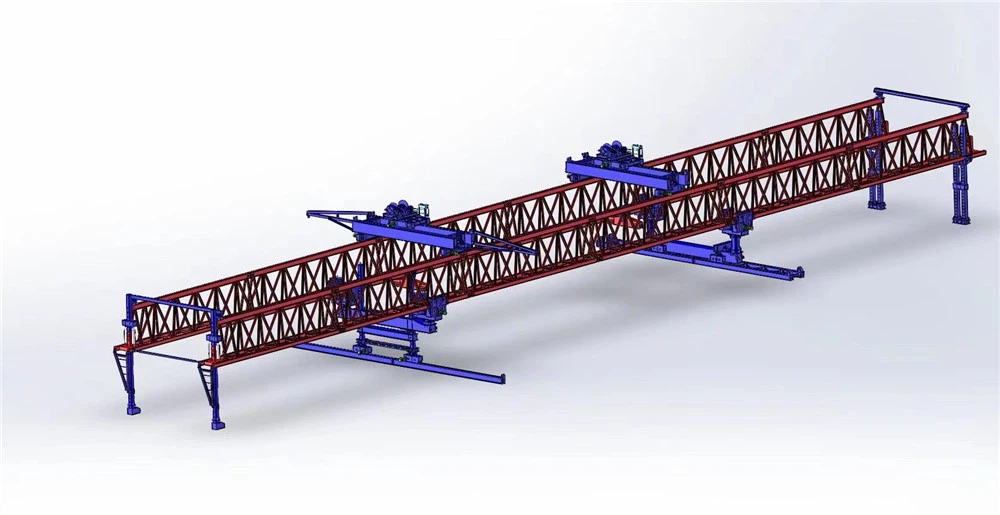
Girder Launching Gantry (GLG): A specialized machine that travels along already constructed bridge segments to place the next pre-cast segment. It handles the heavy lifting and precise positioning.
Self-Propelled Modular Transporters (SPMTs): Multi-axle trailers with independent computer-controlled hydraulic systems. They can be configured to transport and lift entire bridge spans weighing thousands of tons into place, making a 140-ton lift a standard operation for them.
3. Foundation & Piling Equipment
Used to create the deep, stable foundations required to support the bridge's weight.
Pile Driver/Hammer: A large diesel, hydraulic, or vibratory hammer that drives steel or concrete piles deep into the ground.
Rotary Drilling Rig: For drilling large-diameter shafts for caisson foundations. Key components include:
Kelly Bar: The long, square telescopic drill pipe that transmits torque.
Drilling Tool (Auger or Bucket): The cutting head that removes soil.
Hydraulic Power Unit: Provides high torque for drilling and power for extraction.
4. Positioning & Alignment Components
Precision is critical. These components ensure everything is placed within millimeter tolerances.
Hydraulic Jacks (Flat & Strand):
Lifting Jacks: Synchronized systems used to lift entire bridge decks for bearing replacement or incremental launching.
Stressing Jacks: Used in post-tensioning to tension the high-strength steel tendons (strands) inside concrete segments, putting the concrete into compression.
Bearings (Temporary & Permanent): Allow for movement (expansion, contraction, rotation) between the bridge superstructure and substructure.
Elastomeric Bearings: Made of layers of steel and rubber.
Pot Bearings: Handle high loads and rotation.
Spherical Bearings: For multi-directional rotation.
Surveying & Monitoring Equipment: High-precision GPS, robotic total stations, and laser scanners are used to guide and verify the position of every component in real-time.
5. Material Handling & Processing
Concrete Batching Plant: Not on-site, but produces the high-strength concrete delivered to the site.
Concrete Pumps (Boom Pumps): With long, articulated booms to place concrete precisely in formwork, especially for high piers.
High-Strength Bolts & Turnbuckles: Used for structural steel connections. They are tensioned to a specific preload to create friction-grip connections.

Sketch

Advantages
1. Safety Advantages
Reduced On-Site Labor: Minimizes the number of workers needed in elevated and potentially hazardous positions over water, roads, or ravines.
Controlled Construction Environment: The lifting and placement process is highly mechanized and controlled from a central cabin, reducing human error and accidents associated with traditional crane operations.
Elimination of Extensive Falsework: Unlike traditional methods that require building massive temporary support structures (falsework) underneath the bridge, the machine is supported on the already-constructed bridge piers and deck. This is vastly safer for workers below and for traffic passing underneath.
Stability: These machines are designed for exceptional stability during the lifting and moving of heavy loads, greatly reducing the risk of tipping or load drops compared to mobile cranes operating on temporary ground.
2. Efficiency and Speed Advantages
Rapid, Repetitive Construction Cycle: The machine is designed for a repetitive "launch, lift, place, and move forward" cycle. This allows for the construction of one segment (e.g., 30-50 meters) every 2-4 days, dramatically accelerating project timelines.
All-Weather Operation: The machine provides a sheltered working platform for crews, allowing work to continue in weather conditions (light rain, wind) that would halt traditional crane operations.
Parallel Work Activities: While the machine is placing segments at the front, other crews can work simultaneously on finishing tasks (e.g., post-tensioning, drainage, railings) on the already-completed deck sections behind it.
Minimal Site Preparation: Requires less ground-level site preparation and clearing compared to methods needing large crane pads and access roads for heavy transport.
3. Economic and Project Management Advantages
Predictable Scheduling: The repetitive nature of the process makes project scheduling highly predictable, reducing the risk of costly delays.
Lower Overall Project Cost: While the initial investment or rental cost of the machine is high, the savings from reduced labor, faster completion times, and eliminated falsework often lead to a lower total project cost, especially for long or repetitive bridges (>500 meters).
Reduced Rental Fleet: Replaces the need for multiple large-capacity mobile cranes and their associated transport, setup, and operator costs.
Accessibility in Difficult Terrain: This is a primary advantage. It is the only feasible method for building bridges over deep valleys, wide rivers, busy highways, active railways, or environmentally sensitive areas where building temporary ground supports is impossible, prohibitively expensive, or too disruptive.
4. Technical and Quality Advantages
Extreme Precision: The machines are equipped with hydraulic precision placers and sophisticated laser-guided or GPS-aided alignment systems. This ensures each segment or girder is placed with millimeter-level accuracy, which is critical for the final alignment and smoothness of the bridge deck.
Handling of Large, Heavy Components: The 140-ton capacity allows for the use of large pre-cast segments. Larger segments mean fewer joints in the final deck, leading to a stronger, more durable, and smoother-riding bridge.
Superior Structural Performance: The incremental launching method ensures that the structure is built in a continuous, statically determinate way, allowing engineers to precisely control stresses throughout construction.
Minimal Ground Footprint: The machine's support points are on the piers, leaving the ground below virtually untouched. This is crucial for projects over protected ecosystems or operational transport corridors.
5. Environmental and Social Advantages
Minimal Ecological Disturbance: Avoids the need to clear large swaths of land for crane setups and access roads, protecting the surrounding environment.
Reduced Traffic Disruption: When building over existing roads or railways, the machine's operation causes minimal disruption to the traffic below. There's no need for frequent lane closures to set up cranes or falsework.
Lower Noise Pollution: The operation is generally quieter than the constant coming and going of heavy crane trucks and support vehicles associated with other methods.
Improved Worker Safety: As mentioned above, this also translates to a more socially responsible construction process with a lower risk of workplace incidents.

Application
1. Girder Placement (Most Common Application):
What it does: This is the classic use. The machine lifts and precisely positions pre-cast concrete or steel girders onto piers (columns) and abutments. These girders form the primary support structure for the bridge deck.
Project Types: Highway overpasses, viaducts, railway bridges, and river crossings. A 140-ton machine would handle very long (e.g., 40-50 meter / 130-160 ft) pre-stressed concrete girders or large steel I-beams and box girders.
2. Segmental Bridge Construction:
What it does: For complex bridges (like cable-stayed or balanced cantilever bridges), the deck is built in segments. The machine lifts these pre-cast segments (weighing up to 140 tons each) and holds them in perfect alignment while they are permanently epoxied and post-tensioned to the existing structure.
Project Types: Long-span bridges, bridges over deep valleys, water bodies, or existing infrastructure where falsework (temporary supports from the ground) is impossible or unsafe.
3. Launching Gantry Systems:
What it does: This is a self-propelled, decked gantry crane that "launches" itself forward over the newly placed girders. It picks up girders from the back (where transporters deliver them), moves them along its own deck, and places them on the front piers. It then moves forward to repeat the process for the next span.
Advantage: It works entirely from the top of the structure, minimizing disruption to the terrain below (e.g., over busy highways, rivers, or rugged terrain). A 140-ton launching gantry is a common size for major projects.
4. Shear Leg Gantry or Stiffleg Derrick:
What it does: These are more stationary but incredibly stable lifting systems often used in bridge yards or at the project site to offload and assemble components. They can make very heavy, controlled lifts with a large radius.

Production Procedure
Phase 1: Pre-Production (Engineering & Planning)
This is the most critical phase, ensuring the final product meets all technical and safety requirements.
Design & Engineering:
Conceptual & Detailed Design: Using CAD (Computer-Aided Design) software, engineers create 3D models and 2D detailed drawings of every component. This includes structural members, mechanical systems (hydraulics, winches), and electrical control systems.
Structural Analysis (FEA): Finite Element Analysis (FEA) is performed on the model to simulate stresses, deflections, and fatigue under maximum load (140 tons + safety factor). This ensures structural integrity and identifies potential weak points.
Hydraulic & Electrical System Design: Schematics for hydraulic circuits (cylinders, pumps, valves, hoses) and electrical control systems (PLC, sensors, wiring) are designed.
Design Review: A multidisciplinary team (structural, mechanical, electrical engineers) reviews all designs for errors, manufacturability, and compliance with standards.
Procurement Planning:
Bill of Materials (BOM): A comprehensive list of all raw materials (steel plates, profiles, etc.) and purchased components (hydraulic cylinders, motors, PLCs, bearings, wire ropes) is generated from the design.
Supplier Selection: Qualified suppliers are selected based on their ability to provide certified materials (e.g., high-yield strength steel S355, S460) and reliable, high-quality components.
Material Ordering: Raw materials (steel plates, sections) are ordered with necessary mill certificates. Long-lead items (custom hydraulic cylinders, specialized motors) are ordered early.
Process Planning:
Work Instructions: Detailed procedures are written for cutting, welding, machining, and assembly. This includes Welding Procedure Specifications (WPS).
Quality Control Plan: A plan is established defining all inspection points, methods (visual, NDT), and acceptance criteria throughout the production process.
Phase 2: Fabrication & Manufacturing
This phase involves transforming raw materials into finished components.
Material Preparation:
Stocking & Inspection: Incoming steel is verified against mill certificates and inspected for defects.
Marking & Cutting: CNC cutting machines (plasma, laser, or oxy-fuel) are used to cut steel plates and profiles to precise dimensions based on CAD drawings. Parts are marked with unique identifiers.
Component Fabrication:
Bending & Forming: Plates are bent into required shapes (e.g., for girders, boxes) using large press brakes or rolling machines.
Machining: Critical components requiring high-precision mating surfaces (e.g., pivot points, connection interfaces) are machined on CNC milling machines, lathes, or boring mills.
Sub-Assembly Welding: Smaller components are welded into sub-assemblies (e.g., stiffeners welded to a main web plate) by certified welders following the WPS.
Stress Relieving: Critical welded structures may undergo stress relieving heat treatment in a large furnace to eliminate internal stresses from welding.
Surface Treatment:
Blasting & Painting: Fabricated steel components are shot-blasted to SA 2.5 (Near-White Metal) cleanliness standard to remove rust and mill scale.
Priming: A high-performance epoxy primer is immediately applied to prevent corrosion.
Intermediate/Final Coat: Intermediate and top coats (often polyurethane) are applied as specified, with precise dry film thickness (DFT) measurements taken.
Phase 3: Assembly & Integration (Shop Floor)
Components are brought together to build the complete machine.
Structural Assembly:
The main girders/trusses are positioned on large, level assembly jigs or stands.
Cross-beams, support frames, and the main lifting trolley frame are aligned and bolted or welded into place. Precision alignment with laser tools is crucial.
Mechanical System Installation:
Hydraulic System: Pumps, reservoirs, valves, and manifolds are installed. Pre-assembled and tested hydraulic hose bundles are connected.
Winches & Hoists: Main hoist winches (rated for 140T+) are mounted, and wire ropes are spooled.
Travelling System: Bogies, wheels, and drive units for moving the machine along the bridge are installed.
Electrical System Installation:
Cable Trays & Conduits: are installed along the structure.
Wiring: Electricians run and terminate power and control cables to motors, sensors, limit switches, and control panels.
Control Cabin: The operator's cabin, housing the main PLC, HMI (Human-Machine Interface), and control joysticks, is installed and connected.
Phase 4: Testing, Inspection, and Dispatch
The completed machine is rigorously tested before leaving the factory.
Pre-Commissioning Checks:
Visual Inspection: Final check of all bolts for proper torque, welds, and installation.
Hydraulic System Flushing: The hydraulic system is flushed with clean oil to remove any contaminants before final filling.
Electrical Checks: Continuity, insulation resistance, and grounding tests are performed on all electrical circuits.
Functional Testing (No-Load):
The machine is powered on.
All functions are tested without load: travel forward/backward, trolley traversal, hoist up/down, and all safety limit switches.
System pressures, motor currents, and response times are recorded.
Load Testing (Proof Load Test):
Static Load Test: The main hoist is fitted with test weights (often calibrated concrete blocks). The machine lifts a load 25% greater than its rated capacity (140T * 1.25 = 175 Tons). It is held for a sustained period (e.g., 10-15 minutes) while engineers measure deflections against FEA predictions and inspect for any deformation or issues.
Dynamic Load Test: The 140T load is lifted and moved through the full range of motion to test all systems under dynamic conditions.
Final Preparation & Dispatch:
Certification: All test results and inspection reports are compiled into a Factory Acceptance Test (FAT) dossier. A third-party inspector may witness the tests and issue a certificate of compliance.
Dismantling & Preservation: For shipment, the machine is often partially dismantled into modules. Exposed machined surfaces are coated with protective grease.
Packaging & Shipping: Components are securely packaged and loaded onto flatbed trucks or trailers. Lifting points are clearly marked. Detailed packing lists and assembly manuals are provided.


Workshop View
The company has installed an intelligent equipment management platform, and has installed 310 sets (sets) of handling and welding robots. After the completion of the plan, there will be more than 500 sets (sets), and the equipment networking rate will reach 95%. 32 welding lines have been put into use, 50 are planned to be installed, and the automation rate of the entire product line has reached 85%.


Hot Tags: 140 ton bridge construction machine, China 140 ton bridge construction machine manufacturers, suppliers, factory
You Might Also Like


Send Inquiry