






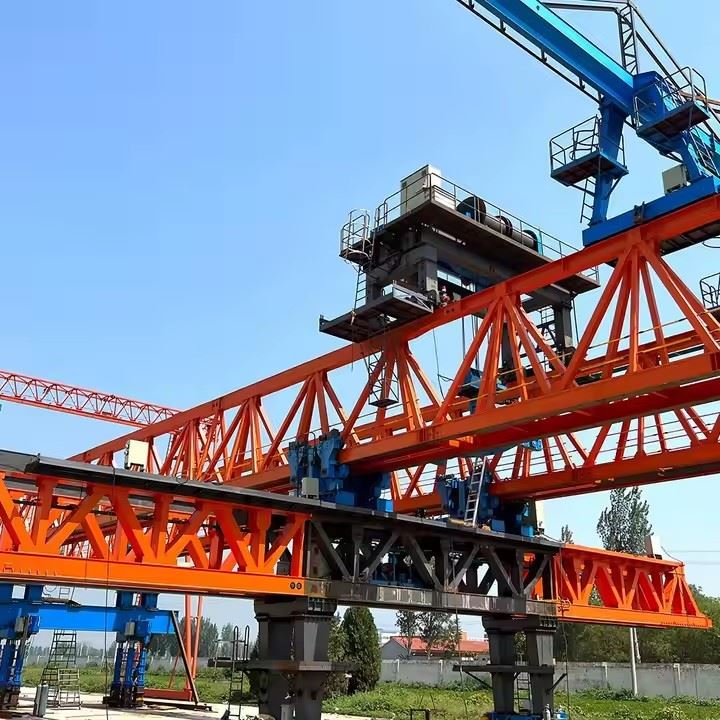
180T Bridge Construction Gantry Crane
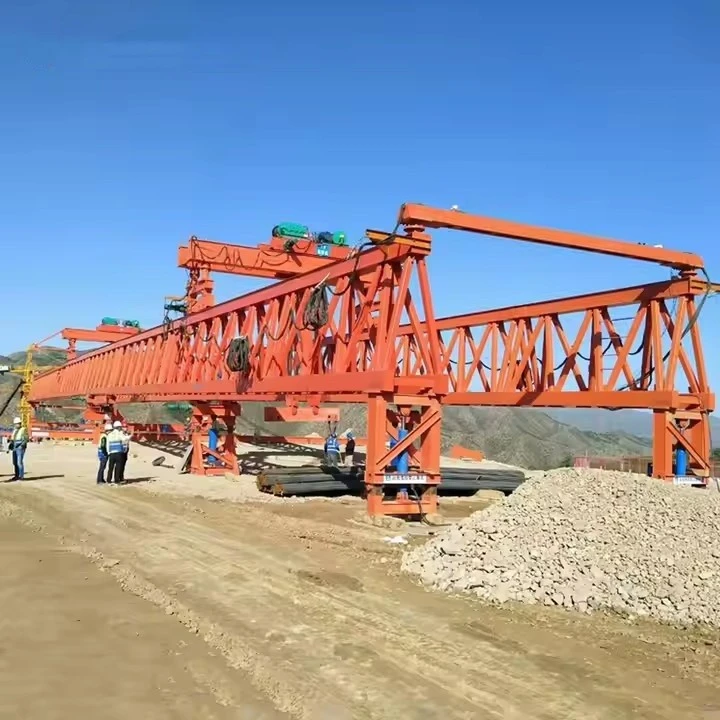
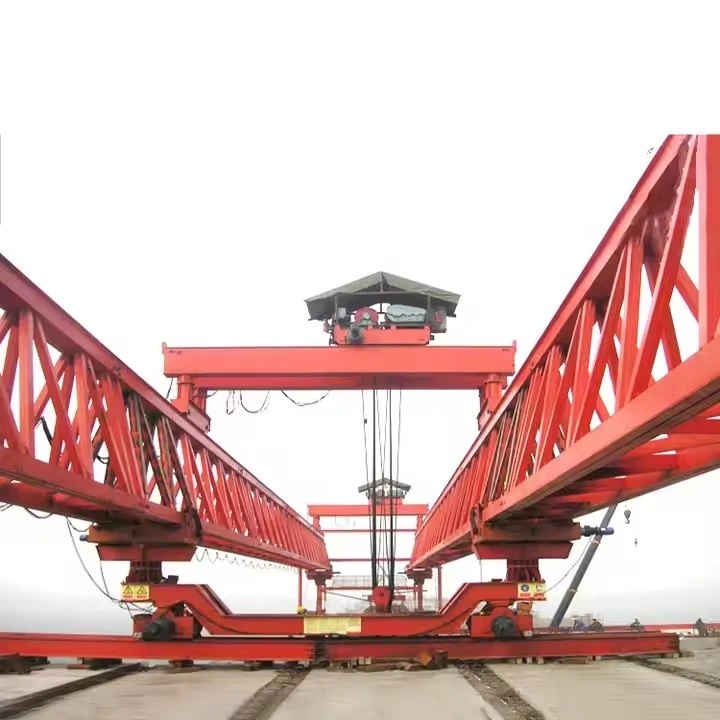
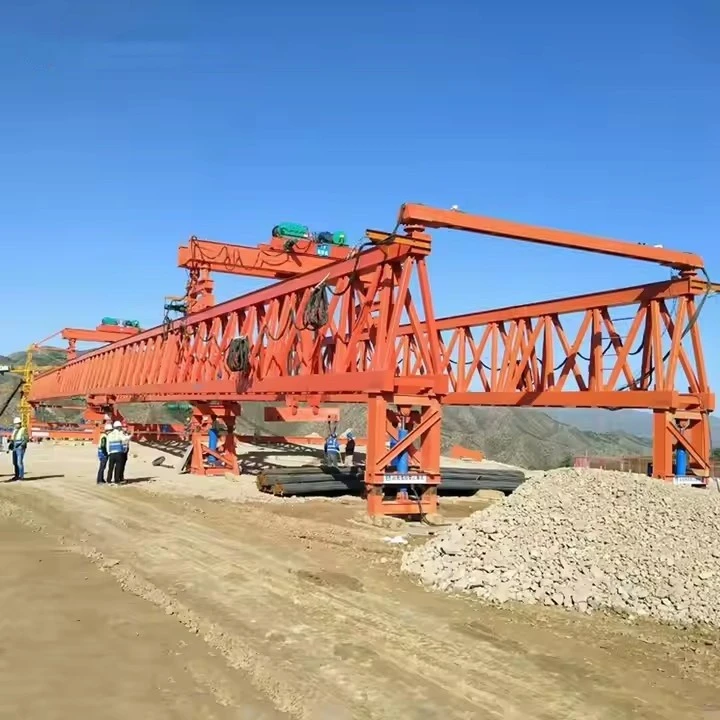
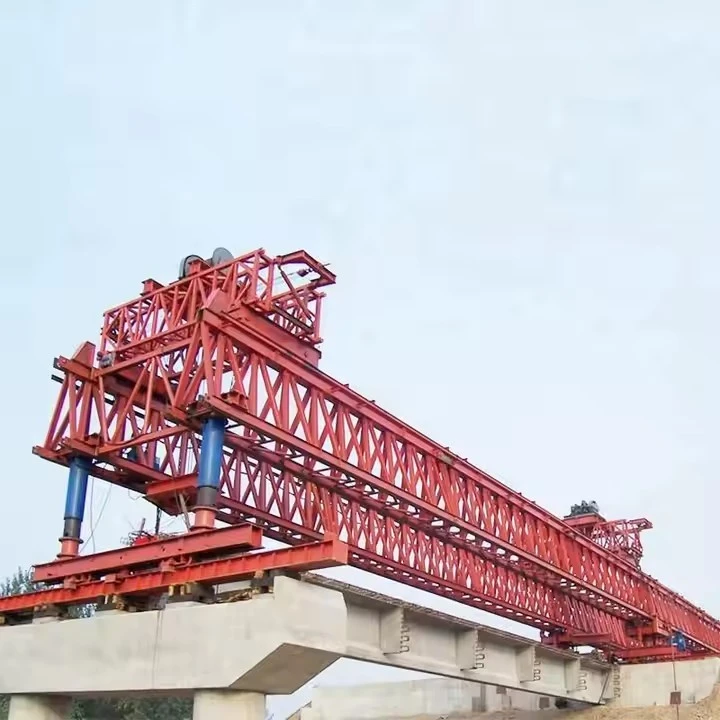
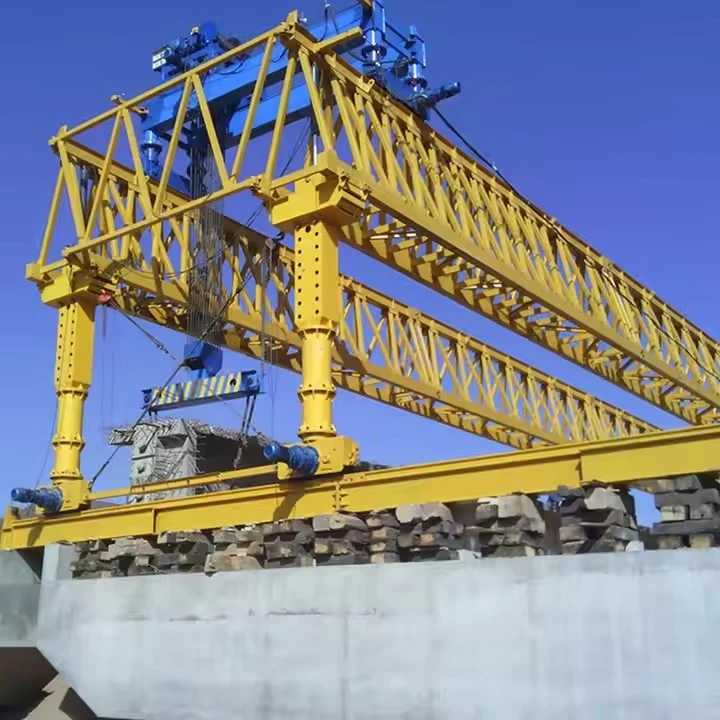
A 180T Bridge Construction Gantry Crane (often referred to as a launching gantry or beam launcher) is a specialized piece of heavy equipment used to lift and install precast concrete girders weighing up to 180 metric tons. It is essential for building highway, railway, and high-speed rail viaducts, especially where ground access is limited or traditional cranes cannot operate.

Key Specifications
| Parameter | Specification |
|---|---|
| Rated Lifting Capacity | 180 tons |
| Adaptable Bridge Span | 30–50 m (customizable) |
| Working Duty | A5–A7 |
| Power Supply | 3-phase AC 380V, 50Hz |
| Lifting Speed | 0.8–1.5 m/min (frequency control) |
| Longitudinal Travel Speed | 0–6 m/min |
| Lateral Travel Speed | 0–3 m/min |
| Adaptable Longitudinal Slope | ≤ 2–5% |
| Minimum Curve Radius | R ≥ 150–350 m |
| Skew Bridge Angle | 0–15° |

Pictures & Components
I. Main Structural Components
Main Girder (Truss)
The primary load-bearing structure, typically a triangular space truss made of high-strength steel (e.g., Q345).
Carries the weight of the girders and its own traveling loads; offers a high strength-to-weight ratio and wind resistance.
Legs (Front, Middle, and Rear Legs)
Transfer loads to the bridge piers; divided into front, middle, and rear legs.
Some designs use four legs (including temporary legs) to enhance stability.
Leg height is adjustable via hydraulic jacks.
Front Nose (Launching Nose)
An extension structure at the front end of the main girder.
Provides guidance and support during longitudinal launching (span-by-span advancement), assisting in spanning onto the next pier.
Cross Beams and Bracing Systems
Connect the legs to the main girder, ensuring structural rigidity and overall stability of the machine.
II. Lifting and Traveling Systems
Hoisting Trolley (Crane Trolley)
Usually equipped with dual trolleys that travel along the main girder for lifting girders.
Includes wire ropes, hooks, and spreader beams; some are equipped with anti-sway functions.
Longitudinal Traveling Mechanism
Drives the entire machine forward span-by-span along the bridge direction.
Typically consists of wheel sets, rollers, or crawler mechanisms.
Transverse Traveling Mechanism
Used for lateral fine-tuning of the girder's position to achieve precise alignment during installation.
Span-Change Adjustment Mechanism
Used to adapt to bridges of different span lengths by adjusting leg spacing or the main girder's working configuration.
III. Power, Control, and Safety Systems
Power and Hydraulic System
Includes electric motors, gear reducers, and hydraulic stations.
Hydraulic systems are commonly used for jacking, leveling, and adjustment of leg heights.
Control System
Equipped with a PLC (Programmable Logic Controller) and operator cabin (or remote control).
Achieves synchronized operation of lifting and traveling, as well as precise positioning.
Safety Protection Devices
Includes overload protection, limit switches, emergency stop systems, wind speed monitoring, and anti-collision devices.
Ensures operational safety under heavy-load conditions.

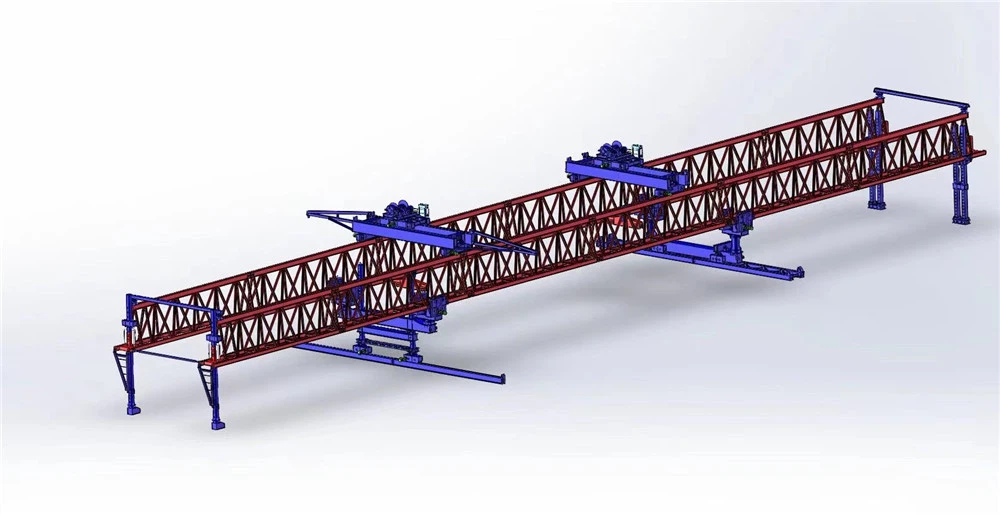
Sketch

Advantages
A 180T bridge construction gantry crane offers significant advantages over conventional ground-based crane erection or falsework methods, particularly regarding site access, environmental impact, and operational efficiency for repetitive span construction.
🏗️ Unrestricted Site Access and Minimal Environmental Impact
The most defining advantage is the ability to erect precast girders entirely from above the structure, leaving the space below completely unobstructed.
Obstacle Clearance: It can span over deep valleys, wide rivers, busy highways, or active railway lines without requiring temporary supports or interrupting existing traffic.
Limited Ground Access: This method is ideal for projects where ground access is severely restricted, such as in dense urban alignments or difficult terrain, eliminating the need for extensive ground improvements or large crane pads.
⚡ High Efficiency for Repetitive Spans
For long viaducts with many identical spans, the self-launching capability provides a distinct speed advantage.
Rapid Relocation: The machine is self-launching, meaning it can move forward to the next pier using its own hydraulic and mechanical systems without dismantling, significantly reducing setup time between spans.
Fast Cycle Times: Under optimal conditions, a span-by-span erection cycle can be completed rapidly (for example, some 180T class units are cited with an operational efficiency of approximately 7 days per span, while some segmental methods can achieve a span per week).
Streamlined Logistics: Segments or girders can be delivered directly along the newly constructed deck from the rear of the gantry, simplifying the supply chain compared to lifting from ground level.
🎯 Enhanced Safety and Precision
Working from the completed deck rather than from the ground or with large mobile cranes offers safety and quality benefits.
Controlled Environment: All lifting and positioning operations are performed from the stable platform of the gantry and the erected deck, reducing the risk associated with ground-based crane swings or working at heights with limited space.
Precise Positioning: Modern 180T units are equipped with advanced control systems (like PLC and frequency converters) that allow for smooth start-stop and millimeter-level alignment, ensuring the heavy girders are placed accurately onto the bearings.
Integrated Safety: The equipment is designed with comprehensive safety features (overload protection, limit switches, wind monitoring) specifically for heavy lifts, providing a higher level of assurance than general-purpose lifting equipment.
💰 Cost-Effectiveness for Large Projects
While the initial investment is high, the economics favor this equipment for the right scale of project.
Reduced Temporary Works: It minimizes or eliminates the need for expensive ground-based falsework, temporary towers, or large crawler crane mobilization, especially over difficult terrain.
Labor Efficiency: The mechanized process reduces the labor intensity and the number of ground personnel required in the danger zone beneath the load compared to traditional scaffolding methods.
Depreciation: The high capital cost is most effectively amortized on large, repetitive projects (e.g., long high-speed rail viaducts or metro lines) where the machine can be used over many spans.


Application
A 180T bridge construction gantry crane is primarily applied across a wide range of bridge types and construction environments where ground access is restricted, spans are repetitive, and precision placement of heavy precast girders is required. Its applications span highway, railway, urban transit, and difficult terrain projects.
🛣️ Highway and Expressway Viaducts
This is a core application area, particularly for long elevated highways with many identical spans.
Precast Girder Erection: Used for installing precast concrete box girders, T-beams, and I-girders on expressways, flyovers, and multi-span highway bridges .
Minimizing Traffic Disruption: It enables girder erection over active roads, rivers, and valleys without requiring extensive ground closures or temporary supports, keeping traffic flowing below .
Bridge Widening: Can be adapted for adding new girders to existing bridges or replacing old beams during infrastructure upgrades .
🚄 Railway and High-Speed Rail Viaducts
The high precision and heavy lifting capacity of 180T class machines are essential for rail infrastructure.
High-Speed Rail: Designed for the precise placement of heavy precast concrete girders required for high-speed rail viaducts, where strict alignment standards are critical for safety .
Conventional and Metro Rail: Used for erecting girders on conventional railway bridges and elevated metro transit systems. The ability to work from above is particularly valuable in dense urban environments where ground access is limited .
🌉 Difficult Terrain and Water Crossings
The crane's ability to operate without ground-based support makes it indispensable in challenging environments.
River and Valley Crossings: It erects girders over rivers, lakes, and deep valleys, eliminating the need for floating cranes, barges, or extensive temporary scaffolding in water or on unstable ground .
Mountainous Regions: Ideal for areas with difficult terrain where conventional lifting equipment cannot be mobilized efficiently, reducing the need for large access roads and ground-based cranes .
🏙️ Urban Infrastructure and Complex Interchanges
In dense urban settings, the crane's overhead operation method is a key advantage.
Elevated Transit Systems: Used for installing girders on metro viaducts and elevated light rail systems, minimizing disruption to buildings, utilities, and surface traffic .
Overpasses and Interchanges: Suitable for complex bridge layouts, including curved and skewed structures, ensuring accurate girder placement in multi-level transportation projects without major road closures .
🧱 Specific Construction Methods
The 180T gantry supports different erection methodologies depending on the bridge design.
Whole-Span Assembly: The entire prefabricated girder is lifted and placed onto the piers, suitable for simply supported or continuous beams with spans up to 60 meters .
Segmental Construction: It can handle the lifting and installation of precast bridge segments for span-by-span or balanced cantilever construction, which is common in modern long-span viaducts .

Production Procedure
📐 1. Design & Engineering
The process begins with confirming project-specific requirements: lifting capacity (180T), beam length and type, span, and working conditions. Engineers perform structural analysis for strength and stability, load calculations, deflection checks, and Finite Element Analysis (FEA). The output includes General Arrangement (GA) drawings, detailed fabrication drawings, and assembly/installation plans.
🔩 2. Raw Material Procurement & Inspection
High-grade structural steel (such as Q345B or Q420) is selected for the main structure. Materials undergo inspection for mechanical properties, thickness and dimensional accuracy, and surface defects. Only certified materials with valid mill certificates proceed to fabrication.
🔨 3. Steel Structure Fabrication
This is the core manufacturing stage. Steel plates and profiles are cut using CNC flame or plasma cutting, then formed with precision bending. Welding of the main truss beams typically uses Submerged Arc Welding (SAW) for deep penetration, while secondary structures use CO₂/MIG welding. The main truss girders, support legs, and cross beams are assembled with strict dimensional control.
🔍 4. Welding Inspection (NDT)
Critical welds undergo Non-Destructive Testing to detect internal and surface defects. This includes Ultrasonic Testing (UT), Magnetic Particle Testing (MT), and Visual Inspection (VT). Load-bearing welds are documented with welder identification and date for full traceability.
⚙️ 5. Precision Machining
Key mechanical components are machined to precise tolerances: wheel assemblies, bearing housings, pin shafts, and connection joints. This ensures proper alignment, smooth movement, and durability of the traveling and lifting mechanisms.
🧰 6. Component Manufacturing & Sub-Assembly
Lifting winches, trolleys, hydraulic cylinders, and piping are produced or sourced as complete sub-systems. Each component is tested individually before integration into the main structure.
🔗 7. Factory Pre-Assembly (Trial Assembly)
Major structural sections are partially or fully assembled at the factory to verify structural alignment, bolt and pin connections, and fit-up accuracy. This step identifies and corrects any interface issues before shipment, ensuring smoother on-site installation.
⚡ 8. Electrical & Hydraulic System Installation
The PLC control system, motors, cables, sensors, hydraulic pumps, valves, and pipelines are installed. The work includes insulation testing, grounding checks, and leakage inspection for the hydraulic circuits.
🎨 9. Surface Treatment & Painting
Steel structures undergo shot blasting to Sa2.5 standard to remove rust and scale, followed by application of anti-corrosion primer and final paint layers. Marine-grade coatings are optional for harsh environments. Dry film thickness is verified.
🧪 10. Factory Testing & Commissioning
The completed machine undergoes functional testing of the hoisting, trolley, and travel systems. Load testing includes a static load test at 125% of rated capacity and a dynamic load test at 110% to verify structural integrity and operational stability. Hydraulic synchronization and electrical control accuracy are also checked. No unit is released without a successful test report.
📦 11. Disassembly, Packing & Delivery
The machine is modularly disassembled into transportable sections. Structural components, mechanical systems, and electrical parts are packed separately for container or bulk shipment.
🏗️ 12. On-Site Installation & Commissioning
At the project site, the truss structure and supports are reassembled, mechanical and electrical systems are connected, and final alignment and calibration are performed. This concludes with a test run and operator training before handover.


Workshop View
The company has installed an intelligent equipment management platform, and has installed 310 sets (sets) of handling and welding robots. After the completion of the plan, there will be more than 500 sets (sets), and the equipment networking rate will reach 95%. 32 welding lines have been put into use, 50 are planned to be installed, and the automation rate of the entire product line has reached 85%.


Hot Tags: 180t bridge construction gantry crane, China 180t bridge construction gantry crane manufacturers, suppliers, factory
You Might Also Like


Send Inquiry