







Highway Bridge Erecting Machine
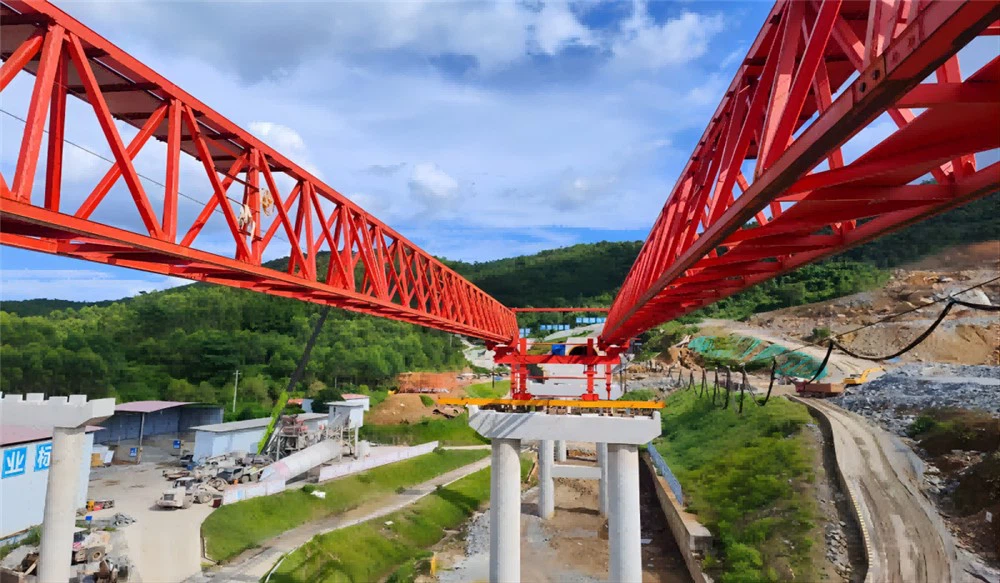
A highway bridge erecting machine is specialized construction equipment designed for assembling and installing bridge components, such as girders, beams, and segments, during highway bridge construction. These machines are essential for large-scale infrastructure projects, ensuring efficiency, precision, and safety.

Key Features
Types of Bridge Erecting Machines
Girder Launching Gantry (GLG): Used for placing precast girders in highway and railway bridges.
Beam Launching Equipment: Handles heavy beams in long-span bridges.
Mobile Modular Transporters (MMT): For moving large bridge segments into position.
Crane Systems (Gantry & Overhead): Assist in lifting and placing structural elements.
Technical Capabilities
Can handle spans exceeding 80 meters and loads up to 900 tons.
Equipped with hydraulic systems for precise positioning.
Some models feature self-propelled mechanisms for mobility along construction sites.

Specification
Technical Specifications
Lifting Capacity: 100 tons
Applicable Girder Length: Typically 20m - 50m (can vary based on design)
Girder Types: Precast concrete girders, steel girders, I-beams, or box girders
Span Length: 20m - 50m (depending on project requirements)
Self-weight of Machine: Approx. 80 - 200 tons (varies by design)
Launching Method:
Single-girder or double-girder design
Overhead or underslung operation
Self-propelled trolley system
Control System:
PLC-based fully automatic control
Remote & cabin operation
Power Supply:
Electric-driven (380V/50Hz or customized)
Hydraulic system for launching movement
Travel Speed:
Longitudinal travel: 2-5 m/min
Lifting speed: 0.5-2 m/min
Transverse movement: 1-3 m/min
Safety Features:
Overload protection
Emergency braking system
Anti-tilt and anti-slip devices
Limit switches for movement control
Hydraulic safety locks


Pictures & Components
A highway bridge erecting machine is a complex piece of equipment designed to lift, transport, and precisely position bridge components (such as girders, beams, and precast segments) during construction. Below are its key components:
1. Main Gantry Frame (Beam Launcher)
The primary structural framework that spans the bridge construction area.
Made of high-strength steel to support heavy loads.
Often modular for different span lengths.
2. Lifting System
Hoists & Winches: Electric or hydraulic systems for vertical lifting.
Spreaders & Lifting Beams: Distribute load evenly to prevent damage to bridge segments.
Hydraulic Jacks: Provide fine adjustments during placement.
3. Support Legs & Outriggers
Provide stability during lifting operations.
Some models have self-propelled wheels or crawlers for mobility.
Adjustable height to accommodate different bridge heights.
4. Traveling Mechanism
Rail-Based Systems: Moves along temporary tracks installed on piers.
Self-Propelled Wheels/Tires: For flexible movement on construction sites.
Hydraulic Walkers: Used in heavy-duty machines for step-by-step advancement.
5. Hydraulic & Control System
Hydraulic Pumps & Cylinders: Power lifting, balancing, and positioning.
PLC (Programmable Logic Controller): Ensures precise movements and synchronization.
Remote Control: Allows operators to control movements safely from a distance.
6. Auxiliary Systems
Counterweights: Balance the machine when handling heavy loads.
Safety Devices: Limit switches, overload sensors, and emergency brakes.
Temporary Supports & Falsework: Used to stabilize segments before final installation.
7. Specialized Attachments (Depending on Design)
Segment Holders: For precast concrete segmental bridges.
Rotating Heads: For adjusting girder angles during placement.
Cantilever Arms: For launching girders in balanced cantilever construction.

Sketch


Advantages
Advantages of Highway Bridge Erecting Machines
Efficiency & Speed
Significantly reduces construction time compared to traditional methods (e.g., manual assembly or crane-based lifting) by enabling rapid placement of girders, beams, and precast segments.
Automated systems (e.g., hydraulic controls, PLCs) streamline operations, minimizing human error.
Precision & Safety
Equipped with hydraulic jacks and remote controls for millimeter-level accuracy in positioning bridge components.
Integrated safety features (e.g., overload sensors, emergency brakes) reduce accident risks.
Versatility
Adaptable to various bridge types (e.g., box girders, T-beams, segmental bridges) and terrains (e.g., highways, railways, urban transit).
Modular designs allow customization for spans up to 80 meters and loads exceeding 900 tons.
Cost-Effectiveness
Lowers labor costs and material waste through mechanized processes.
Reusable across multiple projects, offering long-term economic benefits.
Innovative Technology
Incorporates anti-seismic and wind-resistant designs for stability in challenging environments.
Some models feature self-propelled mechanisms (e.g., crawlers, rail systems) for mobility without disassembly.

Application
Applications of Highway Bridge Erecting Machines
Highway & High-Speed Rail Bridges
Used in major projects like the Beijing-Shanghai High-Speed Railway and South-North Water Diversion Project in China.
Ideal for launching precast concrete girders and beams over long spans.
Urban Infrastructure
Constructs elevated roads, metro viaducts, and maglev train tracks (e.g., Shanghai Maglev).
Specialized Bridges
Supports wind power installations, ship engineering, and water diversion projects.
Enables cantilever construction for bridges over rivers or valleys.
International Projects
Exported to Brazil, Russia, Malaysia, and other countries for global infrastructure development.
Retrofitting & Maintenance
Assists in bridge reinforcement (e.g., using prestressed carbon fiber for cracked box girders).
Production Procedure
1. Design and Engineering
Requirement Analysis: Gather customer specifications, including girder size, bridge span, and working conditions.
Structural Design: Perform mechanical calculations, load analysis, and finite element analysis (FEA) to ensure strength and stability.
Electrical & Hydraulic System Design: Develop control circuits, safety features, and hydraulic power systems.
Approval & Prototyping: Get client approval on the design before moving to manufacturing.
2. Material Procurement
Steel Selection: High-strength structural steel plates and sections are sourced.
Standard Components: Motors, winches, hydraulic cylinders, electrical panels, and sensors are procured.
Quality Inspection: Raw materials and components undergo quality testing before production.
3. Fabrication & Machining
Steel Cutting: CNC cutting machines are used to cut steel plates and profiles into required shapes.
Welding: High-precision welding is performed for the main girder, trolley, and support structures.
Machining: Drilling, milling, and grinding of key components ensure precise assembly.
Surface Treatment: Shot blasting and anti-rust coatings are applied to protect the structure.
4. Assembly
Main Girder Assembly: The main beam structure is assembled with high-strength bolts and welding.
Trolley Installation: Winch trolleys and hydraulic jacks are installed for lifting operations.
Hydraulic System Assembly: Hydraulic pumps, cylinders, and hoses are connected.
Electrical System Integration: Control panels, sensors, and remote-control systems are installed.
5. Testing & Quality Control
Non-Destructive Testing (NDT): Weld joints are tested for cracks and defects.
Load Testing: The machine is tested under no-load and full-load conditions to verify performance.
Movement & Function Tests: The launching system, lifting mechanisms, and safety interlocks are tested.
6. Surface Coating & Painting
Anti-Corrosion Treatment: Protective coatings are applied to prevent rust.
Final Painting: Multiple layers of industrial paint are applied for durability.
7. Packing & Transportation
Disassembly: The machine is partially disassembled for easier transportation.
Packaging: Sensitive components are packed in wooden crates, while steel structures are secured for shipping.
Shipment: The parts are transported to the customer's site via trucks or ships.
8. On-Site Installation & Commissioning
Assembly: The girder launcher is reassembled at the project site.
Alignment & Calibration: Final adjustments are made to ensure precise operation.
Trial Operation: The machine is tested with dummy loads before actual girder launching.
Operator Training: The client's staff is trained on safe operation and maintenance.

Workshop View
The company has installed an intelligent equipment management platform, and has installed 310 sets (sets) of handling and welding robots. After the completion of the plan, there will be more than 500 sets (sets), and the equipment networking rate will reach 95%. 32 welding lines have been put into use, 50 are planned to be installed, and the automation rate of the entire product line has reached 85%.


Hot Tags: highway bridge erecting machine, China highway bridge erecting machine manufacturers, suppliers, factory, Forged Wheel, Double Girder Overhead Travelling Crane, Forged Part, Electric Hoist Single Girder Gantry Crane, Steel Rail Wheels, Electromagnetic Overhead Crane with Rotary Carrier Beam
You Might Also Like


Send Inquiry