










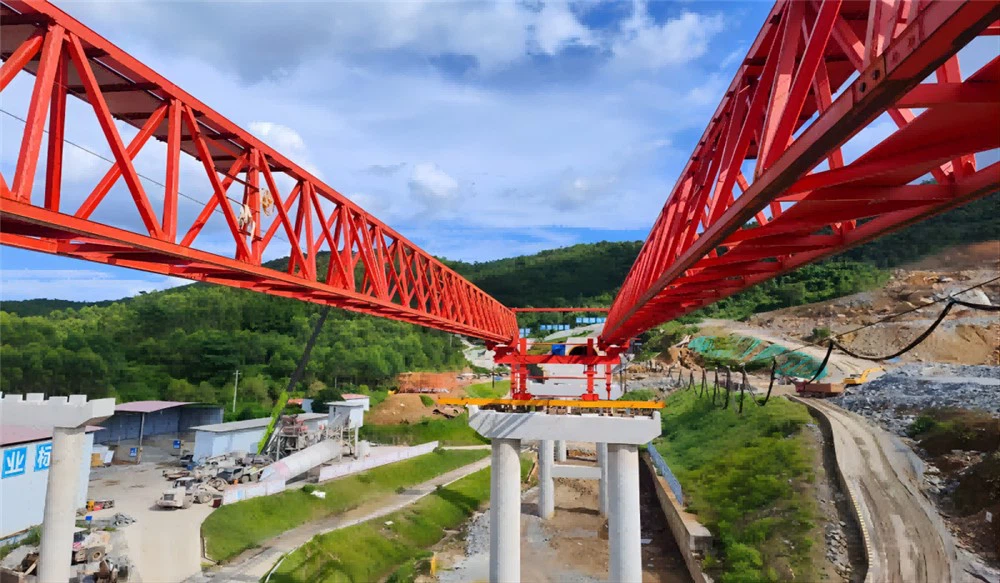
180ton Beam Launcher Crane
It's designed to lift, transport, and place precast concrete segments or beams, which are the building blocks of a bridge's superstructure.

Key Features
These features collectively contribute to the efficiency, safety, and effectiveness of 180ton beam launcher cranes in bridge construction projects. When choosing a 180ton beam launcher crane for a specific project, it's important to consider factors such as the bridge design, site conditions, required span length, and load-bearing capacity.
1. Lifting Capacity: 180ton beam launcher cranes are designed to handle heavy loads, as they need to lift and transport large precast concrete segments that make up bridge spans. Their lifting capacity can vary depending on the specific model and design.
2. Span Length: These cranes are built to accommodate various bridge spans, ranging from medium to long lengths. The span length determines how far the crane can move along the bridge alignment.
3. Segment Handling: 180ton beam launcher cranes are equipped with specialized lifting mechanisms, such as hoists and trolleys, that can securely grip and lift precast segments without causing damage.
4. Precision Positioning: Accurate placement of segments is crucial for proper alignment and structural integrity. 180ton beam launcher cranes are equipped with sophisticated positioning systems that ensure precise segment placement.
5. Mobility: These cranes can move along temporary piers or tracks that are set up parallel to the bridge alignment. They may use wheels, crawlers, or a combination of both for movement.
6. Safety Features: Safety is a top priority in construction. 180ton beam launcher cranes incorporate safety features such as load monitoring systems, anti-collision systems, emergency stop buttons, and more.
7. Control Systems: Modern 180ton beam launcher cranes come with advanced control systems that allow operators to manage various crane functions with precision. These systems may include remote control options for safer operation.
8. Weather Resistance: Construction projects can be affected by weather conditions. 180ton beam launcher cranes are often designed to withstand adverse weather, ensuring that construction can continue even in challenging environments.
9. Assembly and Disassembly: These cranes need to be assembled and disassembled as construction progresses. Efficient assembly and disassembly processes are essential to minimize downtime and keep the project on track.
10. Flexibility: 180ton beam launcher cranes can be customized to suit the specific requirements of different bridge construction projects. They can be adapted to different bridge designs and construction methods.

Specification
1. Lifting Capacity: Typically stated in tons or kilograms, this specification indicates the maximum weight the crane can lift. It's important to ensure that the crane's lifting capacity matches the weight of the precast concrete segments being used in the construction.
2. Span Length: The maximum distance the crane can move along the bridge alignment. This specification is crucial for determining the crane's reach and coverage area.
3. Lifting Height: The maximum vertical distance the crane can lift a segment. This specification is important for ensuring that the crane can reach the desired placement height.
4. Traveling Speed: The speed at which the crane can move along the temporary piers or tracks. Faster traveling speeds can contribute to higher construction efficiency.
5. Hoisting Speed: The speed at which the crane's lifting mechanisms can raise and lower segments. A faster hoisting speed can help improve overall construction productivity.
6. Positioning Accuracy: Specifies how accurately the crane can position and place segments. This is critical for maintaining the alignment and structural integrity of the bridge.
7. Power Source: Specifies the type of power used to operate the crane, such as electric, diesel, or hybrid. This can have implications for environmental impact and operational costs.
8. Control System: Describes the crane's control interface, which can include features like joystick controls, touchscreens, and remote control capabilities.
9. Safety Features: Specifies the safety mechanisms incorporated into the crane, such as overload protection, anti-collision systems, emergency stop buttons, and more.
10. Weather Resistance: If applicable, this specification highlights the crane's ability to operate in adverse weather conditions.


Pictures & Components
A 180ton beam launcher crane consists of various components that work together to facilitate the lifting, transportation, and placement of precast concrete segments during bridge construction.
1. Main Bridge Structure: This is the primary framework of the crane that supports the various components and provides the necessary structural integrity. It includes the main girder, crossbeams, and other supporting structures.
2. Lifting Mechanisms: These are the systems responsible for lifting the precast concrete segments. The lifting mechanisms include hoists, winches, or hydraulic cylinders that raise and lower the segments as needed.
3. Trolley System: The trolley moves along the main girder, allowing the crane to transport segments horizontally along the bridge alignment. The trolley is equipped with the necessary mechanisms to securely grip and carry the segments.
4. Positioning Systems: Precise segment placement is crucial for the integrity of the bridge. Positioning systems include sensors, lasers, and other devices that ensure accurate alignment and positioning of the segments.
5. Counterweight System: To maintain stability, 180ton beam launcher cranes often incorporate counterweights that balance the weight of the lifted load. These counterweights help prevent the crane from tipping over during operation.
6. Traveling System: This system enables the crane to move along temporary piers or tracks parallel to the bridge alignment. It may consist of wheels, crawlers, or other mechanisms depending on the design.
7. Control Cabin: The control cabin provides a workspace for the crane operator. It contains the controls, instruments, and displays needed to operate the crane, monitor loads, and ensure safe operation.
8. Safety Devices: 180ton beam launcher cranes are equipped with various safety features such as load limiters, anti-collision systems, emergency stop buttons, and alarms to prevent accidents and ensure the safety of the construction site and personnel.
9. Power Source: Depending on the design, 180ton beam launcher cranes can be powered by electricity, diesel engines, or other power sources. The power source provides the energy needed to operate the lifting and movement mechanisms.
10. Remote Control System: Some cranes offer remote control options that allow operators to control the crane's movements and functions from a distance, enhancing safety and flexibility.

Sketch


Advantages
180ton beam launcher cranes offer several advantages in bridge construction compared to traditional construction methods. Here are some of the key advantages of our 180ton beam launcher cranes:
1. Efficiency: 180ton beam launcher cranes can significantly accelerate the construction process by allowing multiple precast concrete segments to be placed in sequence. This reduces the overall construction time and project duration.
2. Reduced Traffic Disruption: The faster construction enabled by 180ton beam launcher cranes means that traffic disruption at the construction site is minimized, reducing inconvenience to commuters and travelers.
3. High-Quality Segments: Precast concrete segments are manufactured in controlled environments, leading to higher quality and consistency compared to cast-in-place methods. This can result in a more durable and long-lasting bridge structure.
4. Enhanced Safety: 180ton beam launcher cranes provide a safer working environment for construction personnel. Operators can control the crane from a distance, reducing the risks associated with working at heights and in confined spaces.
5. Accurate Alignment: Precise positioning systems ensure accurate alignment and placement of segments, resulting in a well-aligned and structurally sound bridge.
6. Long-Span Bridges: 180ton beam launcher cranes are particularly useful for constructing long-span bridges where traditional construction methods might be less feasible or more time-consuming.
7. Less Formwork: Traditional construction methods often require extensive formwork for casting concrete on-site. 180ton beam launcher cranes reduce the need for formwork, saving time and materials.
8. Minimized Environmental Impact: Some modern 180ton beam launcher cranes are designed with environmental considerations in mind, incorporating features to reduce noise, emissions, and energy consumption.
9. Flexibility: 180ton beam launcher cranes can be customized to suit different bridge designs and construction requirements, making them adaptable to a wide range of projects.
10. Remote Monitoring: Some crane models offer remote monitoring capabilities, allowing engineers and supervisors to track construction progress and crane performance from a distance.
11. Cost Savings: While the initial investment in a 180ton beam launcher crane might be significant, the overall cost savings from reduced construction time, labor, and improved efficiency can make it a cost-effective choice.
12. Reduced Weather Dependency: 180ton beam launcher cranes can operate in various weather conditions, reducing delays caused by weather-dependent traditional construction methods.

Application
180ton beam launcher cranes are primarily used in the construction of bridges and viaducts, where they play a critical role in lifting, transporting, and placing precast concrete segments that form the superstructure of the bridge.
1. Bridge Construction: 180ton beam launcher cranes are extensively used for constructing various types of bridges, including highway bridges, railway bridges, pedestrian bridges, and overpasses. They are particularly valuable for projects involving long-span bridges and elevated highways.
2. Viaducts and Flyovers: In urban infrastructure projects, 180ton beam launcher cranes are used to build elevated roadways, viaducts, and flyovers. These structures often require efficient construction methods to minimize disruption to existing traffic flow.
3. High-Speed Railways: 180ton beam launcher cranes are utilized in the construction of railway viaducts and bridges for high-speed rail networks. The speed of construction is crucial to meeting the demands of these projects.
4. River Crossings: When constructing bridges over rivers or water bodies, 180ton beam launcher cranes are used to facilitate the placement of segments in challenging environments.
5. Expressways and Freeways: For the rapid construction of expressways and freeways, 180ton beam launcher cranes provide an efficient solution to meet tight project schedules.
6. Interchanges and Complex Structures: Interchanges that involve complex bridge configurations can benefit from the precise alignment and placement provided by 180ton beam launcher cranes.
7. Rapid Construction: In projects with time-sensitive construction schedules, such as emergency bridge replacements or disaster recovery efforts, 180ton beam launcher cranes enable faster construction.
8. Long-Span Structures: 180ton beam launcher cranes are especially useful for constructing long-span bridges and viaducts, where traditional methods might be slower and more resource-intensive.
9. Modular Bridge Construction: 180ton beam launcher cranes are well-suited for modular construction approaches, where precast segments are produced off-site and assembled quickly using the crane.
10. Railway Bridges: 180ton beam launcher cranes are used for constructing bridges and viaducts in railway projects, ensuring efficient track integration and alignment.
11. Highway Interchanges: The complex structures of highway interchanges can be constructed efficiently using 180ton beam launcher cranes, reducing overall construction time.
12. Cable-Stayed Bridges: Some 180ton beam launcher crane systems are designed to work in conjunction with cable-stayed bridge construction, aiding in the placement of cable-supported spans.
Production Procedure
The production procedure for a 180ton beam launcher crane involves several stages, from design and fabrication to assembly and testing. Here's a general overview of the typical steps involved in producing a 180ton beam launcher crane:
1. Design and Engineering:
- Preliminary Design: Engineers create a preliminary design of the 180ton beam launcher crane based on project specifications, including lifting capacity, span length, segment handling, and safety features.
- Detailed Design: Detailed engineering drawings are developed, specifying dimensions, materials, load calculations, structural components, mechanisms, control systems, and safety features.
2. Fabrication of Components:
- Manufacturing: Various components of the 180ton beam launcher crane are fabricated, including the main girder, trolley system, lifting mechanisms, control cabin, counterweight system, and more.
- Quality Control: Fabricated components undergo quality checks and inspections to ensure they meet engineering specifications and industry standards.
3. Surface Treatment and Painting:
- Surface Preparation: Components are cleaned, blasted, and treated to remove impurities and ensure proper adhesion of paint.
- Painting: Components are coated with corrosion-resistant paint to protect against environmental elements and extend the crane's lifespan.
4. Assembly:
- Subassembly: Different components are assembled into subassemblies, such as the trolley system, lifting mechanisms, and control cabin.
- Main Assembly: Subassemblies are brought together to assemble the main structure of the 180ton beam launcher crane, including the main girder, trolley, and lifting mechanisms.
5. Installation of Mechanical and Electrical Systems:
- Mechanical Systems: Installation of lifting mechanisms, hoists, winches, and trolley systems takes place.
- Electrical Systems: Wiring, controls, sensors, and safety devices are installed to facilitate crane operation and ensure safety.
6. Testing and Quality Assurance:
- Functional Testing: The crane undergoes rigorous testing to ensure that all mechanical and electrical components function correctly and operate smoothly.
- Load Testing: Load tests are conducted to verify that the crane can handle its specified lifting capacity safely.
7. Calibration and Alignment:
- Precise Alignment: Positioning systems are calibrated to ensure accurate placement of precast segments during construction.
8. Finishing Touches:
- Final Painting: The entire crane structure is given a final coat of paint to ensure uniformity and durability.
- Labeling and Marking: Safety labels, identification plates, and markings are applied as required by industry regulations.
9. Transport and Installation on Site:
- Disassembly: If the crane is designed for easy transport, it may be disassembled into manageable sections for transportation to the construction site.
- Site Assembly: The crane is reassembled at the construction site, following detailed assembly instructions.
10. Final Testing and Commissioning:
- Site Testing: The crane undergoes further testing at the construction site to ensure that it operates correctly and safely in the intended environment.
- Operator Training: Crane operators receive training on how to operate the crane safely and efficiently.

Workshop View
The company has installed an intelligent equipment management platform, and has installed 310 sets (sets) of handling and welding robots. After the completion of the plan, there will be more than 500 sets (sets), and the equipment networking rate will reach 95%. 32 welding lines have been put into use, 50 are planned to be installed, and the automation rate of the entire product line has reached 85%.


Hot Tags: 180ton beam launcher crane, China 180ton beam launcher crane manufacturers, suppliers, factory
Previous
120ton Bridge Beam LauncherNext
No InformationYou Might Also Like


Send Inquiry