







120 Ton Bridge Girder Erection Machine
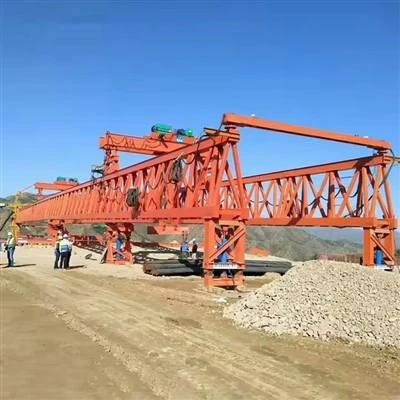
The 120 Ton Bridge Girder Erection Machine (also called 120T Beam Launcher, Bridge Launching Girder, or Girder Erection Crane) is a specialized heavy-duty construction machine used for lifting, transporting, and accurately installing precast concrete bridge girders onto bridge piers. It is widely applied in highway bridges, railway bridges, viaducts, and overpass construction projects.
The machine adopts a self-launching gantry structure, allowing it to move along completed bridge sections and erect new girders efficiently without requiring large ground cranes. It is suitable for precast beams such as T-beams, box girders, I-girders, and concrete segments.

A 120 Ton Bridge Girder Erection Machine provides an efficient and reliable solution for modern bridge construction, improving erection speed, reducing labor requirements, and ensuring accurate placement of heavy precast concrete girders.
A 120 Ton Bridge Girder Erection Machine works by using a combination of steel girder structures, hydraulic systems, lifting trolleys, and traveling mechanisms to lift, transport, and install precast bridge girders safely and accurately.
Key Design Parameters & Performance Specifications
| Parameter | Specification |
|---|---|
| Lifting Capacity (per girder) | 120 Metric Tons |
| Maximum Span (Pier to Pier) | 50 meters (Typical), customizable up to 60m |
| Minimum Curve Radius | 2,000 meters (can be designed for tighter radii) |
| Maximum Supported Grade | ±4% |
| Lifting Hoists | 2 x Main Hoists (typically 120-ton capacity each) |
| Hoist Lifting Speed | 0-5 m/min (variable speed control) |
| Trolley Traversing Speed | 0-10 m/min (variable speed control) |
| Main Beam Launching Speed | 0-5 m/min (variable speed control) |
| Machine Self-Propelling Speed | 0-5 m/min (variable speed control) |
| Control System | Centralized PLC with frequency control for all motions. Remote control operation. |
| Power Supply | 380V / 50Hz / 3 Phase (or as per project requirement) |

Pictures & Components
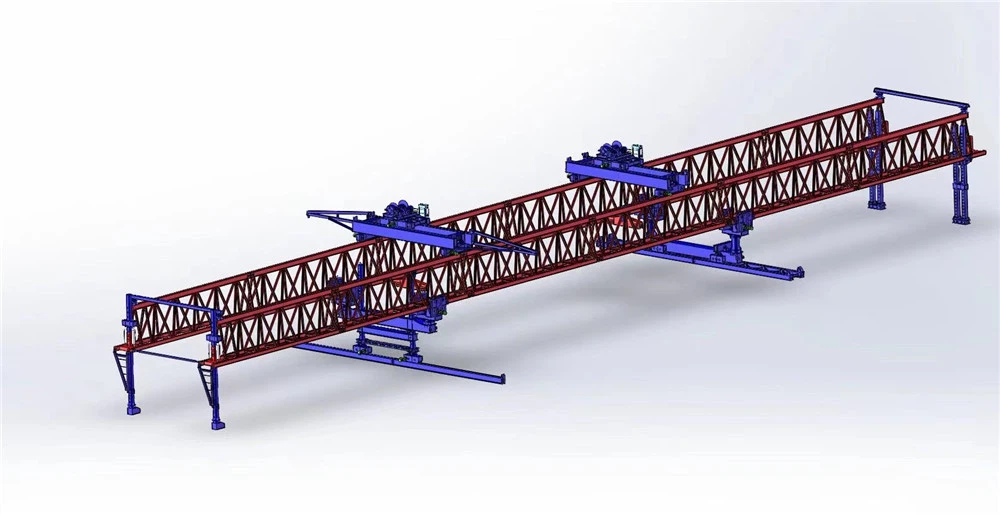
A 120 Ton Bridge Girder Erection Machine consists of several major systems that work together to lift, transport, and install precast concrete bridge girders safely and efficiently.
1. Main Girder Structure
The primary load-bearing structure of the machine.
Usually made of high-strength welded steel truss or box sections.
Supports the lifting trolley and carries the weight of the precast girder.
Designed for high strength, rigidity, and stability during operation.
2. Supporting Legs System
Includes front leg, middle leg, and rear leg.
Functions:
Supports the entire launcher structure on bridge piers.
Transfers lifting loads safely to the bridge foundation.
Provides stability during girder lifting and launching.
Equipped with hydraulic cylinders for adjustment and movement.
3. Lifting Trolley System
Travels along the main girder track.
Equipped with hoisting mechanisms, wire ropes, pulleys, and lifting hooks.
Performs:
Girder lifting
Longitudinal transportation
Precise positioning
4. Hoisting Mechanism
Main components include:
Hoisting motor
Reducer
Winch drum
Wire rope
Pulley block
Hook assembly
Function:
Provides vertical lifting and lowering of bridge girders.
Ensures smooth and controlled lifting operation.
5. Hydraulic System
Includes:
Hydraulic pump station
Hydraulic cylinders
Hydraulic valves
Oil pipelines
Functions:
Controls support leg extension and retraction.
Assists machine launching and span movement.
Provides stable and synchronized operation.
6. Traveling Mechanism
Consists of traveling motors, reducers, wheels, and rails.
Allows movement of:
Lifting trolley along the main girder
Entire launcher between bridge spans
7. Electrical Control System
Includes:
Control cabinet
PLC control system
Frequency converters
Remote control system
Electrical protection devices
Functions:
Controls lifting, traveling, and hydraulic operations.
Provides smooth speed adjustment and safe operation.
8. Bridge Supporting and Anchoring System
Temporary support devices used during launching.
Ensures the machine remains stable while moving to the next span.
Prevents unwanted movement during operation.
9. Safety Protection Devices
Includes:
Overload limiter
Limit switches
Hydraulic locking device
Emergency stop button
Anti-falling protection device
Wind speed monitoring system (optional)
Purpose:
Ensures safe operation under heavy lifting conditions.
10. Girder Lifting Accessories
Includes:
Lifting hooks
Slings
Shackles
Spreader beams (if required)
Function:
Connects the lifting system with precast concrete girders securely.
11. Power Supply System
Electrical power supply unit
Cables and distribution system
Provides energy for motors, controls, and hydraulic equipment.

Sketch

Advantages
1. High Lifting Capacity
Designed for lifting and installing precast concrete girders up to 120 tons.
Suitable for heavy T-beams, box girders, I-girders, and other bridge components.
Provides reliable performance for large-scale bridge construction projects.
2. High Construction Efficiency
Enables continuous span-by-span girder erection without frequent dismantling.
Reduces construction time compared with traditional crane lifting methods.
Improves productivity for highway, railway, and viaduct projects.
3. Self-Launching Capability
The machine can move forward to the next bridge span by itself.
No need for large ground cranes or additional lifting equipment during relocation.
Suitable for long-distance bridge construction.
4. Excellent Safety Performance
Equipped with multiple safety systems, including:
Overload protection
Hydraulic locking devices
Limit switches
Emergency stop system
Anti-falling protection
Ensures stable and safe operation during heavy lifting.
5. Precise Girder Installation
The lifting trolley provides accurate longitudinal movement.
Hydraulic adjustment allows precise positioning of girders on bridge piers.
Improves installation accuracy and reduces adjustment work.
6. Strong Adaptability
Suitable for different bridge structures and construction conditions.
Can be customized for:
Different bridge spans
Various girder types
Straight, curved, or inclined bridge sections (according to design requirements)
7. Reduced Dependence on Ground Conditions
Operates mainly on completed bridge structures.
Suitable for areas with:
Rivers
Mountains
Urban construction zones
Limited access conditions
8. Cost Saving
Reduces the requirement for expensive large-capacity mobile cranes.
Lowers labor requirements and improves construction efficiency.
Provides long-term economic benefits for bridge contractors.
9. Modular Design
Main components can be dismantled into sections for transportation.
Easy assembly, installation, and maintenance.
Convenient for projects in different locations.
10. Reliable Operation and Long Service Life
Made from high-strength steel structures.
Designed for heavy-duty working conditions.
Durable components ensure stable operation over many construction cycles.


Application
The 120 Ton Bridge Girder Erection Machine is widely used for the installation of heavy precast concrete girders in various bridge and infrastructure construction projects. It provides an efficient solution for lifting, transporting, and accurately placing bridge beams.
1. Highway Bridge Construction
Used for erecting precast concrete girders for expressways and highway bridges.
Suitable for long-span bridges requiring heavy beam installation.
Improves construction speed and reduces dependence on large mobile cranes.
2. Railway Bridge Construction
Applied in conventional railway and high-speed railway projects.
Provides accurate placement of railway bridge beams.
Ensures stable and safe erection of heavy precast structures.
3. Urban Viaduct Construction
Used for elevated roads, flyovers, and urban transportation projects.
Suitable for construction areas with limited space and restricted ground access.
Minimizes disruption to traffic and surrounding environments.
4. River Crossing Bridges
Ideal for bridges built over rivers, lakes, and valleys.
Allows girder installation where ground crane access is difficult.
Reduces the need for temporary ground support structures.
5. Mountain and Challenging Terrain Bridges
Suitable for bridge projects in mountainous areas and uneven terrain.
Operates mainly on completed bridge sections instead of relying on ground conditions.
Provides flexibility in remote construction locations.
6. Precast Concrete Girder Installation
Used for installing various types of bridge beams, including:
T-beams
Box girders
I-girders
Precast segmental beams
7. Large Infrastructure Projects
Applicable in:
Highway expansion projects
Railway modernization projects
Large-scale transportation networks
Municipal bridge development projects
8. Special Bridge Structures
Can be customized for:
Long-span bridges
Curved bridges
Inclined bridge sections
Multi-span continuous bridges

Production Procedure
The production of a 120 Ton Bridge Girder Erection Machine involves engineering design, steel structure fabrication, mechanical assembly, electrical installation, testing, and commissioning. Each stage is strictly controlled to ensure safety, reliability, and long service life under heavy lifting conditions.
1. Engineering Design & Technical Review
Confirm project requirements:
Lifting capacity (120 Ton)
Bridge span length
Girder type and dimensions
Working environment
Operating conditions
Perform structural strength calculations and stability analysis.
Prepare detailed manufacturing drawings and production documents.
2. Raw Material Preparation
Select high-quality steel plates, profiles, and structural materials.
Conduct incoming material inspection:
Material specification check
Thickness measurement
Quality certification verification
Prepare materials through:
Cutting
Drilling
Edge preparation
3. Main Structure Fabrication
Main Girder Manufacturing
Steel plates are cut and assembled according to drawings.
Welding is performed using qualified welding procedures.
Weld seams are inspected to ensure structural strength.
Main girder dimensions are checked for accuracy.
Support Legs Manufacturing
Fabricate front, middle, and rear support legs.
Install connection plates, pins, and hydraulic mounting structures.
Perform dimensional inspection after welding.
4. Machining of Components
Manufacture and process key mechanical parts, including:
Wheels
Shafts
Pins
Gear components
Drum assemblies
Pulley blocks
Connection components
Precision machining ensures smooth operation and proper alignment.
5. Surface Treatment
Remove rust and welding residues by shot blasting.
Apply anti-corrosion primer coating.
Apply finishing paint according to customer requirements.
Ensure protection against outdoor construction environments.
6. Mechanical Assembly
Assembly of major systems:
Hoisting System
Install:
Hoisting motor
Reducer
Winch drum
Wire rope
Hook system
Traveling System
Install:
Traveling motors
Gear reducers
Wheels
Rail systems
Hydraulic System
Install:
Hydraulic cylinders
Hydraulic pumps
Valves
Hydraulic pipelines
7. Electrical System Installation
Install:
Control cabinet
PLC control system
Remote control system
Frequency converter (if required)
Safety protection devices
Electrical wiring and insulation tests are performed before operation.
8. Factory Assembly & Inspection
The complete machine is assembled in the factory for inspection.
Inspection items include:
Overall dimensions
Structural alignment
Bolt connections
Hydraulic system pressure
Electrical operation
Traveling mechanism performance
9. Load Testing
Conduct testing according to design requirements:
No-load Test
Check lifting, traveling, and control functions.
Rated Load Test
Test operation with 120 Ton rated load.
Verify:
Lifting stability
Brake performance
Structural deformation
Safety devices
Safety Test
Check:
Overload protection
Limit switches
Emergency stop system
Hydraulic locking system
10. Disassembly & Transportation Preparation
Divide the machine into transportable sections.
Mark components for easy site assembly.
Prepare packing and shipping documents.
11. Site Installation & Commissioning
At the construction site:
Assemble the main structure.
Install hydraulic and electrical systems.
Perform final commissioning.
Train operators on safe operation procedures.


Workshop View
The company has installed an intelligent equipment management platform, and has installed 310 sets (sets) of handling and welding robots. After the completion of the plan, there will be more than 500 sets (sets), and the equipment networking rate will reach 95%. 32 welding lines have been put into use, 50 are planned to be installed, and the automation rate of the entire product line has reached 85%.


Hot Tags: 120 ton bridge girder erection machine, China 120 ton bridge girder erection machine manufacturers, suppliers, factory
You Might Also Like


Send Inquiry