







100 Ton Bridge Girder Erection Machine
The 120 Ton Bridge Girder Erection Machine (also called 120T Beam Launcher, Bridge Launching Girder, or Girder Erection Crane) is a specialized heavy-duty construction machine used for lifting, transporting, and accurately installing precast concrete bridge girders onto bridge piers. It is widely applied in highway bridges, railway bridges, viaducts, and overpass construction projects.
The machine adopts a self-launching gantry structure, allowing it to move along completed bridge sections and erect new girders efficiently without requiring large ground cranes. It is suitable for precast beams such as T-beams, box girders, I-girders, and concrete segments.

📊 Typical Technical Specifications
While exact parameters vary by manufacturer and model, a standard 100-ton machine often falls within these ranges:
| Parameter | Typical Range / Specification |
|---|---|
| Maximum Lifting Capacity | 100 tons |
| Bridge Span (Pier Distance) | ≤ 30 m to 40 m (some models support up to 50 m) |
| Adaptive Longitudinal Slope | ±3% to 5% |
| Adaptive Skew Angle | Up to 45° |
| Total Power | Approximately 65 kW to 96 kW |
⚙️ Key Features & Design
Modern 100-ton erectors are designed for efficiency and safety, incorporating several key technological features:
Structural Design: The main girders are typically box-type structures made of high-strength steel, segmented for easier transport and assembled on-site with pins or high-strength bolts .
Propulsion Method: Many modern models use a step-by-step (walking) propulsion system. This allows the machine to advance without laying temporary tracks on the bridge deck, saving time and cost .
Stability & Counterweight: During the "passing span" phase (moving forward without a load), the machine relies on a carefully calculated counterweight system to prevent tipping. This often involves using the lifting trolleys themselves as counterweights or adding steel plates .
Adaptability: These machines are built to handle challenging terrain. They can navigate curves with a minimum radius of 200-300 meters and adjust to skewed bridge alignments up to 45 degrees .
Control & Safety: Advanced models often feature PLC control systems, variable frequency drives, and safety devices like anemometers, overload protection, and limit switches .


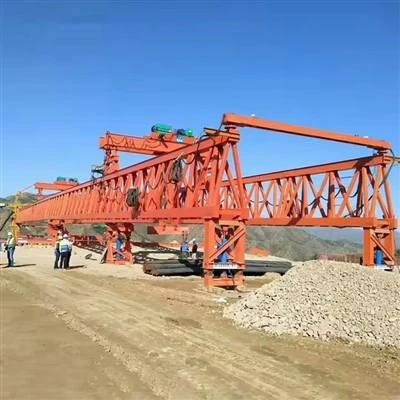
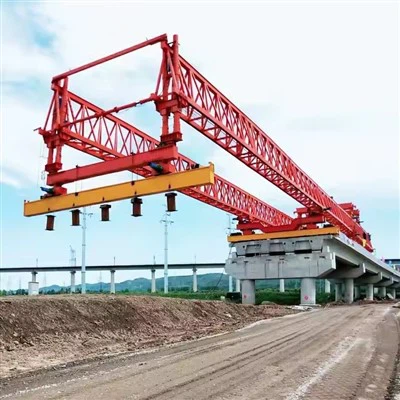
Pictures & Components
A 100-ton bridge girder erection machine is built around four core subsystems that work together to lift, transport, and place heavy precast beams. While designs vary, they all share a common set of functional components.
🏗️ Core Structural Components
These form the machine's skeleton and provide the load-bearing capacity.
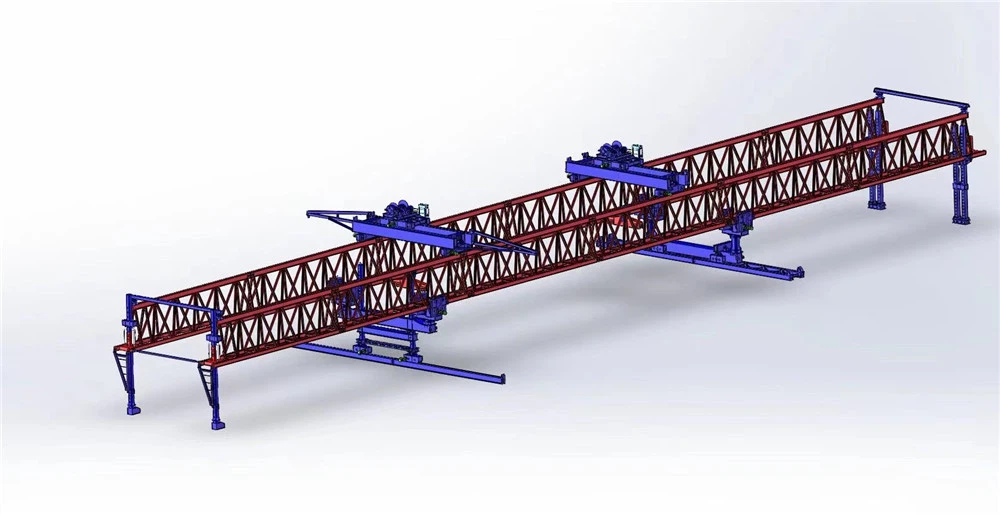
Main Girder (Main Beam): This is the primary load-bearing beam that spans across the bridge piers. It is typically a box-type or truss structure made of high-strength steel, often assembled from multiple segments for easier transport to the site.
Supporting Legs / Columns: These vertical supports hold the main girder aloft. A typical configuration includes:
Front Leg (Front Column): Supports the front of the machine on the next pier.
Middle Legs (Middle Columns): Support the machine on the already-built bridge deck or pier. These often have wheel systems that allow the main girder to slide forward.
Rear Leg (Rear Column): Supports the rear of the machine and often provides the propulsion for the forward "walking" motion.
Cross Beams: These connect multiple main girders together (in double-girder designs) to increase the machine's torsional rigidity and overall stability.
🏗️ Lifting & Trolley System
This is the "business end" of the machine, responsible for actually handling the beam.
Lifting Trolleys / Cranes: Most 100-ton machines are equipped with two independent trolleys that work together to lift a single beam. Each trolley typically has:
Hoisting Mechanism: Consists of winches, wire ropes, and pulley blocks to lift and lower the beam.
Longitudinal Travel: Allows the trolleys to move back and forth along the main girder to transport the beam from the feeding point to its final position.
Transverse Travel: Enables precise side-to-side adjustment for accurate alignment over the piers.
⚙️ Power, Control & Safety Systems
These systems provide the muscle and intelligence to operate the machine safely.
Hydraulic System: Used extensively for height adjustment of the supporting legs (to adapt to slopes and cross-falls) and for operating various locking mechanisms.
Electrical System: Powers the motors, winches, and travel drives. Modern machines often use variable frequency drives (VFDs) for smooth, stepless speed control and precise positioning.
Safety Monitoring System: A critical component for a 100-ton lift. It typically includes overload protection, limit switches, anemometers (wind alarms), anti-collision devices between trolleys, and emergency stop switches.

Sketch

Advantages
🛡️ Superior Safety & Stability
The most significant advantage is safety. Traditional mobile cranes require high lifting heights-sometimes up to 30 meters-which increases the risk of accidents. In contrast, a girder erection machine operates with a much lower lifting height, keeping the load closer to the ground and significantly reducing high-altitude risks . Additionally, these machines are equipped with advanced safety systems, including overload protection, wind speed monitoring, and intelligent deviation correction to ensure stable operation even in windy or complex conditions .
🚀 Higher Efficiency & Speed
Girder erection machines are designed for rapid, continuous work. While a single mobile crane might place a limited number of beams per day, a dedicated machine can double that efficiency. For example, one project reported that using a bridge erector allowed them to install up to 9 box girders per day, compared to just a few with traditional cranes . The process is highly mechanized, with synchronous lifting and precise positioning that streamlines the workflow.
💰 Cost Savings & Reduced Ground Preparation
Using a girder erection machine can lead to substantial cost savings. Mobile cranes often require extensive ground preparation, such as reinforcing the soil along the entire transport route to support the heavy equipment. A bridge erector, however, eliminates the need for this ground treatment entirely. One project estimated this alone saved approximately 108,000 RMB in construction costs . Furthermore, these machines have lower maintenance needs due to their durable, corrosion-resistant steel frameworks .
🏗️ Adaptability to Complex Terrain
Girder erection machines excel in challenging environments where mobile cranes cannot operate. They are capable of navigating small radius curves, steep slopes, and narrow construction sites where there is simply no room for a large crane to set up . This makes them indispensable for projects like mountain highways, urban viaducts, and railway bridges that often feature curved or skewed alignments .
🎯 Precision & Control
Modern 100-ton erectors offer exceptional control. Features like variable frequency drives and micro-movement adjustment allow operators to place heavy beams with millimeter-level accuracy . The dual trolley design enables both synchronous lifting and independent fine-tuning, ensuring the girder is perfectly aligned before it is set down.
In summary, while the initial investment in a specialized erector is higher, its advantages in safety, speed, adaptability, and long-term cost savings make it the preferred choice for large-scale, professional bridge projects.

Application
🛣️ Highway & Railway Bridges
This is the core application. The machine is used to install precast concrete girders for expressways, standard highways, and railway bridges. Its 100-ton capacity is specifically matched to handle typical girder weights for spans between 20 and 40 meters, such as T-beams or small box girders, which are the most common components in medium-span bridge construction.
🚇 Urban Viaducts & Metro Projects
For city infrastructure, these machines are essential for erecting elevated metro lines, light rail tracks, and urban viaducts. They are favored here because they can operate within tight spaces and minimize ground-level disruption, which is crucial in dense urban environments where large mobile cranes would be impractical or disruptive.
🌉 River & Waterway Crossings
A key application is bridging rivers. The machine is often used for cross-river bridges and municipal river crossings where traditional scaffolding on water is impossible or too costly. They use a "walking" or cantilever method to advance across the piers without needing temporary supports in the water, adapting to soft riverbeds and changing water levels.
⛰️ Mountainous & Complex Terrain
The equipment's design allows it to work in challenging topography where cranes cannot operate. It is well-suited for mountain highway slopes, small-radius curves, and steep gradients. Its ability to handle longitudinal slopes up to ±3% and tight curves makes it a preferred choice for infrastructure projects in rugged areas.
🚄 High-Speed Rail (HSR) Infrastructure
100-ton erectors are used in the construction of high-speed rail lines (250km/h to 350km/h) for erecting the heavy, prestressed concrete box girders that form the rail bed. The precision alignment required for high-speed tracks is a key driver for using these specialized machines.
🧩 Segmental & Prefabricated Construction
The machine supports modern prefabricated bridge methods. It can be configured as a segmental erection machine to assemble bridge spans piece-by-piece like "building blocks," which is useful for projects aiming to reduce on-site construction time and environmental impact. This method is particularly valuable in environmentally sensitive or residential areas where dust and noise must be minimized.
In summary, the 100-ton class is a versatile "sweet spot" machine. It is heavy enough to handle the standard girders of most medium-span bridges (highways, railways, metros) but light and flexible enough to navigate the tight curves and soft ground found in river, mountain, and urban projects.

Production Procedure
The production procedure for a 100-ton bridge girder erection machine generally involves two distinct phases: workshop manufacturing of the steel components and site assembly of the complete machine. While exact steps vary by manufacturer and model, the following represents a typical industry workflow.
🏭 Workshop Manufacturing of Steel Components
The main girders, legs, and guide beams are fabricated in a factory setting before being shipped to the construction site.
Material Preparation & Pretreatment
The process begins with selecting steel plates, H-beams, and side plates. All materials undergo rigorous pretreatment: surface and internal defects (rust, scars, slag inclusions) are checked and removed. The steel is then corrected for deformation, shot-blasted for rust removal, and primed with a protective coating .
Fabrication of Main Girders and Chord Members
For the main load-bearing components, side plates are welded to the two sides of an H-beam to form a square tube structure. Welding slag is cleaned, and weld quality is inspected. These tubes are then placed in a CNC machining center to drill pin holes according to drawings. A connecting plate is inserted into one end of the tube and secured with a pin, forming a complete "chord member" .
Assembly of Truss Structures
Three chord members are arranged to form a truss: one as the upper chord and two as the lower chords, creating an isosceles triangle cross-section. Using specialized assembly tooling (组体工装), the chords are precisely positioned. Gusset plates are welded at intervals along the chords, and web members are welded between them. After welding, the guide beam undergoes self-inspection, steel stamping, and specialized inspection .
Welding of High-Strength Steel (Advanced Models)
For modern machines using high-strength steel like GT785D, welding requires specialized procedures. This includes preheating to 100-150°C, using uniform electric heating, post-weld hydrogen elimination at 200-250°C for 2 hours, and strict production controls to prevent cracking .
Girder Overturning (For Large Components)
Large main girders (which can weigh up to 205 tons for certain models) require flipping during production. A specialized girder overturn tool is used-a disc-shaped base with a rectangular opening that fits over the girder end. A purlin car pulls the girder through the opening to complete the flip, avoiding the high cost and safety hazards of using multiple large truck cranes .
🔧 On-Site Assembly Procedure
Once components are transported to the construction site, they are assembled into the complete machine. The following procedure is based on a documented JQ900A assembly process .
Positioning the Main Girders
A transport vehicle with a carrying bracket is positioned. The left and right main girders are lifted one at a time using two 70-ton cranes. Critical contact points between the main girders and the bracket are marked in advance to ensure precise placement. After both girders are placed, the spacing between them is measured at front, middle, and rear positions-specifically, the distance between inner rail edges must be maintained at 9m ± 0.01m .
Connecting the Girders
Cross beams and lattice frames are installed between the two main girders to form a rigid, integrated structure. A 9-meter angle steel may be welded between the girders to maintain stable spacing. Measurements are repeated to verify alignment .
Installing Legs and Trolleys
The upper section of the No. 2 column is installed at the middle of the transport vehicle, supported by stacked sleepers. The lifting trolleys are then installed between the two main girders. The carrying bracket is raised to a high position (approximately 10 meters above ground) .
Installing Remaining Legs and Systems
The No. 3 column (rear) and No. 1 column (front) are installed sequentially at the head and tail of the transport vehicle. Electrical and hydraulic systems are installed, along with ladders, railings, and walkways. Finally, the lower section of the No. 2 column is installed, and the machine undergoes debugging and type testing before being put into service .


Workshop View
The company has installed an intelligent equipment management platform, and has installed 310 sets (sets) of handling and welding robots. After the completion of the plan, there will be more than 500 sets (sets), and the equipment networking rate will reach 95%. 32 welding lines have been put into use, 50 are planned to be installed, and the automation rate of the entire product line has reached 85%.


Hot Tags: 100 ton bridge girder erection machine, China 100 ton bridge girder erection machine manufacturers, suppliers, factory
You Might Also Like



Send Inquiry