










120T 30m Self-balancing Bridge Launching Girder
A 120T 30m Self-Balancing Bridge Launching Girder is a specialized bridge erection machine designed for the installation of precast concrete girders in highway and viaduct construction. It is engineered with a self-balancing structural system that ensures stability during lifting, transporting, and placing heavy bridge segments without the need for excessive external counterweights.
This equipment is widely used for medium-span bridge projects where safe, efficient, and precise girder installation is required.

Main Features
Self-balancing design reduces reliance on large counterweights
High structural rigidity for stable girder launching
Hydraulic lifting system ensures smooth and controlled operations
Precise beam positioning for accurate bridge alignment
Modular structure for easy transport and assembly
Front launching nose reduces bending stress during span crossing
Integrated safety systems including overload and anti-tilt protection
Efficient span-by-span construction capability
Key Design Parameters & Performance Specifications
| Parameter | Specification |
|---|---|
| Lifting Capacity (per girder) | 120 Metric Tons |
| Maximum Span (Pier to Pier) | 50 meters (Typical), customizable up to 60m |
| Minimum Curve Radius | 2,000 meters (can be designed for tighter radii) |
| Maximum Supported Grade | ±4% |
| Lifting Hoists | 2 x Main Hoists (typically 120-ton capacity each) |
| Hoist Lifting Speed | 0-5 m/min (variable speed control) |
| Trolley Traversing Speed | 0-10 m/min (variable speed control) |
| Main Beam Launching Speed | 0-5 m/min (variable speed control) |
| Machine Self-Propelling Speed | 0-5 m/min (variable speed control) |
| Control System | Centralized PLC with frequency control for all motions. Remote control operation. |
| Power Supply | 380V / 50Hz / 3 Phase (or as per project requirement) |

Pictures & Components
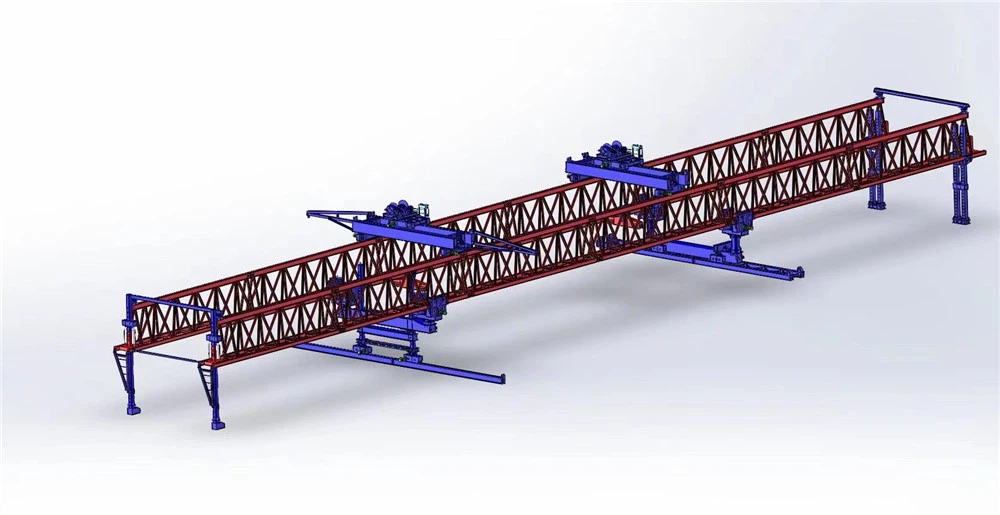
Components of a 120T 30m Self-Balancing Bridge Launching Girder
A 120T 30m Self-Balancing Bridge Launching Girder is made up of several integrated structural, mechanical, hydraulic, and electrical systems that work together to safely lift, move, and install precast bridge girders.
1. Main Girder Structure
High-strength steel box girder or truss structure
Primary load-bearing component of the system
Designed for 120T lifting capacity and 30m span operation
Ensures overall rigidity and stability during launching
2. Self-Balancing System
Integrated load distribution mechanism
Eliminates or reduces the need for large external counterweights
Maintains equilibrium during lifting and forward movement
Enhances safety and structural efficiency
3. Launching Nose (Front Cantilever Beam)
Extendable front section of the girder
Reduces bending moment when crossing spans
Assists in smooth transition between bridge piers
4. Hydraulic Lifting System
Hydraulic cylinders, pumps, and pipelines
Used for lifting, lowering, and fine adjustment of girders
Provides smooth and controlled operation under heavy loads
5. Longitudinal Traveling System
Rail-based or wheel-based movement system
Moves the entire launching girder forward span-by-span
Powered by hydraulic motors or winch systems
6. Transverse Adjustment System
Side-shifting mechanism for precise alignment
Ensures accurate positioning of precast girders on bridge piers
Allows fine adjustments during installation
7. Support Legs / Temporary Pier Supports
Front and rear support towers
Transfer loads safely to bridge piers during operation
Adjustable height for different construction stages
8. Lifting Winch System
Steel wire rope winches for girder handling
Assists in lifting and positioning heavy precast beams
Provides additional control during installation
9. Electrical Control System
Central PLC control cabinet
Operator control console with real-time monitoring
Controls hydraulic, movement, and safety functions
10. Safety Protection System
Overload protection devices
Anti-tilt and stability sensors
Emergency stop and braking system
Limit switches for travel and lifting control
11. Walkways and Maintenance Platforms
Operator access platforms along the structure
Equipped with guardrails and ladders
Used for inspection and maintenance operations

Sketch

Advantages
Advantages of a 120T 30m Self-Balancing Bridge Launching Girder
High Load Capacity (120T Capability)
Designed to safely handle heavy precast girders, including large box girders and T-beams used in highway bridge construction.
Self-Balancing Structure
The built-in balancing system reduces or eliminates the need for large external counterweights, improving stability and simplifying operation.
Efficient 30m Span Construction
Optimized for 30-meter spans, enabling smooth and continuous bridge erection in medium-span highway projects.
Improved Construction Safety
Equipped with overload protection, anti-tilt systems, hydraulic locking, and emergency stop functions to ensure safe operation at all stages.
High Precision Girder Placement
Hydraulic and control systems allow accurate alignment and positioning of precast beams on bridge piers.
Reduced Construction Time
Supports span-by-span erection, significantly speeding up bridge construction compared to conventional methods.
Lower Ground Dependency
Minimizes the need for temporary scaffolding or large cranes, making it suitable for rivers, valleys, and elevated terrains.
Strong Adaptability
Can be used in various environments such as urban highways, mountainous regions, and cross-water bridge projects.
Modular and Easy Installation
Designed with modular components for easier transportation, assembly, and disassembly at different job sites.
Cost-Effective Operation
Reduces labor, equipment rental, and temporary support structure costs, improving overall project economics.
Reliable Hydraulic System Performance
Ensures smooth lifting, lowering, and movement with stable and controlled operations.
Enhanced Operational Efficiency
Allows continuous construction workflow with minimal downtime between spans.

Application
Applications of a 120T 30m Self-Balancing Bridge Launching Girder
A 120T 30m Self-Balancing Bridge Launching Girder is mainly used in highway and infrastructure projects where precast bridge girders need to be safely installed over medium spans with high precision and efficiency.
1. Highway Bridge Construction
Installation of precast box girders and T-beams
Suitable for expressways and national highway bridge projects
Supports span-by-span erection methods
2. Elevated Viaduct Projects
Construction of urban elevated road systems
Used in interchange ramps and flyover structures
Ideal for continuous bridge sections in cities
3. River and Water Crossing Bridges
Bridge erection across rivers, canals, and reservoirs
Reduces the need for ground-based cranes or scaffolding
Ensures safe construction over water bodies
4. Mountainous and Difficult Terrain Projects
Suitable for valleys, hills, and uneven ground conditions
Enables bridge construction in areas with limited site access
Minimizes environmental disturbance
5. Urban Infrastructure Development
Overpasses and road interchanges in dense city areas
Used where space constraints limit conventional lifting equipment
Supports rapid urban transport network expansion
6. Large-Scale Transportation Projects
Part of national highway expansion and expressway networks
Used in long-distance corridor bridge construction
Supports standardized precast girder installation systems
Suitable Working Conditions
Medium-span bridge projects (around 30m spans)
Areas with limited ground support access
Projects requiring repetitive span erection
Sites with strict safety and environmental constraints
Summary
The 120T 30m self-balancing launching girder is widely used in modern bridge construction projects requiring efficiency, safety, and precision, especially where conventional cranes or scaffolding methods are not practical.

Production Procedure
Production Procedure of a 120T 30m Self-Balancing Bridge Launching Girder
The manufacturing of a 120T 30m Self-Balancing Bridge Launching Girder involves precise engineering, heavy steel fabrication, hydraulic integration, and rigorous testing to ensure safe performance in bridge construction.
1. Design & Engineering
Structural design based on 120T load capacity and 30m span requirement
Finite Element Analysis (FEA) for strength, deflection, and stability verification
Design of self-balancing mechanism and load distribution system
Preparation of detailed fabrication drawings and assembly plans
2. Material Selection & Preparation
Procurement of high-strength structural steel (Q355 or higher grade)
Inspection and certification of raw materials
CNC cutting of steel plates and profiles
Preparation of components for main girder, supports, and auxiliary structures
3. Main Structure Fabrication
Assembly and welding of main box girder or truss structure
Manufacturing of launching nose and extension sections
Reinforcement of high-stress connection areas
Non-destructive testing (ultrasonic/radiographic) of welds
4. Self-Balancing System Assembly
Installation of balancing beams and load distribution components
Integration of counterbalance adjustment mechanisms (if required)
Calibration of load-sharing structure for stability during operation
5. Hydraulic System Installation
Installation of hydraulic cylinders, pumps, and pipelines
Setup of lifting, lowering, and adjustment systems
Pressure testing of hydraulic circuits
Synchronization testing of multi-cylinder operations
6. Mechanical Systems Assembly
Installation of longitudinal traveling system (rails/wheels)
Assembly of transverse adjustment mechanisms
Installation of winch and steel wire rope systems
Fitting of support legs and temporary piers
7. Electrical & Control System Integration
Installation of PLC control cabinet and operator console
Wiring of sensors, switches, and safety interlocks
Programming of control logic for synchronized operation
Integration of monitoring and alarm systems
8. Surface Treatment & Painting
Sandblasting for rust removal and surface cleaning
Application of anti-corrosion primer coating
Final protective paint coating for outdoor durability
Component labeling and identification marking
9. Factory Assembly & Testing
Full or partial pre-assembly in factory environment
No-load and load testing of lifting and traveling systems
Verification of self-balancing performance
Safety system checks (overload, tilt protection, emergency stop)
10. Disassembly & Transportation
Systematic disassembly into transportable modules
Packaging of hydraulic, electrical, and mechanical components
Secure loading for road or sea transportation
11. On-Site Installation & Commissioning
Reassembly at construction site
Alignment and calibration of girder system
Trial operation under no-load and test-load conditions
Final safety inspection and approval before use
Summary
The production process ensures the 120T 30m self-balancing bridge launching girder is strong, precise, and safe, capable of performing reliable and efficient girder erection in demanding highway and infrastructure construction projects.


Workshop View
The company has installed an intelligent equipment management platform, and has installed 310 sets (sets) of handling and welding robots. After the completion of the plan, there will be more than 500 sets (sets), and the equipment networking rate will reach 95%. 32 welding lines have been put into use, 50 are planned to be installed, and the automation rate of the entire product line has reached 85%.


Hot Tags: 120t 30m self-balancing bridge launching girder, China 120t 30m self-balancing bridge launching girder manufacturers, suppliers, factory
You Might Also Like


Send Inquiry