










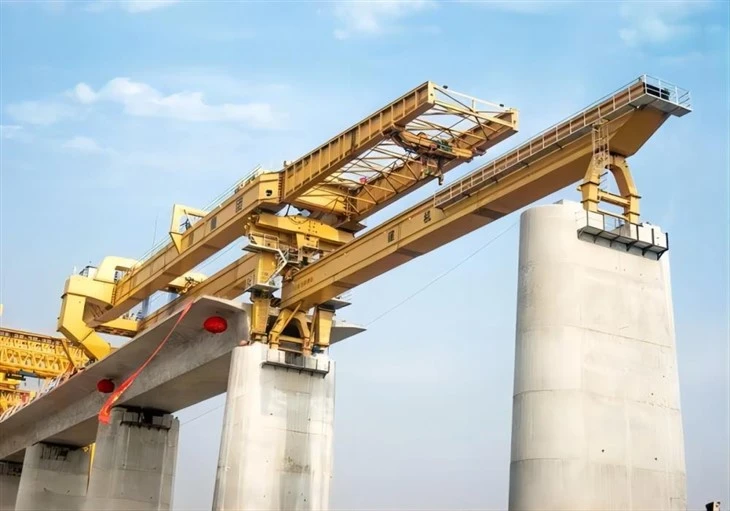

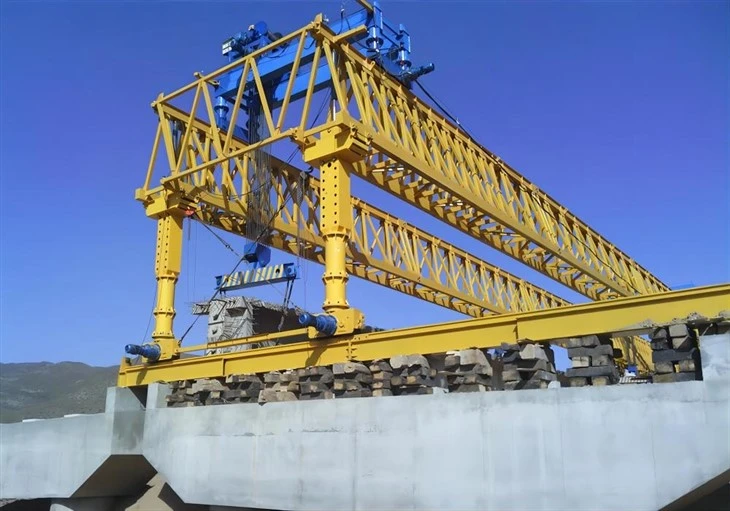

Bridge Beam Erection Crane
Designed to transform the way bridges are built, our Bridge Beam Erection Crane represents a leap forward in construction technology. With a meticulous focus on performance, adaptability, and worker well-being, this crane is poised to redefine industry standards and raise the bar for construction excellence.

Key Features
1. Precision Engineering: Our Bridge Beam Erection Crane is engineered with precision at its core. Its state-of-the-art control systems ensure unparalleled accuracy during the beam placement process, minimizing the need for adjustments and rework.
2. Effortless Adaptability: No two bridge projects are the same. That's why our crane boasts a modular design that allows for easy configuration and adaptation to various bridge geometries and load requirements. From short spans to lengthy viaducts, this crane is your versatile partner.
3. Safety Redefined: Safety remains our top priority. Equipped with cutting-edge safety features such as real-time monitoring, anti-collision technology, and operator assistance systems, our crane safeguards the well-being of both the construction team and the structure itself.
4. Swift Assembly: Time is of the essence in construction. Our Bridge Beam Erection Crane is designed for swift assembly and disassembly, reducing downtime and expediting project timelines.
5. Environmental Efficiency: Embracing sustainable practices, our crane incorporates energy-efficient components and materials, minimizing its carbon footprint without compromising on performance.
6. Operator Comfort: A comfortable operator is a productive operator. The crane's ergonomic cabin design, intuitive controls, and panoramic visibility ensure that operators can carry out their tasks with utmost efficiency and comfort.
Specification
1. Lifting capacity: 160 tons (excluding spreader weight)
2. Self-weight of the bridge erecting machine: 118 tons (maximum weight of a single piece: 7t)
3. Wind resistance
No-load walking state: 8 level
No-load anchoring state: 12 grades
Lifting state with full load: Level 7
4. Lifting speed: full load: 0~1.0/min
No load: 0~1.5 m/min
5. Luffing speed: 0~0.6 m/min (with load luffing)
6. Working range: Rmin=7m Rmax=12m
7. The walking mode of the whole machine: walking type (the oil cylinder is pushed up, and there is no load during the walking process)
8. Traveling speed of the whole machine: The whole movement is 15m , including the anchoring disassembly, reversing the track, and positioning, the whole process takes no more than 2 hours.
9. No-load climbing ability of the whole machine: ±3.5°
10. Lifting height: 65m below the bridge deck, 1m above the bridge
11. Front and rear anchoring distance: 18m (16m, 19.5m)
12. The distance between the left and right support points during work: outside 10.5m, inside 5.7m
Distance between front and rear support points: 16.85m
13. Lifting deflection angle: horizontal bridge direction 1.5 degrees, longitudinal bridge direction 3.5 degrees
14. Spreader leveling performance: With vertical and horizontal leveling functions
15. The installed capacity of the whole machine: 110Kw
16. Stability factor of the whole machine: meets the requirements of GB3811-83 ( various working conditions∑M>0 )
17. Product features and advantages: Double-width and two-way beam erection, step-by-step walking, counterweight cross-span, front and rear outriggers are equipped with hydraulic systems, outriggers can be adjusted by 0.8-1 meters, the main beam can be adjusted, and 45-degree inclined beams can be erected, etc.


Pictures & Components
A Bridge Beam Erection Crane is a complex piece of heavy machinery composed of various components that work together to lift, transport, and position bridge beams during construction. Here are the main components typically found in a Bridge Beam Erection Crane:
1. Main Girder: The main girder forms the primary horizontal structural component of the crane. It provides the framework along which the trolley and hoisting mechanisms move. The main girder's design determines the crane's lifting capacity and span.
2. Hoist Mechanism: The hoist mechanism is responsible for lifting and lowering the bridge beams. It consists of a motor, gearbox, drum, wire rope, and hook. The hoist's lifting capacity and speed are critical factors in the crane's performance.
3. Trolley Mechanism: The trolley mechanism moves horizontally along the main girder, allowing the crane to position the load accurately. It typically contains a motor, gearbox, and wheels to facilitate smooth movement.
4. End Carriages: These are located at the ends of the main girder and support the entire crane structure. End carriages include wheels that run on rails attached to the bridge's support structure.
5. Operator's Cabin: The operator's cabin is where the crane operator controls and monitors the crane's movements. It's equipped with controls, instruments, safety features, and often offers good visibility to ensure precise operation.
6. Electrical and Control System: Modern Bridge Beam Erection Cranes are equipped with advanced electrical and control systems. These systems include motor controls, safety features, anti-collision technology, load monitoring, and user interfaces for the operator.
7. Power Supply System: Cranes require a power supply to operate. Depending on the site's conditions, the power supply can be from electricity grids, diesel generators, or other sources.
8. Counterweights: Counterweights are used to balance the crane's load and prevent it from tipping over when lifting heavy objects. They are strategically positioned on the crane structure.
9. Hydraulic System (if applicable): Some cranes may include hydraulic systems for specific functions such as beam alignment or fine-tuned adjustments during the installation process.

Sketch


Advantages
A Bridge Beam Erection Crane offers a range of advantages that contribute to increased efficiency, safety, and precision during the construction of bridges and other elevated structures.
1. Increased Efficiency: Bridge Beam Erection Cranes streamline the process of lifting, transporting, and placing heavy bridge beams into position. This efficiency reduces construction timelines, allowing projects to be completed faster.
2. Accurate Beam Placement: The precision controls and mechanisms of the crane enable accurate placement of bridge beams. This accuracy ensures that beams fit seamlessly into the structure, minimizing the need for adjustments and rework.
3. Versatility: Bridge Beam Erection Cranes are designed to accommodate various types of bridge configurations, including different beam lengths, widths, and weights. Their adaptability makes them suitable for a wide range of bridge construction projects.
4. Enhanced Safety: Safety features such as anti-collision systems, load monitoring, and stability controls contribute to a safer work environment. These features help prevent accidents, protect workers, and safeguard the structural integrity of the bridge.
5. Reduced Manual Labor: Traditional methods of beam placement often involve significant manual labor. By using a Bridge Beam Erection Crane, the need for heavy manual lifting and positioning is minimized, reducing physical strain on workers.
6. Optimized Resource Allocation: The crane's lifting capacity allows for larger and heavier beams to be used in bridge construction. This can lead to optimized structural design and resource allocation, potentially resulting in cost savings.
7. Quick Assembly and Disassembly: Bridge Beam Erection Cranes are designed for easy setup and dismantling. This agility translates to reduced downtime during construction and efficient utilization of resources.
8. Operator Comfort and Control: The operator's cabin is designed with ergonomic controls and good visibility, ensuring that operators can work comfortably and make precise adjustments during the beam placement process.
9. Adaptation to Challenging Conditions: Bridge Beam Erection Cranes can be designed to operate in various environmental conditions, including rugged terrains, high winds, and limited space. This adaptability ensures that construction projects can proceed under challenging circumstances.
10. Consistency in Construction: The consistent and controlled movement of the crane contributes to uniformity in beam placement, resulting in a more stable and structurally sound bridge.

Application
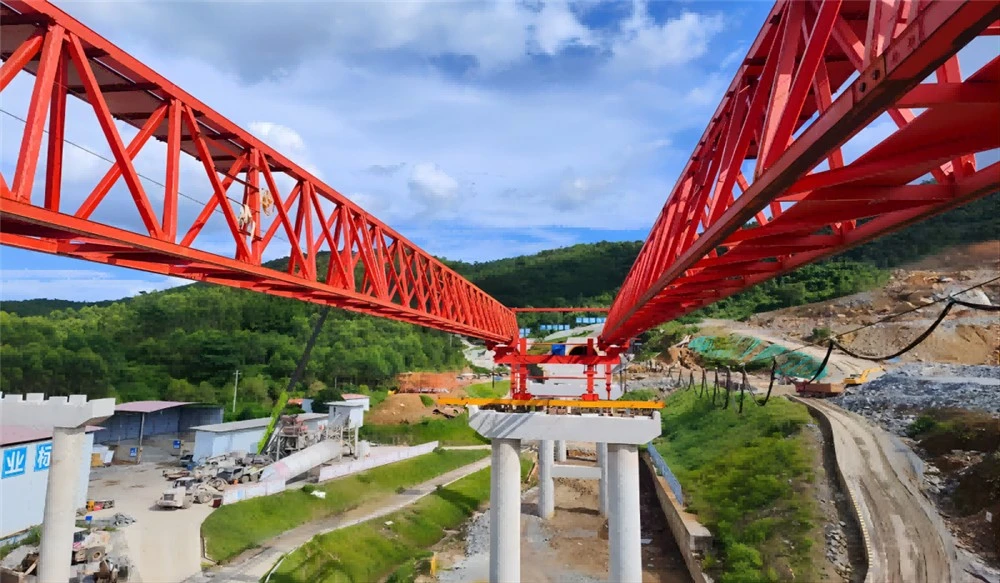
A Bridge Beam Erection Crane plays a vital role in the construction of various types of bridges and elevated structures. Its primary application is to lift, transport, and accurately position heavy bridge beams or girders during the construction process.
1. Highway Bridges: Bridge Beam Erection Cranes are extensively used in the construction of highway bridges and overpasses. They help lift and place precast concrete or steel beams that form the main load-bearing elements of the bridge's superstructure.
2. Railway Bridges: Similar to highway bridges, railway bridges require the precise installation of large and heavy beams to support the railway tracks. Bridge Beam Erection Cranes ensure accurate alignment and placement of these beams.
3. Pedestrian Bridges: Pedestrian walkways and footbridges often use precast beams that need to be carefully positioned. Bridge Beam Erection Cranes ensure the safe and efficient installation of these beams for pedestrian access.
4. Viaducts: Viaducts are elevated structures that carry roads, railways, or other transportation routes over valleys, rivers, or other obstacles. Bridge Beam Erection Cranes are essential for assembling the components of these complex structures.
5. Flyovers and Interchanges: In urban areas with complex traffic networks, flyovers and interchanges require specialized bridge construction techniques. Bridge Beam Erection Cranes are used to lift and place beams that create these elevated roadways.
6. Industrial Facilities: Bridge Beam Erection Cranes find applications in the construction of industrial facilities where overhead cranes are needed for material handling, such as moving heavy machinery and equipment within large manufacturing plants or warehouses.
7. Port Infrastructure: Cranes used in port facilities can also serve as Bridge Beam Erection Cranes when constructing structures like port bridges, loading ramps, and other elevated port infrastructure.
8. Emergency Replacements and Repairs: In cases where a bridge needs emergency replacement or repair due to structural damage, a Bridge Beam Erection Crane can expedite the process by efficiently lifting and placing new beams.
9. Retrofitting and Expansion: When existing bridges require retrofitting or expansion, Bridge Beam Erection Cranes facilitate the addition of new structural elements with minimal disruption to traffic flow.
10. Complex Architectural Designs: Bridges with unique architectural designs often involve intricate beam placements. A Bridge Beam Erection Crane's precision ensures that these complex designs are accurately realized.
Production Procedure
The production procedure for a Bridge Beam Erection Crane involves several stages, from design and manufacturing to assembly and testing. Below is an overview of the typical production process for a Bridge Beam Erection Crane:
1. Design and Engineering:
- Detailed engineering and design are conducted based on project requirements, including load capacity, span length, beam types, and environmental conditions.
- Structural calculations, 3D modeling, and simulations are performed to ensure the crane's integrity and functionality.
2. Component Fabrication:
- Raw materials such as steel beams, plates, and other structural elements are sourced.
- Various components are fabricated, including the main girder, end carriages, trolley, operator's cabin, hoisting mechanisms, electrical panels, and safety features.
3. Machining and Finishing:
- Components undergo machining processes like cutting, drilling, welding, and surface finishing to meet design specifications.
- Paint or protective coatings are applied to prevent corrosion and enhance aesthetics.
4. Assembly:
- The main girder is assembled by connecting fabricated sections.
- End carriages, trolley mechanisms, and hoist systems are attached to the main girder.
- Operator's cabin, electrical panels, control systems, and safety features are integrated.
5. Quality Control and Inspection:
- Rigorous quality control checks are conducted at each assembly stage to ensure components meet standards.
- Non-destructive testing, dimensional accuracy checks, and weld quality inspections are performed.
6. Electrical and Control System Installation:
- Electrical wiring, motor connections, sensors, and control panels are installed and connected.
- Safety features such as limit switches, emergency stop buttons, and load sensors are integrated.
7. Testing and Commissioning:
- Functional tests are conducted to verify the crane's movement, lifting, and control systems.
- Load tests are performed to ensure the crane's lifting capacity meets design specifications.
- Operational and safety tests, including emergency shutdown simulations, are carried out.
8. Operator Training:
- Crane operators and maintenance personnel are trained on the crane's operation, controls, safety protocols, and maintenance procedures.
9. Shipping and Transportation:
- The assembled crane is disassembled if necessary, and components are securely packaged for transportation to the construction site.
- Careful planning ensures the safe and timely delivery of all crane components.
10. On-Site Assembly:
- The crane components are transported to the construction site.
- A team of skilled technicians assembles the crane according to the manufacturer's guidelines.
11. Final Testing and Certification:
- The crane undergoes final tests and adjustments on-site to ensure it functions as intended.
- Government regulations and industry standards are followed, and the crane is certified for safe operation.

Workshop View
The company has installed an intelligent equipment management platform, and has installed 310 sets (sets) of handling and welding robots. After the completion of the plan, there will be more than 500 sets (sets), and the equipment networking rate will reach 95%. 32 welding lines have been put into use, 50 are planned to be installed, and the automation rate of the entire product line has reached 85%.


Hot Tags: bridge beam erection crane, China bridge beam erection crane manufacturers, suppliers, factory
You Might Also Like


Send Inquiry