








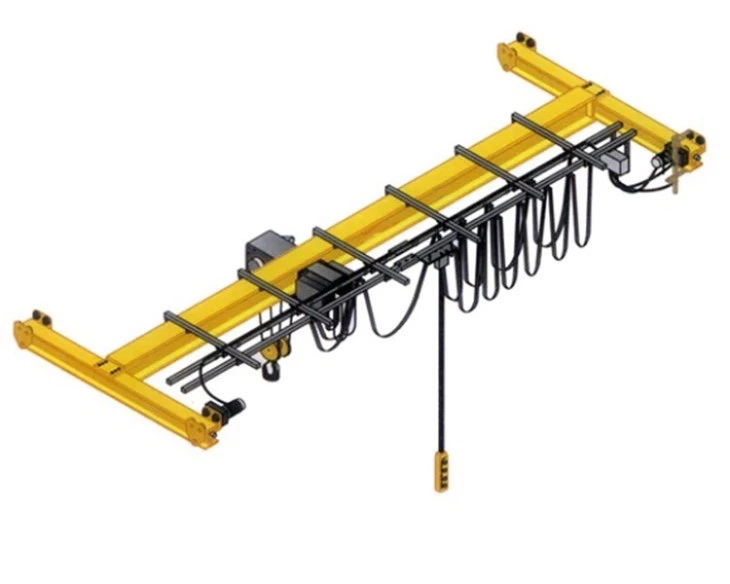


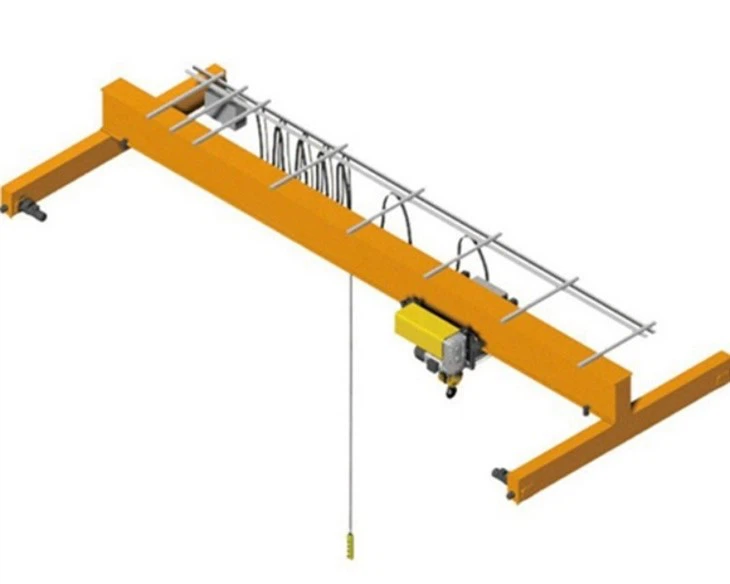

Engine Equipped Bridge Crane
Products Description
1. Structure:
Single Girder Design: The crane features a single horizontal girder or beam that supports the load. This design makes the crane lighter and more cost-effective while still being capable of lifting heavy items.
Engine-Equipped: This crane type is equipped with a motorized drive system that ensures smooth movement and lifting operations. It typically includes a powerful electric motor for controlling the hoist, trolley, and bridge motion.
Bridge Structure: The crane is mounted on a pair of rails or tracks, running along the length of the building. The bridge provides horizontal movement, allowing the crane to cover the entire working area.
Hoisting Mechanism: The hoist, which is powered by the engine, is used to raise and lower the load. It can be attached to a trolley system that moves along the bridge beam.
2. Key Components:
Hoist: A lifting mechanism used for raising or lowering the load, typically powered by electric motors.
Trolley: The trolley moves along the girder or beam and carries the hoist across the crane's span.
Bridge: The bridge is the main supporting framework that spans the building or workspace and allows the crane to travel back and forth.
End Trucks: Mounted at the ends of the crane bridge, these trucks facilitate the horizontal movement of the entire crane assembly.
Engine (Motor): Powers the crane's movement and lifting capabilities, ensuring consistent and reliable operation.
Core Components: Gearbox, Motor, Gear
Place of Origin: Henan, China
Warranty: 1 Year
Weight (KG): 10000 kg
Video outgoing-inspection: Provided
Machinery Test Report: Provided
Selling Units: Single item
Single package size: 600X300X300 cm
Single gross weight: 200.000 kg
Pictures & Components
1.Main beam
1)Material: The main beam is typically made of high-strength steel or other durable materials, ensuring that it can handle the weight of the crane, the load, and operational stresses.
2)Shape: The beam is usually I-beam or box-shaped for enhanced strength and durability. The I-beam is a common choice because of its ability to handle both vertical and lateral loads effectively.
3)Single Girder Configuration: In a single girder crane, the main beam runs across the width of the crane and supports the trolley and hoist mechanism. The simplicity of this design makes it more cost-effective while still capable of handling moderate to heavy loads.
2.Lifting System
Key Components of the Lifting System:
1)Hoist:
The hoist is the core component of the lifting system. It is used to lift and lower the load by moving vertically along the crane's main beam (girder).
Hoist Types:
Electric Hoists: These are the most common, powered by electric motors to lift loads with precision.
Manual Hoists: In some cases, manual hoists are used for smaller loads, although electric hoists are preferred for heavier applications.
Lifting Speed Control: Most hoists allow for speed adjustments to provide smooth lifting and lowering operations.
2)Trolley:
The trolley carries the hoist and moves along the main beam (girder) horizontally, positioning the hoist over the load.
Powered by the crane's motor, the trolley moves the hoist across the length of the bridge to move the load horizontally.
3)Motor:
The motor powers the hoist, trolley, and sometimes the bridge itself (depending on the design). The motor used for the lifting system is typically an electric motor.
The motor controls the lifting (vertical movement) and travelling (horizontal movement) motions.
Variable Frequency Drives (VFDs): Some cranes use VFDs to control the speed and torque of the motor for smooth operation and energy efficiency.
4)Chain or Wire Rope:
The hoist is typically powered by a chain or wire rope, which is wound around a drum or pulley.
Chain Hoists: In some cranes, the lifting system uses chains for lifting heavy loads. The chain is more suitable for low-headroom applications.
Wire Rope Hoists: For heavier lifting capacities, wire ropes are often used, as they provide higher tensile strength and are more durable for industrial-grade lifting.
The rope or chain is connected to the load, and as it moves through the hoist mechanism, it raises or lowers the load.
 |
 |
3.End carriage
1)Movement Along the Runway:
The primary function of the end carriage is to enable the crane to travel along the building's runway or rails. The wheels on the end carriage allow the crane to move horizontally, which is essential for positioning the load at different points within the workspace.
The end carriage wheels roll on the rails or tracks that are usually fixed to the ceiling or floor, guiding the crane in its intended path.
2)Support for the Crane Bridge:
The end carriage supports the bridge (main beam) of the crane, which is where the hoist and trolley are mounted. The crane's weight is distributed across both end carriages, ensuring stability and reducing the risk of structural strain.
3)Load Distribution:
The end carriage plays a vital role in distributing the load from the bridge across the tracks and ultimately to the supporting building structure. It helps in maintaining balance and stability during crane operation, especially when lifting heavy loads.
 |
 |
4.Crane travelling mechanism
The crane traveling mechanism of a single girder engine-equipped bridge crane is designed to move the crane horizontally along the tracks to position loads accurately across the workspace. It consists of components such as end carriages, wheels, tracks, and a motorized drive system (or manual operation in some cases). The system is controlled by a control panel or remote and incorporates safety features like limit switches, anti-sway technology, and braking systems to ensure safe and efficient operation. Regular maintenance of the wheels, tracks, and motor components is essential to keep the traveling mechanism functioning smoothly.
5.Trolley travelling mechanism
The trolley traveling mechanism of a single girder engine-equipped bridge crane allows for the horizontal movement of the hoist across the crane's main girder. This movement is facilitated by components such as the trolley, wheels, rails, and motorized or manual drive systems. Motorized systems provide smooth and precise control, while manual systems are used for simpler or smaller applications. Safety features like limit switches, overload protection, and emergency stop buttons ensure safe operation. Regular maintenance of the trolley system, including inspections and lubrication, is essential for ensuring smooth, efficient, and safe crane operation.
6.Crane wheel
Purpose of the Crane Wheel:
1)The crane wheels are mounted on the end carriages (also called end trucks) and allow the crane to travel smoothly along the tracks or rails.
2)These wheels support the weight of the crane bridge, hoist, trolley, and the loads being lifted.
3)The wheels must be designed to withstand significant loads and constant motion while maintaining smooth travel along the runway.

7.Crane Hook
1. Hook Type
Forged Steel Hook: High-strength, durable, and capable of handling heavy loads.
Single or Double Hook: Depending on the lifting capacity and application.
Swivel Hook: Allows for rotational movement to adjust load positioning.
2. Load Capacity
Varies based on the crane's design, usually ranging from 1 ton to 20 tons for single girder bridge cranes.
3. Safety Features
Latch Mechanism: Prevents accidental load slippage.
Overload Protection: Sensors or limit switches to prevent excessive load lifting.
Heat Treatment: Hooks are often heat-treated for enhanced strength and wear resistance.

Motor
Key Features of the Motors
1)Power Source:
Three-phase AC (380V, 415V, or 460V, 50/60Hz) (varies by region)
Can be customized to match specific industrial power supply requirements
2)Types of Motors:
Asynchronous squirrel cage motors (common in industrial cranes)
Slip ring motors (for high torque applications)
Variable Frequency Drive (VFD) Motors (for smooth speed control)
3)Motor Cooling & Protection:
IP54/IP55 protection rating (dust and water resistance)
F-class insulation (for heat resistance and longer lifespan)
Thermal protection to prevent overheating
4)Speed Control Options:
Single-speed motors (fixed speed operation)
Dual-speed motors (for precision lifting)
Variable Frequency Drive (VFD) motors (smooth acceleration & deceleration)
5)Noise & Efficiency:
Low noise operation (<85 dB)
Energy-efficient design to reduce power consumption

.
Sound and light alarm system & limit switch
Sound & Light Alarm System & Limit Switch
A single girder engine-equipped bridge crane includes various safety features to ensure secure operation. Two key components are the sound and light alarm system and the limit switches.
1)Sound & Light Alarm System
The sound and light alarm system is designed to warn workers in the area when the crane is operating or if there is a safety hazard.
2)Limit Switch System
Limit switches prevent over-traveling of the crane, hoist, or trolley, ensuring safety and prolonging equipment life.

10.Safety Devices
1)Overload Protection Device
Function: Prevents lifting loads beyond the crane's rated capacity.
How It Works:
Uses load cells or electronic overload limiters to detect excessive loads.
Automatically stops lifting if the load exceeds the safe limit.
Benefits: Prevents structural damage, rope breakage, and accidents.
2)Limit Switches
Function: Prevents over-traveling of the hoist, trolley, and crane.
Types:
Hoist Limit Switch (Prevents over-lifting and over-lowering of the hook).
Travel Limit Switch (Stops crane movement at runway endpoints).
Trolley Limit Switch (Stops trolley at the girder ends).
Overload Limit Switch (Stops operation if lifting force is too high).
Anti-Collision Limit Switch (Prevents two cranes from colliding).
Benefits: Increases operational safety and prevents mechanical damage.
3)Emergency Stop Button
Function: Allows immediate shutdown of the crane in case of an emergency.
How It Works:
Installed on the control panel, pendant control, or remote control.
Cuts power supply instantly to halt all movements.
Benefits: Prevents accidents and allows quick response to hazardous situations.
4)Sound & Light Alarm System
Function: Warns nearby workers when the crane is in operation.
Components:
Audible Alarm (Buzzer/Siren): Alerts workers before crane movement.
Flashing Beacon Light: Improves visibility, especially in noisy environments.
Benefits: Enhances worksite safety by reducing the risk of accidental collisions.
5)Anti-Collision System
Function: Prevents multiple cranes on the same runway from colliding.
How It Works:
Uses infrared sensors or radar detection to detect nearby cranes.
Automatically reduces speed or stops the crane before a collision occurs.
Benefits: Prevents equipment damage and workplace accidents.
6)Rail Clamping & Storm Locking Device
Function: Secures the crane to the rail during strong winds or when not in use.
How It Works:
Rail Clamps: Lock onto the crane rails to prevent unintended movement.
Storm Locks: Mechanical locks that hold the crane in place during storms.
Benefits: Prevents crane derailment and ensures stability in extreme weather.
7)Buffer & Shock Absorber
Function: Reduces impact forces when the crane reaches the runway end.
How It Works:
Uses rubber buffers or hydraulic shock absorbers at the crane's travel limits.
Benefits: Prevents sudden stops, reducing stress on crane components.
11.Control Mode
1)endant Control (Wired Control)
How It Works:
A wired pendant is connected to the crane and hangs from the hoist or bridge.
The operator controls lifting, lowering, and movement using push buttons.
2)Wireless Remote Control
How It Works:
Uses a radio frequency (RF) transmitter to send signals to the crane.
The operator controls the crane from a safe distance.
3)Cabin Control (Operator Cabin)
How It Works:
The crane has a fixed operator cabin mounted on the girder.
The operator sits inside the cabin and controls the crane using a joystick or buttons.
4)Dual Control Mode (Pendant + Remote Control)
How It Works:
The crane can be operated via pendant control or wireless remote, depending on the situation.
The system automatically switches to the active controller.

Sketch

Main technical

Advantages
1. Cost-Effective Solution
Lower Initial Investment – Compared to double girder cranes, a single girder crane requires fewer materials, making it more affordable.
Reduced Installation Costs – Lighter structure means lower transportation and setup costs.
Lower Maintenance Costs – Fewer components lead to easier and cheaper maintenance.
2. Lightweight & Compact Design
Less Structural Load – Puts less pressure on the building's foundation and supports.
Requires Less Space – Ideal for factories with limited height clearance.
Easier to Install & Relocate – Lightweight structure makes it more adaptable.
3. Energy Efficiency
Lower Power Consumption – Uses a smaller motor compared to double girder cranes, saving energy.
Efficient Lifting Mechanism – Optimized motor & hoist system reduce unnecessary power usage.
4. High Versatility & Customization
Multiple Control Options – Can be operated via pendant control, wireless remote, or cabin control.
Various Load Capacities – Typically ranges from 1 ton to 20 tons, meeting different industrial needs.
Customizable Features – Can include variable speed control, limit switches, and safety alarms.
5. Smooth & Precise Operation
Advanced Hoist Technology – Ensures smooth lifting and lowering without sudden jerks.
Variable Frequency Drive (VFD) Option – Allows precise speed control for better load positioning.
Low Vibration & Noise – Suitable for workplaces requiring quiet operation.
6. Enhanced Safety Features
Equipped with Safety Devices – Includes overload protection, limit switches, emergency stop buttons, anti-collision systems, and alarms.
Better Visibility for Operators – The lower structure allows better monitoring of operations.
Less Risk of Structural Failure – Designed for stable lifting with reduced stress on components.
7. Wide Range of Applications
Used in manufacturing, warehouses, maintenance workshops, and logistics centers.
Works well for light to medium-duty lifting operations.
Compatible with different hoist types (electric wire rope hoist, chain hoist, or manual hoist).
Application:
1. Manufacturing Industry
Application: Used for lifting and moving raw materials, semi-finished products, and assembled parts.
Industries:
Automotive manufacturing
Machinery production
Metal fabrication
Example: Lifting car engines and body frames during automobile assembly.
2. Warehouses & Logistics Centers
Application: Facilitates loading, unloading, and organizing goods efficiently.
Common Uses:
Moving heavy pallets and containers.
Transporting stored materials to production areas.
Loading/unloading trucks and storage racks.
Example: A logistics center using a crane to handle bulk goods or large equipment parts.
3. Steel & Metal Processing Industry
Application: Used for handling metal sheets, steel beams, and heavy components.
Industries:
Steel mills (moving billets, pipes, and plates).
Metal fabrication workshops (cutting, bending, and welding operations).
Example: Lifting steel sheets for laser cutting machines.
4. Construction Industry
Application: Helps move building materials, such as cement bags, steel bars, and pre-cast concrete slabs.
Common Uses:
Transporting structural components at prefabrication sites.
Lifting heavy machinery in construction workshops.
Example: Lifting concrete beams and panels in a precast construction factory.
5. Power Plants & Energy Industry
Application: Used for maintenance and installation of generators, transformers, and turbines.
Industries:
Thermal power plants (handling turbines and boilers).
Hydropower plants (lifting heavy equipment for repairs).
Example: A hydropower plant using a crane for lifting generator parts during maintenance.
6. Railway & Aerospace Industry
Application: Assists in handling train components, aircraft parts, and maintenance equipment.
Industries:
Railway depots (lifting train wheels and bogies).
Aircraft maintenance hangars (handling jet engines and fuselage parts).
Example: Lifting aircraft landing gear components for inspection and repair.
Crane production procedure
1. Design & Engineering
Process:
Collect customer requirements (load capacity, span, lifting height, control type, etc.).
Design crane structure using CAD and 3D modeling software.
Perform structural analysis to ensure load-bearing capacity.
Finalize technical specifications for production.
2. Material Procurement & Preparation
Process:
Source high-quality steel plates, beams, motors, hoists, and electrical components.
Perform material inspection to check for defects.
Cut and prepare steel components using CNC cutting machines.
3. Main Girder Fabrication
Process:
Cutting: Use plasma or laser cutting machines to shape the girder sections.
Welding: Assemble steel plates and profiles using robotic or manual welding.
Stress Testing: Conduct weld seam inspections (ultrasonic/magnetic testing).
Straightening: Use hydraulic presses to ensure a perfectly straight girder
4. End Carriage & Wheel Assembly
Process:
Fabricate end carriages (side beams supporting the main girder).
Install wheel assemblies (for smooth runway travel).
Fit bearings and motorized drive systems.
Align components to minimize friction and noise
5. Hoist & Motor Assembly
Process:
Install the electric hoist onto the girder.
Connect the lifting motor, gearbox, and drum.
Fit wire ropes or chain hoists as per the crane design.
Test the hoist braking system and lifting speed.
6. Electrical System Installation
Process:
Install electrical panels, control circuits, and limit switches.
Connect wireless remote or pendant control systems.
Fit overload protection, emergency stop buttons, and alarms.
Test wiring continuity and voltage stability.
7. Surface Treatment & Painting
Process:
Perform sandblasting to remove rust and contaminants.
Apply anti-corrosion primer for durability.
Spray industrial-grade paint (custom colors available).
8. Final Assembly & Pre-Shipment Testing
Process:
Fully assemble all crane components.
Conduct load testing with weights to verify capacity.
Perform movement, braking, and emergency stop tests.
Certify crane with ISO, CE, or other industry standards.
9.Packaging & Delivery
Process:
Disassemble large components for safe transportation.
Securely package motors, hoists, and electrical parts.
Arrange shipping via containers or trucks.

Workshop view:
The company has installed an intelligent equipment management platform, and has installed 310 sets (sets) of handling and welding robots. After the completion of the plan, there will be more than 500 sets (sets), and the equipment networking rate will reach 95%. 32 welding lines have been put into use, 50 are planned to be installed, and the automation rate of the entire product line has reached 85%.


Hot Tags: engine equipped bridge crane, China engine equipped bridge crane manufacturers, suppliers, factory, Single Girder Overhead Travelling Crane, Single Girder Overhead Crane
You Might Also Like


Send Inquiry