










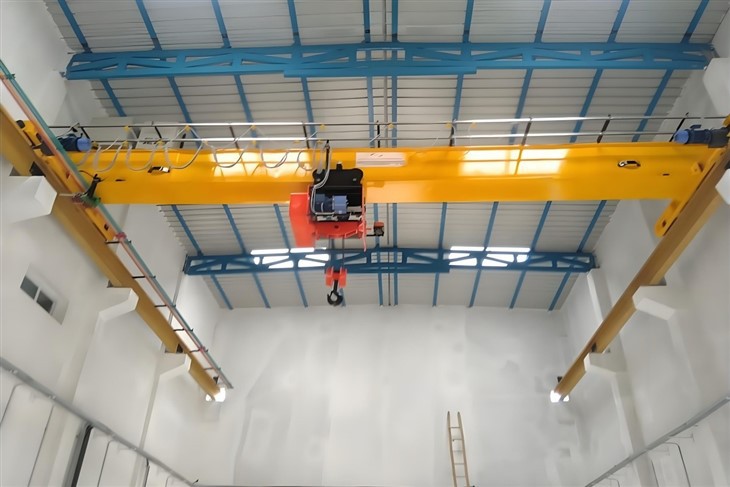


Electric Overhead Crane
An Electric Overhead Crane is a type of lifting equipment that moves along an overhead runway system, typically installed in industrial environments like factories, warehouses, and construction sites. These cranes are powered by electricity and are designed to lift, lower, and transport heavy loads horizontally with precision.
Key Components of an Electric Overhead Crane:
Bridge – The main horizontal beam that spans the work area.
Runway – Tracks installed on the building structure that allow the crane to move.
Hoist – The lifting mechanism (chain or wire rope) that raises and lowers the load.
Trolley – Moves the hoist along the bridge.
End Trucks – Wheeled assemblies at each end of the bridge that facilitate movement along the runway.
Controls – Operated via pendant, radio remote, or cabin control.
Electric Motors – Power the hoist, trolley, and bridge movements.
- Capacity: 1-20ton
- Capacity: 3.2-80ton
- Span length: 4-31.5m
- Lifting height:customized according to clients' site conditions
- Work duty: FEM Standard A5
- Raged voltage: 220V~690V, 50-60Hz, 3ph AC
- Protection class: IP54 IP55
- Crane control mode: Pendantcontrol / Remote control / Cabin control

Pictures & Components
Electric overhead cranes are essential lifting equipment used in industries like manufacturing, construction, and logistics. They consist of several key components that work together to lift, move, and position heavy loads safely and efficiently. Here are the main components of an electric overhead crane:
1. Bridge
The primary horizontal beam that spans the width of the crane bay.
Consists of one or two girders (single-girder or double-girder design).
Moves along runway rails mounted on the building structure.
2. Runway System
Includes runway beams (supporting rails) and runway rails (tracks for crane movement).
Can be top-running (rails mounted on elevated beams) or underhung (suspended from ceiling structures).

3. Hoist (Lifting Mechanism)
The component responsible for lifting and lowering loads.
Includes:
Electric motor – Powers the hoisting mechanism.
Wire rope or chain – The lifting medium.
Drum or sheave – Guides the rope/chain.
Hook block – Attaches to the load.
Brake system – Ensures safe load control.

4. Trolley
The assembly that carries the hoist along the bridge.
Moves perpendicular to the bridge for precise load positioning.
Powered by an electric motor with wheels running on bridge rails.

5. End Trucks (End Carriages)
Located at each end of the bridge.
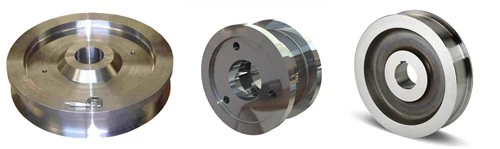
Contain wheels that allow the crane to move along the runway rails.
Include drive motors for bridge movement (in motorized cranes).
6. Controls & Electrical System
Pendant control (handheld) or radio remote control for operator input.
Control panel – Houses contactors, relays, and variable frequency drives (VFDs).
Limit switches – Prevent over-travel of the bridge, trolley, or hoist.
Power supply – Typically via festoon system (cable reels) or busbar system.

7. Safety Components
Overload limiter – Prevents lifting beyond rated capacity.
Emergency stop (E-stop) – Immediately cuts power in emergencies.
Bumpers & buffers – Absorb impact at travel limits.
Anti-collision systems – Used in multi-crane setups.
8. Cab (Optional)
Enclosed operator cabin (for large cranes with frequent use).
Includes joystick controls, instrumentation, and safety features.
11. Crane hook
An electric overhead crane is a type of lifting equipment that moves along a runway system installed overhead, typically in industrial environments like factories, warehouses, and construction sites. The crane hook is a critical component attached to the hoist or lifting mechanism, used to secure and lift loads.
Key Features of an Electric Overhead Crane Hook:
Material & Strength
Made from high-grade alloy steel for durability.
Heat-treated to withstand heavy loads without deformation.
Rated with a Working Load Limit (WLL) to ensure safe operation.
Types of Hooks
Single Hook – Common for general lifting.
Double Hook – Used for balanced lifting of larger loads.
Ramshorn Hook – Designed for slings and multiple attachment points.
Safety Latch Hook – Includes a latch to prevent slings/chains from slipping.
Attachment Mechanism
Connected to the hoist via a swivel mechanism for rotation.
May include a shackle or pulley system for rigging flexibility.
Safety Considerations
Regular inspections for cracks, wear, or deformation.
Must comply with OSHA, ASME B30.10, or other regional safety standards.
Overload protection to prevent hook failure.

12.Motor
An electric overhead crane motor is a crucial component of an overhead crane system, providing the necessary power to lift, lower, and move loads horizontally along the crane bridge and runway. These motors are designed for heavy-duty industrial applications, ensuring reliability, efficiency, and precise control.
Types of Motors Used in Overhead Cranes
Hoist Motor
Powers the lifting mechanism (hoist) to raise and lower loads.
Typically a three-phase AC induction motor or DC motor (for variable speed control).
May include a brake system to hold loads securely.
Bridge/Trolley Motor
Drives the crane's horizontal movement along the bridge (cross travel) or trolley (long travel).
Often uses AC squirrel cage motors or variable frequency drive (VFD)-controlled motors for smooth operation.
End Truck Motor
Moves the entire crane along the runway rails.
Usually a geared motor for controlled acceleration and deceleration.
Key Features of Overhead Crane Motors
Duty Cycle – Designed for intermittent duty (S3-S5) to handle frequent starts and stops.
Enclosure Type – IP54 or IP55 for dust and moisture resistance.
Braking System – Electromagnetic or mechanical brakes for safety.
Speed Control – Variable Frequency Drives (VFDs) allow precise speed adjustments.
Thermal Protection – Overload protection to prevent overheating.

8. Sound and light alarm system and limit switch safety device
An Electric Overhead Crane typically incorporates several safety features, including a sound and light alarm system and limit switch safety devices, to ensure safe operation and prevent accidents. Below is an overview of these systems:
1. Sound and Light Alarm System
This system provides visual and audible warnings to alert personnel before and during crane operation.
Components:
Horn/Buzzer (Sound Alarm): Emits a loud audible signal before crane movement starts.
Strobe Light/Beacon (Light Alarm): Flashing LED or rotating beacon to provide a visual warning.
Control Panel Integration: The alarm is triggered automatically when the crane is activated or when approaching a limit.
Functions:
Start-Up Warning: Alerts workers before the crane begins moving.
Emergency Warning: Activates in case of malfunctions or hazardous conditions.
Approaching Limit Warning: Sounds when the crane nears its travel limits.
2. Limit Switch Safety Device
Limit switches are critical safety devices that prevent the crane (or hoist) from over-traveling beyond its designed limits.
Types of Limit Switches:
Hoist Upper/Lower Limit Switches
Prevents the hoist hook from over-raising (which can damage the wire rope) or over-lowering (which can cause slack rope hazards).
Typically mechanical, rotary, or proximity-based.
Bridge & Trolley Travel Limit Switches
Stops the crane at the ends of the runway or trolley travel path.
Can be lever-operated, cam-operated, or magnetic.
Emergency Limit Switch (Final Limit)
Acts as a backup if the primary limit fails (often a hardwired safety cut-off).
How They Work:
When the crane reaches a set limit, the switch is triggered, cutting power to the motor.
Some systems include progressive deceleration (soft stops) before hitting the hard limit.
Safety Standards & Compliance
These systems must comply with:
OSHA 1910.179 (Overhead & Gantry Cranes)
ASME B30.2 / B30.17 (Safety Standards)
IEC 60204-32 (Electrical Safety of Machinery)
ISO 12488-1 (Crane Compliance)
Maintenance & Testing
Regularly test alarms and limit switches to ensure functionality.
Check for worn-out switches or damaged wiring.
Verify that deceleration and stopping distances are within safe limits.
Conclusion
A properly functioning sound & light alarm system and limit switches are essential for preventing collisions, overloading, and equipment damage in overhead crane operations. Regular inspections and compliance with safety standards ensure safe and efficient crane performance.

10. Control Mode
The control mode of an Electric Overhead Crane determines how the crane is operated, including the method of issuing commands, precision requirements, and safety considerations. Here are the common control modes used in overhead cranes:
1. Pendant Control (Push Button Pendant)
Operation: A handheld pendant (wired or wireless) with buttons for hoisting, lowering, and trolley/bridge movement.
Applications:
Ideal for small to medium cranes.
Used in workshops, warehouses, and assembly lines.
Advantages:
Simple and cost-effective.
Direct operator control.
Disadvantages:
Limited range (for wired pendants).
Operator must be near the crane.
2. Radio Remote Control (Wireless)
Operation: Uses a wireless transmitter (remote) to control crane movements.
Applications:
Suitable for large cranes or hazardous environments.
Used in steel plants, foundries, and construction sites.
Advantages:
Greater mobility for the operator.
Improved safety (operator can stay at a safe distance).
Disadvantages:
Requires battery management.
Potential interference in some environments.
3. Cabin Control (Operator Cab)
Operation: The crane is operated from an enclosed or open cab mounted on the crane.
Applications:
Heavy-duty cranes (e.g., steel mills, ports).
High-precision lifting tasks.
Advantages:
Better visibility for complex operations.
Comfortable for long shifts.
Disadvantages:
Higher cost.
Requires proper access and safety measures.
4. Semi-Automatic/Automatic Control
Operation: Uses Programmable Logic Controllers (PLCs) or Computerized Systems for pre-programmed movements.
Applications:
Repetitive tasks (e.g., loading/unloading, production lines).
Smart factories (Industry 4.0).
Advantages:
High precision and efficiency.
Reduces human error.
Disadvantages:
Higher initial setup cost.
Requires maintenance and programming expertise.
5. Dual Control (Pendant + Remote or Cab)
Operation: Combines multiple control modes (e.g., pendant + radio remote or cab).
Applications:
Flexible operations (e.g., maintenance + regular use).
Critical environments needing backup control.
Advantages:
Redundancy improves safety.
Adaptable to different tasks.
Disadvantages:
More complex wiring/system integration.
6. Voice-Activated Control (Emerging Tech)
Operation: Uses voice commands to control crane movements (AI-assisted).
Applications:
Experimental/specialized environments.
Hands-free operations.
Advantages:
Useful when hands are occupied.
Disadvantages:
Limited adoption, still under development.

11. Sketch

Main Technical Data


Advantages
Electric overhead cranes are widely used in industries such as manufacturing, construction, logistics, and warehousing due to their efficiency and reliability. Here are some key advantages of electric overhead cranes:
1. High Efficiency & Productivity
Fast & Smooth Operation: Electric motors provide precise control over lifting, lowering, and traversing, improving workflow efficiency.
Automation Compatibility: Can be integrated with automated systems (e.g., remote control, programmable logic controllers) for streamlined operations.
2. Energy Efficiency & Cost Savings
Lower Operating Costs: Electric cranes consume less energy compared to hydraulic or diesel-powered alternatives.
Reduced Maintenance: Fewer moving parts and no fuel requirements decrease long-term maintenance expenses.
3. Precise & Safe Operation
Accurate Load Handling: Variable speed controls allow for smooth starts, stops, and positioning of heavy loads.
Safety Features: Equipped with overload protection, emergency stop buttons, limit switches, and anti-collision systems.
4. High Load Capacity & Durability
Handles Heavy Loads: Designed for lifting capacities ranging from a few tons to several hundred tons.
Robust Construction: Built with high-quality steel and wear-resistant components for long service life.
5. Space Optimization
Ceiling-Mounted Design: Doesn't occupy floor space, maximizing workspace utilization.
Wide Coverage: Can span large work areas with bridge and trolley movement.
6. Environmentally Friendly
Zero Emissions: Electric cranes produce no exhaust fumes, making them ideal for indoor use.
Low Noise: Quieter operation compared to diesel or hydraulic cranes.
7. Versatility in Applications
Adaptable to Various Industries: Used in steel plants, warehouses, shipyards, automotive, and aerospace sectors.
Customizable Configurations: Available in single-girder (light-duty) or double-girder (heavy-duty) designs.
8. Reduced Manual Labor
Minimizes Worker Fatigue: Automates heavy lifting, reducing physical strain on workers.
Enhances Workplace Safety: Lowers the risk of injuries from manual material handling.
Conclusion
Electric overhead cranes offer a combination of power, precision, safety, and cost-effectiveness, making them a preferred choice for industrial material handling. Their ability to improve productivity while reducing operational costs ensures a strong return on investment (ROI).
Application
Electric overhead cranes (EOT cranes) are widely used in industrial and construction settings for lifting and moving heavy loads with precision and efficiency. Below are key applications, benefits, and considerations for their use:
1. Common Applications of Electric Overhead Cranes
Manufacturing Plants – Used in assembly lines for handling raw materials, machinery, and finished products.
Warehouses & Logistics – Facilitate loading/unloading of heavy goods, optimizing storage space with high lifting capacity.
Steel & Metal Industries – Transport molten metal, coils, and heavy metal sheets safely.
Power Plants – Assist in maintenance tasks, such as lifting turbines, generators, and heavy equipment.
Construction Sites – Help in moving steel beams, concrete panels, and other heavy construction materials.
Automotive Industry – Used for lifting car bodies, engines, and assembly line components.
Shipbuilding & Ports – Handle large ship parts and containers efficiently.
Types Of Cranes For Different Working Conditions

Crane Production Procedure
The production procedure for an Electric Overhead Crane involves several stages, from design and material procurement to assembly, testing, and final delivery. Below is a step-by-step outline of the typical manufacturing process:
1. Design & Engineering
Customer Requirements Analysis: Determine load capacity, span, lifting height, duty cycle (FEM/ISO classification), and operating environment.
Structural Design:
CAD modeling for bridge girders, end carriages, and hoist mechanisms.
Finite Element Analysis (FEA) to ensure structural integrity.
Electrical & Control System Design:
Motor selection (hoist, trolley, bridge travel).
Control panel design (VFDs, limit switches, overload protection).
Regulatory Compliance: Ensure adherence to standards (ISO, DIN, FEM, OSHA, or CMAA for US markets).
2. Material Procurement
Steel Sections: Procure high-quality steel (S355JR or equivalent) for girders, end carriages, and trolley frames.
Mechanical Components:
Wire ropes, hooks, pulleys, gears, and bearings.
Wheels and rails for crane movement.
Electrical Components:
Motors, brakes, control panels, pendant/radio remote systems.
Festoon/cable reels for power supply.
3. Fabrication of Structural Components
Cutting & Welding:
CNC cutting of steel plates/beams.
Welding of bridge girders (box-type or I-beam) and end carriages (per EN 1090 or AWS standards).
Machining:
Drilling holes for bolts, machining rail contact surfaces.
Precision machining of gearboxes and shafts.
Surface Treatment:
Shot blasting for rust removal.
Primer and paint (epoxy/polyurethane) for corrosion resistance.
4. Assembly of Mechanical Systems
Bridge Assembly:
Join girders to end carriages (bolted or welded).
Install runway rails and alignment checks.
Hoist & Trolley Assembly:
Mount hoist mechanism (electric chain hoist or wire rope hoist) on the trolley.
Install gearmotors, brakes, and drum/sheave assemblies.
Wheel & Drive Mechanism:
Attach drive wheels to end carriages (double-girder cranes may have dual drives).
5. Electrical Installation
Wiring & Controls:
Install power supply systems (festoon, conductor bars, or cable reels).
Connect motors, limit switches, and overload protectors.
Set up control panels with Variable Frequency Drives (VFDs) for smooth operation.
Safety Systems:
Emergency stop buttons, anti-collision sensors, and load limiters.
Warning lights/alarms.
6. Testing & Quality Control
Load Testing:
Static Load Test: 125% of rated capacity (per ISO 4310 or CMAA).
Dynamic Load Test: 110% of rated capacity with operational checks.
Functional Tests:
Hoisting, trolley, and bridge movement.
Brake effectiveness and limit switch operation.
Electrical Safety Checks: Insulation resistance, grounding, and short-circuit protection.
7. Disassembly & Packaging
Modular Disassembly (if required for shipping):
Separate bridge girders, end carriages, and hoist/trolley.
Packaging:
Protect machined surfaces and electrical components.
Use wooden crates for international shipments.
8. Installation & Commissioning (On-Site)
Runway Installation: Ensure proper alignment of rails/beams.
Crane Reassembly: Bolt together components per assembly drawings.
Final Testing:
Verify smooth operation under load.
Train operators on safe usage.
9. Documentation & Delivery
User Manuals: Include operation, maintenance, and safety guidelines.
Certificates: Provide test reports, CE/ISO certifications, and warranty documents.
After-Sales Support: Offer maintenance services and spare parts.

Workshop View
The company has installed an intelligent equipment management platform, and has installed 310 sets (sets) of handling and welding robots. After the completion of the plan, there will be more than 500 sets (sets), and the equipment networking rate will reach 95%. 32 welding lines have been put into use, 50 are planned to be installed, and the automation rate of the entire product line has reached.


Hot Tags: electric overhead crane, China electric overhead crane manufacturers, suppliers, factory, Single Girder Overhead Crane, Single Girder Overhead Travelling Crane
You Might Also Like


Send Inquiry