








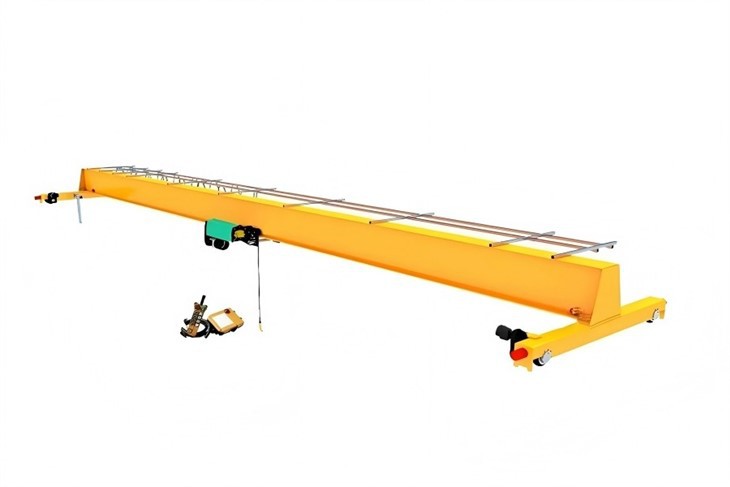


Engine Equipped Single Girder Bridge Crane
Products Description
An engine equipped Single Girder bridge crane is a type of overhead crane designed for environments where electrical power is unavailable or unreliable. These cranes are commonly used in remote construction sites, shipping yards, or outdoor storage areas.
Key Features of an engine equipped Single Girder bridge crane:
Diesel/Gasoline Engine – Provides independent power, eliminating the need for an electrical supply.
Single Girder Design – Consists of one main beam (usually an I-beam or box girder) with a hoist and trolley system.
Mobility & Flexibility – Ideal for outdoor or temporary applications where fixed power sources are absent.
Load Capacity – Typically ranges from 1 ton to 20 tons, depending on design.
Travel Mechanism – The crane moves on rails or tracks, powered by the engine.
Control Options:
Manual push/pull (for lighter loads)
Wireless remote control
Cab-operated control (for heavier-duty applications)
Single Girder vs. Double Girder for 10-Ton Capacity
| Feature | Single Girder (LD) | Double Girder (QD) |
|---|---|---|
| Max Span | Up to 25m | Up to 35m+ |
| Lifting Height | Standard (6-18m) | Higher (up to 30m) |
| Hook Approach | Limited | Better (more space under girder) |
| Duty Cycle | Medium (A3-A4) | Heavy (A5-A6) |
| Cost | Lower | Higher (20-30% more) |
Lifting Capacity: 10 metric tons (10,000 kg)
Span (L): Typically 5m to 30m (customizable based on workshop width)
Lifting Height (H): 6m to 30m (adjustable based on building height)
Work Duty Class: A3 (Medium Duty) to A5 (Heavy Duty) (depending on usage frequency)
Operating Speed:
Hoisting: 3~8 m/min (adjustable with VFD for precision)
Trolley Travel: 10~20 m/min
Bridge Travel: 20~30 m/min
Power Supply: 3-Phase, 380V/50Hz (or 480V/60Hz for some regions)
Control Method: Pendant control / Radio remote / Cabin operation

Pictures & Components
An engine equipped Single Girder bridge crane is a type of overhead crane that consists of a single bridge girder supported by two end trucks. It is commonly used in workshops, warehouses, and industrial facilities for material handling. Here are the key components of an engine-equipped single girder bridge crane:
1. Main Components:
A. Bridge Girder (Main Beam)
The primary horizontal beam that spans the width of the workspace.
Usually made of rolled steel (I-beam or box-type design).
Supports the hoist and trolley.
B. End Trucks (End Carriages)
Located at both ends of the bridge girder.
Equipped with wheels for movement along the runway rails.
Contains drive mechanisms (motors, gearboxes, and brakes).
 |
 |
C. Hoist and Trolley
Electric Hoist – Lifts and lowers loads (chain hoist or wire rope hoist).
Trolley – Moves the hoist along the length of the bridge girder.
Can be motorized (powered movement) or manual (hand-pushed).
D. Runway System
Consists of runway beams (rails) installed on building columns or freestanding supports.
The crane moves along these rails.
E. Drive Mechanism
Bridge Drive – Moves the entire crane along the runway (usually two-wheel drive or four-wheel drive).
Trolley Drive – Moves the trolley along the bridge girder.
Powered by electric motors (AC or DC) with gear reducers.
 |
 |
F. Control System
Pendant Control (hanging push-button station) for manual operation.
Radio Remote Control for wireless operation.
Cabin Control (optional for larger cranes).
G. Power Supply
Festoon System (cable and trolley) or Conductor Bars (bus bars) for power transmission.
Supplies electricity to the hoist, trolley, and bridge drives.

H. Safety Devices
Limit Switches – Prevents over-travel of the hoist and crane.
Overload Protection – Prevents lifting beyond rated capacity.
Emergency Stop – Instantly cuts power in case of danger.
Bumpers – Absorbs impact at the ends of the runway.

2. Optional Components:
Frequency Inverter – For smooth speed control.
Anti-Sway System – Reduces load swing during movement.
Weighing System – Measures load weight.
Cabin (Operator's Cab) – For seated control (common in larger cranes).

3. Engine-Powered Option (Instead of Electric)
Some single girder cranes use diesel or hydraulic power instead of electric motors, especially in outdoor or remote locations without reliable electricity. Key differences:
Diesel Engine – Provides mobility and independence from grid power.
Hydraulic Motors – Used for drive and lifting functions.
Fuel Tank & Cooling System – Required for engine operation.
.

| 🔩 Option | 📋 Use |
|---|---|
| Variable Frequency Drives (VFD) | For smooth speed control of hoisting/travel motion. |
| Anti-sway Control | Minimizes load swing, especially useful for longer spans. |
| Load Display System | Shows real-time lifted weight on digital screen. |
| Maintenance Platform | For easy access to hoist and motor systems (common in double girder designs). |

Sketch

Main technical

Advantages
An engine equipped Single Girder bridge crane offers several advantages, especially in environments where electrical power is unavailable, unreliable, or impractical. Here are the key benefits:
1. Portability & Independence from Electrical Power
Can operate in remote locations, construction sites, or outdoor areas without reliance on grid electricity.
Ideal for temporary job sites, mining, or agricultural applications.
2. Enhanced Mobility & Flexibility
The engine-driven system allows for self-propelled movement without needing external power tracks.
Suitable for rough terrains or uneven surfaces where traditional electric cranes may struggle.
3. High Load Capacity with Compact Design
Single girder design keeps the crane lightweight yet strong, making it easier to transport while maintaining good lifting capacity (typically up to 20 tons).
More cost-effective than double girder cranes for moderate lifting needs.
4. Fuel Efficiency & Long Runtime
Modern diesel/hybrid engines provide long operating hours without frequent refueling.
Better suited for continuous heavy-duty operations compared to battery-powered alternatives.
5. Lower Installation Costs
No need for complex electrical infrastructure (rails, conductors, or substations).
Faster deployment compared to fixed electric overhead cranes.
6. Robust Performance in Harsh Conditions
Works reliably in extreme weather (rain, dust, high temperatures) where electric systems may fail.
Resistant to power fluctuations or outages.
7. Easy Maintenance & Durability
Diesel engines are mechanically simpler than complex electric motor systems in some cases.
Fewer components susceptible to electrical faults (no issues with wiring, contactors, or variable frequency drives).
8. Cost-Effective for Temporary or Mobile Use
Lower upfront investment compared to permanent electric crane installations.
Can be relocated easily for different projects, reducing rental or setup costs.
Application:
An engine equipped Single Girder bridge crane is designed for applications where electrical power supply is unavailable, unreliable, or impractical. These cranes are commonly used in remote locations, construction sites, ports, and other outdoor or temporary work environments.
Key Applications of Engine-Powered Single Girder Bridge Cranes:
Construction Sites
Lifting and moving heavy materials (steel beams, concrete panels, machinery).
Ideal for remote or off-grid construction projects where electricity is not accessible.
Ports & Shipyards
Loading/unloading cargo from ships, trucks, or storage areas.
Useful in temporary or mobile operations where fixed cranes are unavailable.
Mining & Oil Fields
Handling equipment, pipes, and materials in rugged, off-grid locations.
Diesel-powered cranes provide reliability in harsh environments.
Agriculture & Forestry
Moving heavy logs, farm machinery, or storage materials in rural areas.
Emergency & Disaster Recovery
Rapid deployment in areas with damaged infrastructure (e.g., after hurricanes or earthquakes).
Military & Defense
Transporting heavy equipment in field operations where power sources are limited.
Crane production procedure
The production procedure for an engine-equipped single girder bridge crane involves several key stages, from design to final testing. Below is a step-by-step outline of the typical manufacturing process:
1. Design & Engineering
Customer Requirements Analysis: Determine load capacity, span, lifting height, duty cycle (FEM/ISO classification), and operating environment.
Structural Design:
Main girder (single box or I-beam design).
End carriages (for movement along rails).
Hoist trolley (with electric hoist or manual chain block).
Electrical System Design: Motor power, control system (pendant/remote/wireless), and safety devices (limit switches, overload protection).
Regulatory Compliance: Ensure adherence to standards (ISO, DIN, FEM, OSHA, or local regulations).
2. Material Procurement
Steel Plates/Girders: For main beam and end carriages (commonly Q235B or Q345B steel).
Wheels & Rails: For smooth travel (forged or cast steel).
Electrical Components: Motors (travel/lifting), gearboxes, brakes, cables, and control panels.
Hoisting Mechanism: Electric chain hoist or wire rope hoist (selected based on capacity).
3. Fabrication Process
A. Main Girder Fabrication
Cutting: Steel plates cut via CNC plasma/oxy-fuel cutting.
Welding: Automated/submerged arc welding for girder assembly (precise camber pre-set to avoid deflection).
Shot Blasting & Painting: Surface treatment for corrosion resistance (primer + topcoat).
B. End Carriage Assembly
Frame Welding: Fabrication of end frames with wheel mounts.
Wheel Installation: Wheels mounted on axles with bearings for rail movement.
C. Trolley & Hoist Integration
Trolley Frame: Fabricated to support the hoist.
Hoist Mounting: Electric hoist (e.g., 1-ton to 10-ton capacity) installed on trolley.
4. Electrical System Installation
Wiring: Power supply (3-phase), control circuits, and pendant station.
Safety Devices:
Limit switches (travel/lifting).
Emergency stop.
Overload protector.
5. Assembly & Testing
Girder-End Carriage Joining: Bolt/weld the main girder to end carriages.
Runway Alignment: Ensure crane rails are level and parallel.
Load Testing:
No-load Test: Check travel, lifting, and braking.
Static Load Test: 125% of rated capacity.
Dynamic Load Test: 110% of rated capacity.
6. Quality Inspection & Certification
Dimensional checks, weld inspections (UT/RT if required), and electrical safety tests.
Issue compliance certificates (CE, ISO, or local standards).
7. Packaging & Delivery
Disassemble (if needed for transport) and pack components securely.
Provide installation manuals and maintenance guidelines.
This process ensures a reliable, safe, and efficient single girder bridge crane tailored to operational needs. Let me know if you need details on any specific stage!

Workshop view:
The company has installed an intelligent equipment management platform, and has installed 310 sets (sets) of handling and welding robots. After the completion of the plan, there will be more than 500 sets (sets), and the equipment networking rate will reach 95%. 32 welding lines have been put into use, 50 are planned to be installed, and the automation rate of the entire product line has reached 85%.


Hot Tags: engine equipped single girder bridge crane, China engine equipped single girder bridge crane manufacturers, suppliers, factory, Single Girder Overhead Travelling Crane, Single Girder Overhead Crane
You Might Also Like


Send Inquiry