







Free Standing Crane
Products Description
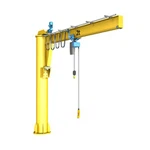
A free standing crane is a type of lifting equipment designed to move heavy materials or equipment with ease in industrial and construction settings. Unlike mounted cranes, which are fixed to the ground or a structure, a free-standing crane is independent and portable, supported by its own framework.
The Free Standing Crane is an innovative lifting solution designed for high versatility and mobility in workplaces where traditional, fixed cranes might not be feasible. It is suitable for use in warehouses, workshops, construction sites, and manufacturing plants. With a robust design and simple installation process, these cranes provide the flexibility of easily moving loads in tight spaces, improving productivity and safety.
The Free Standing Crane is different from fixed cranes. Freestanding cranes can be repositioned as needed, allowing maximum flexibility in various working environments. Designed for lifting heavy materials, the crane is equipped with a lifting system capable of carrying a large amount of weight, making it ideal for industrial operations. Made of high-quality steel, the crane can withstand heavy use and harsh conditions, ensuring a long service life and reliable performance.
The compact and streamlined structure of the free standing crane ensures that the crane does not take up too much floor space, making it suitable for smaller or crowded work areas. The crane's assembly process is simple, requiring minimal time and effort to install. No permanent fixtures are required, making it an affordable choice for temporary lifting operations. : Equipped with overload protection, non-slip surface and stable base support, it ensures safe operation and minimizes the risk of accidents.
Core Components:Motor, PLC, Bearing, Gearbox
Place of Origin: China
Warranty: 1 Year
Weight (KG): 500 kg
Video outgoing-inspection:Provided
Machinery Test Report:Provided
Application:Industrial manufacturing industry
Usage:Workshop Workstation Construction Application
Control Method:Ground Control+ Remote Control (customized)
Color:Customized
Lifting Capacity:2Ton
MOQ:1 Set
Design:Computer Optimization
Certification:CE
Install:Supervise
Motor:China Top Brand

Pictures & Components
1.Main beam
1) The box-type main beam is welded from steel plates, has high rigidity and load-bearing capacity, and is often used in cranes with larger spans. The I-beam main beam uses I-beam as the main material, has a simple structure and low cost, and is suitable for smaller spans and light lifting tasks.
2) The main beam is a single beam body that spans the legs on both sides. Lifting equipment such as electric hoists run under or on the side of the main beam through tracks, which is suitable for small and medium-sized lifting operations. A walking track is provided under or on the side of the main beam for the horizontal movement of the electric hoist or trolley. The flatness and wear resistance of the track are crucial to the operating stability of the equipment. The main beam is designed with reasonable mechanics to ensure uniform stress distribution during lifting, reduce deformation and stress concentration areas, and increase service life.
3) The main beam is usually made of high-strength steel to ensure its load-bearing capacity and bending resistance. Commonly used steel models include Q235B or Q345B, and the specific choice depends on the load-bearing requirements and working environment of the crane. The design load-bearing capacity of the main beam determines the rated lifting capacity of the crane, which is usually designed and verified according to the use requirements. The rigidity of the main beam determines the degree of deformation of the crane when lifting heavy objects, ensuring smooth operation under load.

Lifting System
A lifting system for a free-standing crane typically involves several key components that work together to ensure smooth and efficient lifting operations.
Hoist Mechanism:The hoist mechanism consists of a motor, drum, and wire rope. The motor drives the drum, which winds or unwinds the wire rope to lift or lower the load. The hoist mechanism controls the vertical movement of the load and is often equipped with brakes for safety.
Mast or Upright Tower:The mast is the vertical structure of the crane, typically made of steel, which holds the lifting components and supports the lifting capacity. It can range in height depending on the crane's design and intended use.
Jib or Arm:The jib is the horizontal or angled arm that extends from the crane's mast. It supports the hook or lifting platform and is used to move loads in a variety of directions. The jib can be fixed or adjustable, depending on the crane design.
Hook or Lifting Device:Attached to the end of the crane's jib or arm is a hook, clamp, or lifting platform that holds the load. It can be designed for various lifting applications, including moving containers, equipment, or materials.
Base Structure (Foundation):The free-standing crane is anchored to a solid foundation, usually made of concrete. This ensures that the crane can handle heavy loads without tipping over. The foundation is critical in providing stability and preventing movement during lifting.
Control System:The control system allows the crane operator to manage all lifting operations. It typically includes a set of controls for moving the jib, hoisting the load, and monitoring safety features. Modern systems may include remote control capabilities or even automation for precise control.

3.End carriage
The end carriage of a free-standing crane refers to the part of the crane's structure that sits at either end of the crane's bridge. It supports the bridge beam and enables it to move along the crane runway. This component is equipped with wheels or rollers that run along tracks or rails, allowing the crane to travel horizontally across the area.
Key functions of the end carriage include:
Support for the crane bridge: It holds the bridge or girder in place and allows it to travel smoothly along the runway.
Motion system: It houses the wheels or bogies that provide horizontal movement of the crane.
Power supply: The end carriage often contains the electrical systems and motorized drives that enable the crane's movement.
Safety features: End carriages are designed to ensure stability and prevent accidents, with features like brakes and shock absorbers.
The design of the end carriage depends on the specific requirements of the crane, including its weight capacity, operating environment, and the dimensions of the area in which the crane will be used.

4.Crane travelling mechanism
1) Operation principle
The crane travelling mechanism involves a combination of electric motors, wheels, and rails that enable the crane to move horizontally along its track. The drive system controls the movement, while the structure supports the crane's operations, and the control system allows operators to manage the motion of the crane within its designated workspace.
The crane is mounted on a set of rails or tracks. The crane travels along these rails with the help of wheels or rail-mounted bogies. These wheels are powered by electric motors or manual systems, depending on the type of crane.The movement is powered by electric motors that are connected to a drive system (typically a geared system). These motors can drive the wheels directly or via a chain or belt system to propel the crane along the rail. The crane follows the predefined path laid by the tracks. The rails could be straight or curved, allowing for various movements within a specific workspace.
2) Functional characteristics
Movement along the Rail: The crane is mounted on wheels or a similar moving system that allows it to travel along fixed rails (or tracks). These rails are typically positioned on the structure of the crane and are designed to guide the crane in a straight line.
Drive System: The travelling mechanism is powered by an electric motor or other means (such as hydraulic or pneumatic systems). The motor drives the wheels or tracks, allowing the crane to move. The drive system is usually controlled by a variable frequency drive to manage speed and smooth operation.
Steering and Control: The crane traveling mechanism includes steering or control systems that allow the operator to change the direction of the crane's movement. This can be done manually or automatically, depending on the design of the crane and its control system.
Load Carrying Capacity: The travelling mechanism is designed to carry the weight of the crane, its load, and other components. This requires robust structural elements, including reinforced wheels, track systems, and drive mechanisms, which are engineered to handle the stress of both the load and the crane's movement.
Safety Features: The travelling mechanism is often equipped with safety features to prevent accidents. This includes limit switches that stop the crane if it moves beyond its safe range, emergency braking systems, and safety sensors to detect obstacles.
Smooth and Efficient Operation: The mechanism is designed to minimize friction and wear, ensuring smooth operation. This is achieved through the use of high-quality bearings, lubrication systems, and precise alignment of the wheels and tracks.
.
Trolley travelling mechanism
1) Operation principle
The trolley is a carriage that runs along the crane beam, carrying the hook or other lifting device. It is mounted on rails or tracks attached to the crane's main structure.The traveling mechanism is responsible for moving the trolley horizontally, from one end of the crane's track to the other.The motors, gearbox, drive wheels, and rails play a critical role in moving the trolley.
2) Functional characteristics
Movement along the Crane Beam: The primary function of the trolley traveling mechanism is to move the trolley (carrying the hoist or load) along the crane's horizontal beam or girder. This movement allows the crane to cover a wide area and handle materials across a large space.
Smooth and Controlled Motion: The mechanism ensures smooth, controlled motion of the trolley, which is essential for safe and efficient load handling. This is typically achieved through a combination of electric motors, gear systems, and rails.
Speed Control: The traveling mechanism provides the ability to control the speed of the trolley's movement. The speed can often be adjusted depending on the requirements of the operation, allowing for both slow, precise movements or faster transitions across the crane's span.
Load Handling Capacity: The trolley mechanism is designed to handle the maximum load capacity that the crane can carry. It must be strong and durable enough to support and transport heavy loads without compromising stability.
Manual or Automated Operation: The traveling mechanism can be operated either manually (via a hand pendant or push-button control) or automatically (through an automated system), depending on the crane's design and the complexity of the tasks it is used for.
6.Crane wheel
A crane wheel on a free-standing crane is a vital component in the crane's wheel system, which allows for the movement of the crane along its rail track. The wheel is typically designed to support heavy loads and provide stability and smooth movement.
Material: The crane wheels are often made of high-quality steel or cast iron to withstand the weight of the crane and any loads it is lifting. They are designed to resist wear and tear over time.
Design: Crane wheels are usually flanged, meaning they have a raised edge on the outer circumference to keep the wheel securely on the rail. This is crucial for stability, especially during heavy lifting or when the crane moves at high speeds.
Load Capacity: The wheels are designed to bear the weight of the crane and its load. In heavy-duty applications, such as for large industrial cranes, the wheels must be able to withstand immense stress without deforming or cracking.
Alignment and Rotation: Proper alignment is crucial for smooth operation. The wheels are often mounted on axles, which allow for rotation. Regular maintenance is needed to ensure the wheels rotate smoothly without excessive friction.
Track System: For a free-standing crane, the track on which the wheels run is equally important. The track must be level and properly maintained to prevent misalignment, which can cause wear on the wheels and lead to inefficient operation.

7.Crane Hook
A crane hook is an essential component of a free-standing crane, designed to lift and lower heavy loads. It serves as the primary point of contact for attaching a load to the crane's lifting mechanism.
Shape and Structure: Crane hooks are typically made of high-strength steel or other durable materials, featuring a curved or "J" shape to secure and hold a load.
Safety Mechanisms:Latch Mechanism: Many crane hooks include a safety latch that helps prevent the load from slipping off.
Swivel Hooks: Some hooks are designed to swivel, allowing the load to rotate as needed without getting tangled.
Load Capacity: The crane hook must be able to handle the maximum weight the crane is designed to lift. This capacity varies significantly depending on the crane's design and intended use.
Free-Standing Cranes: In the context of a free-standing crane, the hook is used in conjunction with a hoist to move loads vertically. Free-standing cranes are often used in smaller industrial or construction settings and do not require an overhead structure, which makes them versatile and easier to install.

Motor
The motor of a free-standing crane is a critical component that powers the movement of the crane's hoisting, trolley, or travel mechanisms. The type of motor used can vary depending on the crane's design, application, and capacity.
AC Motors: These are the most common and are typically used in industrial cranes. They are durable, reliable, and can handle large loads. AC motors are often coupled with variable frequency drives (VFDs) to provide precise control over speed and torque.
DC Motors: These are less common than AC motors in modern cranes but can still be found in older systems or specialized applications. They offer good speed control and are often used in cranes with complex control requirements.
Synchronous Motors: These motors are used in applications where the speed of the motor must be constant and synchronized with the frequency of the power supply. They are more efficient but often require more complex control systems.

.
Sound and light alarm system & limit switch
1) Sound and light alarm system
A sound and light alarm system for a free-standing crane is designed to enhance safety and visibility during crane operation. The system provides both auditory and visual signals to warn operators and workers of the crane's movements, emergency situations, or other critical actions.
Sound Alarm:A loud, attention-grabbing sound is emitted to alert individuals in the vicinity that the crane is in operation or in an emergency state.Can be configured to produce different tones or patterns to signify specific conditions, such as an emergency or a general operational warning.Typical sound types include sirens, horns, or beeps.
Light Alarm:Flashing lights or beacons that provide a visual warning. These lights are usually placed on the crane structure, visible from a distance.Flashing lights can be in various colors (e.g., red, yellow, blue) to represent different statuses: red for emergency, yellow for caution, or blue for operational mode.The lights can be strobe or rotating to increase visibility, even in low-light conditions.
2) Limit switch
A limit switch in a freestanding crane is an essential safety device used to monitor and control the movement of the crane. It helps to ensure that the crane operates within safe limits and prevents it from exceeding its designated operating range, thus avoiding damage to the crane or surrounding infrastructure.
Key Functions of a Limit Switch in a Freestanding Crane:
Over-travel Protection: The limit switch can detect when the crane reaches its maximum travel distance, either vertically (for hoists) or horizontally (for the trolley and bridge). Once the limit switch is triggered, it sends a signal to stop the movement, preventing over-travel.
Preventing Collision: It ensures that the crane's components, such as the trolley or hoist, do not collide with other parts of the crane or any surrounding structures.
Safety Shutdown: If the crane is operating beyond its safe limits, the limit switch will initiate a shutdown or emergency stop to prevent further movement and potential accidents.
Automatic Stop Functionality: When the crane's load reaches a certain position (either fully up, down, or extended), the limit switch will trigger an automatic stop, halting the crane's movement.
Types of Limit Switches:
Mechanical Limit Switches: These are activated by physical contact, often through the movement of a lever or roller that interacts with the crane's moving parts.
Proximity Limit Switches: These are activated when the crane's moving parts come within a certain distance of the sensor, which detects the presence of metal or other objects.
Electronic Limit Switches: These are more advanced and may use sensors or encoders to monitor the crane's position and control its movements more precisely.

10.Safety Devices
Overload Protection:Overload Limit Switch: Prevents the crane from lifting beyond its rated capacity. If the load exceeds the limit, the crane automatically stops lifting.Load Moment Indicator (LMI): Monitors the load in real-time to ensure it stays within safe limits, providing warnings or shutdowns if necessary.
Anti-Two Block Device:Prevents the hook block from coming into contact with the crane's boom (which can cause damage or dangerous situations). It works by detecting when the block gets too close and halts the crane's hoisting action.
Emergency Stop Button:A critical safety feature, usually located in easy-to-reach spots, that immediately shuts down all crane functions in case of an emergency.
Limit Switches:Horizontal and vertical limit switches are installed to stop the crane from moving beyond safe operational ranges, preventing damage to the crane and its surroundings.
Anti-Sway Control:Helps reduce swinging of the load by controlling the hoist and trolley movement, improving stability and preventing dangerous load swings.
Wind Speed Monitoring:Devices that measure wind speed and provide warnings or automatically stop crane operation when wind speeds exceed safe thresholds.
Crane Cab Safety Features:Cranes equipped with operator cabs often include safety devices such as secure access, safety harness anchor points, and ergonomically designed control systems for reducing operator fatigue and preventing accidents.
Emergency Lighting:In case of power failure, emergency lighting ensures that the operator can still see the controls and the environment around the crane.
Horn and Signal Lights:Warn people nearby of crane movement, especially in busy environments. These include horns, flashing lights, and other audible/visible signals.
Braking System:Cranes are equipped with reliable mechanical and electrical brakes to stop the crane quickly and safely during operation.
Inspection and Maintenance Devices:Monitoring systems that track wear and tear on critical crane components, such as the hoist, cables, and gears. This helps ensure that the crane is always in a safe, operable condition.
Boom Lock and Latch:A device to prevent the boom from unintentionally collapsing or folding when it is not in use, providing extra stability.
11.Control Mode
Manual Control:Operated directly by an operator using a control panel or joystick.The operator can control the crane's movements, such as lifting, lowering, and moving the load.This mode offers high flexibility but requires a skilled operator for safe operation.
Remote Control:Utilizes a wireless device, such as a handheld remote or a mobile device, to control the crane.Allows the operator to be at a distance from the crane, increasing safety and convenience.Often used in situations where manual control is difficult or dangerous.
Automatic or Programmable Control:Cranes can be programmed to follow a specific set of instructions for repetitive tasks.Sensors and controllers automatically adjust the crane's movements.This mode is often used in industrial settings for efficiency and consistency.
Semi-Automatic Control:Combines manual and automatic control.Operators can intervene in the process if needed, but the crane performs most functions automatically.
Pendant Control:A pendant is a handheld control device connected by a cable to the crane.Similar to manual control, but the pendant allows more mobility for the operator around the crane.
Tower Crane Control:Involves remote control or a fixed operator cabin, especially in larger cranes.Operators can control all crane movements from the cabin or via a remote device.

Sketch

Main technical

Advantages
Flexibility in Installation: Unlike overhead cranes that require complex structural support or modifications to buildings, freestanding cranes can be installed in most open areas without needing to modify the infrastructure.
Space Optimization: Freestanding cranes are ideal for operations in tight or constrained spaces, as they don't require ceiling support or modifications to existing structures. This helps in maximizing the available floor space.
Cost-Effective: Because they don't require expensive overhead infrastructure, freestanding cranes can be more affordable to install and maintain compared to overhead or bridge cranes.
Portability: Some models of freestanding cranes are designed to be portable, meaning they can be moved to different locations within a facility as needed. This can be beneficial for industries that require flexibility or frequently move heavy loads.
Ease of Use: These cranes are typically easier to operate and require less maintenance than larger overhead crane systems, especially in environments with lower lifting demands.
Safety: With fewer moving parts and simpler construction, freestanding cranes can be safer to operate and maintain, reducing the risk of breakdowns or accidents.
High Load Capacity: Depending on the design, freestanding cranes can lift significant weights, making them suitable for a variety of industrial applications, including warehouses, manufacturing plants, and assembly lines.
Minimal Footprint: They are designed to have a smaller physical footprint compared to other types of cranes, which is useful in environments where space is limited.
Customization: Freestanding cranes can often be customized in terms of lifting height, span, and load capacity to suit specific operational needs.
Reduced Need for Facility Modifications: Unlike ceiling-mounted cranes, these systems don't require any modifications to the building structure, which can be particularly beneficial in older or rented facilities.
Application
1. Industrial Settings
Manufacturing Plants: Free-standing cranes are often used for moving heavy components, machinery, or tools across factory floors where overhead support structures are not available.
Assembly Lines: They can be used to move materials or finished products along the assembly line.
2. Construction Sites
Heavy Lifting: These cranes can lift heavy building materials, machinery, and other construction elements on sites where it's difficult to install traditional overhead cranes.
Portable Use: Free-standing cranes can be relocated within the construction site as needed, making them ideal for sites with changing layout or requirements.
3. Warehousing and Distribution
Storage Solutions: They are used in warehouses for lifting and moving large items, including pallets of goods, heavy boxes, or equipment that need to be loaded or unloaded.
Inventory Management: Free-standing cranes allow efficient storage management by helping to lift and organize materials, improving space utilization.
4. Automotive Industry
Car Assembly: In automotive manufacturing, these cranes are used to handle parts and assemblies that are too heavy or large to be moved by workers alone.
5. Aerospace
Aircraft Assembly: Free-standing cranes assist in lifting large and heavy parts of aircraft during their assembly or maintenance, where traditional ceiling-mounted cranes may not be viable.
6. Shipyards
Handling Ship Parts: In shipbuilding, they can be used to move large components like engine parts, machinery, and other heavy equipment.
7. Maintenance and Repair
Equipment Maintenance: These cranes can be used in various industries for the maintenance of machinery, moving large or heavy components for repair or replacement.
8. Outdoor Use (Heavy-duty Tasks)
Mining and Heavy Industries: Free-standing cranes are commonly used in environments where external support structures cannot be installed due to space constraints, such as in mining or remote construction projects.
9. Laboratories and Research Facilities
Handling Laboratory Equipment: Free-standing cranes can be used to move large and delicate equipment in research and development labs, especially in scientific or medical environments.
Crane production procedure
1. Design & Engineering
Initial Design: The design process starts with specifying the load capacity, span, lifting height, and operational conditions (such as the environment, speed, and frequency of use).
CAD Modeling: Detailed Computer-Aided Design (CAD) models are created for structural components, electrical systems, and safety features.
Structural Analysis: Engineering analysis (e.g., stress tests, fatigue analysis) is done to ensure the crane can handle the specified loads without failure.
2. Material Selection
Steel Selection: High-quality steel is chosen for the crane's frame, beams, and other structural components to ensure strength and durability.
Other Materials: Components like cables, hoists, motors, and control systems are also sourced from suppliers.
3. Fabrication of Structural Components
Cutting & Shaping: The steel is cut, shaped, and welded into components, such as the main gantry frame, cross beams, trolley beams, and support legs.
Welding: Precision welding is performed to assemble the frame and other large parts. This requires skilled workers to ensure accuracy and structural integrity.
Machining: Holes, slots, or grooves are machined into the steel parts for mounting other components (like hoist gears, wheels, and motors).
4. Assembly
Frame Assembly: The main structure of the crane is assembled in sections. The legs, beams, and cross members are welded or bolted together, depending on the design.
Installation of Rails: Rails are attached to the frame to allow for horizontal movement of the trolley.
Motor & Hoist Installation: The electric hoist, motors, gearboxes, and other mechanical components are installed on the crane trolley or hook.
Electrical Wiring: Wiring for the motors, limit switches, control systems, and power supply is carefully routed and secured.
Control Panel: A control panel is set up, allowing operators to control the movement and operation of the crane.
5. Painting & Surface Treatment
Cleaning: The fabricated parts are cleaned to remove dirt, oil, and other contaminants.
Priming: A primer is applied to prevent rust and provide a solid foundation for paint.
Painting: The crane frame and components are painted, typically with high-quality industrial coatings to protect against environmental factors and wear.
Curing: The paint is allowed to cure for durability.
6. Testing
Load Testing: The crane is subjected to load tests, where it is gradually loaded up to its rated capacity to ensure safe operation under stress.
Functional Testing: All crane functions (lifting, lowering, hoist movement, etc.) are tested. The electrical and mechanical systems are checked for proper operation.
Safety Features: Safety systems such as overload protection, emergency stops, and limit switches are tested.
7. Final Inspection
Quality Control: A thorough inspection is conducted to ensure that all parts meet the required standards, both in terms of materials and workmanship.
Documentation: The crane is inspected for compliance with regulatory standards, and all necessary documentation is provided (e.g., certification of load testing).
8. Delivery and Installation
Transport: The completed crane is carefully disassembled (if necessary) and transported to the installation site.
Installation: At the site, the crane is reassembled (if required) and installed on the foundation or support structure.
Final Testing: The crane undergoes a final test at the installation site to ensure all systems function properly.
9. Training and Handover
Operator Training: Operators are trained on how to use the crane safely, including control operation, maintenance routines, and emergency procedures.
Documentation Handover: The customer receives maintenance manuals, warranty details, and any other necessary documentation.
10. Maintenance and Support
Ongoing Maintenance: Routine inspections and maintenance are recommended to ensure the crane continues to function optimally over its lifespan.
Spare Parts & Support: The manufacturer provides spare parts and technical support as needed.

Workshop view:
The company has installed an intelligent equipment management platform, and has installed 310 sets (sets) of handling and welding robots. After the completion of the plan, there will be more than 500 sets (sets), and the equipment networking rate will reach 95%. 32 welding lines have been put into use, 50 are planned to be installed, and the automation rate of the entire product line has reached 85%.


Hot Tags: free standing crane, China free standing crane manufacturers, suppliers, factory, Single Girder Overhead Travelling Crane, Single Girder Overhead Crane
You Might Also Like



Send Inquiry