










New Electric Scissor Lift
Products Description
Key Features of a Modern Electric Scissor Lift
Electric Power Source:
Batteries: Typically use 24V, 36V, or 48V deep-cycle lead-acid or advanced lithium-ion (Li-ion) batteries. Li-ion options are becoming more common due to faster charging, longer life, and no maintenance.
Charging: Standard onboard chargers plug into a standard wall outlet. Many models feature opportunity charging (can be plugged in during breaks).
Drive System:
Non-Steerable (Static): These are moved by a manual hand crank or a push-around handle. Ideal for applications where the lift is positioned and then used in one spot.
Self-Propelled (Driveable): Feature a control box on a long umbilical cord or a platform-mounted panel with thumb switches or buttons. This allows the operator to drive, steer, and raise/lower the platform from the elevated position for precise maneuvering.
Platform & Capacity:
Platform Height: Ranges from ~10 feet (3 meters) to over 50 feet (15+ meters) for large models.
Capacity (Load): Common capacities are 500 lbs (227 kg), 750 lbs (340 kg), and 1,000 lbs (454 kg) for smaller models. Larger industrial models can handle 2,500 lbs (1,134 kg) or more.
Platform Size: Varies by model but is designed to hold multiple workers, tools, and materials.
Safety Systems:
Auto Brakes: Automatic brakes engage when the drive control is released.
Pothole Protection: Critical safety feature that places plates under the wheels to prevent the lift from tipping into a small hole or depression.
Tilt Sensor: Alarms and/or stops lift functions if the machine tilts beyond a safe angle.
Lowering Controls: Ground-level and platform-mounted lowering controls for emergency descent.
Guardrails: Standard non-slip platforms with toe guards and mid-rails.
Maneuverability:
Compact Design: Many are "compact" or "slab" models designed to fit through standard doorways and service elevators.
Zero Tail Swing: The base frame does not extend beyond the rear wheels, allowing for tight 360-degree rotation in confined spaces.
Rough Terrain Capability: Some electric models have larger, treaded tires and higher ground clearance for mild outdoor use on grass, gravel, or uneven concrete.
Application
1. Primary Application:
What is the main task? (e.g., installing lighting, HVAC maintenance, stocking warehouse shelves, building maintenance, construction interior fit-out).
What materials will be handled? (e.g., light tools, heavy piping, fragile glass panels). This affects platform size and capacity.
2. Working Height & Reach:
Working Height (WH): The maximum height a worker needs to reach to perform their task. This is the most critical metric.
Platform Height + Worker's Shoulder Height (~5 ft / 1.5 m) = Safe Working Height
Platform Height: The maximum height the platform can elevate to. Always add a safety margin of 2-3 feet to your required working height.
3. Platform Size & Capacity:
Capacity: How much weight will be on the platform? Include workers, tools, and materials. Never exceed the rated capacity.
Size: How many people need to be on it simultaneously? Standard sizes are for 1-2 people. Do you need space for a tool cart or a large bundle of material?
4. Terrain & Operating Environment:
Indoor vs. Outdoor: Indoor models have non-marking tires (usually polyurethane) for clean floors. Outdoor models have heavier-duty pneumatic tires for rough terrain.
Surface Conditions: Smooth concrete, rough asphalt, gradients, or obstacles? This determines the required drive power and tire type.
Classifications:
Gradeability: The slope the lift can drive up while elevated (e.g., 3% is standard for indoor, some can handle 25%+ for outdoor use).
IP Rating: Ingress Protection rating (e.g., IP54 for dust and water resistance) is crucial for outdoor or washdown environments (like food processing plants).
5. Access & Maneuverability:
Aisle Width: How narrow are the passages it must travel through? This defines the required overall width.
Doorways: What is the width and height of doorways it must pass through? This defines the stowed height and width.
Turning Radius: Important for maneuvering in tight spaces.
6. Power Source:
Electric (Battery): Zero emissions, quiet, ideal for indoor use. Requires charging. Consider battery life vs. your shift length.
Rough-Terrain (RT) Electric: Larger batteries, pneumatic tires, and higher ground clearance for outdoor use, but still emission-free.
Advantages
1. Environmental and Indoor Air Quality Advantages
Zero Emissions: Electric lifts produce no exhaust emissions (CO2, NOx, etc.) during operation. This is their single biggest advantage, making them mandatory for indoor use in warehouses, factories, shopping malls, airports, and food processing plants.
Improved Air Quality: Without exhaust fumes, they don't contaminate the air, protecting both workers' health and sensitive products like food, pharmaceuticals, and electronics.
2. Operational Performance Advantages
Quieter Operation: Electric motors are significantly quieter than internal combustion (IC) engines. This reduces noise pollution, which is crucial for:
Indoor work: Preventing disruption in offices, hospitals, and libraries.
Night work and residential areas: Meeting strict noise ordinances.
Communication: Operators can communicate more easily with ground crews without shouting.
Consistent Power: Electric lifts provide full power and performance at all times, regardless of battery charge level (until they are nearly depleted). IC engines can experience power loss in high altitudes or extreme temperatures.
Smooth and Precise Control: Electric drives often offer more responsive and smoother control over lifting, lowering, and driving functions, allowing for precise positioning.
3. Economic and Maintenance Advantages
Lower Operating Costs: Electricity is much cheaper than gasoline, diesel, or propane. The cost to recharge a battery is a fraction of the cost to fuel an IC engine.
Reduced Maintenance Costs: Electric powertrains have far fewer moving parts than IC engines. There are no:
Engine oil or filters to change
Spark plugs or fuel filters to replace
Complex transmission systems
Exhaust systems to maintain
This translates to less downtime and significantly lower maintenance expenses over the life of the machine.
Regenerative Braking: Many electric models feature regenerative braking, which captures energy during descent or deceleration and uses it to recharge the batteries, extending run times.
4. Operational and Practical Advantages
Non-Marking Tires: Standard on most indoor electric models, these tires prevent scuff marks and damage to sensitive floor surfaces like epoxy coatings, polished concrete, and tile.
Compact and Maneuverable: Electric scissor lifts are often designed to be more compact with better maneuverability, ideal for navigating narrow aisles in warehouses and congested indoor spaces.
Instant Start: No warm-up time is needed. They operate immediately, even in freezing conditions where a diesel engine might struggle to start.
5. Safety Advantages
Intrinsic Safety: The absence of flammable fuels and hot engine components reduces the risk of fire, especially important in environments with combustible materials.
No Risk of Carbon Monoxide Poisoning: A critical safety feature for any enclosed or poorly ventilated space.
Parameters table

Pictures


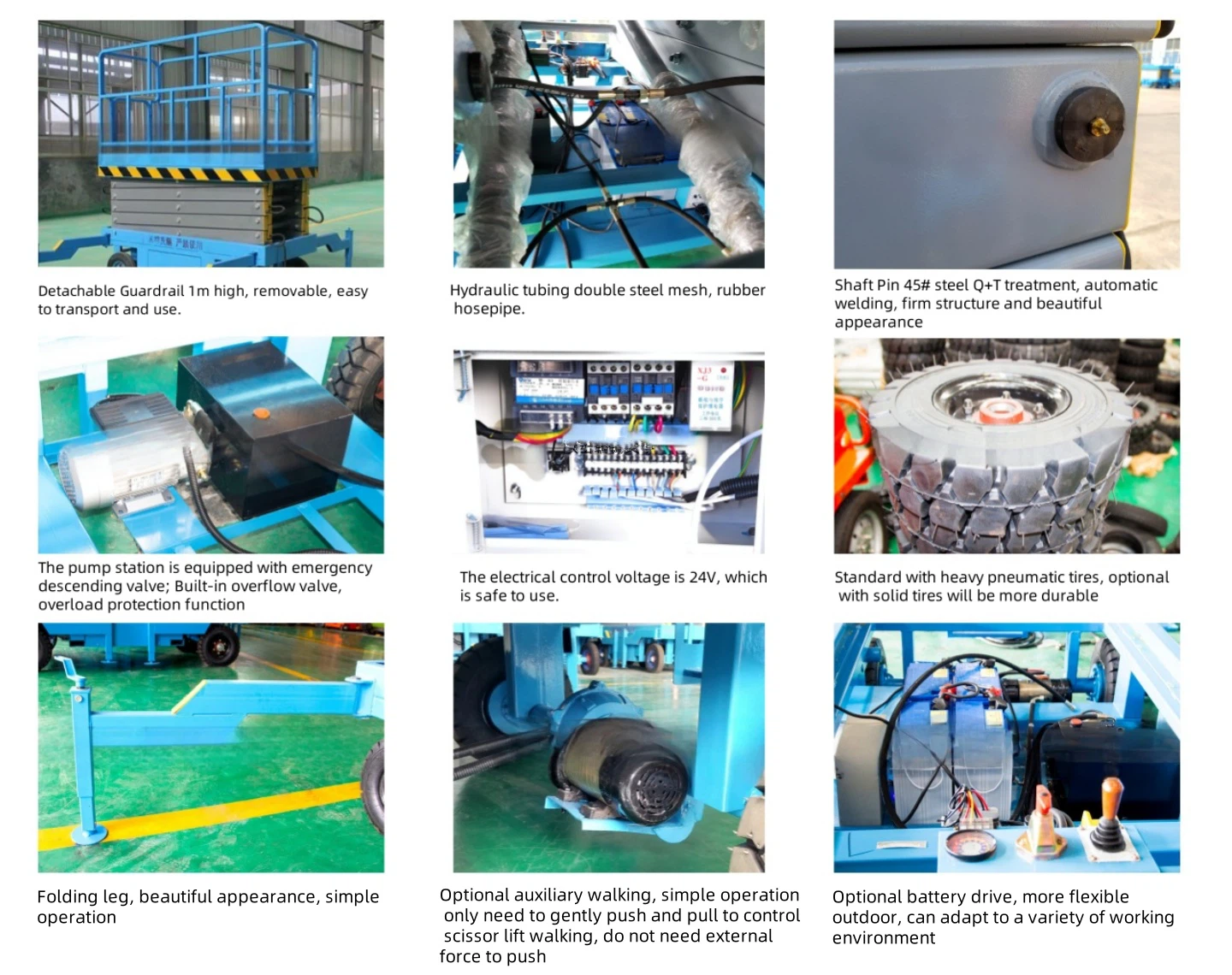
Parts Details

Workshop view:
The company has installed an intelligent equipment management platform, and has installed 310 sets (sets) of handling and welding robots. After the completion of the plan, there will be more than 500 sets (sets), and the equipment networking rate will reach 95%. 32 welding lines have been put into use, 50 are planned to be installed, and the automation rate of the entire product line has reached 85%.


Hot Tags: new electric scissor lift, China new electric scissor lift manufacturers, suppliers, factory
You Might Also Like


Send Inquiry