










Double Hoist Overhead Crane
Double hoist overhead crane is a kind of lifting equipment used for large tonnage and long span material handling, mainly used in industrial plants, large warehouses and ports.
Double hoist overhead crane This type of crane is equipped with two hoists (or called cranes), which can work independently or simultaneously. This design enhances the load capacity and stability of the crane, enabling it to handle heavier and larger materials. The structure of the double hoist bridge crane is similar to a bridge, and the bridge moves on two wheels or tracks. This design enables the crane to work on a longer span, improving the working range and efficiency.
Double hoist overhead crane is widely used in places such as steel mills, machinery manufacturing, shipyards, mines and large warehouses for lifting and handling operations of various heavy objects. This crane plays an important role in large industrial projects and warehousing logistics due to its efficient and reliable performance.Lifting speed:12.1m/min
Warranty of core components:1.5 years
Warranty:1.5 years
Weight (KG):67500 kg
Max. Lifting Load:30Ton
Span:28.5M
Working duty:A6 A7

Pictures & Components
1.Main beam
1.The main beam of a double hoist overhead crane is one of its main load-bearing structures, playing a supporting and bearing role. The main beam usually consists of two main parts: the upper beam and the lower beam, which are connected by vertical longitudinal beams to form a bridge structure. The upper beam and the lower beam are usually made of steel to ensure sufficient strength and rigidity.
2.The main beam generally uses high-strength steel, such as Q235 or Q345 steel, to ensure its load-bearing capacity and durability. These materials are designed with detailed mechanical calculations to ensure that they will not be excessively deformed or damaged under load.
3.The main function of the main beam is to support the two hoists of the crane and their slings, while bearing various loads during the operation of the crane, including the weight of the materials and the dynamic loads generated by the operation. The design of the main beam usually takes into account various factors such as span, load capacity and working environment. The cross-section design of the main beam can be box-shaped, I-shaped, etc., depending on the design requirements and load conditions of the crane.
4.As one of the core components of the double hoist overhead crane, the design and manufacturing quality of the main beam directly affects the performance and safety of the entire crane.
Lifting System
1.The lifting system of the double hoist bridge crane is one of its core parts, responsible for lifting and lowering materials.
2.The lifting system is mainly composed of the following components: hoist (crane), wire rope or chain, motor, brake system, control system, pulley and guide device.
3.These components work together to enable the double hoist bridge crane to efficiently and safely carry out various heavy lifting operations.

End Beam
The end beam of a double hoist bridge crane is one of its important structural components, which plays the role of connecting the main beam and the support system. The main function of the end beam is to support the main beam and enable the crane to move on the running track.
2.The end beam body is usually made of steel and connected to the main beam to form the two ends of the bridge crane. The end beam usually includes a crossbeam and a support column. The end beam may be equipped with a wheel frame, pulleys and other support devices to carry the weight of the main beam and the running load. The end beam connects the main beam with the crane's traveling system (such as tracks), carries the lifting load on the main beam, and transfers these loads to the ground or supporting structure.
3.The end beam is usually made of high-strength steel to ensure its stability and durability under load. Commonly used materials include Q235 or Q345 steel. The design of the end beam needs to take into account the span, load capacity and working environment of the crane. Detailed mechanical calculations will be carried out during the design to ensure that the end beam can work stably under various working conditions. The manufacturing process of the end beam includes cutting, welding, processing and painting of steel. The structural strength and stability of the end beam need to be ensured during the manufacturing process.
The end beam plays a vital role in the double hoist bridge crane. Its design and maintenance directly affect the stability, operation efficiency and safety of the crane.
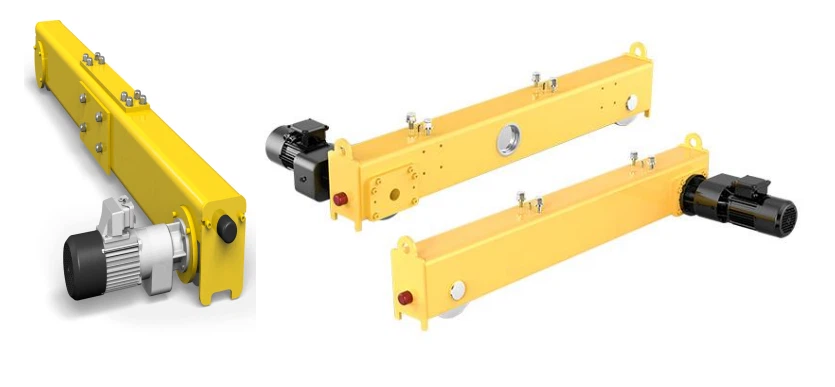
Crane travelling mechanism
The crane operation system of a double hoist bridge crane is one of its key components, responsible for the movement of the crane in the lateral direction on the bridge. This system ensures that the crane can effectively cover the required span in the working area.
2.The crane operation system usually consists of two or more cranes, which are installed on the lower part of the main beam. Each trolley contains wheels, drive devices and support structures. The wheels on the trolley run along the track or steel beam under the bridge. The number and design of wheels need to be configured according to the load and working environment of the crane.
3.The control system of the crane operation usually includes an operating panel or remote control device, through which the operator can control the start, stop and speed of the trolley. Some systems may also be equipped with automated control devices such as PLC (programmable logic controller) and sensors to provide more precise control and monitoring functions.
4.The trolley operation system is an important part of the double hoist bridge crane, and its performance directly affects the operating efficiency and safety of the crane. Through precise design, reliable drive system and effective maintenance, the stability and reliability of the trolley operation system in long-term use can be ensured.
Trolley travelling mechanism
1.The trolley travelling system of a double hoist bridge crane is one of its important components, responsible for the movement of the crane along the longitudinal direction on the main beam. This system enables the crane to lift and carry materials within the span of the bridge. The trolley travelling system includes one or more trolleys, which are installed on the lower part of the main beam. Each trolley contains wheels, drive devices and support structures.
2.The movement of the trolley is usually driven by an electric motor, which transmits power to the wheels through a reducer, gear system or chain. Modern trolley travelling systems may be equipped with frequency converters to adjust the speed and direction of movement of the motor to achieve smooth acceleration, deceleration and forward and reverse movement.
3.The control system of the crane operation usually includes an operating panel or remote control device, through which the operator can control the start, stop and speed of the trolley. Some systems may also be equipped with automated control devices such as PLC (programmable logic controller) and sensors to provide more precise control and monitoring functions.
4.The trolley travelling system is an important part of the double hoist bridge crane, and its performance directly affects the operating efficiency and operational safety of the crane. Through precise design, reliable drive system and effective maintenance, the stability and reliability of the trolley running system in long-term use can be ensured.
Crane wheel
1.The wheel of a double hoist overhead crane is one of its key components, responsible for supporting the weight of the crane and enabling it to run smoothly on the track. The design and maintenance of the wheel system is crucial to the performance and safety of the crane. The wheel is usually made of high-strength steel with good wear resistance and load-bearing capacity. The design of the wheel can be solid or spoked, depending on the design requirements of the crane. The wheel is usually mounted on bearings, which allow the wheel to rotate freely on the track and bear the load of the crane.
2.The wheels of a double hoist overhead crane are generally made of high-strength alloy steel (such as 40Cr or 42CrMo), which have high compressive strength and wear resistance. The design of the wheel needs to take into account the load capacity and operating conditions of the crane. Factors such as the diameter, width and rim shape of the wheel will affect the performance of the wheel. The wheel runs along the track or steel beam, which is usually installed on the floor of the factory or warehouse. The flatness and installation accuracy of the track are crucial to the smooth operation of the wheel.
3.The wheel of a double hoist overhead crane is one of the core components in the operation system of a double hoist bridge crane, and its performance directly affects the stability, operation efficiency and safety of the crane. Through accurate design and regular maintenance, the reliability of the wheel system can be ensured in long-term use.
 |
 |
 |
Crane hook
1.The hook of a double hoist overhead crane is a key component in the crane system for lifting and handling materials. The design and function of the hook directly affect the lifting capacity and safety of the crane. The main part of the hook is the hook body, which is usually made of high-strength steel (such as alloy steel) to withstand the heavy load during the lifting process. The shape design of the hook body is usually C-shaped or S-shaped so that the hoisted object can be firmly hung. The top part of the hook is usually designed with a lifting ring or lifting lug for connecting the crane's lifting rope or chain.
2.The main function of the hook of a double hoist overhead crane is to lift and carry various materials. During the lifting process, the hook needs to ensure the stability of the hoisted object and effectively distribute the load. The hook can cooperate with the hoist system of the crane to achieve the lifting needs of different materials by adjusting the height and angle. When using the hook, ensure that its load is within the design load range to avoid overload operation. When lifting materials, ensure that the contact surface between the hook and the hoisted object is flat to prevent the hoisted object from slipping due to poor contact.
3.As a key component of double hoist overhead crane, the design and maintenance of the hook is directly related to the operational safety and work efficiency of the crane. The long-term stability and reliability of the hook can be ensured through precise design, reliable safety devices and regular maintenance inspections.
 |
 |
 |
Motor
1.The motor of the double hoist overhead crane is its main power source, responsible for driving various functional systems of the crane, including the operation of the trolley, the movement of the trolley, and the work of the lifting system. The motor drives the wheels of the trolley, so that the crane can move in the lateral direction on the main beam. The motor drives the wheels of the trolley, so that the crane can move in the longitudinal direction on the main beam. The motor drives the hoist system to realize the lifting and lowering of materials.
2.Frequency converter (VFD) of the overhead of the double hoist bridge crane: used to adjust the speed and torque of the motor to achieve smooth acceleration and deceleration. The frequency converter can improve the efficiency and response speed of the system. PLC control: Programmable logic controller (PLC) is used to realize automatic control, coordinate the operation of the motor, and ensure the coordinated work of various systems. Remote control: The operator can control the start, stop and speed adjustment of the motor through the remote control device.
3.Safety of the motor of the double hoist overhead crane: Overload protection: The motor is usually equipped with an overload protection device. When the load exceeds the set value, the motor will automatically stop running to prevent damage. Overheat protection: The motor is equipped with an overheat protection device. When the temperature is too high, the motor will automatically shut down or alarm to prevent overheating damage.
4.The motor plays a vital role in the double hoist overhead crane, ensuring that the various functions of the crane can operate efficiently and stably. The performance and safety of the crane can be improved by properly selecting, installing and maintaining the motor.
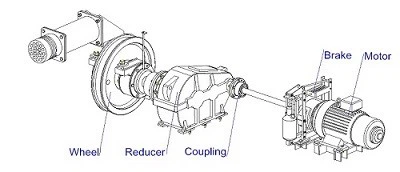
.
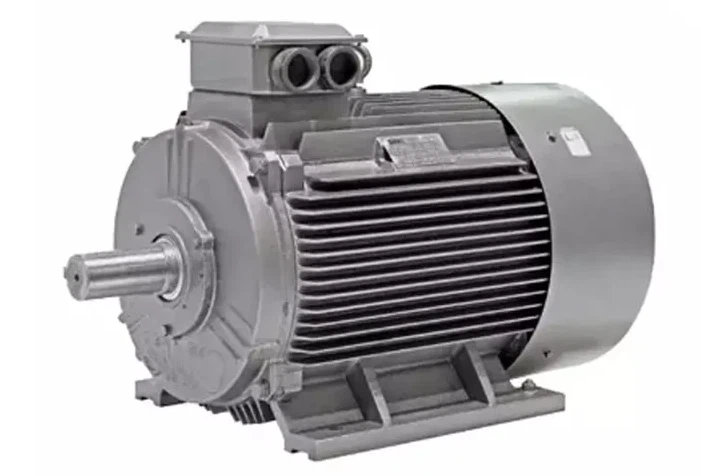

Sound and light alarm system & limit switch
1.The sound and light alarm system and limit switch of the double hoist overhead crane are important safety devices used to improve the safety of crane operation and prevent potential accidents.
2.Sound and light alarm system of double hoist overhead crane
The sound and light alarm system warns the operator or surrounding personnel through a combination of sound and light to remind the operator or surrounding personnel of potential dangers or abnormal status of the equipment. It is usually used to issue warnings such as equipment start-up, stop, overload, failure, etc. to ensure that the operator can take timely measures. The sound and light alarm system is usually installed in a conspicuous position on the crane to ensure that the operator and surrounding personnel can clearly hear and see the alarm signal. Adjust the intensity of sound and light according to the working environment and needs to ensure that the alarm system can effectively transmit warnings.
3.Limit switch of double hoist overhead crane
The limit switch is used to monitor the position of each moving part of the crane to prevent it from exceeding the predetermined working range. This helps to protect the equipment from damage and ensure safe operation. When a part of the crane approaches or reaches the position set by the limit switch, the limit switch will automatically trigger to stop further movement of the equipment. Limit switches are usually installed at key positions of the main beam, trolley, carriage and other moving parts. The installation position needs to be determined according to specific design and work requirements.
Debugging: After installation, the limit switch needs to be debugged to ensure that it can accurately detect the predetermined position and trigger the corresponding protection measures when necessary. Limit switches are usually installed at key positions of the main beam, trolley, carriage and other moving parts. The installation position needs to be determined according to the specific design and work requirements. After installation, the limit switch needs to be debugged to ensure that it can accurately detect the predetermined position and trigger the corresponding protection measures when necessary.
4.The sound and light alarm system and limit switch of the double hoist overhead crane are important safety devices to ensure the safe operation of the double hoist bridge crane. Through effective installation, maintenance and inspection, the safety and reliability of the equipment can be improved and the risks in operation can be reduced.
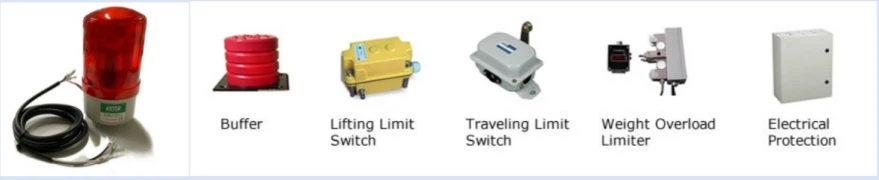
Safety Devices
1.The safety equipment of double hoist overhead crane is configured to ensure the safe operation of the equipment, protect the operators and maintain the normal operation of the equipment. These safety equipment can prevent accidents, reduce failures and improve the safety of operation.
2.The following are some common safety equipment and systems:
Emergency stop device
Function: Allow the operator to immediately stop all movements of the crane in an emergency.
Function: Quickly interrupt the operation of the crane in the event of an emergency and reduce the possibility of accidents.
Safety brake system
Function: The safety brake system can automatically maintain or stop the movement of the crane when the motor is powered off or fails.
Function: Prevent the crane from accidentally sliding down or losing control due to power outages.
Anti-collision device
Function: Monitor the range of motion of the crane through sensors or radar systems to prevent collisions with surrounding objects.
Function: Avoid collision accidents caused by insufficient space or operational errors.
Safety lock
Function: Prevent the hook or other hook parts from accidentally falling off when lifting materials.
Function: Ensure the stability of the hoisted objects during lifting and transportation to prevent them from falling.
Anti-tilt device
Function: Detect and prevent the crane from tilting or unbalanced during operation.
Function: Maintain the stability of the crane to avoid equipment damage or accidents caused by tilting.
Emergency lighting system
Function: Automatically turn on when the main lighting system fails to ensure visibility of the operating area in an emergency.
Function: Improve operational safety and visibility in an emergency.
Electrical protection system
Function: Including current protection, short circuit protection, leakage protection, etc. to ensure the safety of the electrical system.
Function: Prevent fire, electric shock or equipment damage caused by electrical system failure.
3.These safety devices play a vital role in the design and operation of double hoist bridge cranes, and can effectively improve the safety and reliability of the equipment through comprehensive application.

Sketch

Main technical data

Advantages
1. Improved lifting capacity
Double hoist design: The double hoist configuration enables higher lifting capacity and a wider working range. The double hoist structure enables heavier loads to be handled, which improves the crane's working efficiency.
2. Strong stability
Symmetrical load: The double hoist design makes the load more evenly distributed on the crane's main beam, increases the stability of the crane, and reduces safety risks caused by uneven loads.
3. Improved work efficiency
Double hoist independent operation: The double hoist can be operated independently, allowing multiple operations to be performed simultaneously, which improves work efficiency. For example, lifting operations in two different positions can be performed simultaneously.
4. Strong adaptability
Wide application: Double hoist bridge cranes can be used in a variety of industrial environments, including heavy manufacturing, warehousing and logistics. Its design is suitable for applications with large spans and heavy loads.
5. Flexible operation
Versatility: The various systems equipped (such as double hoists, double trolleys, etc.) enable the crane to perform complex lifting tasks. The operator can adjust the lifting height, position and angle as needed to achieve precise operation.
6. High safety
Multiple safety devices: Usually equipped with a variety of safety devices, such as limit switches, sound and light alarm systems, overload protection devices, etc., to ensure the safety of equipment and operators.
Stable operation: The double hoist structure improves the operating stability of the crane and reduces the risk of accidents caused by instability during the lifting process.
7. Convenient maintenance
Structural design: The structural design of the double hoist bridge crane makes maintenance and overhaul more convenient. Each component is usually easy to access and inspect, which simplifies the maintenance process.
8. Improve the level of craftsmanship
Precise lifting: The double hoist system makes the lifting process more precise, can handle complex and delicate operation requirements, and improves the level of craftsmanship.
Application:
1. Improved lifting capacity
Double hoist design: The double hoist configuration enables higher lifting capacity and a wider working range. The double hoist structure enables heavier loads to be handled, which improves the crane's working efficiency.
2. Strong stability
Symmetrical load: The double hoist design makes the load more evenly distributed on the crane's main beam, increases the stability of the crane, and reduces safety risks caused by uneven loads.
3. Improved work efficiency
Double hoist independent operation: The double hoist can be operated independently, allowing multiple operations to be performed simultaneously, which improves work efficiency. For example, lifting operations in two different positions can be performed simultaneously.
4. Strong adaptability
Wide application: Double hoist bridge cranes can be used in a variety of industrial environments, including heavy manufacturing, warehousing and logistics. Its design is suitable for applications with large spans and heavy loads.
5. Flexible operation
Versatility: The various systems equipped (such as double hoists, double trolleys, etc.) enable the crane to perform complex lifting tasks. The operator can adjust the lifting height, position and angle as needed to achieve precise operation.
6. High safety
Multiple safety devices: Usually equipped with a variety of safety devices, such as limit switches, sound and light alarm systems, overload protection devices, etc., to ensure the safety of equipment and operators.
Stable operation: The double hoist structure improves the operating stability of the crane and reduces the risk of accidents caused by instability during the lifting process.
7. Convenient maintenance
Structural design: The structural design of the double hoist bridge crane makes maintenance and overhaul more convenient. Each component is usually easy to access and inspect, which simplifies the maintenance process.
8. Improve the level of craftsmanship
Precise lifting: The double hoist system makes the lifting process more precise, can handle complex and delicate operation requirements, and improves the level of craftsmanship.
Crane production procedure
1. Demand Analysis and Design
Demand Analysis: Determine the basic parameters of the crane, such as specifications, load capacity, span, etc., based on customer needs and usage environment.
Design Phase: Engineers carry out detailed design according to the needs, including the design of components such as the main beam, end beam, trolley, trolley, lifting system and motor. Use computer-aided design (CAD) software for design and simulation to ensure the rationality and performance of the design.
2. Material Preparation
Material Selection: Select suitable high-strength steel and other raw materials, which must meet the load-bearing and safety requirements of the crane.
Material Inspection: Conduct quality inspection on raw materials to ensure that they meet design standards and safety requirements.
3. Manufacturing and Processing
Cutting and Forming: Cut the steel into the size and shape required by the design. The main components such as the main beam, end beam, wheels, etc. are preliminarily formed.
Welding and Assembly: Perform welding operations to assemble the components into preliminary structural parts, such as welding of the main beam and end beam. The welding quality and process need to be strictly controlled to ensure the strength and stability of the structure.
Machining: Precision machining of welded structural parts to ensure that the size and shape of the components meet the design requirements. Including drilling, milling and grinding.
4. Component manufacturing
Lifting system: manufacturing and assembling the lifting system, including hoists, motors, ropes or chains, etc.
Wheels and bearings: processing and assembling the wheel and bearing system to ensure that it can run smoothly and bear the load of the crane.
Electrical system: installing electrical components such as motors, control systems, inverters and cables.
5. General assembly
Component assembly: general assembly of each processed component, including the assembly of the main beam, end beam, trolley, trolley and lifting system.
System integration: integrating electrical systems, control systems and safety equipment to ensure the coordination between systems.
6. Testing and debugging
Static test: checking the structure and installation of the crane to ensure the strength and stability of all components and connection points.
Dynamic test: conducting actual operation tests, including running tests, lifting tests, load tests, etc., to ensure that the functions of the crane are normal.
Safety inspection: checking the safety equipment of the crane, including limit switches, sound and light alarm systems, overload protection devices, etc., to ensure their normal operation.
7. Quality Inspection
Inspection Standards: Quality inspection is carried out in accordance with international and industry standards to ensure the performance, safety and reliability of the crane.
Report Generation: Generate test and inspection reports to record the performance data and inspection results of the equipment.
8. Delivery and Installation
Transportation Preparation: Disassemble and pack the tested crane and prepare for transportation to the customer site.
On-site Installation: Install, debug and test the equipment at the customer site. Including assembly, debugging and confirmation of normal operation of the equipment.
9. Training and Maintenance
Operation Training: Train the customer's operators to explain the operation methods and safety precautions of the crane.
Maintenance Recommendations: Provide equipment maintenance manuals and maintenance recommendations to ensure the long-term and stable operation of the equipment.
10. After-sales Service
Support and Service: Provide after-sales service support, including equipment repair, maintenance and technical consultation.
Feedback and Improvement: Collect customer feedback and continuously improve equipment design and production processes.

Workshop view
The company has installed an intelligent equipment management platform, and has installed 310 sets (sets) of handling and welding robots. After the completion of the plan, there will be more than 500 sets (sets), and the equipment networking rate will reach 95%. 32 welding lines have been put into use, 50 are planned to be installed, and the automation rate of the entire product line has reached.


Hot Tags: double hoist overhead crane, China double hoist overhead crane manufacturers, suppliers, factory
Previous
Electric Single Beam CraneYou Might Also Like


Send Inquiry