







Overhead Isolation Crane
Products Description
An overhead isolation crane is a specialized lifting device designed for industries that require precise control of operations, especially in environments where sensitive or hazardous materials are handled. The crane system is carefully designed to perfectly isolate the load from the surrounding environment, ensuring safe, reliable and efficient transportation of materials.
This crane has advanced isolation technology. The crane uses unique isolation mechanisms such as shock absorbers or air cushions to minimize any disturbance or shock during load lifting and transportation.
It also has high load capacity. These cranes are designed to handle heavy loads and are often used in industries such as manufacturing, power plants and laboratories that require the transportation of large or delicate equipment.
Overhead isolation cranes are equipped with advanced control systems that allow precise positioning and movement, which is essential for handling sensitive or high-value materials. These cranes are designed with multiple safety protocols, including load limiters, emergency stop systems and sensors to ensure that the crane can operate safely even in challenging environments.
It has a sturdy structure. The overhead isolation crane is made of high-quality materials and is forged to be durable and corrosion-resistant. It is designed for continuous, heavy-duty operations. The crane can be customized to meet specific industry needs, such as different load capacities, span lengths and specialized lifting accessories.
Core Components:Bearing, Motor
Place of Origin:Henan, China (Mainland)
Warranty:1.5 years
Weight (KG):25010 kg
Video outgoing-inspection:Provided
Machinery Test Report:Provided
Control Model :Remote Control or Cabin Control insulation Crane
Lifting Mechanism:Insulation Hoist Crane
Work Duty:A5-A6 ISO & FEM 2m~3m Insulation Crane
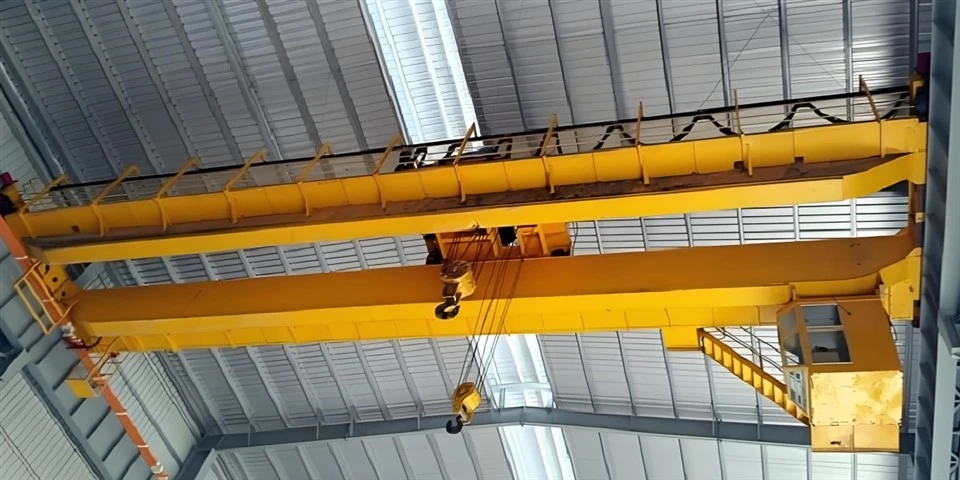
Crane type:Double Girder Crane
Main Electrical Parts:Schneider Brand
Capacity:10 Ton Insulation E.O.T Crane
Power Source:220V,380V,400V,415V,440V 50/60Hz 3Phase
Crane feature:Insulation Crane

Pictures & Components
1.Main beam
The main beam of an overhead isolation crane, also known as the main beam or main support beam, is an important structural component that supports the load and transfers the weight of the hoisted object to the truck at the end of the crane. It runs horizontally through the crane structure and is usually designed to withstand the heavy dynamic loads generated during lifting and moving.
The main beam is made of high-quality steel material due to its high strength-to-weight ratio, durability, and resistance to wear and corrosion. Aluminum can be used for lighter cranes but is less common in heavy-duty applications.
The main beam must be designed to withstand the static and dynamic loads of crane operation, including the weight of the hook, hoist, and any load being hoisted.
Types of main beams include box beams, I-beams, truss beams, etc. The main beam can be designed with vibration isolation elements to reduce the shock and noise transmitted to the crane structure. This may involve rubber mounts, shock absorbers, or spring isolators designed to minimize the vibration transmitted by the crane to other parts of the building or the surrounding environment.

2.Lifting System
The hoisting system of an overhead isolation crane typically involves several key components designed to lift and move heavy loads while providing stability and safety.
Hoist: The hoist is the main lifting mechanism that provides vertical movement to lift and lower the load. It usually consists of a motor, gearbox, drum, and wire rope or chain. Electric hoists lift loads by wrapping ropes or chains around drums. Hoists can be designed for various load capacities and speeds depending on the requirements of the crane.
Pulley: The pulley moves the hoist along the bridge or girder of the crane. It is usually mounted on wheels that run on the crane track (track system or beam).
The pulley provides horizontal movement, allowing the hoist to move along the length of the crane to position the load as required.
Bridge (or Girder): The bridge is the main structural component of the crane and provides horizontal support for the pulley and hoist. It spans the area where the crane operates and is supported by end cars or end frames that run along the tracks.
End cars (or end frames): End cars are mounted at both ends of the crane bridge and are equipped with wheels that allow the bridge to move along the track beams. The end car supports the weight of the crane, allowing the entire crane to move along the track.
Power Supply: The power supply for the crane is usually derived from the mains. Overhead isolation cranes usually use electric motors to drive the hoist, trolley, and bridge movement. The power supply is usually provided through a conductor or cable drum system suspended above the crane.

3.End carriage
The end frame of an overhead isolation crane refers to the portion of the crane that supports the main hoist and moves along the track or track beams at the end of the crane structure. The main function of the end frame is to provide a means for the crane to move horizontally along the entire length of the crane track.
In overhead isolation cranes, which are often used to isolate or handle heavy loads in industrial or professional environments, the end frame plays a vital role in ensuring smooth movement while maintaining structural integrity and safety. These cranes often operate in environments where the load needs to be isolated from external vibrations, electrical interference or other forms of interference, and the end frame supports the critical mechanical components of the crane's operation.
The drive mechanism of the end frame typically includes a motor, gearbox and wheels that enable the crane to move along the track. The wheels are designed to move smoothly along the crane track or track beams. The quality of the wheel and track alignment is critical to smooth travel and load handling.

4.Crane travelling mechanism
1) Working principle
The electric motor drives the crane along the track. The torque is transmitted to the wheels through the gearbox. Direction is controlled by reversing motor rotation or selecting a specific gear operation. Speed is controlled by varying the motor input (using a VFD - Variable Frequency Drive).
2) Component of the crane operating mechanism
Main frame (end car): The end car is equipped with wheels and is installed at both ends of the crane bridge. It provides support for the entire crane and ensures that it remains aligned with the track.
Wheels: Drive wheels (connected to the motor) and idler wheels (free rolling). Usually made of forged steel for durability. Usually run on a track system, which can be flat or angled.
Drive mechanism: It consists of an electric motor, gearbox and coupling. It transmits torque from the motor to the wheels, pushing the crane along the track. The speed is usually variable to achieve precise positioning.
Braking system: Electromagnetic or hydraulic brakes are used to stop or hold the position of the crane. It is essential for safety and precision, especially in isolation areas.
Control system: It can be operated by a pendant, wireless remote control or cab controller. It provides the operator with control of direction, speed and stopping.
Buffers and limit switches: Buffers absorb shock when the crane reaches the end of the track. Limit switches prevent the crane from going beyond the track.
5.Trolley travelling mechanism
1) Working principle
he operator uses a control system to command the trolley to move in the desired direction. The drive motor powers the gearbox, which transmits torque to the trolley wheels. The wheels roll along the rails of the bridge beams, enabling precise horizontal movement. Brakes and limit switches ensure that the trolley stops smoothly and does not exceed the specified travel limits.
2)Components of the trolley operating mechanism
Trolley frame: A sturdy structure that houses the hoist and travel mechanism. It runs along the bridge beam.
Wheels: The trolley is equipped with drive wheels and idler wheels to roll along the bridge beam track of the crane.
Drive motor: The electric motor provides power to move the trolley along the track.
Gearbox: The motor is connected to the wheels through a gearbox, which reduces the motor speed and increases the torque for smooth movement.
Brakes: Electromagnetic or hydraulic brakes ensure controlled stopping and holding of the trolley in position.
Control system: This includes push button controls, pendant controls, or wireless remote systems to control trolley movement.
Limit switches: Safety devices that prevent the trolley from exceeding the end stops on the crane bridge.
Power supply system: A cable festoon system or wire rods provide power to the trolley motor.
6.Crane wheel
The crane wheels of overhead isolation cranes are a critical component in crane operation, primarily responsible for supporting the crane's weight and enabling it to move smoothly along the track. These wheels are designed to withstand high loads, minimize rolling resistance, and ensure long, efficient operation.
Crane wheels are typically made of high-strength steel or alloy steel with high wear resistance. Common materials include: 42CrMo4 case-hardened carbon steel
The tread can be flat or tapered, depending on the track design and application. The flange is used to guide the wheel on the track and prevent derailment. The wheels are typically heat treated or case-hardened to a hardness level of around HRC 45-55, which increases durability and reduces wear.

7.Crane Hook
The crane hook on an overhead isolation crane is an important component used to lift, hold and move heavy loads. It is usually made of forged alloy steel or high-strength carbon steel for durability and load-bearing capacity.
The hook usually has a safety latch to prevent the load from sliding off during lifting. Its load capacity depends on the design and intended use of the crane. In heavy industrial applications, the load capacity ranges from a few tons to hundreds of tons. Many hooks have a swivel feature that allows the load to rotate freely, reducing the possibility of entanglement or damage to the sling or chain.

8.Motor
The motor of an overhead isolation crane is a key component that drives the crane's hoisting and traveling mechanisms. It converts electrical energy into mechanical energy to ensure efficient and safe operation of the crane.
Hoisting motor: Used to lift and lower the load. Usually a heavy-duty motor with high torque and precise control. Often includes a brake system for safety.
Travel motor: Powers the horizontal movement of the crane along the track beam. Designed for smooth acceleration and deceleration to prevent load swing. Usually equipped with a variable frequency drive (VFD) to control speed.
Trolley motor: Drives the movement of the trolley (the part that carries the crane). The working principle is similar to the travel motor and can accurately position the load.


9.Sound and light alarm system & limit switch
1) Sound and light alarm system
- The audible and visual alarm system for overhead cranes is designed to increase operational safety and ensure timely alarms during critical activities.
- Audible alarms are loud sirens or buzzers that notify nearby workers of potential dangers, such as crane movement, load lowering or emergency situations. The volume can be adjusted to suit different industrial environments.
- Visual alarms (lights) are bright flashing lights, usually LED beacons, visible from a distance.
- Multi-color signals (e.g., red for danger, amber for warning, green for safe conditions).
2) Limit switch
- A limit switch on an overhead isolation crane is a safety device that helps control and monitor the position of the crane's moving parts. It prevents the crane's movement beyond predefined limits, ensuring safe operation by protecting the crane and surrounding equipment from potential damage.
- Functions of Overhead Crane Limit Switches:
- End of Travel Protection: The limit switch ensures that the crane stops when it reaches the end of its travel, either horizontally or vertically. This prevents overtravel, which can cause mechanical failure or damage.
- Safety Stop: If the crane reaches a critical limit or an unsafe position, the limit switch will signal the system to stop operating, triggering a safety stop.
- Position Monitoring: It provides feedback to the crane operator or control system to monitor the position of the hook, trolley or bridge.
- Overload Protection: In some designs, the limit switch is integrated with the load sensor, which prevents overload by shutting down the crane if the load exceeds the safe limit.

10.Safety Devices
- Safety devices on overhead isolation cranes are essential to ensure operator safety and prevent accidents or equipment damage.
- Overload protection system: Prevents a crane from lifting more than its rated load capacity. Can include sensors that trigger alarms or stop crane operation if the weight exceeds safe limits.
- Limit switches: Used to prevent overtravel of a crane, trolley, or bridge. They ensure that the crane does not exceed its defined limits, thereby avoiding collisions or damage to structures.
- Emergency stop button: Manual stop feature that can be pressed in an emergency to quickly shut down the crane and stop all movement.
- Anti-sway system: Reduces the swinging movement of the load, which can cause accidents or instability. Helps stabilize the load during movement, especially in windy environments or when lifting fragile materials.
- Crane load indicator: Displays the weight of the load being lifted and warns the operator if the load is approaching maximum capacity. Provides real-time data to ensure safe operation.
11.Control Mode
The control mode of an overhead isolation crane refers to how the crane's movements are directed and managed. Typically, overhead cranes can operate in different control modes, which can be selected based on the crane's design, operational needs, and safety requirements.
- Manual control: The crane operator directly controls the crane using a pendant (handheld controller) or joystick. This mode allows precise control of crane movements, including lifting, lowering, horizontal movement, and rotation.
- Semi-automatic control: The crane can operate in a semi-automatic mode, where certain movements (such as horizontal movement) are completed automatically according to preset parameters, but more complex operations still require manual control. The operator usually controls lifting and placing objects, but can rely on automation to complete parts of the process.
- Automatic control: The crane can operate autonomously, following a preset program or sequence. This mode is often used in large manufacturing plants or for specific tasks that require precision and repeatability. The crane may be equipped with sensors, cameras, or RFID technology to ensure that it follows the correct path and accurately places objects.
- Remote control: A remote control unit (in the form of a wireless pendant or a complex control station) allows the operator to control the crane from a distance. This mode allows the operator to remain outside the danger zone, thereby improving safety. Specific tasks in isolated areas, hazardous environments, or areas where the crane must avoid human interaction.

12.Sketch

Main technical

Advantages
- Designed to handle heavy loads while isolating vibration, shock, or noise, overhead isolation cranes offer several benefits, especially in industries where precision and safety are critical.
- Vibration and shock reduction: These cranes are engineered to reduce the transfer of vibration and shock to sensitive equipment or structures. This is especially important in environments where precision is required, such as laboratories, precision electronics manufacturing, or aerospace.
- Improved safety: The isolation systems in these cranes help prevent incidents caused by sudden movement or vibration transfer that could lead to equipment failure or accidents.
- Reduced noise: Isolation helps suppress noise, making the work environment quieter. This is important in environments such as hospitals or clean rooms, where noise can interfere with operations or disrupt workflow.
- Improved load handling: These cranes are ideal for handling loads in sensitive or high-precision applications, such as lifting delicate machinery or parts, without transferring excessive forces that could cause damage.
- Reduced wear: By minimizing vibration and shock, overhead isolation cranes can reduce wear on the crane's mechanical components, resulting in less frequent maintenance and longer service life.
- Improved productivity: With better control over vibration and noise, workers can focus more effectively on their tasks, improving overall productivity and reducing downtime.
- Adaptable to complex environments: Overhead isolation cranes are suitable for complex and demanding environments such as laboratories, high-tech product assembly lines, or any environment where environmental factors must be controlled.
Application
- Overhead isolation cranes are often used in industries that require heavy loads to be moved in an environment that is isolated from the ground or surrounding structures. These cranes are designed to isolate the movement of the load from the ground, which is critical in specialized operations.
- Sensitive Equipment Handling: In environments such as semiconductor manufacturing or clean rooms, overhead isolation cranes are used to handle sensitive equipment, ensuring that vibrations or disturbances that could damage delicate parts are minimized.
- Medical and Research Facilities: In research environments, especially in high-precision laboratories, these cranes help move large or sensitive equipment without causing vibrations that could interfere with experiments. Used in operating rooms or equipment storage areas to move heavy or sensitive medical equipment, ensuring that vibrations do not affect medical procedures or equipment performance.
- Nuclear and Hazardous Materials Handling: Overhead isolation cranes are used to handle radioactive materials or reactor components, where vibration isolation ensures safety and prevents accidental contamination or equipment failure. In chemical plants or hazardous waste management areas, these cranes help move materials in a controlled, isolated manner to prevent environmental exposure.
- Precision Manufacturing: Moving large, complex parts, such as aircraft fuselages or engines, requires vibration isolation to prevent damage to delicate parts. These cranes can be used in assembly lines for delicate or critical parts that require high precision.
- Cleanrooms: Overhead isolation cranes are ideal for cleanrooms where particles or vibrations could compromise product quality. These environments require minimal disturbance, and this type of crane provides a safe way to transport heavy objects without compromising air purity or cleanliness.
- High-Precision Metalworking: In high-precision metalworking operations, overhead isolation cranes can carefully handle large metal parts to prevent deformation or damage from vibration, especially during assembly or finishing operations.
Crane production procedure
1. Understanding the specific needs of the customer, including load capacity, span, lifting height, and the operating environment of the crane (e.g. industrial plant, warehouse, etc.). The engineering team designs the structural components of the crane, such as girders, trolleys, hoists, and isolation systems. This includes calculating forces, selecting materials, and ensuring compliance with relevant standards and specifications (e.g. ISO, DIN). Focus is placed on isolation systems (usually to reduce vibration and noise), ensuring appropriate damping or vibration isolation mechanisms. These may involve rubber pads, springs, or special bearings to absorb mechanical energy.
2. The steel plates, beams, and profiles required for the main structure are ordered and delivered to the factory. Key components such as motors, control systems, gears, wheels, and lifting mechanisms (hoists) are sourced from specialized suppliers.
3. The steel is cut, welded, and formed into various components such as girders, trolley frames, and other structural components. Some components, such as wheels, gears, and shafts, undergo a machining process to meet precise tolerances. Isolation components are manufactured, including rubber bearings, springs, or damping materials. They are integrated into the crane structure that needs to be isolated.
4. The crane's main structure is assembled, starting with the girders and main beams, which are welded or bolted together. The lifting mechanism, including the motor, rollers, and rope system, is installed. The lifting components are tested to ensure smooth operation. The trolley moves along the beam and is equipped with wheels and other components for horizontal movement. The isolation system is integrated into the crane, usually between the crane frame and the building structure or any vibration-sensitive machinery.
5. The crane's electrical system is installed and wired, including power supplies, control panels, remote control systems, and safety features. The control system can include features such as speed control, overload protection, and emergency stop functions. Overload sensors, limit switches, and emergency stop buttons are integrated into the design.
6. Testing The crane is tested with loads of varying weights to ensure it can safely lift and handle the rated capacity. The crane's movements (horizontal and vertical) are checked for smooth operation, responsiveness to controls, and proper operation of the isolation system. Safety features, including emergency stops, limit switches, and load monitoring systems, are checked for compliance with safety standards.
7. A final quality check is performed to ensure that all components meet design specifications and safety requirements. The crane is cleaned and a protective coating or paint is applied to prevent corrosion and improve aesthetics.
8. The fully assembled crane is delivered to the site. The crane is installed on site and the isolation components are rechecked for proper installation and alignment. Final commissioning is performed and the crane is tested in the actual working environment to ensure full readiness.

Workshop view:
The company has installed an intelligent equipment management platform, and has installed 310 sets (sets) of handling and welding robots. After the completion of the plan, there will be more than 500 sets (sets), and the equipment networking rate will reach 95%. 32 welding lines have been put into use, 50 are planned to be installed, and the automation rate of the entire product line has reached 85%.


Hot Tags: overhead isolation crane, China overhead isolation crane manufacturers, suppliers, factory, Double Girder Bridge Crane with Electric Hoist, Bridge Crane
Previous
Insulation Bridge CraneYou Might Also Like



Send Inquiry