










Bridge Crane System
Products Description
A single girder bridge crane system is a type of overhead crane commonly used in industrial and manufacturing environments for lifting and moving heavy loads. It is designed with a single beam (or girder) running along the length of the crane, supported by two end trucks, and mounted on a bridge structure.
2)Key Components:
Bridge Girder (Single Girder):The main horizontal beam that spans the width of the crane.It supports the trolley and hoist mechanism.Made from high-strength steel to ensure durability and support heavy loads.
End Trucks:These are the structures on either end of the girder that move along the runway rails.
Trolley:A component that moves along the girder.It houses the hoist and moves horizontally, enabling load positioning within the workspace.
Hoist:The hoist mechanism is responsible for lifting and lowering the load.
Runway Rails:They are typically installed along the length of the facility, allowing the crane to traverse the entire area.
Control System:The crane can be operated manually or with an automated control system.Control can be through pendant controllers, radio remote systems, or fixed control panels.
Core Components:PLC, Engine, Bearing, Gearbox, Motor
Place of Origin:Henan, China
Warranty:1 Year
Weight (KG):124000 kg
Video outgoing-inspection:Provided
Machinery Test Report:Provided
Crane type:Single Girder Overhead Bridge Automatic Crane
Lifting mechanism:Eliectric Hoist
Control method:Ground Control+Remote Control
Crane feature:Easy Operated Girder Bridge Crane
Color:Customized Color Acceptable
Power supply:380V 50Hz
Type:Hoist Single Girder Bridge Crane
Work Duty:A3-A5

Pictures & Components
1.Main beam
1)A single girder bridge crane system typically consists of several key components that work together to move loads within a specific area. The main beam (also known as the girder) is one of the central structural elements of the crane system, providing support for the hoist and trolley that move along the span.
2)Key Features of the Main Beam (Girder) in a Single Girder Bridge Crane:
Structural Role: The main beam serves as the horizontal support that holds the hoist and trolley mechanism. It carries the weight of the load and transfers it to the end trucks and the crane runway structure.
Material: The girder is usually made of steel or other high-strength materials to handle the dynamic loads and forces applied during crane operation. It may be formed as an I-beam, box beam, or rolled steel section, depending on the design and load requirements.
Dimensions: The size and shape of the girder are determined by the maximum load capacity, the span of the crane, and the working conditions. The girder must be strong enough to resist bending, deflection, and torsion while carrying the expected loads.

Lifting System
1)The lifting system of a single girder bridge crane is responsible for raising and lowering the load. It consists of several key components that work together to safely and efficiently lift the load within the crane's rated capacity. The lifting system is typically attached to the crane's trolley, which moves along the main beam (girder).
2)Summary of the Lifting System in a Single Girder Bridge Crane:
Hoist: Lifts and lowers the load.
Trolley: Moves the hoist horizontally along the bridge.
Bridge (Main Beam/Girder): Provides the horizontal span for the crane system.
Control System: Operates the hoist, trolley, and bridge.
Safety Features: Includes overload protection, safety latches, brakes, and emergency stops.
 |
 |
3.End carriage
1)Support for the Bridge: The end carriage supports the ends of the bridge girder (main beam). It houses the wheels that allow the crane bridge to travel along the runway system, which is typically mounted on rails or tracks.
2)Horizontal Movement: The end carriage enables the horizontal movement of the entire crane along the runway system. The bridge is mounted on two end carriages (one at each end of the bridge), and together, they allow the crane to move back and forth across the work area, typically controlled by an electric motor or a manual drive system.
3)Load Distribution: The end carriage helps distribute the weight of the bridge and the load being lifted across the runway system. The load from the hoist, trolley, and bridge is transferred through the end carriages to the tracks, allowing smooth movement while minimizing wear and tear on the crane components.
 |
 |
4.Crane travelling mechanism
1)The crane traveling mechanism in a single girder bridge crane system is responsible for the horizontal movement of the crane along the runway or rail system. This mechanism enables the entire crane to travel from one end of the working area to the other, allowing for precise positioning of the load across a wide span. It consists of several key components working together to provide smooth, controlled movement of the crane along the runway tracks.
2)The crane traveling mechanism is responsible for the movement of the entire crane bridge along the runway system. The main components of the traveling mechanism include the end carriages, wheels and rails, drive system, braking system, and control system. Together, these components enable the crane to move horizontally, positioning the load accurately across the work area. The design and operation of the traveling mechanism depend on factors like load capacity, speed, and safety considerations.
5.Trolley travelling mechanism
1)Safety Features of the Trolley Traveling Mechanism:
Limit Switches: These stop the trolley from over-traveling in either direction and help prevent damage to the crane or load.
Load Limiters: Prevents the trolley from moving if the load exceeds the crane's safe operating capacity.
Anti-Sway Mechanisms: Some cranes are equipped with anti-sway systems to reduce load swinging while the trolley moves, improving safety and precision.
2)Summary:
The trolley traveling mechanism in a single girder bridge crane system is responsible for the horizontal movement of the hoist along the girder. Key components include the trolley frame, wheels, motor and gearbox for powered trolleys, brakes, control system, and rails. Powered trolleys are typically controlled by electric motors and offer variable speed and direction control, while manual trolleys are simpler and used for lighter-duty applications.
6.Crane wheel
1)Horizontal Movement:
The primary function of the crane wheel is to enable the horizontal movement of the crane along the runway. It allows the entire bridge (including the main girder, hoist, and trolley) to move back and forth across the workspace.
2)Load Distribution:
The crane wheel helps distribute the weight of the crane, hoist, and any lifted load across the runway rails. The weight of the crane and its load is transferred through the wheels to the rails, ensuring stable and controlled movement.
3)Support:
The wheels provide support for the crane, helping maintain the alignment and stability of the crane as it moves across the runway.
4)Durability and Smooth Movement:
A properly designed and maintained crane wheel reduces friction and minimizes wear on the rails, ensuring smooth operation with minimal resistance and noise. This enhances efficiency and prolongs the lifespan of the entire crane system.

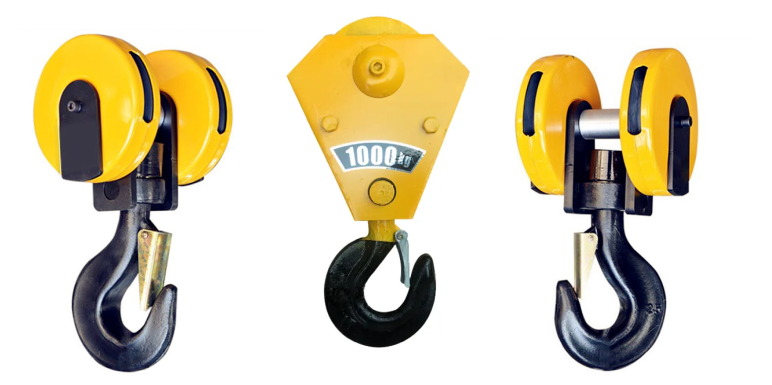
7.Crane Hook
Shape and Design:
1)The hook typically has a curved shape with an opening at the top for attaching slings or chains, and a deep throat to ensure the load remains securely in place.
2)The hook throat is the critical part of the hook where the rigging connects. The design of the throat is important to prevent slings from slipping out during lifting operations.
3)Safety latches are often added to prevent the rigging from accidentally coming loose or detaching.
Motor
1)Regular Inspections:
Visual inspections and routine checks are essential to ensure that the motor is operating efficiently and without signs of wear or overheating.
Monitoring motor temperature, vibration levels, and noise can help detect early signs of failure.
2)Lubrication:
Motors that have gearing mechanisms (such as hoisting or traveling motors with gearboxes) should be regularly lubricated to prevent wear on moving parts.
3)Cleaning:
Keeping the motor free from dust, dirt, and debris is important to ensure it operates efficiently and to prevent overheating.
4)Testing:
Periodic performance tests should be conducted to check for issues such as voltage irregularities, current imbalances, or reduced torque, which could indicate that maintenance or replacement is needed.

.
Sound and light alarm system & limit switch
1)Sound and Light Alarm System
A sound and light alarm system is used to provide both visual and audible warnings during crane operation. These alarms help enhance safety by alerting operators and nearby workers to important events or potential hazards, such as an overload, reaching the end of travel, or other abnormal conditions.
2)Limit Switches
Limit switches are mechanical or electrical devices used to detect the position of the crane's moving parts, such as the hoist, trolley, or bridge, and to trigger specific actions when a predefined position is reached. They serve as safety features to prevent the crane from exceeding its travel limits or operating range.

10.Safety Devices
1. Overload Protection Devices
Overload protection devices are essential for preventing the crane from lifting more than its rated load capacity, which could result in structural failure, hoist damage, or accidents.
2. Limit Switches
Limit switches prevent the crane's components (such as the hoist, trolley, or bridge) from moving beyond their travel limits, reducing the risk of mechanical damage, collision, and system failure.
3. Emergency Stop (E-Stop)
The emergency stop is a crucial safety feature that immediately halts all crane movements in case of an emergency, preventing accidents or further damage to the crane and surrounding area.
4. Sound and Light Alarm System
The sound and light alarm system provides visual and audible warnings to the operator and surrounding personnel in case of abnormal crane conditions, such as overloads, reaching travel limits, or emergency situations.
5. Crane Hook Safety Latch
The safety latch on the crane hook prevents the lifting slings, chains, or ropes from accidentally detaching from the hook during lifting operations. This is especially important in dynamic environments where the load may shift during lifting.
6. Anti-Sway and Anti-Tilt Devices
These devices are designed to reduce the risk of swinging loads (sway) and tilting during lifting, improving load stability and crane safety.
7. Brake Systems
Brakes are essential for controlling the movement of the crane and ensuring that the load is securely held in place when stationary.
11.Control Mode
1)Manual Control Mode
In manual control mode, the operator directly controls the crane's movements using physical controls, such as joysticks, pushbuttons, or a pendant. This mode is common in traditional crane setups and provides the operator with full control over the crane's movements.
2)Semi-Automatic Control Mode
Semi-automatic control combines manual control with some level of automation to assist the operator in specific tasks, such as speed control, position tracking, or load monitoring. This mode is typically used when the crane needs to perform repetitive tasks but still requires human intervention for finer control.
3)Automatic Control Mode
Automatic control is used in highly automated systems, where the crane's movements are governed by a computer system, and minimal operator input is required. This mode is often found in advanced applications, such as automated warehouses, large manufacturing plants, or overhead crane systems in ports.
4)Radio Control Mode (Wireless Control)
Radio control allows operators to control the crane remotely using a wireless radio frequency (RF) control system, often in combination with other control modes (manual, semi-automatic, or fully automatic). This mode improves operator mobility and can enhance safety, especially in hazardous or congested environments.

Sketch

Main technical

Advantages
1. Cost-Effective
Lower Initial Cost: A single girder crane uses fewer components and a simpler design compared to a double girder crane, making it a more affordable option for many companies.
Lower Installation Cost: Since the structure is lighter and simpler, installation is generally quicker and less expensive, saving on labor and setup costs.
Reduced Maintenance Costs: With fewer parts and a simpler design, maintenance costs are typically lower, and parts are easier to replace or repair.
2. Space-Efficient Design
Compact Design: The single girder structure uses less space, making it ideal for applications where overhead space is limited. It has a more compact profile, which is beneficial in low-clearance buildings or spaces with restricted height.
Better Headroom: Single girder cranes provide more clearance (headroom) under the hoist, maximizing usable vertical space in a building.
3. Lightweight Construction
Lighter Load on Building Structure: Since the single girder design is lighter, it exerts less force on the building or supporting structure. This means it can be used in buildings that have limited load-bearing capacity or for retrofitting existing buildings without requiring substantial structural upgrades.
Ease of Transportation: The lighter structure and fewer components make transportation and handling of the crane easier and cheaper.
4. Simplified Operation
Ease of Use: Single girder cranes are generally simpler to operate, requiring less training for the operator compared to more complex systems. The straightforward design allows for smooth and easy control of hoisting and traveling motions.
5. Suitable for Smaller Lifting Capacities
Ideal for Lighter Loads: Single girder cranes are typically used for lifting loads that range from 1 to 20 tons, making them well-suited for many light- to medium-duty industrial applications.
6. Flexibility and Versatility
Versatile Use: Single girder cranes can be used for a wide range of applications, such as lifting materials in workshops, warehouses, assembly lines, and other industrial environments.
Application:
1. Warehousing and Storage
Material Handling: Single girder cranes are commonly used in warehouses for lifting and moving goods, raw materials, or finished products. They are especially useful for moving pallets, boxes, or bulk materials.
Inventory Management: In warehouses with racking systems, a single girder bridge crane can be used to move products in and out of storage locations, increasing efficiency in inventory management.
2. Manufacturing and Assembly Lines
Component Handling: In manufacturing plants, single girder cranes are often used for handling smaller components, raw materials, or assemblies. They are typically employed on assembly lines to move parts from one stage of production to the next.
Workshops: Small to medium-sized workshops, including those in industries like metalworking or automotive, use single girder cranes to lift and position heavy components like machinery, tools, or sheet metal.
3. Construction Sites
Material Lifting: On construction sites, single girder cranes can be used to lift construction materials such as cement bags, bricks, steel beams, and other equipment to various floors of buildings under construction.
Site Equipment Handling: They are often used to move construction tools, scaffolding, and smaller construction machinery.
4. Steel Mills and Fabrication Shops
Steel Handling: In steel mills, single girder cranes are used to handle and move steel plates, rods, or coils in storage and during fabrication processes.
Welding and Fabrication: These cranes help in positioning large, heavy parts for welding or assembly in steel fabrication shops. The crane's ability to lift heavy parts and move them with precision is essential for these tasks.
5. Automotive Industry
Engine Assembly: In automotive assembly plants, single girder cranes can be used to lift heavy engine components or car body parts during assembly.
6. Ports and Shipping
Cargo Handling: At ports and docks, single girder cranes are used for moving lighter cargo such as containers, pallets, and bags. These cranes are typically used in areas with limited space and for handling smaller shipments.
Crane production procedure
The production procedure for a single girder bridge crane system involves several stages, including design, material selection, manufacturing, assembly, testing, and delivery. The process can vary depending on the manufacturer and the specific requirements of the crane system (e.g., lifting capacity, span, and operational environment). Below is an overview of the typical production process for a single girder bridge crane system:
Design & Engineering: Customization based on client requirements, crane specifications, and material selection.
Material Procurement: Sourcing steel, components, motors, and electrical parts.
Fabrication: Manufacturing of key crane components such as the girder, end carriages, trolley, hoist, and electrical systems.
Assembly: Assembling the crane's structural components, hoist, and control systems.
Testing & Quality Control: Load testing, safety feature checks, and operational testing.
Surface Treatment: Corrosion protection via painting or galvanizing.
Packaging & Shipping: Packing the crane for transportation and delivery.
Installation & Commissioning: Assembling on-site, conducting final tests, and training the operator.
Handover & After-Sales Support: Crane handover, documentation, and ongoing support.

Workshop view:
The company has installed an intelligent equipment management platform, and has installed 310 sets (sets) of handling and welding robots. After the completion of the plan, there will be more than 500 sets (sets), and the equipment networking rate will reach 95%. 32 welding lines have been put into use, 50 are planned to be installed, and the automation rate of the entire product line has reached 85%.


Hot Tags: bridge crane system, China bridge crane system manufacturers, suppliers, factory, Double Girder Bridge Crane with Electric Hoist, Bridge Crane
You Might Also Like



Send Inquiry