







Under Running Bridge Crane
Products Description
The under running bridge crane , also known as an Underhung Bridge Crane, is a type of overhead crane that operates on a system of tracks installed on the underside of a building's ceiling or roof structure. Unlike top-running cranes that travel on rails atop runway beams, under running cranes are designed to run on the bottom flange of an overhead runway.The under running bridge cranes are a practical and space-efficient solution for many industrial applications, offering both flexibility and robust performance in environments with unique structural challenges.
The under running bridge cranes often use electric motors with variable frequency drives (VFD), providing smooth acceleration, deceleration, and precise load control, which enhances both safety and efficiency.Typically, under running bridge cranes can handle loads ranging from 1 ton to 25 tons, with spans that vary based on the facility's design and structural support.The under running bridge cranes typically handle light to medium-duty loads, usually ranging from 1 ton to 10 tons, though some systems can be designed for heavier applications.
Due to their design and the way they integrate into the existing structure, under running cranes can be more economical compared to top-running systems, particularly in facilities with less headroom or specific design constraints.
The underhung design of the under running bridge crane maximizes available workspace and minimizes interference with other equipment. It is ideal for facilities with limited headroom.The crane's layout allows for wider coverage areas in the workspace compared to traditional cranes, thanks to its ability to navigate around existing structural columns or building components.
Core Components:PLC, Engine, Bearing
Place of Origin:Henan, China
Warranty:1 Year
Weight (KG); 25600 kg
Video outgoing-inspection: Provided
Machinery Test Report: Provided
Electical: Schneider brand or Siemens brand
Power supply: Customer request
Control method: Cabin or Pendent line or Remote Control
Color: Customer's Requirements
Lifting mechanism: Eliectric Hoist or Electric Trolley
Girder Type: Box Shape
Power Source: Clients' Requirments
Ambient temperature: -25°-40°
Motor: Global Brand

Pictures & Components
1.Main beam
1) The main beam of the under running bridge crane (also known as an underhung crane) is the primary horizontal structural component that supports the load and transfers it across the length of the crane. It typically runs along a pair of end trucks that are attached to tracks or beams installed on the ceiling or roof structure of the facility, as opposed to a top-running crane, which runs on tracks mounted on support columns or gantry structures.
The main function of the under running bridge crane is to lift and lower the load as the hoist moves along the girder. The girder must be strong enough to handle the weight of the hoist and the maximum rated load. The length of the girder also determines the width of the workspace the crane can cover. The girder also helps distribute the weight of the load to the end truck and the facility's supporting structure.
3) The main beam features are usually made of high-strength steel to provide the required structural integrity. Depending on the load capacity and span requirements, down-lift cranes can be single-beam (one main beam) or dual-beam designs (two parallel main beams). The cross-section of the beam can vary (I-beams or box beams are common) and are designed to optimize strength while minimizing weight. The main beam is usually attached to the top structure of the building, rather than supported from below.

Lifting System
Motor: The motor of an under-running bridge crane lifting system is typically an electric motor that provides the necessary power to lift and lower the load. These motors are designed to operate efficiently, and their specifications depend on the crane's design, the weight of the loads it will lift, and the speed at which it needs to move.
Reducer: A reducer in an under-running bridge crane lifting system refers to a gear mechanism that is used to reduce the rotational speed of the motor and, in turn, increase the torque output. In such a lifting system, the reducer is typically located between the motor and the load-bearing parts of the crane. It is responsible for converting the high-speed low-torque motion from the motor into a lower-speed, high-torque motion that can be used to lift or move heavy loads with precision.
Drum: The drums are usually made from durable materials like steel or cast iron to withstand the mechanical stresses during lifting operations.The design often includes grooves or flanges to guide the hoisting rope or cable in a smooth and organized manner, preventing tangles and wear.The drum is typically connected to a motor that drives the rotation, which is either direct or through a gearbox, depending on the crane design.
Wire rope: Most wire ropes used in crane systems are made from steel, which provides high strength, durability, and resistance to wear.The rope construction refers to the way the strands are twisted together. Common constructions for crane applications include 6x19, 6x37, and 8x19, where the numbers denote the number of strands and wires in each strand.
Pulley block: Pulley (or Sheave): This is the wheel-like component that guides the lifting rope or cable, allowing it to change direction with minimal friction. The pulley typically features grooves along its perimeter to keep the cable properly aligned.
Lifting device: The main component of the lifting system is the hoist, which is the main lifting mechanism for raising and lowering the load. It is suspended from the bridge and usually includes a motor, drum, wire rope or chain and a hook or lifting attachment. The hoist can be electric, manual or pneumatic, depending on the application.
 |
 |
3.End carriage
1) The end carriage of an under-running bridge crane refers to the component that supports the entire bridge crane structure, allowing it to travel along the rails or tracks at either end of the crane runway. Under-running bridge cranes are characterized by the fact that the bridge structure itself runs along the bottom (or under) of the supporting runway beams, as opposed to an over-running crane, where the bridge runs above the supporting rails.
2) The end carriage serves as the interface between the crane's bridge and the supporting track system, housing the wheels or rollers that facilitate movement.This part is crucial for the crane's stability, alignment, and smooth operation, as it carries the load of the entire bridge and any payload being lifted.
3) The end carriage will generally include: Wheels or rollers that travel along the runway beams.Bearings or other mechanisms to reduce friction and enable smooth movement.A frame or structural support that connects the crane's bridge to the wheels.
Motors and drive systems (if powered end carriages are used for movement).The end carriage will often be designed with an emphasis on precision, strength, and durability, as it must support both the crane's weight and the loads it is designed to lift.
|
|
 |

4.Crane travelling mechanism
1) Working principle
Drive Mechanism: The movement of the bridge (the travelling mechanism) is powered by an electric motor, which is connected to the wheels through a system of gears, sprockets, or chains.The motor provides the necessary force to rotate the wheels and move the crane along the runway rails. Typically, a geared motor system is used for better torque control and speed regulation.
Control System: The crane is operated using a remote control, pendant, or cabin-based control system that allows the operator to control the speed and direction of movement of the bridge.The control system can also adjust the hoist's position to lift and lower loads as needed during the crane's travel along the runway.
2) Functions of the crane operating mechanism
Movement along the runway: The bridge moves from one end of the span to the other, providing coverage over a large area.
Drive system: The wheels roll along the upper flange of the runway beams, ensuring smooth movement.
Guide and support: The wheels of the traveling mechanism also help guide and support the bridge. They ensure the bridge remains aligned properly with the runway and can operate smoothly without derailing.
Control and positioning: The operator can control the crane's travel mechanism via a control system, allowing the crane to position itself accurately over a designated work area.
Load handling: The traveling mechanism ensures that the crane maintains stability while lifting and transporting heavy loads.
5.Trolley travelling mechanism
1) Structural composition
The structural components of the trolley operating mechanism of the downward bridge crane are the trolley frame, trolley wheels, drive mechanism, track or track system, end car, power supply, control system and so on.
2) Function of the trolley operating mechanism
The under-running bridge crane trolley traveling mechanism allows the hoist to move horizontally across the bridge, ensuring the effective and controlled positioning of loads within the crane's operational area.
6.Crane wheel
The crane wheels of an under-running bridge crane are mounted on the ends of the crane bridge and are used to support the weight of the bridge structure while traveling along the runway. These wheels are often made of steel and designed to operate on specially designed tracks or rails.
7.Crane Hook
1) The Crane hooks are typically made from high-strength steel or alloy materials to withstand the stresses from heavy loads. They are designed with a wide opening to accommodate different types of rigging (like slings or chains).
2) The crane hook's primary function is to securely attach to the load being lifted, allowing the lifting mechanism to carry and move the load. Many hooks are equipped with safety latches or gates to prevent the load from accidentally detaching. These features help ensure the stability of the load during movement.

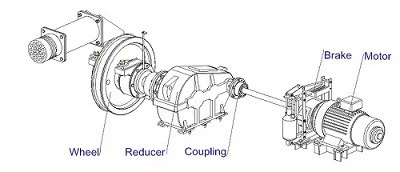
Motor
AC Motors are the most common and are typically used for bridge crane applications. They can be either induction or synchronous motors, with induction motors being the most common.DC Motors are still used in some applications due to their smooth and precise control, especially for variable speed applications.
Cranes often require variable speed control for precise positioning. This can be achieved using Variable Frequency Drives (VFDs) for AC motors or DC drives for DC motors.The VFD adjusts the frequency of the AC supply to control the motor's speed. It allows for smoother starts, stops, and load handling.
The motor should be mounted on the crane structure in a way that allows for minimal vibration, which could affect the stability of the load or the precision of the crane's movements.Proper alignment with the gear system and the driving wheel ensures smooth operation.Regular maintenance is essential to ensure the motor operates efficiently and to extend its lifespan. This includes cleaning the motor, checking insulation resistance, and ensuring the lubrication of bearings and moving parts.
.
Sound and light alarm system & limit switch
1) Sound and light alarm system
For safety and operational efficiency, an alarm system for these cranes is essential to alert personnel of any potential hazards or malfunctions. The sound and light alarm system is commonly used to provide both audible and visual warnings.Sound Alarm:Horns or Sirens: These emit loud noises to warn of hazards or operational changes. Different tones can indicate different alerts (e.g., warning vs. emergency).Volume Control: Adjustable volume settings to ensure the alarm is audible over other environmental noises.
Sound Alarm (Audible Warning): The purpose is to alert nearby personnel to operating conditions such as crane movement, load lifting or any malfunction. Horns or sirens are usually used to produce a loud sound to ensure personnel are aware of the crane's movement, especially in a noisy environment. The sound can be continuous or intermittently pulsed to indicate different operating conditions (for example, a continuous sound indicates an overload condition, an intermittent sound indicates normal operation or proximity warning). Some systems allow the volume to be adjusted to suit.
Light Alarm (Visual Warning): Purpose is to provide a visual signal to personnel in case the sound alarm cannot be heard or to provide additional alerts. Typically, high-intensity LED lights are used to flash in a visible color (usually red or yellow) to indicate a condition such as crane movement, emergency, or hazard.Different colors represent different conditions. Some systems use a strobe light or rotating beacon, which is highly visible even from a distance and in poor visibility conditions (e.g., nighttime, dusty environments).
2) Limit switch
The limit switch of an under-running bridge crane is an important safety and control component that ensures the crane operates within its designated travel limits. It helps prevent the crane's trolley or bridge from exceeding predefined boundaries, avoiding potential damage or accidents.
Functions: Prevents the crane's trolley or bridge from traveling beyond the end of its rail, protecting both the crane and any surrounding equipment or structures. Provides feedback to the control system to inform the operator of the crane's position, allowing for safe and efficient operation. In case the crane exceeds its operational limits, the limit switch can trigger an emergency stop, halting the crane to prevent damage.
Types: Mechanical Limit Switches are physical switches that are activated when the crane's trolley or bridge moves into a specified position, causing the switch to open or close. Proximity Sensors use non-contact sensing technology (like inductive or capacitive sensors) to detect the position of the crane components, often used for more precise control. Rotary Limit Switches are used to monitor the rotation of the crane's hoisting mechanism, ensuring it doesn't rotate beyond safe limits.

10.Safety Devices
Overload protection is to prevent lifting exceeding the rated capacity of the crane.
Limit switches are to stop the movement of the crane at predefined positions (e.g. end stops).
Emergency stop button is a manual stop option in case of emergency.
Anti-collision system is to avoid collision of the crane with other objects or equipment.
Warning lights/sounds signal when the crane is moving or approaching a danger zone.
Load sensing devices ensure that the load is within the safety limits of the crane.
Hoist brakes prevent the load from falling when the power is off.
11.Control Mode
Pendant Control: The operator uses a handheld pendant control with push buttons or a joystick to manage the crane's movements.
Cab Control (Operator Cabin): In this mode, the crane has an operator's cabin mounted on the bridge or at a fixed location, where the operator can directly control all aspects of the crane using levers, buttons, or joysticks.
Radio Remote Control: The operator uses a wireless, hand-held radio transmitter to control the crane from a distance.
Automated Control (Computerized/PLC Control): In this mode, the crane operates based on pre-programmed instructions or commands sent via a PLC (Programmable Logic Controller) or another automated system.
Manual Control: In some systems, the crane is manually controlled, often through mechanical switches or basic buttons.
Joy Stick Control: Similar to pendant control but with a joystick that provides smoother control for operators, particularly when the crane has more complex movements.

12.Sketch

Main technical

Advantages
Maximizes floor space: Since the crane runs beneath the runway beams, it helps in optimizing overhead space. This is particularly beneficial in facilities with limited headroom or low ceilings. It can be installed in tight or confined areas and used in spaces where a top-running crane might not fit.
Greater flexibility: Underhung cranes can offer curved or multiple runways, allowing for more versatile movement in complex layouts. Multiple underhung cranes can operate on the same runway system without interference, increasing productivity in a shared workspace.
Lower structural requirements: Under running cranes don't need the same robust structural supports that top-running cranes require. This can reduce the cost of installation, particularly in existing buildings where modifying the structure for a top-running system might be more expensive. The cranes are usually lighter in construction compared to top-running cranes, reducing the load on the supporting structure and, in turn, the overall construction cost.
Easier installation: The lighter weight and design typically make underhung cranes easier to install compared to heavier overhead cranes. Since the crane is mounted below the runway, maintenance and inspection of the components are often more accessible.
Minimal headroom needed: These cranes are ideal for environments where the height of the building is limited, making them suitable for smaller spaces or existing structures that can't be modified to accommodate a top-running system.
Reduced risk of structural overload: Because underhung cranes are usually lighter and operate under the runway, they exert less stress on the building's structure, reducing the risk of overloading.
Application:
Material Handling in Confined Spaces: Under running bridge cranes are ideal in areas where headroom is limited or the building design doesn't allow for top-running cranes.They make good use of the building's ceiling space, allowing for maximum floor area for operations.
Assembly Lines and Manufacturing: Commonly used in production facilities where materials and parts need to be moved from one station to another.These cranes are excellent for precise positioning of heavy objects during assembly processes.
Warehousing and Storage Facilities: Under running cranes are used for lifting and moving heavy inventory, machinery, or materials in large warehouses where efficient space management is crucial.
Automotive Industry: In automotive manufacturing and repair plants, under running cranes are used to lift engines, vehicle frames, and other components.
Maintenance and Repair: Under running cranes can be deployed in workshops for lifting heavy equipment during maintenance or repair activities.
Ideal for service bays where maximum floor space is needed.
Light-to-Medium Duty Applications: Since under running cranes generally have lower lifting capacities compared to top-running cranes, they are typically used for light to medium duty applications.
Crane production procedure
1. Design and Engineering
Based on the requirements analysis, the specific needs of the application are understood, including load capacity, span, lifting height, and operating environment. Detailed technical drawings and specifications are created using CAD software. This includes the design of the bridge, hoist, end car, and control system. Finally, the appropriate materials are selected for the crane components, ensuring they meet the strength, weight, and durability requirements.
2. Procurement
Necessary components such as steel profiles for the bridge, hoist mechanism, motor, and electrical system are ordered from suppliers. Materials are inspected upon delivery to ensure they meet the required specifications.
3. Fabrication
Steel profiles are cut to the required size and components such as bridge girders, end cars, and brackets are processed.
Parts are then welded together according to design specifications to ensure structural integrity. This step may involve assembling the hoist mechanism, trolley, and other key components.
4. Assembly
Assemble the bridge girders and connect the end car. This is usually done in a designated assembly area or factory workshop.
The hoist mechanism is then mounted on the bridge and connected to the trolley so that it can move along the bridge.
5. Electrical and Control Systems
Electrical components are installed, including control panels, motors, and safety devices. Ensure that all wiring complies with safety standards. Set up the control system, which may include a remote control or pendant controller for operation.
6. Testing
On the one hand, a static load test is performed to ensure that the crane can withstand its rated capacity without deformation or failure. On the other hand, the crane is tested under operating conditions to check for smooth movement, proper lifting functions, and the responsiveness of the control system. Finally, all safety features are checked, including limit switches, emergency stops, and overload protection systems.
7. Final inspection and certification
A final inspection is performed to ensure that all components comply with design specifications and safety standards. An operating and maintenance manual, safety instructions, and certification documents are prepared for the crane.
8. Delivery and installation
The crane is safely transported to the installation site. On-site installation installs the crane on the supporting structure, ensuring proper alignment and secure connections. It also provides training for operators and maintenance personnel on safe operating and maintenance practices.
9. Post-installation testing
Final adjustments are made, any necessary adjustments are made after installation, and a final test is performed to confirm operational readiness.
10. Maintenance
A regular maintenance plan is established to ensure continued safety and functionality, which includes inspection, lubrication, and replacement of worn parts.
Workshop view:
The company has installed an intelligent equipment management platform, and has installed 310 sets (sets) of handling and welding robots. After the completion of the plan, there will be more than 500 sets (sets), and the equipment networking rate will reach 95%. 32 welding lines have been put into use, 50 are planned to be installed, and the automation rate of the entire product line has reached 85%.




Hot Tags: under running bridge crane, China under running bridge crane manufacturers, suppliers, factory, Bridge Crane, Double Girder Bridge Crane with Electric Hoist
Previous
Industrial Bridge CraneYou Might Also Like


Send Inquiry